
The aging provision (Altersrückstellung) is defined as a mandatory capital reserve built into German private health insurance premiums to pre-fund rising healthcare costs as policyholders grow older. German insurance law, specifically §149 VAG, requires this reserve to prevent the sharp premium spikes that would otherwise hit you hardest in retirement. Without it, private health insurance would become unaffordable precisely when you need it most. For professionals in Germany weighing private insurance options, understanding this mechanism is the foundation of sound retirement healthcare planning. Myhealthcarebroker works with clients daily to explain exactly how aging provision private insurance works and what it means for your long-term costs.
How does the aging provision work in German private health insurance?
The aging provision is the core mechanism that separates Germany's funded private insurance model from the public pay-as-you-go system. Private health insurance (PKV) operates on a capital-funded basis, meaning each generation pre-funds its own future care. Public health insurance (GKV) collects contributions from current workers to pay current claims, with no reserve built up for individual policyholders.
Here is how the reserve accumulates in practice:
- Every month from age 21 to 60, a 10% surcharge flows into the aging reserve on top of your regular premium, as required by §149 VAG.
- Your insurer invests this capital collectively across all policyholders in the same tariff pool.
- The invested reserve grows over decades and is drawn down later to offset the higher claims you generate as an older policyholder.
- The surcharge ends in the calendar year you complete your 60th year, at which point the release phase begins.
The logic is straightforward. Healthcare costs rise with age, but your earning power does not keep pace indefinitely. The reserve bridges that gap by collecting more from you when you are younger and healthier, then returning value when your claims increase. Private insurers call this the Kapitaldeckungsverfahren, or capital-funded method. It contrasts directly with the GKV's Umlageverfahren, where today's workers fund today's retirees with no individual reserve.
The 10% surcharge applies during the years when you are typically earning well and using fewer healthcare services. That timing is not accidental. It maximizes reserve accumulation precisely when the cost to you is most manageable.

Pro Tip: Enrolling in private health insurance early, ideally in your late 20s or early 30s, gives the aging reserve more years to compound. A longer accumulation period means a larger cushion against premium increases later, and your base premium is also lower when you are young and healthy.
What are the legal rules governing the aging provision?
The legal framework for the aging provision is specific and leaves little room for flexibility. §149 VAG mandates the 10% surcharge for all private health insurance policyholders between ages 21 and 60. This is not optional. Every insurer offering full private health coverage in Germany must comply.
Several key legal constraints shape how the reserve works in practice:
- Non-withdrawable. The reserve is not a personal savings account. You cannot request a payout at any point during your policy.
- Non-inheritable. If you die, the reserve stays within the insurer's collective tariff pool. Your heirs receive nothing from it.
- Partially portable. When switching insurers, only a statutory portion equivalent to the Basistarif (basic tariff, as defined under §146 VAG) transfers to your new provider. The rest stays with your old insurer.
- Tariff-pool specific. The reserve belongs to the collective pool of your tariff, not to you individually. It offsets costs across all policyholders in that pool.
The portability limitation is the most consequential rule for professionals who consider switching providers mid-career. Switching late in life is economically disadvantageous because you forfeit the bulk of the reserve you spent years building. A 55-year-old who switches insurers will typically start rebuilding a reserve from a much lower base, which translates directly into higher premiums at the worst possible time.
Premium reductions typically begin around age 60, when the surcharge stops and the reserve begins releasing. A further reduction occurs at retirement, when most policyholders also drop their Krankentagegeld (sick pay) coverage, since they no longer earn an employment income that needs protecting.
How does the aging provision affect your premiums before and after retirement?
The real-world premium impact of the aging provision is significant and worth planning around. Upon retirement, the accumulated reserve releases to help offset medical cost increases, resulting in a premium reduction of 15%–25% compared to peak pre-retirement contributions.
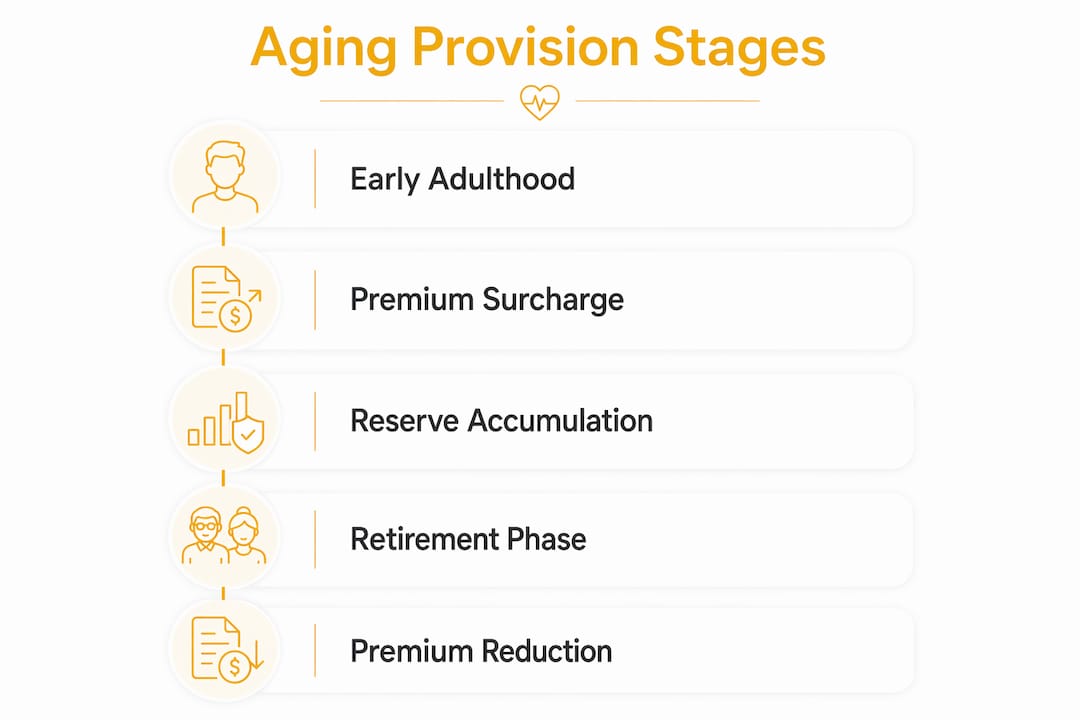
That reduction comes from two sources working together. First, the reserve itself offsets the higher claims you generate as an older policyholder. Second, dropping Krankentagegeld coverage at retirement removes a premium component you no longer need. The combined effect softens the blow of retirement income reduction considerably.
The table below illustrates how premiums typically shift across a policyholder's lifetime, factoring in aging provision accumulation and release:
| Age | Premium phase | Aging provision effect |
|---|---|---|
| 30 | Base premium plus 10% surcharge | Reserve accumulation begins; total cost is moderate |
| 50 | Higher base premium plus 10% surcharge | Reserve growing; premium rises with medical inflation |
| 65 | Retirement premium, no surcharge | Reserve releases; premium drops 15%–25% from peak |
Medical inflation and demographic changes push premiums upward over time regardless of the reserve. The aging provision does not eliminate those increases. It cushions them. Without the reserve, your premium at 65 would reflect the full actuarial cost of an older policyholder's claims, which would be substantially higher than what you actually pay.
Pro Tip: Use a private insurance cost calculator to model your projected premiums at different life stages. Factoring in the aging provision release gives you a more accurate picture of retirement healthcare costs than looking at current premiums alone.
For professionals planning retirement in Germany, this 15%–25% reduction is a meaningful financial variable. It belongs in any serious retirement budget alongside pension income, investment returns, and living expenses. The 2026 private health insurance guide from Myhealthcarebroker covers current premium benchmarks in more detail.
What are the most common misconceptions about aging provisions?
The aging provision is widely misunderstood, even among professionals who have held private health insurance for years. Clearing up these misconceptions protects you from poor decisions, particularly around switching insurers.
The most persistent myths include:
- "It's my personal savings." The reserve is a collective asset within your tariff pool. It is not a personal account with your name on it. You cannot withdraw it, borrow against it, or transfer it freely.
- "I can switch insurers without losing it." Switching late in life means leaving most of your reserve behind. Only the Basistarif-equivalent portion transfers, which is typically a fraction of what you have accumulated.
- "The reserve guarantees stable premiums." The aging provision moderates premium increases. It does not freeze them. Medical inflation and regulatory changes still push premiums up over time.
- "Public insurance is safer in retirement." GKV contributions in retirement are tied to your pension income, which is often lower than your working income. PKV with a well-funded aging reserve can be more cost-effective for higher earners in retirement, depending on individual circumstances.
The practical advice follows directly from these clarifications. Maintain continuity with your insurer. Review your tariff periodically with an independent advisor. Avoid switching providers after age 45 unless the financial case is overwhelming and you have modeled the reserve loss carefully. The long-term care pressures facing Germany's insurance system make the funded PKV model more relevant, not less, as the population ages.
The aging provision is a collective risk-sharing mechanism. Its value is systemic. It keeps the entire tariff pool solvent as policyholders age, which benefits everyone in the pool, including you.
Key Takeaways
The aging provision (Altersrückstellung) is a mandatory, collective capital reserve in German private health insurance that pre-funds future healthcare costs and reduces premiums by 15%–25% at retirement.
| Point | Details |
|---|---|
| Legal requirement | §149 VAG mandates a 10% surcharge on premiums from age 21 to 60 for all PKV policyholders. |
| Not a personal account | The reserve cannot be withdrawn, inherited, or freely transferred; it belongs to the tariff pool. |
| Retirement premium relief | Reserve release at retirement reduces premiums by 15%–25%, especially when sick pay coverage also drops. |
| Switching costs | Changing insurers after middle age forfeits most of the accumulated reserve, raising future premiums. |
| Early enrollment advantage | Joining private health insurance young maximizes reserve accumulation and locks in a lower base premium. |
What I've learned advising professionals on aging provisions
Working with professionals in Germany on private health insurance, I see the same pattern repeatedly. People understand that the aging provision exists, but they treat it as background noise rather than a planning variable. That is a mistake that compounds over time.
The clients who get this right are the ones who think about the aging provision at enrollment, not at retirement. They choose a tariff with a strong reserve structure, stay with their insurer through market fluctuations, and model their retirement premiums years in advance. The 15%–25% reduction at retirement is not automatic good luck. It is the result of years of consistent contributions and, critically, not switching insurers at the wrong moment.
The clients who struggle are usually the ones who switched providers in their late 40s or early 50s, often chasing a lower short-term premium. They saved a few hundred euros per year and forfeited a reserve worth tens of thousands. The math rarely works in their favor. I have seen this enough times that I now treat insurer continuity as a near-absolute rule for anyone over 45.
Myhealthcarebroker's value in this context is straightforward. We are independent, so we have no incentive to recommend a switch unless the numbers genuinely support it. When a client asks whether to change insurers, we model the reserve loss, the new premium trajectory, and the break-even point before giving any recommendation. That kind of analysis is what separates informed decisions from expensive ones.
— Marco
How Myhealthcarebroker helps you plan around aging provisions
Private health insurance in Germany is complex enough in German. In English, without an independent guide, it is genuinely difficult to make confident decisions about aging provisions, tariff selection, and retirement cost planning.

Myhealthcarebroker specializes in exactly this. As independent consultants, we compare private health insurance options across providers, explain the aging provision mechanics in plain English, and help you model what your premiums will look like at 50, 60, and 65. Whether you are newly eligible for PKV or reviewing a policy you have held for years, our eligibility check is the fastest way to understand your options. There is no jargon, no pressure, and no single insurer pushing their product. Just clear, personalized advice that fits your situation.
FAQ
What is the aging provision in German private health insurance?
The aging provision (Altersrückstellung) is a mandatory capital reserve built into private health insurance premiums under §149 VAG. It pre-funds rising healthcare costs as policyholders age, reducing premiums at retirement.
How much does the aging provision reduce premiums at retirement?
The reserve release at retirement typically reduces premiums by 15%–25% compared to peak pre-retirement contributions. Dropping sick pay (Krankentagegeld) coverage at retirement adds a further reduction on top of that.
Can I take my aging provision with me if I switch insurers?
Only a statutory portion equivalent to the Basistarif transfers when you switch. The remainder stays with your original insurer, making late-career switching financially costly for most policyholders.
Is the aging provision the same as a personal savings account?
No. The reserve is a collective asset within your tariff pool, not an individual account. You cannot withdraw it, borrow against it, or pass it to heirs. It exists to keep the tariff pool solvent as all policyholders age.
When does the 10% aging provision surcharge stop?
The surcharge ends in the calendar year you complete your 60th year. After that, the accumulated reserve begins releasing to offset the higher healthcare costs typical of older policyholders.