
A DAAD scholarship is a merit-based grant from the German Academic Exchange Service (Deutsches Akademisches Austauschdienst) that funds study, research, and short courses in Germany for graduates, doctoral candidates, postdocs, and researchers. Your single best next step: search the DAAD scholarship database and open the Call for Applications for each programme that matches your career stage. US-based applicants should also bookmark the DAAD Office New York for country-specific eligibility guidance.
DAAD supports over 100,000 German and international students and researchers every year, making it the world's largest funding organization of its kind. That scale matters: it means programmes exist across virtually every academic discipline and career stage, but it also means competition is real and preparation counts.
- Search the DAAD scholarship database to find open Calls for Applications.
- Contact DAAD Office New York for US-specific eligibility questions.
Table of Contents
- What DAAD funds and who it supports
- Which DAAD programme type fits your career stage
- How to find the right programme using the DAAD scholarship database
- Eligibility rules and what selection committees evaluate
- Application steps, required documents, and timeline
- What DAAD funding typically covers
- Health insurance, visa, and practical essentials for US applicants
- DAAD country office contacts and official resources for US applicants
- Your concrete next steps as a US applicant
- Key Takeaways
- The part of DAAD applications most guides skip
What DAAD funds and who it supports
DAAD's mission is to promote international academic exchange between Germany and the rest of the world. It does this by funding individuals at nearly every stage of an academic career, from undergraduates attending a summer course to senior researchers building long-term institutional partnerships.
The primary target groups for DAAD funding opportunities are:
- Undergraduates and recent graduates seeking short-term or summer study programmes in Germany
- Master's students pursuing a full degree or a research semester at a German university
- Doctoral candidates (PhD students) working on dissertations with German supervisors or co-supervisors
- Postdoctoral researchers and faculty conducting independent research or collaborative projects
- University staff and administrators involved in institutional partnership programmes
- Project leaders managing bilateral or multilateral academic cooperation
Programme rules vary significantly by country of application. A programme open to US applicants may not be available to applicants applying from a different country, even if they hold US citizenship. The scholarship database and your nearest DAAD country office are the authoritative sources for what is actually open to you.
Which DAAD programme type fits your career stage
The table below maps the main programme categories to the applicants they serve. Use it to shortlist the two or three programmes worth reading in full.

| Programme Type | Target Group | Typical Duration | Typical Funding Components | Common Eligibility Requirements | Where to Find the Call |
|---|---|---|---|---|---|
| Study Scholarships (Master's) | Graduates pursuing a master's degree | 10 months | Monthly stipend, travel allowance, possible language course | Bachelor's degree, strong academic record, language proof | DAAD scholarship database |
| Research Grants in Germany | Doctoral candidates, postdocs | 1 month | Monthly stipend, travel allowance, research allowance | Completed or near-complete degree, research plan, supervisor confirmation | DAAD scholarship database |
| Bi-nationally Supervised Doctoral Degrees / Cotutelle | PhD candidates seeking joint supervision | — | Stipend, travel, possible family allowance | Enrolled PhD candidate, confirmed German co-supervisor | DAAD scholarship database |
| University Summer Courses | Undergraduates, graduates | 2–6 weeks | Partial or full course fee subsidy, possible travel support | Enrolled student status, language requirements vary | DAAD scholarship database |
| Short Research Stays and Faculty Grants | Postdocs, faculty, researchers | 1–3 months | Stipend, travel allowance | Completed doctorate, institutional affiliation | DAAD scholarship database |
| Project and Partnership Funding | Universities, research institutions | Multi-year | Institutional grants, mobility support | Institutional application, not individual | DAAD scholarship database |
A few points worth noting:
- The DAAD scholarship database is the definitive source for current Calls for Applications. Programme availability changes each cycle.
- Some programmes are funded jointly with partner organizations and carry additional eligibility conditions.
- Doctoral and postdoctoral programmes often require a letter of confirmation from a German host supervisor before you can submit.
How to find the right programme using the DAAD scholarship database
The database is more powerful than most applicants realize, but only if you use the filters deliberately. Here is a practical sequence:
- Go to the DAAD scholarship database — The main search page lets you filter by target group, country of application, subject area, and funding type.
Pro Tip: Use the "programme purpose" filter to distinguish between full-degree funding and short research stays. Many applicants waste time reading Calls for programmes that fund a different type of stay than they need.
When to contact DAAD Office New York: reach out after you have read at least one Call for Applications and have a specific question about eligibility or timing. Come prepared with your degree level, the programme title, and your intended start date. The DAAD Office New York handles enquiries from US and Canadian applicants and can clarify country-specific rules that the database alone does not answer.
Eligibility rules and what selection committees evaluate
Common eligibility checkpoints across most DAAD programmes:
- Degree requirement: Most programmes require at least a bachelor's degree. Research grants typically require a completed master's or an advanced doctoral enrolment.
- Time-since-degree rules: Some programmes cap eligibility at a set number of years after your last degree. Check the Call carefully.
- Nationality and residency: US and Canadian applicants are typically eligible if they are citizens, permanent residents, or foreign nationals who earned their last degree in the US or Canada. Eligibility can turn on where your degree was earned, not just your passport.
- Language requirements: Applications may be submitted in German or English for most programmes. Language certificates reference CEFR levels when specified, so check whether your programme requires a B2, C1, or higher certificate in German or English.
Selection is handled by independent voluntary committees that evaluate each application holistically. The criteria they weigh include academic record, the quality and clarity of the proposed project, professional qualifications, and the applicant's potential for future impact. Special circumstances, such as non-traditional career paths or gaps in study, can be addressed in your application and are considered.
Pro Tip: A sharp, clearly scoped project description often carries more weight than a marginally higher GPA. Selection committees want to see that you know exactly what you will do in Germany and why it matters. Spend more time on your research or study plan than on polishing your transcript.
Application steps, required documents, and timeline
The application flow
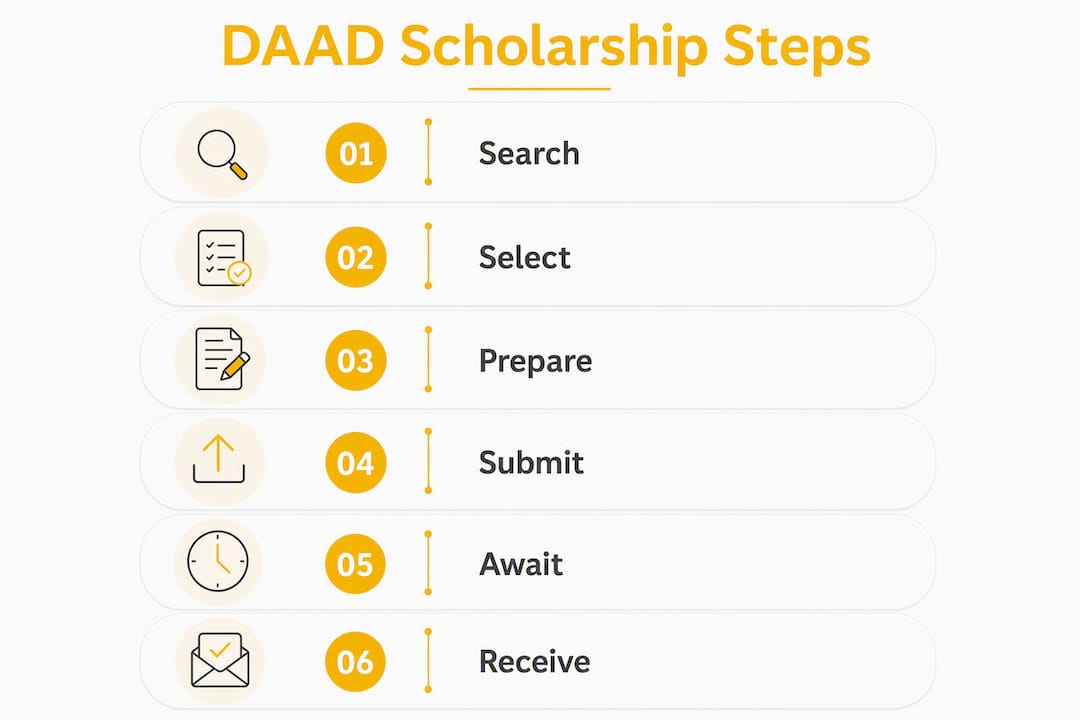
- Choose your programme — from the DAAD scholarship database and confirm you meet the eligibility criteria in the Call for Applications.
Document checklist
- Degree certificates and official transcripts
- CV (academic format, typically chronological)
- Study or research plan (the most critical document)
- Language certificate (CEFR-referenced, if required by the Call)
- Two or three letters of recommendation
- Host supervisor confirmation letter (required by many doctoral and research programmes)
- Passport copy and, where required, proof of enrolment
Documents not in German or English must be translated into German or English. Translations do not always need to be certified at the application stage, but certified versions are typically required before funding begins if you are selected. Plan for this early.
Timeline guidance
Allow at least 6–12 weeks before the deadline to request letters of recommendation. Referees who know you well but are busy academics need time; asking with less than four weeks' notice risks a rushed letter that does not serve you. Language tests like TestDaF or IELTS require booking in advance, sometimes months ahead.

Pro Tip: The DAAD portal works best on a stable desktop connection. Complete all complex entries on a desktop browser, and save PDFs of every final document locally before submitting. Some Calls disable re-uploading after submission, so treat your upload as final.
What DAAD funding typically covers
DAAD funding is not a single flat package. The components vary by programme, and the Call for Applications is the only authoritative source for what your specific programme pays.
That said, most programmes share a common structure:
- Monthly stipend: — The most consistent component. Typical figures cited in DAAD materials are approximately EUR 992/month for students and approximately EUR 1,300/month for doctoral and PhD candidates. Always verify the current rate in the Call.
| Funding Component | Typical Provision | Notes |
|---|---|---|
| Monthly stipend | ~EUR 992 (students); ~EUR 1,300 (doctoral) | Verify current rate in the Call |
| Travel allowance | Flat rate, distance-based | Paid once; amount varies by programme |
| Research allowance | Programme-dependent | Not universal; check the Call |
| Family benefits | Programme-dependent | Available in some longer-term grants |
| Insurance | Health/accident/liability in many programmes | Confirm scope in the Call |
Health insurance, visa, and practical essentials for US applicants
Winning a DAAD scholarship is the start, not the finish. Several practical steps must happen before you arrive in Germany, and health insurance is the one most applicants underestimate.
Visa and residence permit basics
Most non-EU nationals, including US citizens, need a German national visa (Type D) before entering Germany for a stay longer than 90 days. Your host university will issue a letter of admission or enrolment confirmation that German authorities require as part of the visa application. Apply for your visa at the German consulate or embassy in your US city of residence, and do it as soon as you receive your DAAD award letter.
Health insurance
Germany requires all residents to hold valid health insurance, and scholarship holders are no exception. DAAD programmes often include basic coverage, but the scope varies and may not meet all German statutory requirements or cover the full duration of your stay. Understanding your options before you land saves real money and avoids gaps in coverage.
- Students under 30 enrolled at a German university are typically eligible for statutory public health insurance at a reduced student rate.
- Researchers and postdocs above the income threshold may qualify for private health insurance, which often offers broader coverage.
- Myhealthcarebroker's student insurance guidance explains the options specific to scholarship recipients in plain English.
- For visa documentation, health insurance for a German visa outlines exactly what German authorities accept.
Pro Tip: Arrange your health insurance before you board the plane. German registration authorities (Einwohnermeldeamt) and universities ask for proof of coverage on day one. Sorting it out after arrival adds unnecessary stress to an already busy first week.
Post-award checklist
- Register with your host university and activate your student or researcher ID.
- Arrange accommodation (university housing applications often open months in advance).
- Activate health insurance coverage from your first day in Germany.
- Register with your local Einwohnermeldeamt (residents' registration office) within two weeks of arrival.
- Open a German bank account to receive your stipend payments.
DAAD country office contacts and official resources for US applicants
These are the resources worth bookmarking before you start any application:
- DAAD scholarship database: The primary tool for finding open Calls, reading programme details, and accessing the submission portal.
- DAAD Office New York — Find Funding: The US country office page with programme listings filtered for North American applicants and contact details for direct enquiries.
- Important information for scholarship applicants: DAAD's official FAQ covering documents, translations, language requirements, and portal guidance.
- DAAD Scholarships overview: The programme overview page with selection criteria and funding component summaries.
When you contact DAAD Office New York, include the programme title, your current degree level, your intended start date, and a specific question. Vague enquiries get generic answers. The office is most useful for confirming whether a specific programme is open to applicants from your state or institution, and for clarifying deadlines when the database shows conflicting information.
Always treat the Call for Applications as the source of truth. Website overviews and third-party guides (including this one) summarize; the Call governs.
Your concrete next steps as a US applicant
Move from reading to applying with this prioritized sequence:
- This week: Search the DAAD scholarship database using your target group and country filters. Identify two or three programmes that match your career stage and research goals.
- Week 2: — Register in the DAAD portal so your account is ready before the call opens.
- Post-award: Arrange health insurance before departure. Use Myhealthcarebroker's private health insurance calculator to estimate costs and compare statutory versus private options for your situation.
Allow roughly 6–12 weeks from your first database search to a complete, submission-ready application. Contact DAAD Office New York for any eligibility questions that the Call does not resolve.
This article provides general information about DAAD scholarship programmes. Always confirm current rules, deadlines, and funding amounts directly with DAAD or a qualified advisor before submitting an application.
Key Takeaways
DAAD scholarships fund study and research in Germany across every academic career stage, and your application's strength turns on the quality of your project description, not your GPA alone.
| Point | Details |
|---|---|
| Start with the database | The DAAD scholarship database is the only authoritative source for open Calls and current deadlines. |
| Eligibility turns on degree location | US applicants must confirm both citizenship/residency rules and where their last degree was earned. |
| Stipend benchmarks to verify | DAAD materials cite approximately EUR 992/month for students and EUR 1,300/month for doctoral candidates; confirm in your Call. |
| Project plan is the key document | Selection committees weigh project clarity and professional impact heavily, often above marginal grade differences. |
| Health insurance is day-one mandatory | Arrange coverage before arrival; use Myhealthcarebroker's calculator to compare statutory and private options. |
The part of DAAD applications most guides skip
Most DAAD guides spend their word count on document checklists and stipend tables. Those matter, but they are not where applications are won or lost.
The real differentiator is how clearly you articulate what you will do in Germany and why it cannot happen anywhere else. Selection committees read hundreds of applications from candidates with strong transcripts. What separates the funded applicants is a project description that is specific, scoped, and honest about its limitations. Vague ambition ("I want to contribute to the field of...") reads as unpreparedness. A concrete plan ("I will analyze X dataset at Y institute using Z method, building on my prior work at...") reads as someone ready to actually do the work.
There is also a practical gap that almost no guide addresses: the period between award notification and your first day in Germany. That window, often just eight to twelve weeks, is when you need to secure a visa, arrange housing, and set up health insurance. DAAD's included insurance often covers the basics, but it rarely covers everything, and the scope varies by programme. Researchers transitioning from a US institution to a German one sometimes find themselves in a coverage gap they did not anticipate. Sorting your insurance before departure, rather than after arrival, is one of the few genuinely stress-reducing moves available to you at that stage.
One more thing worth saying plainly: for researchers and faculty, a DAAD grant is as much about building a professional network in Germany as it is about the stipend. The relationships formed during a research stay, with supervisors, lab colleagues, and partner institutions, often outlast the funding period by years. Treat the scholarship as an entry point, not an endpoint.