
If you don't have an Anmeldung yet, open a digital bank first. N26, bunq, Wise, and Revolut will all issue you a working IBAN without proof of German registration, and several accept applications before you have a stamped address confirmation at all. Add a branch account later, once you're registered and want in-person services or a Girocard for everyday German shops.
Here's what to open right now, and in what order:
- First: A digital account (N26, bunq, or a similar app-based bank) using VideoIdent, so you have a euro IBAN within days.
- Backup for pre-arrival transfers: A multi-currency account like Wise or Revolut, useful for sending money before you land even if it isn't your primary account.
- Later, once registered: A branch account at Sparkasse, Commerzbank, Deutsche Bank, or Comdirect if you want face-to-face banking, cash deposit machines, or a full Girocard.
Before you touch any application, gather your passport, your phone (with a German number if you can get one, though many apps accept a foreign number temporarily), and whatever address proof you currently have. If VideoIdent is offered, take it. It's faster and skips the post office trip entirely.
One number worth knowing before you commit funds anywhere: deposit guarantee schemes across the EU protect your money up to at least €100,000 per depositor per institution. That applies whether you bank with a 200-year-old savings institution or an app-based challenger bank with a full German license.
Key Takeaways
Opening a digital bank account with VideoIdent before you have an Anmeldung is the fastest way to get a working German IBAN for payroll and rent.
| Point | Details |
|---|---|
| Open digital first | Apply to N26, bunq, or a similar bank using VideoIdent to get a DE IBAN within days, no Anmeldung needed. |
| Match account to visa status | Students and certain visa applicants need a Sperrkonto through providers like Fintiba or Expatrio before arrival. |
| Prioritize salary and rent | A DE IBAN avoids payroll rejections and landlord hesitation that non-German SEPA accounts sometimes trigger. |
| Build Schufa early | Choose a bank that reports to Schufa so future rentals, contracts, and credit approvals move faster. |
| Add a branch account later | Once registered, pair your digital account with a Sparkasse, Commerzbank, or similar bank for in-person services. |
Official and Reputable Pages to Check Next
- Make it in Germany's official bank account guidance covers government-backed expat advice on payment cards and account basics.
- Verivox's bank comparison tool lets you check current fee structures and features across providers before you commit to one.
Once your banking is sorted, health insurance is usually the next big decision on the list. Whether you're weighing private coverage as an employee or need to confirm what counts for a visa application, Myhealthcarebroker's independent advisors compare providers across the market and walk you through it in plain English, with no jargon and no obligation to sign anything you don't understand first.
Table of Contents
- Core German Account Types: Girokonto, Tagesgeld, and More
- Do You Actually Need a German Bank Account?
- How to Open a German Bank Account Step by Step
- What Checks Do German Banks Run on New Applicants?
- Blocked Accounts: Sperrkonto for Students and Visa Applicants
- Girocard, Debit, or Credit: How You'll Actually Pay
- Which German Bank Fits Your Situation Best
- What Will This Actually Cost You?
- Sending Money Across Borders Before and After You Arrive
- How to Choose the Right Account for Your Situation
- Understanding How Health Coverage and Payroll Interact
- The Anmeldung Catch-22 Is Solvable, and Most Guides Overcomplicate It
- Frequently Asked Questions
- Sources
Core German Account Types: Girokonto, Tagesgeld, and More
Germany's account system uses a handful of distinct product categories, and picking the wrong one wastes time. Here's the breakdown.
- Girokonto: The standard current or checking account. This is what you use for salary, rent, and daily spending. Almost everyone reading this needs one.
- Tagesgeld: An instant-access savings account, usually paired with a Girokonto at the same bank. Money sits here earning modest interest but stays withdrawable.
- Sperrkonto: A blocked account, required for many student visa applicants and some other visa categories as proof of financial means. Covered in depth further down.
- Business account (Geschäftskonto): A separate account for freelancers and self-employed workers who want to keep business income distinct from personal spending, often required by German tax authorities for VAT-registered businesses.
An employee moving to Germany for a new job needs a Girokonto, full stop. A master's student on a study visa likely needs a Sperrkonto before arrival and a Girokonto after. A freelancer building a client base might eventually want a business account once invoicing volume justifies the separation.
One detail trips people up constantly: not every IBAN that works in Germany starts with "DE." SEPA rules mean an IBAN from Belgium, Ireland, or Lithuania is technically valid for euro transfers anywhere in the eurozone. In practice, though, German landlords and some payroll departments still balk at non-German account numbers, which brings us to the next question.
Do You Actually Need a German Bank Account?
Legally, no. Practically, usually yes. SEPA regulations require any euro account within the SEPA zone to accept transfers regardless of country prefix, but that legal guarantee doesn't always survive contact with German bureaucracy.
A foreign or other-EU IBAN can work fine for personal transfers, subscriptions, and even some rent payments. Where it tends to break down is payroll. Some German employers' payroll systems are configured to reject or flag non-DE IBANs, which delays your first paycheck exactly when you can least afford delay. Landlords are similarly cautious. A DE IBAN signals stability and makes automatic direct debits (Lastschrift) for utilities and insurance far simpler to set up, since German utility providers overwhelmingly assume a domestic account.
Weigh it like this:
- Non-DE SEPA account (Wise, a home-country bank): Works for receiving international transfers immediately, no Anmeldung needed, but risks payroll rejection and looks unfamiliar to landlords.
- DE IBAN: Universally accepted by employers, landlords, and utility providers; requires either an Anmeldung (for most branch banks) or a digital bank that skips that requirement.
If salary and rent are your two most pressing needs, which they usually are for anyone relocating for work, get a DE IBAN as close to day one as possible. Opening a bank account is frequently the first serious bureaucratic hurdle newcomers face, and solving it early prevents it from blocking everything downstream.
How to Open a German Bank Account Step by Step
The fastest route to a working account is a digital bank paired with VideoIdent verification, because it sidesteps both the Anmeldung requirement and the post office queue. Here's the full sequence.
- Choose your bank type. Digital-first (N26, bunq) if speed matters and you lack Anmeldung; branch-based (Sparkasse, Commerzbank, Deutsche Bank, ING, DKB, Comdirect) if you're already registered and want in-person support.
- Complete the online application. This takes 10 to 20 minutes for most digital banks, longer for branch banks that require an appointment.
- Verify your identity. Choose VideoIdent (a video call with an agent checking your passport) or PostIdent (an in-person post office visit with your ID).
- Wait for approval and card dispatch. Digital banks confirm within hours to a couple of days; branch banks can take one to three weeks, especially if an in-branch appointment is required.
- Receive your card and PIN. These typically arrive separately by mail for security reasons.
- Activate your account and link payroll. Give your new IBAN to your employer's HR department as soon as it's active, since payroll cycles often lock in the account number weeks ahead of the actual payment date.
- Update your address once you register. If you opened with a temporary address, submit your Meldebescheinigung to the bank afterward to keep your account details current.
Here's exactly what to have ready before you start any application:
- Valid passport or EU national ID
- Anmeldung/Meldebescheinigung (if your chosen bank requires it)
- Residence permit or visa (if applicable)
- German Tax ID (Steuer-ID), once issued
- A phone number capable of receiving app verification codes
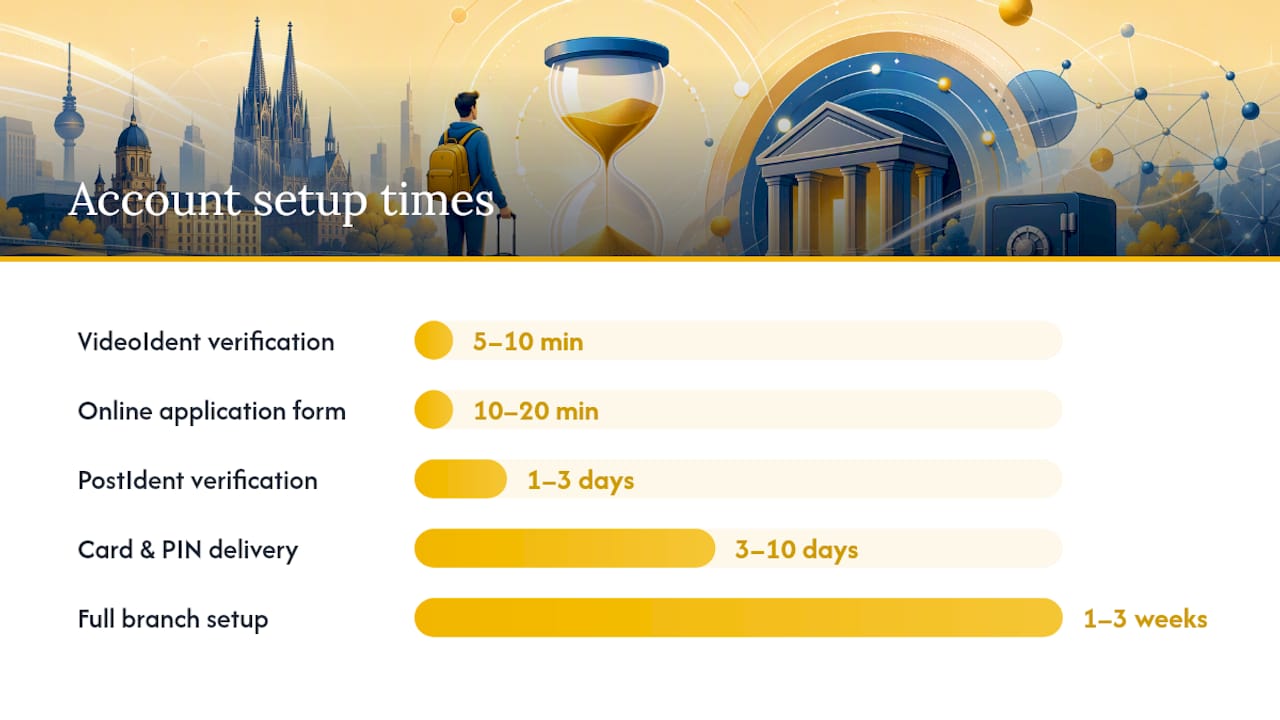
| Step | Typical timeline |
|---|---|
| Online application form | 10 to 20 minutes |
| VideoIdent verification | 5 to 10 minutes, results in hours |
| PostIdent verification | 1 to 3 days processing plus a post office visit |
| Card and PIN delivery | 3 to 10 days by mail |
| Full branch account setup | 1 to 3 weeks, including appointment scheduling |
VideoIdent, used widely by fintechs, takes minutes to complete versus the multi-day round trip PostIdent requires, which is exactly why most newcomers gravitate toward digital-first banks for their first account.
What Checks Do German Banks Run on New Applicants?
Every bank runs identity verification and, in most cases, a Schufa credit check, and new arrivals should expect a specific set of predictable gaps rather than outright rejection.
Here's what typically shows up during onboarding:
- Anmeldung requirement: Most traditional banks want it before opening an account; many online banks including N26, bunq, Wise, and Revolut do not.
- Empty Schufa file: You haven't lived in Germany, so there's no credit history. This isn't a red flag, just a blank slate that limits things like credit card approval initially.
- Nationality restrictions: A small number of providers limit account opening based on citizenship or require additional documentation for non-EU passport holders.
- Proof of income or employment contract: Some branch banks ask for this upfront, particularly for accounts with overdraft facilities.
The practical workaround for the Anmeldung problem is well established at this point: open a digital bank using a temporary address, such as an Airbnb or corporate housing placement, then update your registered address once you receive your Meldebescheinigung. This gets you a functioning DE IBAN in days rather than waiting weeks for a permanent address and registration appointment.
Pro Tip: Choose a bank that reports to Schufa from day one, even if you're only using it for basic transactions. Building Schufa history early speeds up everything that comes later: phone contracts, apartment applications, and credit card approvals all lean on that record.
Blocked Accounts: Sperrkonto for Students and Visa Applicants
A Sperrkonto, or blocked account, is mandatory for many student visa applicants and certain other visa categories as proof you can financially support yourself during your stay. If your visa category requires proof of funds and you're not sponsored by an employer or scholarship, you almost certainly need one.

The mechanism is straightforward: you deposit a required lump sum before your visa appointment, and the account releases a fixed monthly amount to you once you arrive and open a regular account, rather than handing over the full sum at once. This structure exists specifically so visa officers can verify you have enough to cover roughly a year of living costs without the bank exposing you to spending it all in week one.
Specialized providers, including Fintiba and Expatrio, have built their entire business around simplifying this process for applicants who are often still abroad when they need to set it up. Setup typically happens entirely online, takes a few business days once documents are submitted, and comes with a setup fee plus sometimes a small monthly account fee. Compare the numbers carefully. Fees and required deposit amounts change, and the provider your university recommends isn't always the cheapest option available.
Girocard, Debit, or Credit: How You'll Actually Pay
Germany runs on the Girocard, and if your new bank issues one, use it as your default for daily purchases. It's the standard payment method for daily transactions at supermarkets, pharmacies, and most local shops, and many smaller retailers still don't accept international Visa or Mastercard debit cards without a surcharge or outright refusal.
Here's where it gets confusing for newcomers: many digital banks, including N26 and bunq, issue a Visa or Mastercard debit card instead of a Girocard. This isn't a downgrade, just a different tool.
- Girocard: Best for everyday German retail, widely accepted, low fraud liability, but often unusable for online international purchases or car rental deposits abroad.
- Visa/Mastercard debit: Better for online shopping, travel, hotel holds, and car rentals, since these merchants often specifically require a Visa or Mastercard logo.
- Credit cards: Genuinely useful but harder to get approved for meaningfully high limits without an established Schufa record, which new arrivals simply don't have yet.
If you're applying for a branch account and know you'll want both card types, ask directly whether a Girocard is included by default or requires a separate request. Some accounts bundle both.
Which German Bank Fits Your Situation Best
There's no universal winner here. The right bank depends entirely on whether you're optimizing for speed, English support, branch access, or transfer costs, and those priorities genuinely conflict with each other.
- Fastest to open: A digital-only bank. Applications complete in minutes, VideoIdent confirms in hours, and no Anmeldung is required. This is the right move for anyone who needs to receive salary or pay rent within their first two weeks.
- Best for face-to-face banking: A traditional branch bank. If you deposit cash regularly, need a mortgage advisor, or simply prefer speaking to a human, a filialbank with a dense branch network serves you better long term, even if the account takes longer to open.
- Best for students on a budget: Look for accounts with no monthly fee tied to enrollment status, paired with a Sperrkonto provider if your visa requires one.
- Best for cheap international transfers: A multi-currency specialist. If you regularly send money home or receive foreign income, the exchange rate margin on a standard German current account will cost you far more over a year than a dedicated transfer service.
For a branch appointment, bring your passport, Anmeldung, and any employment contract or income proof before you go. Many branches require appointments booked at least a few days out, so don't leave this until the week rent is due.
What Will This Actually Cost You?
Expect either a free digital account or a modest monthly fee at a branch bank, with common waivers tied to salary deposits or student status. Monthly fees at branch banks typically run within a modest low single-digit euro range unless you qualify for a waiver, most commonly by depositing a minimum monthly salary or maintaining student enrollment.
Beyond the base monthly fee, watch for these recurring costs:
- ATM withdrawals: Free at your own bank's network, but expect fees of €4 to €6 at out-of-network machines, particularly at private ATM operators in tourist areas.
- Card delivery: Usually included, though expedited delivery sometimes carries a small charge.
- International transfers: SEPA transfers within the eurozone should be free or near-free; transfers outside SEPA can carry both a flat fee and a currency conversion markup.
- Premium account tiers: Some digital banks charge €5 to €20 monthly for tiers that bundle travel insurance, higher ATM allowances, or multiple currency sub-accounts.
Sending Money Across Borders Before and After You Arrive
SEPA transfers in euros between eurozone accounts should be free and typically settle within one business day, but plan around the fact that some German payroll systems still push back on non-German IBANs. If you're bringing savings from abroad, a low-cost transfer specialist like Wise generally beats your home bank's wire transfer on both fee and exchange rate, and you can send funds toward a German account before you've even landed.
Here's the practical sequencing that avoids the most common friction: send your initial funds via a service like Wise into a multi-currency account, then transfer euros into your DE IBAN once your German digital or branch account is active. This gets money moving immediately while your permanent account is still being processed.
Keep in mind that a non-German IBAN, even a fully SEPA-compliant one from Belgium or another EU country, sometimes gets rejected by German employer payroll software purely due to configuration limitations, not law. If your first paycheck is delayed because of this, ask HR directly whether their system flags non-DE account numbers. Getting ahead of it with a DE IBAN in hand before your start date avoids the awkward conversation entirely.
How to Choose the Right Account for Your Situation
Start with speed and DE IBAN necessity, then layer in the secondary factors that matter for your specific visa, employment, or student status. Here's the checklist, in priority order:
- Do I need a working IBAN within the next two weeks for payroll or rent?
- Do I have an Anmeldung yet, or will I need a bank that works without one?
- Am I on a visa category requiring a Sperrkonto for proof of funds?
- How often will I need in-person branch services, like cash deposits or a mortgage consultation?
- Does the bank report to Schufa, and will that matter for future rentals or contracts?
- What card type comes standard: Girocard, Visa/Mastercard debit, or both?
- What are the realistic ATM withdrawal costs if I travel or need cash frequently?
- Is English-language support available in the app, on the phone, and in writing?
- How much will international transfers cost me on an ongoing basis?
- Are there branch locations near where I'll actually be living or working?
Answer these honestly before you apply anywhere, and you'll avoid the common mistake of picking a bank based on which one a coworker mentioned rather than which one matches your actual situation.
Pro Tip: Many expats end up running two accounts long term: a digital bank for speed and low-cost international transfers, and a branch account for cash handling and in-person advice once they're settled. There's no rule against holding both, and doing so also spreads your money across two separate deposit protection schemes.
Understanding How Health Coverage and Payroll Interact
Once your bank account is active and linked to payroll, the next major administrative piece is health insurance, since German employers deduct statutory contributions directly and higher earners often have the option to go private instead. If you're a salaried employee weighing public versus private health insurance, your account setup and your insurance enrollment typically happen in the same first month, and getting both right early avoids payroll corrections down the line.
Freelancers face a different setup entirely, since insurance premiums are paid directly rather than deducted automatically, which makes having a stable DE IBAN even more important for avoiding missed payments. If that's your situation, insurance options built specifically for freelancers and international workers are worth reviewing before your first invoice goes out. Myhealthcarebroker works as an independent consultancy comparing coverage across major providers, in plain English, so the insurance side of your relocation doesn't become its own separate maze. If you want to check whether private coverage makes sense for your income level, Myhealthcarebroker's eligibility check takes a few minutes and gives you a clear next step.
The Anmeldung Catch-22 Is Solvable, and Most Guides Overcomplicate It
The conventional advice on this topic treats the Anmeldung requirement as a wall you have to wait out. That framing wastes weeks unnecessarily. The actual fix, using a digital bank and a temporary address to secure a DE IBAN before you're fully registered, has been available and reliable for years, yet a surprising number of relocation guides still present branch banking as the default starting point.
What gets underestimated is how much downstream friction a delayed IBAN causes. It's not just an inconvenience while you wait for a branch appointment. It's a delayed paycheck, a landlord who won't finalize your lease, and a Schufa file that stays empty for longer than it needs to, which then slows down your phone contract and your next apartment search. Every week without a working DE IBAN compounds.
Where I'd push back hardest on common guidance is the instinct to treat the "best bank" question as a single decision. It isn't. The smartest newcomers I'd point to run two accounts on purpose: a digital bank opened in the first 48 hours for speed, and a branch account added later once Anmeldung is sorted and long-term needs like cash handling or in-person advice come into play. Treating this as sequential rather than exclusive is the single biggest mindset shift that separates a smooth first month from a frustrating one.
Prioritize the DE IBAN first, and let everything else, card type, branch access, premium features, settle into place once your immediate income and housing needs are covered.
Frequently Asked Questions
Do I need a German bank account to sign a lease? Most landlords strongly prefer a DE IBAN for automatic rent payments, and some will decline a foreign account entirely, so opening one before apartment hunting saves time.
Can I open a German bank account without an Anmeldung? Yes, several digital banks including N26, bunq, Wise, and Revolut allow account opening without a registered address, unlike most traditional branch banks.
What's the difference between VideoIdent and PostIdent? VideoIdent verifies your identity over a video call in minutes, while PostIdent requires an in-person post office visit and typically takes one to three days to process.
How much money do I need for a Sperrkonto? The required deposit amount changes periodically and depends on your visa category, so check current figures directly with your visa office or a specialized provider like Fintiba or Expatrio before applying.
Is a Girocard the same as a debit card? Not exactly. Girocard is Germany's domestic payment network, widely accepted locally but sometimes unusable online or abroad, while a Visa or Mastercard debit card works more broadly for international and online purchases.
Will my foreign bank account work for receiving my German salary? It may work legally under SEPA rules, but some employer payroll systems reject non-German IBANs outright, so a DE IBAN remains the safer choice for salary deposits.
This article is general information, not a substitute for advice from a qualified financial advisor. Consult a qualified financial professional about your own circumstances before acting on anything here.
Sources
- Expats
- Best Banks for Expats in Germany 2026: N26, Wise & Commerzbank Compared
- Opening a bank account in Germany - Wise
- Find the best bank in Germany: Compare banks online | VERIVOX