
Switching from public to private health insurance in Germany is a legal right for employees who earn above a set income threshold, but the process has strict rules, firm deadlines, and long-term financial consequences. The formal terms you will encounter are GKV (gesetzliche Krankenversicherung, the statutory public system) and PKV (private Krankenversicherung, the private system). In 2026, the income threshold that unlocks eligibility is €77,400 per year. Missing a cancellation deadline or underestimating how premiums rise with age can turn a smart financial move into a costly mistake. This guide walks you through every step of the public to private insurance switch, with current figures and practical advice built for expat professionals.
Who can switch public to private insurance in Germany?
Eligibility for the switch from GKV to PKV rests on three factors: income, employment status, and age. Get all three right before you apply for a single quote.
Income threshold. The Jahresarbeitsentgeltgrenze (JAEG) is the annual income limit that determines eligibility. In 2026, you must earn more than €77,400 gross per year, which works out to roughly €6,450 per month. This threshold rises approximately 3% each year, so the figure you qualify under today may not apply next year if your salary stays flat.
Employment status. The rules differ by how you work:
- Employees must exceed the JAEG for at least one full calendar year before switching. Earning above the threshold for a few months is not enough.
- Self-employed professionals and freelancers can join PKV immediately, with no income threshold requirement. This is one of the most underused advantages for expats who go independent in Germany.
- Civil servants (Beamte) receive a government subsidy called Beihilfe that covers a large share of medical costs. PKV is almost always the financially logical choice for this group.
Age. Most private insurers apply stricter underwriting and higher base premiums for applicants over 55. Switching after 55 is not impossible, but the premium loading can be severe. Returning to GKV after age 55 is nearly impossible under current legislation, with very limited exceptions for people who reduce their working hours or income significantly.
Family status. GKV covers dependent spouses and children at no extra cost. PKV does not. Each family member needs a separate policy and pays a separate premium. A single professional with no dependents faces a very different financial picture than a parent with two children and a non-working spouse.
Pre-existing conditions. PKV insurers conduct health screenings. Conditions like diabetes, cardiovascular disease, or a history of mental health treatment can result in premium surcharges, exclusions, or outright rejection. Full disclosure is legally required and financially critical.
Step-by-step process to switch from GKV to PKV
The switching process follows a defined sequence. Skipping or reordering steps creates gaps in coverage or invalid cancellations.
- Confirm your eligibility. Verify that your gross annual salary exceeds €77,400 and that you have held that salary level for the required period. Check your employment contract and recent payslips.
- Obtain multiple quotes. Request quotes from at least three private insurers. Premiums vary significantly for the same coverage level. Use a broker who compares across the full market rather than a tied agent who represents one insurer.
- Complete the medical questionnaire. Every PKV application requires a detailed health declaration. Answer every question accurately. Omitting a pre-existing condition can void your contract later.
- Select your plan and sign the contract. Once you choose a plan, sign the PKV contract. The start date on that contract determines your GKV cancellation timeline.
- Submit your PKV contract to your GKV insurer. You must notify your public insurer in writing and provide proof of your new private contract within a three-month window. This triggers automatic cancellation of your GKV membership. Coverage continuity is mandatory under German law.
- Notify your employer. Your employer currently splits your GKV contribution with you. Once you move to PKV, your employer pays a subsidy of up to €508.59 per month in 2026, which is roughly 50% of your premium up to that cap. Your payroll department needs the new policy details to adjust your salary deductions.
- Start PKV coverage on the same day GKV ends. There must be zero gap between the two policies. Confirm the exact start and end dates in writing with both insurers.
| Step | Action | Timeline |
|---|---|---|
| Eligibility check | Verify income and employment status | Before applying |
| Obtain quotes | Compare at least 3 PKV offers | 2–4 weeks |
| Medical declaration | Complete health questionnaire | During application |
| Sign PKV contract | Confirm start date | Before GKV notice |
| Notify GKV | Submit PKV contract in writing | Within 3 months of PKV start |
| Notify employer | Adjust payroll for subsidy | Before first PKV payment |
Pro Tip: The statutory two-month notice period and 12-month binding period for GKV apply in most cases. A contribution rate increase by your GKV insurer triggers a special right of cancellation, letting you exit before the standard period ends. Watch for any letter from your GKV about a Zusatzbeitrag increase.

Benefits and drawbacks of switching to private insurance
The decision to switch is rarely straightforward. The advantages are real, but so are the risks.
What you gain with PKV
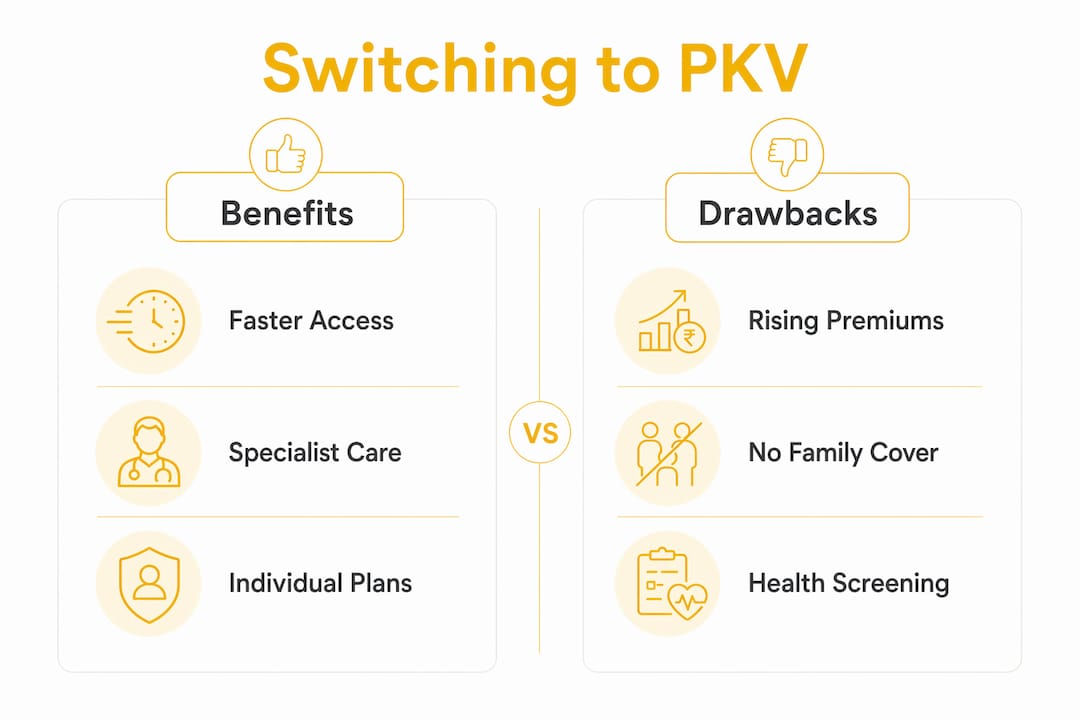
Private health insurance in Germany offers faster access to senior consultants and specialists, shorter waiting times for appointments, and single or double rooms in hospital as standard on most plans. You can also tailor your coverage level, choosing higher dental benefits, alternative medicine, or international coverage that GKV does not provide. The employer subsidy of up to €508.59 per month softens the blow on your net salary, especially when you are young and healthy with a low base premium.
What you risk with PKV
PKV premiums rise with age and are not capped by income, unlike GKV contributions which are income-based and capped at €5,812.50 monthly in 2026. Premiums can more than double by age 60. That trajectory matters enormously if your income plateaus or you take a career break. Losing your job or dropping below the income threshold does not automatically let you return to GKV. And if you later want to switch between private insurers, you lose the age-related reserves built above the base tariff, which creates a real financial penalty for changing providers.
| Factor | GKV (public) | PKV (private) |
|---|---|---|
| Premium basis | Income-based, capped | Age and health-based, uncapped |
| Family coverage | Included at no extra cost | Separate policy per family member |
| Specialist access | Referral often required | Direct access, shorter wait times |
| Employer contribution | ~50% of contribution | Up to €508.59/month subsidy |
| Flexibility to switch back | Possible under conditions | Very restricted after age 55 |
Common pitfalls and expert tips for switching insurance types
Most mistakes happen before the application is even submitted. Knowing where others go wrong puts you ahead.
- Rushing the decision. Getting one quote and signing quickly is the most common error. Premiums for identical coverage can vary by hundreds of euros per month across insurers. Take the time to compare properly.
- Incomplete medical disclosure. Omitting a past diagnosis to get a lower premium is a serious legal risk. If an insurer discovers undisclosed conditions later, they can void the contract or refuse to pay claims.
- Ignoring the long-term premium trajectory. A €250 monthly premium at age 32 can become €600 or more at age 58. Model the numbers over a 20-year horizon, not just the first year.
- Overlooking family costs. A family of four moving from GKV to PKV can see insurance costs multiply significantly. Calculate the full household cost before deciding.
- Missing the Anwartschaft option. An Anwartschaft (deferred insurance) lets you lock in your current health status and future PKV eligibility while remaining in GKV. This is useful if you are close to the income threshold but not yet consistently above it, or if you want to secure your health rating before a condition develops.
- Not using an independent broker. Tied agents represent one insurer. An independent broker like Myhealthcarebroker compares the full market and has no incentive to push a specific product.
Pro Tip: Internal tariff switches under §204 VVG allow PKV members to change plans within the same insurer while retaining all age-related reserves. If your current PKV plan becomes too expensive, this is almost always a better option than switching insurers entirely.
Key takeaways
Switching from public to private health insurance in Germany is a permanent, high-stakes decision that requires meeting the 2026 income threshold of €77,400, following a strict procedural timeline, and fully understanding the long-term premium trajectory before signing anything.
| Point | Details |
|---|---|
| Income threshold | You must earn over €77,400 gross annually in 2026 to qualify as an employee. |
| Cancellation rules | Submit your PKV contract to GKV within 3 months to trigger automatic cancellation. |
| Family cost impact | Each dependent needs a separate PKV policy, which significantly raises household costs. |
| Age and reversibility | Returning to GKV after age 55 is nearly impossible under current German law. |
| Employer subsidy | Your employer contributes up to €508.59 per month toward your PKV premium in 2026. |
What I have learned after years of helping expats make this switch
The most common misunderstanding I see is treating the switch to PKV as a simple upgrade. People focus on the better hospital room and the faster specialist appointment. They do not think about what happens at age 57 when their premium has doubled and their income has not kept pace.
The second thing I see regularly is expats who switch without accounting for their family. A single professional earning €90,000 a year is a strong candidate for PKV. That same person with a non-working spouse and two children is looking at a very different financial calculation. GKV's free dependent coverage is genuinely valuable, and it is easy to underestimate until you price out three separate PKV policies.
My honest view is that PKV is excellent for the right person at the right time. Young, healthy, high-earning, and either single or with a working partner who carries their own insurance. For everyone else, the decision deserves much more scrutiny than it typically gets. The public vs. private comparison is not a question of which system is better in the abstract. It is a question of which system fits your specific financial trajectory over the next 30 years.
If you are unsure, the Anwartschaft option is underused and underappreciated. It lets you secure your health rating now without committing to the full switch. That flexibility has real value, especially if your income is close to the threshold or your health situation is likely to change.
— Marco
How Myhealthcarebroker helps you switch with confidence
Switching health insurance in Germany involves German-language contracts, strict deadlines, and financial decisions that affect you for decades. Myhealthcarebroker makes the process clear and manageable for expat professionals.
As independent consultants, Myhealthcarebroker compares private health insurance options across the full market, not just a handful of preferred providers. The team runs a personalized eligibility check based on your 2026 income, age, and family situation, then walks you through quotes in plain English. From the first check to the final application and employer notification, every step is handled with you. Start with a free eligibility check to find out where you stand today.
FAQ
What is the income threshold to switch to PKV in 2026?
Employees must earn more than €77,400 gross per year (roughly €6,450 per month) to be eligible to switch from GKV to PKV in 2026. This threshold, called the Jahresarbeitsentgeltgrenze, rises approximately 3% each year.
How do I cancel public health insurance in Germany?
You notify your GKV insurer in writing and submit proof of your new private insurance contract. The GKV cancellation is triggered automatically once you provide the PKV contract, provided you do so within the required three-month window.
Can I switch back to public insurance after going private?
Returning to GKV after age 55 is nearly impossible under current German law, with very limited exceptions. Below age 55, returning is possible if your income drops below the threshold or your employment status changes.
Does my employer still contribute if I switch to private insurance?
Yes. Your employer pays a subsidy of up to €508.59 per month toward your PKV premium in 2026, which is roughly equivalent to their share of your GKV contribution.
What is an Anwartschaft and should I consider it?
An Anwartschaft is a deferred private insurance agreement that locks in your current health status and future PKV eligibility while you remain in GKV. It is worth considering if your income is close to the threshold or if you want to secure your health rating before a medical condition develops.