
Review your premium notice and employer subsidy paperwork this week, then run a §204 tariff-switch analysis the moment your premium rises. That single habit does more to maximize PKV benefits in 2026 than any other move available to you. Three numbers anchor the plan: the 2026 compulsory insurance threshold (JAEG) sits at €77,400, the employer subsidy caps are tied to contribution assessment ceilings, and §204 VVG provides a regulated right to switch tariffs within your insurer without new underwriting.
Here's what to do right now:
- Pull your latest premium adjustment letter and check the effective date.
- Ask your insurer, in writing, for a list of equivalent or lower in-house tariff alternatives.
- Confirm with HR that your employer subsidy certificate (Beitragsbescheinigung) reflects your current premium.
Pro Tip: The day a premium increase letter lands, you're on a two-month clock for special cancellation rights under §205 VVG. Mark the date, request tariff alternatives immediately, and don't let the window close while you're still deciding.
Key Takeaways
Maximizing PKV benefits in 2026 comes down to acting on your employer subsidy, deductible, and §204 tariff rights before a premium increase forces the decision for you.
| Point | Details |
|---|---|
| Act within the two-month window | §205 VVG gives you two months after a premium increase to exercise special cancellation rights. |
| Confirm JAEG eligibility | Employees need gross income above €77,400 in 2026 to qualify for PKV. |
| Try §204 before switching insurers | An in-house tariff switch preserves ageing reserves; a new insurer only transfers the Basistarif-equivalent portion. |
| Capture your full employer subsidy | The 2026 maximum subsidy runs roughly €496 to €509 depending on the Zusatzbeitrag, so keep HR paperwork current. |
| Get independent broker support | Myhealthcarebroker offers free, English-language tariff comparisons and risk pre-checks funded by insurer commission. |
Where to Verify These Rules and Numbers
- The Wegweiser Gesundheit guide for official eligibility and Basistarif rules.
- Barmer's health insurance overview for current JAEG figures.
- Industry premium-watch coverage from MeineTarife24 for annual adjustment trends.
Bookmark these and revisit them each year, since the BBG, JAEG, and subsidy caps all shift with routine annual updates.
Table of Contents
- Your 30/90/180-Day Checklist to Maximize PKV Benefits in 2026
- How Does Private Health Insurance Actually Work?
- Who Is Eligible for Private Health Insurance?
- What Does Coverage Actually Include?
- What Drives Your PKV Premium and How Do Ageing Reserves Work?
- What Are the Highest-ROI Tactics to Maximize PKV Benefits Right Now?
- How Do Employer Subsidies and Taxes Affect Your Net Cost?
- What Happens If You Want to Switch Tariffs or Insurers?
- What Should You Watch for in 2027?
- What Documents Do You Need and How Long Does It Take?
- What Should You Ask Before You Sign or Switch?
- Frequently Asked Questions
- Sources
Your 30/90/180-Day Checklist to Maximize PKV Benefits in 2026
Optimizing private health insurance benefits in 2026 isn't a one-afternoon project. It's a sequence, and the sequence matters because some steps (like requesting a §204 tariff switch) close doors on others (like a full insurer change) if you wait too long.
In the next 30 days:
- Verify your premium letter against your actual contract terms and confirm the increase percentage.
- Get an updated employer subsidy certificate from HR reflecting the 2026 caps.
- Request your insurer's full list of §204 tariff alternatives in writing.
Within 90 days:
- Run a broker-assisted risk pre-check (Risikovorabfrage) anonymously before committing to anything.
- Model your long-term costs, including how your accumulated Alterungsrückstellungen would transfer or vanish under each option.
- Evaluate whether a Beitragsentlastungstarif (a rider that reduces future premiums using savings built now) makes sense given your age and income trajectory.
By 180 days:
- Decide between a Tarifwechsel (internal switch) and an Anbieterwechsel (new insurer), based on what the pre-check revealed.
- File any cancellations or replacement contracts before your existing coverage lapses.
- Update your tax records if your premium structure changed mid-year.
This isn't bureaucratic busywork. Miss the 90-day window on a risk pre-check, and you may end up applying to a new insurer with the wrong information already on record.
How Does Private Health Insurance Actually Work?
PKV runs on a completely different mechanism than Germany's statutory scheme, and understanding that mechanism is what lets you optimize PKV coverage in 2026 instead of just reacting to bills. Statutory insurance (GKV) charges you a percentage of income. PKV prices you once, at entry, based on your age and health status, then holds that pricing structure for the life of the contract, subject to periodic actuarial adjustments.
That single design choice explains almost everything else about the system:
- Premiums are locked to your entry-age risk profile, not your current salary. A raise doesn't raise your premium.
- Insurers build Alterungsrückstellungen, ageing reserves, from your premiums while you're young and healthy, specifically to blunt cost increases later in life.
- Every PKV insurer must offer a Basistarif with benefits roughly matching statutory coverage, a safety net if your finances change.
- You typically pay providers directly and get reimbursed afterward, which means cashflow planning matters more in PKV than in GKV.
If you're self-employed, that reimbursement rhythm is worth internalizing early. A single hospital stay can mean a five-figure invoice sitting on your desk for a few weeks before reimbursement lands. Knowing that in advance beats discovering it during a medical emergency.
Who Is Eligible for Private Health Insurance?
Eligibility is the gate that determines whether any of this applies to you, and it's narrower than most people assume. As of 2026, employees can opt into PKV once their gross income clears the compulsory insurance threshold for 2026 (https://www.barmer.de/en/health-guide/health-insurance-germany-1265334). Self-employed individuals and freelancers are generally eligible regardless of income. Civil servants (Beamte) qualify through a separate route tied to the Beihilfe system. Students face narrower, case-specific rules.
The number that matters: €77,400. That's the 2026 JAEG (Jahresarbeitsentgeltgrenze), which is key for employee eligibility for PKV.
If your salary sits close to that threshold, don't wait for your next raise to think about this. Confirm your eligibility status with payroll now, and check whether your employer's subsidy paperwork is current, because a gap here delays everything downstream.
- Confirm your gross salary against the current JAEG.
- Check your employment classification (employee, freelancer, civil servant).
- Ask HR whether your subsidy certificate has been updated for 2026.
What Does Coverage Actually Include?
PKV coverage is modular, and that modularity is exactly why two people paying similar premiums can have wildly different protection. The core buckets are outpatient care, inpatient care (including single-room and senior consultant, or Chefarzt, options), dental, vision, and alternative medicine. Beyond that, you're choosing riders and add-ons, and this is where real optimization happens.
Common tariff features worth understanding before you buy or renew:
- Dental modules vary enormously in depth. A shallow dental rider might cap reimbursement well below the cost of an implant.
- Krankentagegeld (daily sickness allowance) replaces lost income if you're self-employed and unable to work. Employees with sick-pay continuation need it less.
- Beitragsentlastungstarif is a savings-style rider that reduces your premium burden later in life, funded by extra contributions now.
- International travel coverage matters if your work or lifestyle involves regular time outside Germany.
Family coverage is where PKV diverges sharply from statutory insurance. GKV covers a non-earning spouse and children under one household premium. PKV charges a separate premium for every family member, which can turn an attractive individual rate into a much larger household bill once children enter the picture. Read a fuller comparison of statutory versus private coverage before assuming PKV is the obvious choice for a growing family.
What Drives Your PKV Premium and How Do Ageing Reserves Work?
Your premium is set by five inputs: entry age, health status at underwriting, the benefit scope you choose, your deductible (Selbstbeteiligung), and how your insurer manages its ageing reserves. Only two of those, benefit scope and deductible, remain in your control after signing. That's worth sitting with for a moment, because it reframes what "optimizing" your PKV plan actually means: you're not renegotiating your age or your health history, you're adjusting the levers you still own.
Mid-contract premium adjustments happen for reasons outside your control too: rising medical cost inflation across the insurer's whole risk pool, weaker-than-expected investment returns on the reserve fund, or a tariff-wide restructuring. In 2026, the PKV-Verband estimates roughly 60% of policyholders were affected by some adjustment, with an average increase among that group of about 13%. That figure describes the affected subset, not every contract, which is exactly why individualized review matters more than headline averages.
- Entry age and underwriting health status set your baseline cost for the life of the contract.
- Your chosen deductible directly trades monthly premium for out-of-pocket risk.
- Ageing reserves accumulate specifically to prevent your premium from tracking rising healthcare costs one-to-one as you age.
- Tariff-wide restructuring by the insurer can trigger increases even if your personal risk profile hasn't changed.
Pro Tip: When you get an increase notice, don't default to shopping a new insurer. An in-house §204 tariff switch usually preserves your full ageing reserve for equivalent-or-lower benefits, while a full insurer change only transfers your Basistarif-equivalent reserve portion and requires fresh underwriting. Run the numbers on both before you decide.
What Are the Highest-ROI Tactics to Maximize PKV Benefits Right Now?
Not every optimization move delivers equal value. Here's a ranked sequence based on typical feasibility and payoff for high earners and the self-employed:
- Claim your full employer subsidy first. This is free money you may already be leaving on the table if your HR paperwork is outdated.
- Request a §204 tariff review before anything else. It's the lowest-risk lever you have, and it preserves reserves you've already built.
- Reassess your deductible. A higher Selbstbeteiligung lowers your monthly premium; the math only works if your cash reserves can absorb the occasional larger bill.
- Consider a Beitragsentlastungstarif if you're mid-career and want to blunt premium growth in your 50s and 60s.
- Audit your riders. Dental and Krankentagegeld additions make sense for some profiles and are dead weight for others.
- Check your eligibility for Beitragsrückerstattung, a premium rebate for a claim-free year that can meaningfully lower your net annual cost. See how the PKV premium rebate mechanism works before you file a small claim that isn't worth losing it.
- Set up an Anwartschaft (a dormant policy status) if you're temporarily moving abroad or switching to statutory coverage, so you can return without fresh underwriting.
- Compare providers periodically, even if you don't switch. Knowing your market position keeps you from overpaying out of inertia.
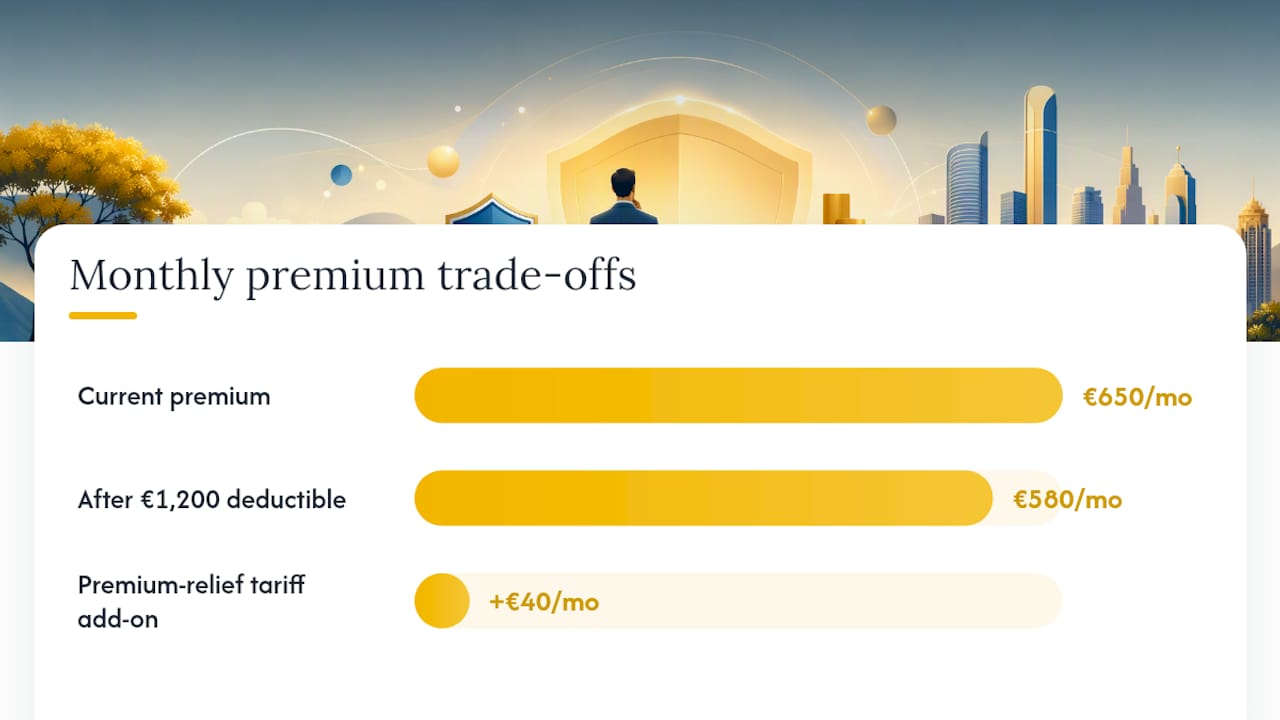
Here's a worked scenario. Say you're 42, paying €650 a month, with no deductible. Option A: raise your deductible to €1,200 a year, dropping your premium to roughly €580 a month, a saving of €840 a year. Over ten years, assuming no major claims, that's over €8,000 saved, minus whatever you spend crossing the deductible in bad years. Option B: add a Beitragsentlastungstarif that costs an extra €40 a month now but is projected to reduce your premium by considerably more once you hit 65. Neither option is universally better. The deductible route rewards you now and assumes good health; the Beitragsentlastungstarif rewards patience and assumes you'll stay with the same insurer long-term.
If you want to run your own numbers instead of trusting a hypothetical, Myhealthcarebroker's premium calculator lets you plug in your age, current premium, projected annual increase, and reserve value to sensitivity-test both paths before committing. For a deeper dive into tariff selection mechanics, the guide to comparing private health plans walks through exclusions and reimbursement timelines insurer by insurer.
Pro Tip: The moment you receive a premium increase notice, request the §204 alternatives list in writing the same day, note the two-month cancellation deadline under §205, and ask your broker to run an anonymous risk pre-check before you disclose your identity to any new insurer.
How Do Employer Subsidies and Taxes Affect Your Net Cost?
If you're an employee above the JAEG, your employer covers roughly half your premium, up to a cap tied to the GKV-equivalent contribution rate. That cap moves with the Beitragsbemessungsgrenze (BBG) and the average Zusatzbeitrag, and published 2026 calculations indicate the maximum employer subsidy is approximately in the mid-€400s range, depending on assumptions about the average Zusatzbeitrag (https://www.online-pkv.de/pkv-bu-blog/arbeitgeberzuschuss-pkv-2026/) depending on the exact Zusatzbeitrag assumption used. If the Zusatzbeitrag rises again, that cap rises with it, so a subsidy figure you locked in mentally last year may already be outdated.

Civil servants interact with this differently: Beihilfe covers a percentage of costs directly, and your PKV premium only needs to cover the remainder, which is why Beamte often carry noticeably smaller private premiums than employees at similar income levels.
On tax treatment, your Basistarif-equivalent portion is generally deductible as a special expense (Sonderausgabe), while premium components for extras like a single room or dental upgrades typically are not. Keep your annual premium certificate and the insurer's tax breakdown together every year.
- Confirm your HR has your current Beitragsbescheinigung on file.
- Re-submit if your premium changed mid-year, since subsidies don't always update automatically.
- Separate your Basistarif-equivalent premium from extras when filing taxes.
What Happens If You Want to Switch Tariffs or Insurers?
Two legal levers govern your options when a premium rises, and knowing which one to reach for first can save you from an expensive mistake. §204 VVG lets you switch tariffs inside your current insurer for equivalent or lesser benefits without new underwriting, and it preserves your ageing reserves intact. §205 VVG gives you a special right to cancel entirely after a premium increase, opening the door to an Anbieterwechsel, a full insurer change.
Switching insurers is riskier than it looks on paper. Under §146 VAG, only the Basistarif-equivalent portion of your reserves transfers to the new insurer, and the rest stays behind. You'll also face fresh underwriting, meaning any health conditions that developed since your original policy could raise your new premium or trigger exclusions.
- Reserves built beyond the Basistarif level generally don't transfer, don't assume a full reserve carryover.
- New underwriting means a health change since your original application could work against you.
- Returning to GKV after age 55 is difficult under normal circumstances, so treat your initial PKV choice as largely permanent.
- Never cancel an existing policy before a replacement contract is confirmed in force, a coverage gap during a health event is a real risk.
- Receive your premium increase notice.
- Within two months, decide: request §204 tariff switch, or exercise §205 cancellation rights.
- If switching insurers, complete underwriting and confirm the new contract before canceling the old one.
What Should You Watch for in 2027?
Germany's statutory insurance system faces continued financial pressure heading into 2027, and the policy responses under discussion (adjustments to the Zusatzbeitrag, contribution base changes) will likely shift the cost comparison between GKV and PKV again. None of that is settled yet, but the direction of travel affects how you should plan your 2026 tariff choices.
The practical response isn't to panic, it's to build review discipline now. Set a fixed annual date to reassess your contract rather than waiting for a premium letter to force the conversation. Run sensitivity scenarios assuming the average Zusatzbeitrag climbs further, since that directly affects your employer subsidy cap. If market-wide premium drift accelerates across insurers generally, consider restructuring your tariff early rather than waiting for your own increase notice.
- Monitor annual BBG and JAEG updates, since both affect your subsidy and eligibility calculations.
- Watch PKV-Verband reporting on aggregate premium movement to gauge whether your own increase is in line with the market or unusually steep.
- Ask an independent broker to model 2027 scenarios against your current tariff before renewal season.
Pro Tip: Don't wait for your insurer's letter to start planning for 2027. A broker-run scenario model this year costs you nothing and gives you a head start if the Zusatzbeitrag moves again.
What Documents Do You Need and How Long Does It Take?
Applications and tariff switches both run on paperwork, and having it ready before you start cuts weeks off the process. Insurers typically ask for proof of income (to confirm JAEG eligibility), a health declaration, statements from your previous insurer, and an employer subsidy certificate if applicable. Non-German nationals may also need residency documentation.
- Gather proof of income, health history, and prior insurance statements.
- Submit your application or §204 switch request with all documents attached.
- Expect underwriting decisions within a few weeks for straightforward cases; tariff switches within the same insurer usually move faster than full applications.
- Assemble your last two to three payslips or your latest tax assessment if self-employed.
- Request your Beitragsbescheinigung from your current insurer in advance.
- Confirm your employer subsidy paperwork before submitting anything to a new insurer.
What Should You Ask Before You Sign or Switch?
A short, direct script protects you from surprises months into a new contract. Ask your insurer how frequently this specific tariff has seen premium adjustments over the past five years, not just the company average. Ask exactly what portion of your reserves would transfer under an Übertragungswert if you ever switch providers. Ask whether a Beitragsentlastungstarif is available and what it would cost to add now versus later.
- What are the waiting periods and reimbursement timelines for dental work and inpatient stays?
- What exclusions apply to pre-existing conditions or family history?
- Can HR confirm the current employer subsidy certificate reflects 2026 figures?
- Can a broker run an anonymous Risikovorabfrage before I approach a new insurer directly?
How does an independent broker actually help you optimize PKV?
What I see most often is people treating their PKV contract as something they signed once and shouldn't touch again. That's backwards. My job is running the tariff comparisons you don't have time for, requesting risk pre-checks anonymously so your health history doesn't leak to insurers you end up not choosing, and timing a switch so your ageing reserves survive the move intact. The service costs you nothing since insurers pay the commission, and for internationals navigating this in a second language, having someone explain the fine print in plain English changes what "optimizing" your coverage actually feels like.
Get a Free PKV Review Before Your Next Renewal
Comparing tariffs across insurers, tracking §204 rights, and modeling a decade of premium growth is a lot to manage alongside a demanding job or your own business. Myhealthcarebroker exists precisely for that gap: independent, commission-based advice that costs you nothing, delivered in plain English, without pushing you toward any single insurer.
Working with Myhealthcarebroker starts with a straightforward eligibility check, followed by a tariff comparison across the market and, where useful, a risk pre-check that keeps your health details anonymous until you decide to proceed. From there, the team handles execution, whether that's a §204 switch, a full application, or ongoing support after you're covered. If your income sits near the JAEG or you're self-employed and unsure where to start, check your eligibility for private health insurance today and get a clear answer on your options before your next renewal notice arrives.
Frequently Asked Questions
What is the single best way to maximize PKV benefits in Germany for 2026? Confirm your employer subsidy is current, then request a §204 in-house tariff review the moment your premium rises. That sequence protects your ageing reserves while capturing money you may already be owed.
Can I switch PKV tariffs without losing my ageing reserves? Yes, a §204 VVG tariff switch within your current insurer for equivalent or lesser benefits preserves your reserves. Switching to a new insurer entirely only transfers the Basistarif-equivalent portion.
How much can my employer contribute to my PKV premium in 2026? The maximum employer subsidy for 2026 falls roughly between €496 and €509 monthly, depending on the average Zusatzbeitrag used in the calculation.
Is it hard to return to statutory insurance (GKV) after choosing PKV? Returning to GKV becomes difficult after age 55 under normal circumstances, which is why your initial decision deserves careful, long-term modeling rather than a quick comparison.
What income do I need to qualify for private health insurance as an employee? As of 2026, employees need gross annual income above €77,400 to opt into PKV, though self-employed individuals and civil servants qualify through separate routes regardless of that threshold.
This article is general information, not a substitute for advice from a qualified financial advisor. Consult a qualified financial professional about your own circumstances before acting on anything here.
Sources
- Health guide for migrants and expats (English) — Wegweiser Gesundheit
- How health insurance works in Germany — Barmer
- Health insurance 2026: PKV premiums rising — MeineTarife24
- Your PKV Premium Just Went Up: What You Can Actually Do — The Good Broker