
The strongest private health insurance alternatives to ottonova.de for expats in Germany are Allianz Private Krankenversicherung, Debeka, HUK-COBURG Krankenversicherung, and AXA Private Krankenversicherung. Each offers a different balance of coverage depth, English-language support, and contract stability that Ottonova, as a digital-first startup, does not always match.
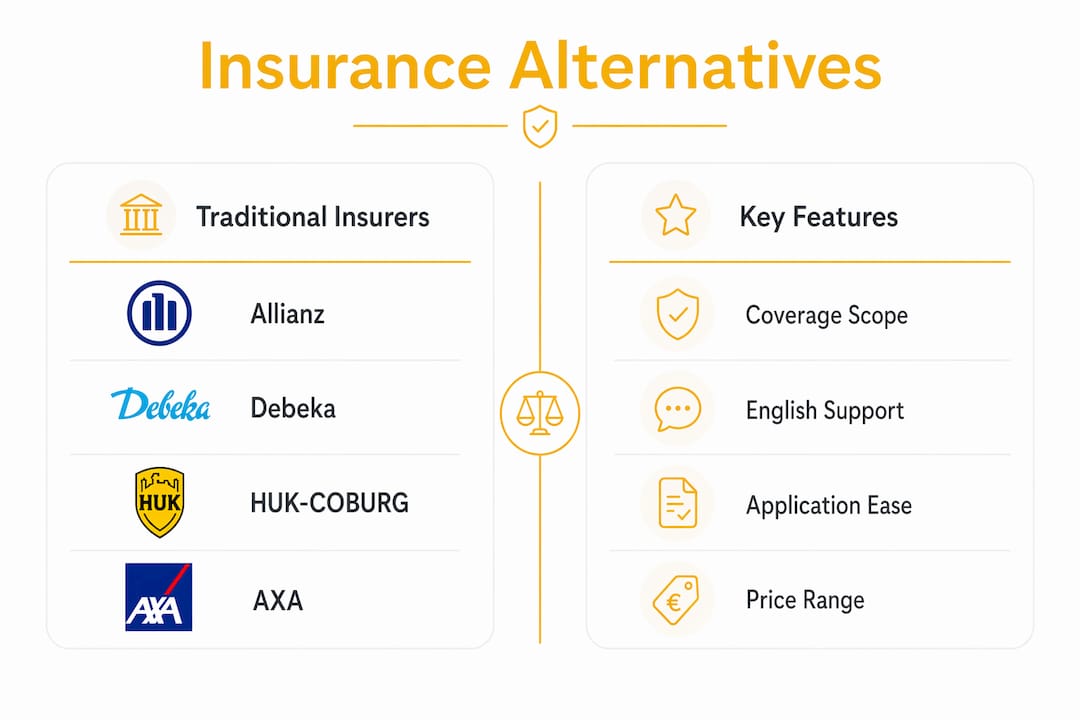
Here is a quick snapshot of how these options compare across the dimensions that matter most to expat professionals:
- Allianz Private Krankenversicherung: broad coverage, strong English support, recognized digital services, suited for long-term residents
- Debeka: Germany's largest private health insurer, permanent contracts, extensive network, preferred for stability
- HUK-COBURG Krankenversicherung: competitive pricing, straightforward application, progressive digital experience
- AXA Private Krankenversicherung: tailored packages, family inclusion options, chronic illness benefits, English customer service
Your choice ultimately depends on how long you plan to stay in Germany, whether you have a family, and how much you value digital convenience versus long-term contract security.
Notable private health insurance alternatives to ottonova.de
The four traditional insurers below each bring something distinct to the table. A side-by-side view helps clarify where they differ.
| Provider | Coverage scope | English support | Application complexity | Waiting times | Price range |
|---|---|---|---|---|---|
| Allianz Private Krankenversicherung | Broad, including specialist and dental | Yes, dedicated expat support | Moderate | Standard | Mid to high |
| Debeka | Extensive, permanent contract stability | Limited but available | Moderate | Standard | Mid range |
| HUK-COBURG Krankenversicherung | Solid core coverage | Available | Straightforward | Standard | Competitive |
| AXA Private Krankenversicherung | Broad, chronic illness and family options | Yes, international focus | Moderate | Standard | Mid to high |
Allianz Private Krankenversicherung
Allianz is one of the most recognized names in German private health insurance, and its expat-facing services reflect that scale. Coverage spans general practitioners, specialists, dental, and hospital care, with plan tiers that let you adjust your out-of-pocket contribution to bring premiums down. English-language customer support is available, which removes a real friction point for expats who are not yet fluent in German. The application process involves standard health underwriting, so pre-existing conditions will be assessed, but Allianz's breadth of plan options means there is usually a workable fit for most healthy professionals.

Debeka
Debeka is the largest private health insurer in Germany, and that scale translates directly into network depth and contract reliability. Notably, Ottonova is backed by Debeka, which tells you something about the parent company's standing. Debeka's own plans are built for permanence: once you are insured, your contract does not require re-underwriting if your residency status changes from temporary to permanent. For expats who arrive thinking they will stay two years and end up staying ten, that continuity is worth a great deal. English support is more limited than at Allianz or AXA, so working with an independent consultant helps here.
HUK-COBURG Krankenversicherung
HUK-COBURG sits at the more affordable end of the private market without sacrificing core coverage quality. The application process is generally considered straightforward compared to larger competitors, and the insurer has invested in digital tools that make policy management more accessible. If premium cost is a primary concern and your health profile is uncomplicated, HUK-COBURG deserves a close look. English support is available, though the depth of expat-specific guidance varies.
AXA Private Krankenversicherung
AXA's private health plans in Germany are built with international professionals in mind. Coverage packages often include benefits for chronic illness management and family members, which makes AXA a practical choice if you are relocating with a partner or children. English-language customer service is a genuine feature, not an afterthought. Premiums sit in the mid-to-high range, but the coverage breadth for complex health needs tends to justify the cost for expats with families or ongoing medical requirements.
How to choose the best private health insurance in Germany as an expat
Picking the right plan comes down to a handful of concrete factors, and getting them in the right order saves you from expensive mistakes later.
- Eligibility first: You qualify for private health insurance in Germany if you earn above the Jahresarbeitentgeltgrenze (JAEG), currently €77,400 annually, or if you are self-employed, a freelancer, or a doctor.
- Residency duration: If you plan to stay fewer than five years, a digital plan may cover your needs. Beyond five years, a permanent contract from a traditional insurer protects you from re-underwriting when your residency permit changes.
- Family situation: Plans vary significantly in how they handle dependents. AXA and Allianz both offer family inclusion; confirm the terms before you apply.
- Coverage needs: Review whether the plan covers your specific health requirements, including any pre-existing conditions, chronic illness management, dental, and mental health care.
- English support: Verify that the insurer offers genuine English-language service, not just a translated brochure. Ongoing claims and policy questions are where language barriers hurt most.
- Application complexity: All private insurers conduct health underwriting. Gather your medical history before you start, and be accurate. Omissions can void coverage later.
- Total cost: Monthly premiums are only part of the picture. Factor in deductibles, co-payments, and any benefit caps to understand your real annual exposure.
Pro Tip: Working with an independent health insurance consultant before you apply saves time and reduces the risk of choosing a plan that does not fit your long-term situation. Independent advisors compare across providers and have no incentive to push one insurer over another.
Common pitfalls expats face with private health insurance in Germany
The most costly mistake expats make is treating a short-term bridge plan as a long-term solution. Bridge plans, often offered by digital health insurance startups, are designed for stays of up to five years. They are useful for new arrivals who are still figuring out their plans, but they are not built for permanence.
- Bridge plans cap out: Startup expat plans are typically limited to five years. After that, you must transition to a different product, and if your health has changed, new underwriting could exclude conditions that developed during your bridge period.
- Residency status changes: When you move from a temporary to a permanent residency permit, a bridge plan may no longer apply. Traditional private insurers with permanent contracts handle this transition without requiring a new health assessment.
- Waiting times: Some plans impose waiting periods for specific treatments, including dental work, maternity care, and elective procedures. Read the fine print before you sign.
- Chronic condition coverage: Not all plans cover ongoing management of chronic conditions at the same level. If you have a pre-existing condition, confirm exactly what is and is not covered before committing.
- Cancellation restrictions: Private health insurance contracts in Germany typically require three months' notice before the end of the insurance year. Missing this window locks you in for another year.
For expats who arrived on a short-term plan and are now approaching the five-year mark, proactive planning for temporary health insurance transitions is the single most important step you can take right now.
What ottonova.de actually offers and where it fits
Ottonova launched in 2017 as Germany's first fully digital, English-language private health insurer. Its target audience is clear: employed expats earning above the JAEG threshold, freelancers, self-employed professionals, and doctors who want a low-friction, app-based insurance experience. The First Class Expats tariff is specifically designed for non-EU expats on limited residency permits, offering reduced rates for stays under five years.
The digital experience is genuinely strong. Applications, claims, and customer support all run through the app, and English is the default language throughout. Ottonova is backed by Debeka, which provides financial stability that a standalone startup would not have. For an expat without a family who plans to leave Germany within five years, Ottonova is a well-designed fit. The limitation is structural: it is a bridge product, not a permanent solution, and expats who stay longer will need to transition to one of Ottonova's other plan tiers or move to a traditional insurer.
How policy cancellation and switching works in Germany
Switching private health insurance in Germany is possible, but it carries real implications that catch many expats off guard. Private contracts generally require three months' written notice before the end of your insurance year. Miss that deadline and you are committed for another full year.
When you switch insurers, the new provider will conduct fresh health underwriting. Any conditions that developed since your original application will be assessed, and the new insurer can exclude them, charge higher premiums, or decline coverage altogether. This is why switching early in your stay, while you are healthy, carries far less risk than switching after several years. Expats on bridge plans approaching the five-year limit should begin the transition process at least six months in advance to avoid a coverage gap. For a detailed look at private health insurance options across providers, comparing terms before you commit is the clearest way to avoid a costly switch later.
What expat users say about these insurers
Expat feedback on German private health insurers tends to cluster around a few consistent themes: claims handling speed, English-language accessibility, and the ease of finding English-speaking doctors.
Ottonova receives strong marks for its digital experience and English support, with users frequently citing the app and the concierge service as standout features. The main criticism is the five-year cap on the expat tariff, which leaves longer-term residents needing to reassess their coverage.
Allianz and AXA draw positive feedback from expats who value coverage depth and the ability to include family members. Both are seen as reliable for complex claims, including specialist referrals and chronic condition management. The trade-off is a more traditional application process and, in some cases, less intuitive digital tools compared to Ottonova.
Debeka's reputation among expats centers on stability and network breadth. Expats who have been in Germany for several years and want a permanent contract without surprises tend to rate Debeka highly. HUK-COBURG earns consistent praise for competitive pricing, particularly from younger, healthier expats who want solid core coverage without paying for benefits they are unlikely to use. For a broader view of expat health insurance reviews across providers, independent comparison resources are more reliable than insurer-published materials.
Myhealthcarebroker helps you find the right plan without the guesswork
Comparing private health insurance across Allianz, Debeka, HUK-COBURG, AXA, and Ottonova is genuinely complex. Premiums, underwriting criteria, English support quality, and contract terms all vary in ways that a brochure comparison will not capture.
Myhealthcarebroker is an independent consultancy that works exclusively with expats and international professionals in Germany. As advisors not tied to any single insurer, the team compares plans across providers, checks your eligibility, and walks you through the application in plain English. Whether you are a freelancer weighing your first private plan or a long-term resident approaching the end of a bridge contract, Myhealthcarebroker offers the kind of personalized, jargon-free guidance that beats a generic comparison tool. Visit Myhealthcarebroker to start with a free eligibility check, or use the private insurance calculator to get a premium estimate before your first conversation.
Key Takeaways
For expats in Germany, the right private health insurance alternative to ottonova.de depends on residency duration, family situation, and whether you need a permanent contract or a short-term bridge plan.
| Point | Details |
|---|---|
| Ottonova suits short stays | The expat tariff is designed for non-EU professionals staying under five years; longer stays require a different plan. |
| Permanent contracts protect you | Traditional insurers like Debeka offer contracts that do not require re-underwriting when residency status changes. |
| English support varies | Allianz and AXA offer stronger English-language service than Debeka or HUK-COBURG for day-to-day queries. |
| Switching carries underwriting risk | New health conditions developed since your original application will be assessed if you switch insurers. |
| Myhealthcarebroker compares across providers | As an independent consultancy, Myhealthcarebroker checks eligibility and compares plans in clear English at no obligation. |