
If you carry private health insurance in Germany, you are legally required to hold private Pflegepflichtversicherung, and it only pays part of the bill when care becomes necessary. The statutory benefits are the same for everyone regardless of insurer, but they arrive largely as reimbursements, leaving a real out-of-pocket share (the Eigenanteil) once you factor in room, board, and extra staffing. There are statutory contribution caps too, so your premium will not rise without limit. If any of this feels unfamiliar, check your six-month provider-switch window and think seriously about a Pflegezusatzversicherung before you need one.
TL;DR:
- The private long-term care insurance in Germany only covers partial costs, leaving significant gaps especially for room, board, and private care hours.
- Premium caps, the Höchstbeiträge, limit how much your care insurance can cost, with specific rules for civil servants and households.
- Claiming benefits involves a medical assessment by Medicproof, with quick start options if hospital discharge occurs, emphasizing organized paperwork.
- Moving from statutory to private coverage alters payment models and long-term reserves, with benefits generally becoming more flexible but cash flow needs to be managed upfront.
- Exclusions include room and board costs, cosmetic modifications, and unlicensed informal care, making supplementary insurance essential for full coverage.
Table of Contents
- Who Needs Pflegepflichtversicherung PKV and When You Can Switch
- What Pflegepflichtversicherung PKV Actually Pays For
- How Contributions and the Höchstbeiträge Cap Work
- Getting a Pflegegrad Approved Through Medicproof
- Why Your Premium Stays Stable as You Age
- Closing the Pflegelücke: Realistic Ways to Cover the Gap
- How Providers Differ Even Within a Standardized System
- What Rights You Have as an Insured Person
- What Changes If You Move From Statutory to Private Cover
- Where Coverage Stops: Common Exclusions to Know
- The Mistake I See Most: Assuming the Basic Policy Is Enough
- Get Help Comparing Pflegepflichtversicherung PKV Options
- Sources
Who Needs Pflegepflichtversicherung PKV and When You Can Switch
Under Social Code Book XI (SGB XI), anyone holding private health insurance in Germany must also hold private long-term care insurance. There's no opt-out. The care policy usually starts automatically alongside your PKV contract, bundled with the same insurer.
You do get one meaningful choice: within the first six months of your health insurance contract, you have the legal right to pick a different insurer for your Pflegepflichtversicherung if you find better terms elsewhere. Every provider must offer identical statutory basic benefits, so this window is mostly about service quality and pricing on the supplementary side, not core coverage.
A few groups face variations worth flagging:
- Civil servants with Beihilfe typically insure only the percentage their employer's allowance doesn't cover, which lowers the private premium substantially.
- Voluntary members of the statutory system (GKV) stay in the social long-term care scheme rather than PKV.
- Cross-border residents should confirm with a private health insurance provider how German rules interact with any care insurance held abroad, since double coverage rarely makes sense.
What Pflegepflichtversicherung PKV Actually Pays For
The private Pflegepflichtversicherung is what Germans call a Teilleistungssystem, a partial-coverage system by design. It was never built to cover the full cost of care. It's built to soften it.
Benefits fall into a few main buckets: home care services (Pflegesachleistung), a cash benefit if a family member provides care instead (Pflegegeld), respite and short-term care, day and night care, and a fixed contribution toward residential nursing home costs. One structural quirk matters here: PKV usually works on reimbursement, meaning you pay the provider first and submit the bill afterward, unlike the statutory system's direct billing model.
Payment amounts scale with your Pflegegrad, the five-tier care-need classification that ranges from minor impairment (Grad 1) to the most severe (Grad 5). The benefits themselves are tax-free, whichever category applies to you.
The gap is the part nobody mentions upfront: nursing homes routinely charge €2,000 to €3,000 or more per month once you add room, board, and investment costs on top of care, and the statutory contribution rarely covers all of it. Common shortfalls include:
- Room and board charges in residential facilities
- Additional private care hours beyond the covered sachleistung limit
- Home modifications and equipment not fully reimbursed
This gap is precisely why Gesund for anyone who wants to avoid depleting savings later in life.
How Contributions and the Höchstbeiträge Cap Work
Unlike the statutory system, where care contributions scale directly with income, your private Pflegepflichtversicherung premium is priced the way the rest of your PKV is: based on your age and health status at entry, standardized across the industry by the PKV-Verband so every insurer applies comparable actuarial logic.
The law still puts a ceiling on what you can be charged. These statutory maximum contributions, the Höchstbeiträge, exist specifically so long-term care coverage never becomes the premium that breaks your budget. Stiftung Warentest publishes concrete cap figures each year, and special reduced caps apply for Beihilfe-eligible civil servants and for insured spouses.
A few mechanics worth knowing before you assume your premium is set in stone:
- New customers are typically underwritten under current health rules, while long-standing policyholders benefit from a legal cap that prevents unlimited premium growth as they age.
- Employees receive an employer contribution toward their care premium, mirroring the employer share paid on statutory health insurance, up to limits explained in consumer guidance.
- The cap applies per person, so households with more than one privately insured adult should check how the spousal reduction interacts with the individual ceiling; specific figures are available from consumer guides.
If your premium currently sits above what you'd expect for your age bracket, that's worth a direct comparison against the published Höchstbeiträge rather than an assumption that the number is fixed.
Getting a Pflegegrad Approved Through Medicproof
Filing a claim starts with a phone call or letter to your insurer, not a doctor's office. Your insurer then commissions Medicproof, the private-sector medical assessment service that plays the same role for PKV holders that the Medizinischer Dienst (MD) plays for statutory members.
- Submit a request to your insurer stating that you or a family member needs care support.
- Medicproof schedules an assessment, usually at home, evaluating mobility, cognition, self-care, and daily task management against the five Pflegegrad tiers.
- If you're hospitalized when the need arises, insurers can request a Vorabeinstufung, a provisional classification based on medical records alone, so short-term benefits can start before the formal home assessment happens after discharge.
- Your insurer issues a decision confirming your Pflegegrad and the benefits that follow.
Pro Tip: Keep discharge summaries and any hospital care notes organized from day one. A complete file speeds up the Vorabeinstufung and can mean payments start weeks earlier than waiting for a standard assessment slot.
Most delays trace back to incomplete paperwork rather than insurer slowness, so a clean, complete application is your best lever.
Why Your Premium Stays Stable as You Age
Private Pflegepflichtversicherung runs on Kapitaldeckung, capital-funded financing where part of every premium you pay while young and healthy gets set aside as an Alterungsrückstellung, an age reserve earmarked to offset the higher costs of insuring you later in life. The statutory system works the opposite way, on Umlage, a pay-as-you-go model where today's contributions fund today's payouts with no individual reserve behind them.
This distinction has real consequences. Because your reserves grow specifically for you, PKV premiums for long-term care tend to rise more gently in old age than they would under a system with no capital backing.
- Entering PKV earlier means more years for reserves to accumulate before you're likely to need care.
- Switching insurers can complicate how those reserves transfer, so review the terms carefully before moving providers.
- An Anwartschaft (a dormant policy option) can preserve your entry age and accumulated standing if you plan to leave Germany temporarily.
Pro Tip: If you're weighing a switch between private insurers for reasons unrelated to care coverage, ask specifically how your Alterungsrückstellungen are treated. Losing years of reserve buildup can outweigh a slightly lower premium elsewhere.
Closing the Pflegelücke: Realistic Ways to Cover the Gap
The mandatory policy was never meant to fund a full-time nursing home stay on its own, which is why the government's own consumer portal treats a Pflegezusatzversicherung as a standard planning step rather than an optional extra.
Two main product types dominate the market:
- Daily cash benefit plans (Pflegetagegeld) pay a fixed amount per day once a Pflegegrad is confirmed, regardless of your actual costs, giving you flexibility in how you spend it.
- Cost-covering plans (Pflegekostenversicherung) reimburse a percentage of documented expenses instead, which suits people who want the benefit to track real bills.
Beyond insurance, some households build earmarked savings or annuity-style products alongside a policy, spreading risk across more than one source. Before buying anything, run through this checklist: What triggers a payout, and at which Pflegegrad? Are there waiting periods before benefits start? Does the plan include inflation protection, so a fixed daily rate doesn't shrink in real terms over twenty years? And how has the insurer's premium history looked for existing policyholders? Our breakdown of Pflegezusatzversicherung options walks through these tradeoffs in more depth.
How Providers Differ Even Within a Standardized System
Every private Pflegepflichtversicherung provider must offer the same statutory basic benefits by law, so the coverage floor doesn't vary. What does vary is everything around it: claims handling speed, the quality of policyholder support during a Medicproof assessment, how transparently the insurer communicates premium changes, and whether Beihilfe-eligible civil servants get streamlined reduced-rate processing.
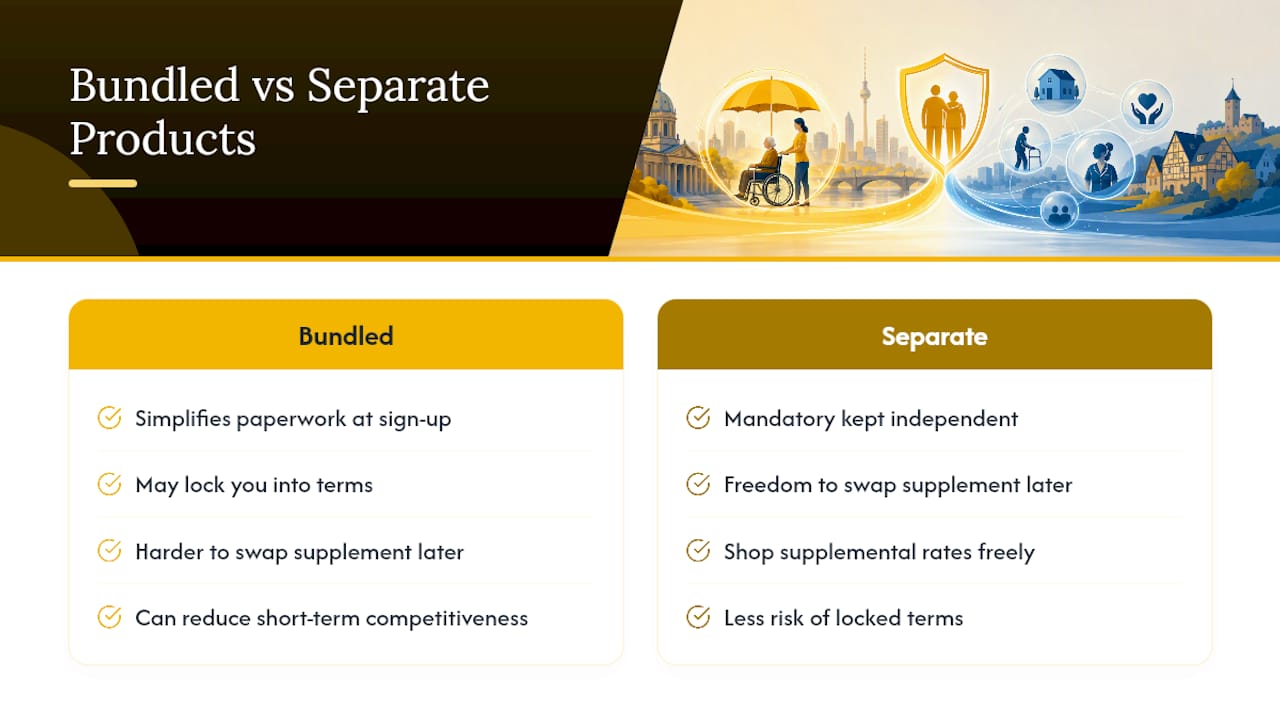
Some insurers bundle the mandatory care policy tightly with supplementary options at sign-up, which can simplify paperwork but sometimes locks you into less competitive terms than shopping the two separately. Others keep the mandatory and supplementary products fully independent, which gives you more freedom to swap the supplementary layer later without touching your core Pflegepflichtversicherung.
For expats and internationally mobile professionals specifically, provider differences often show up in language support and how well the insurer handles cross-border documentation. A German-only claims process is manageable when you're fluent, but far more frustrating when you're navigating Medicproof paperwork in a second language during an already stressful family situation.
Because switching your care insurer only happens easily within that first six-month window, the practical move is comparing providers before you sign, not after. A comparison of private health insurance companies in Germany gives you a starting reference point for how insurers differ on service and pricing structure beyond the statutory minimum, since the mandatory care benefit itself won't be the differentiator.
What Rights You Have as an Insured Person
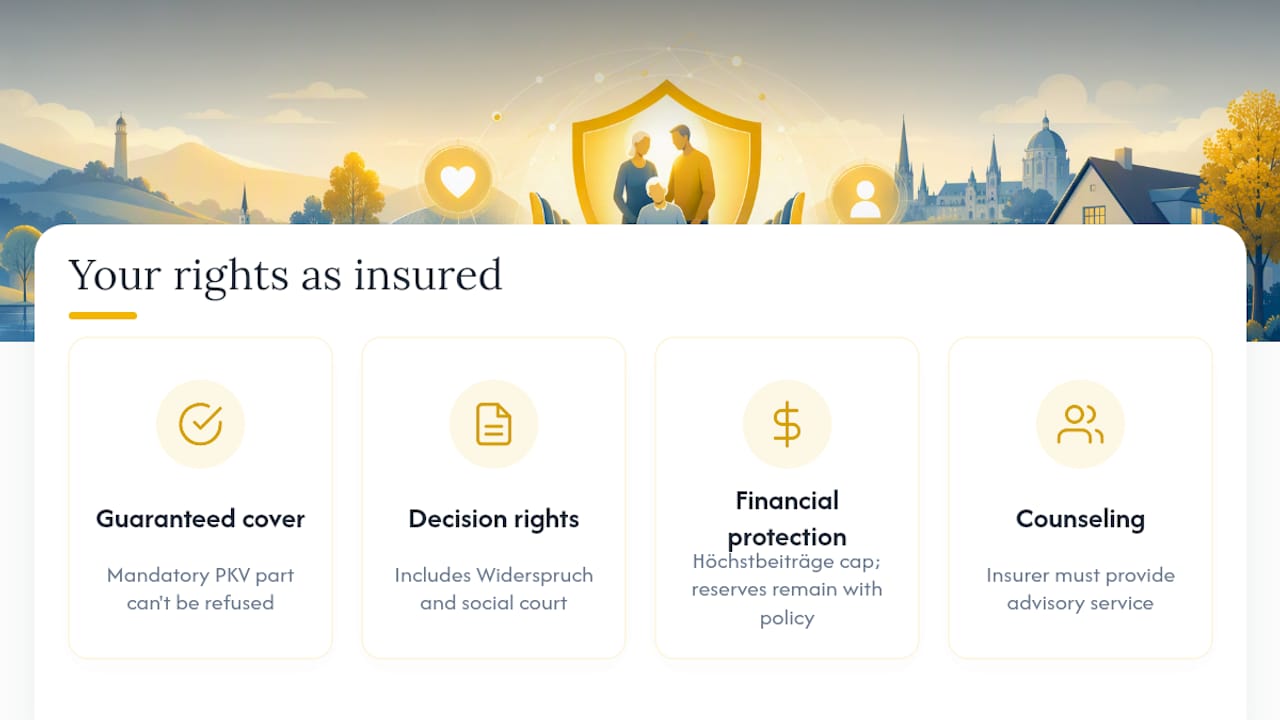
Your Pflegepflichtversicherung comes with legal protections you can lean on, not just obligations. The insurer cannot refuse to cover you for the mandatory portion based on pre-existing conditions the way some supplementary products can restrict eligibility. Coverage is guaranteed as part of your PKV contract, full stop.
You also have a right to a documented, reasoned decision if your insurer denies or downgrades a Pflegegrad claim following a Medicproof assessment. If you disagree with the outcome, you can request a review or pursue a formal objection (Widerspruch), and ultimately escalate to a social court if the disagreement persists, since long-term care disputes fall under the same judicial oversight as other social insurance matters.
The statutory contribution cap itself functions as consumer protection. Insurers cannot simply raise your Pflegepflichtversicherung premium without limit as you age; the Höchstbeiträge exist precisely to prevent that. Reserve treatment is protected too. Your Alterungsrückstellungen belong to your policy, and insurers must follow defined rules on how those reserves apply if you change tariffs within the same company.
One right that's easy to overlook: you're entitled to counseling support. Insurers must provide access to advisory services, similar in spirit to the statutory system's Compass counseling service, to help you understand your Pflegegrad options and benefit entitlements. Use it. It's part of what your premium already funds.
What Changes If You Move From Statutory to Private Cover
Switching from the statutory long-term care scheme into a private Pflegepflichtversicherung, typically because you've become eligible for PKV overall, changes more than which logo is on your card.
The benefit structure shifts from largely direct billing under the statutory model to the reimbursement approach common in PKV, where you often pay providers first and submit claims afterward. Budget for that cash-flow difference, particularly if a family member needs ongoing home care and the bills arrive monthly.
Your premium calculation changes fundamentally too. Statutory contributions are income-based; private contributions are based on your age and health at the point you join, then protected going forward by the Höchstbeiträge cap and by your growing Alterungsrückstellungen. For someone switching at a younger age, this often means a lower starting premium than the statutory system's income-linked rate, with the tradeoff of long-term reserve building instead of pooled risk.
There's a timing nuance too: benefit entitlement generally still requires a qualifying period of insurance, so if you've recently moved from statutory to private cover, confirm with your new insurer exactly how prior statutory membership counts toward that requirement before assuming you're covered from day one. This is exactly the kind of detail worth checking against a private health insurance guide rather than guessing.
Where Coverage Stops: Common Exclusions to Know
The Pflegepflichtversicherung is generous on structure but narrow on scope, and a few exclusion patterns catch people off guard.
Room and board in a nursing home are not covered by the mandatory benefit; only the care component is. That single fact explains most of the gap between what families expect and what actually arrives. Cosmetic or comfort-driven home modifications beyond what's medically necessary for care access typically fall outside the policy too, as do private-pay extras like a preferred single room in a facility versus a shared one.
Care provided informally by unlicensed helpers, rather than recognized care services or a documented family caregiver arrangement, generally won't qualify for reimbursement either. And benefits are capped at fixed monthly or per-service limits tied to your Pflegegrad, so intensive round-the-clock needs almost always exceed what the statutory tier pays, regardless of how severe the underlying condition is.
None of this is a flaw in the system. It's the tradeoff for keeping the mandatory premium affordable and capped for everyone, healthy or not, at the point of entry. The exclusions are exactly why a supplementary plan exists as a category in the first place, rather than being framed as gold-plating for the cautious.
The Mistake I See Most: Assuming the Basic Policy Is Enough
The recurring error isn't ignorance of the obligation. Privately insured clients know they need Pflegepflichtversicherung. What trips people up is assuming "insured" means "covered," when the reimbursement mechanics and the Eigenanteil gap tell a different story once a claim actually happens.
The fix is simple: confirm your six-month window early, request written proof of your Pflegepflichtversicherung status for your records, and price a Pflegezusatzversicherung while you're still young and healthy enough for it to be cheap. For Beihilfe-eligible civil servants especially, the reduced-rate math changes enough that it's worth a second look before you assume the standard figures apply to you.
— Marco
Get Help Comparing Pflegepflichtversicherung PKV Options
Sorting out Höchstbeiträge, Medicproof timelines, and Beihilfe eligibility in a foreign language is a lot to handle alongside your day job. There are services offering free, English-speaking eligibility checks and side-by-side plan comparisons across Germany's major private insurers, to help navigate German-only policy documents.
Beyond the mandatory Pflegepflichtversicherung itself, advisors can help you weigh supplementary Pflegezusatzversicherung options against your actual risk profile, interpret Medicproof outcomes, and support paperwork end to end, with fees typically paid by insurers rather than clients.
If you want a clear picture of your obligations and options, start with a private health insurance eligibility check and get a plan comparison built around your actual situation, not a generic template.
Sources
- So funktioniert die Pflegeversicherung — PKV Verband
- Die Pflegeversicherung — Bundesgesundheitsministerium (BMG)
- Gesund
- Test