
Crossing the 2026 Jahresarbeitsentgeltgrenze (JAEG) of 77,400 € a year makes you eligible to leave statutory health insurance and choose private cover, but only if your employer expects the higher income to continue. If you just got a raise that pushes you past that line, your first move is simple: confirm the annual figure with HR, then watch your mailbox for the notice from your Krankenkasse, because you'll have just two weeks to respond once it arrives.
TL;DR:
- If your salary exceeds 77,400 euros in 2026 and your employer expects this to continue, you become eligible to switch to private health insurance starting January 1 the following year.
- Progressing above the threshold depends on your income verification, which must be confirmed in writing by HR to avoid missing the two-week response window.
- Only recurring income components, such as regular salary and guaranteed bonuses, count toward the JAEG, while one-time bonuses or irregular payments do not.
- A salary raise that crosses the JAEG only affects your insurance status at the start of the next calendar year if you are already employed, not immediately.
- GKV contributions are capped at the contribution assessment ceiling, but PKV premiums depend on age, health, and coverage, often remaining stable despite salary increases.
Table of Contents
- What Is the Jahresarbeitsentgeltgrenze (JAEG) and What Are the 2026 Figures?
- How Does a Salary Increase Trigger Eligibility for PKV?
- Which Parts of Your Salary Actually Count Toward the JAEG?
- Your Step-by-Step Checklist After a Raise
- GKV Contributions vs. PKV Premiums: What Changes When You Earn More
- Special Cases: Self-Employed Income, Temporary Spikes, and Multiple Jobs
- How My Healthcare Broker Helps You Verify Eligibility
- What Employees Consistently Get Wrong About Timing
- Ready to Check Your Eligibility After a Raise?
- Sources
What Is the Jahresarbeitsentgeltgrenze (JAEG) and What Are the 2026 Figures?
The JAEG is the statutory income threshold that determines whether an employee must stay in Germany's public health insurance system or can opt into private coverage instead. Cross it, and the law no longer requires you to be insured through the Gesetzliche Krankenversicherung (GKV). Stay under it, and PKV generally isn't on the table as an employee.
For 2026, the numbers are set at:
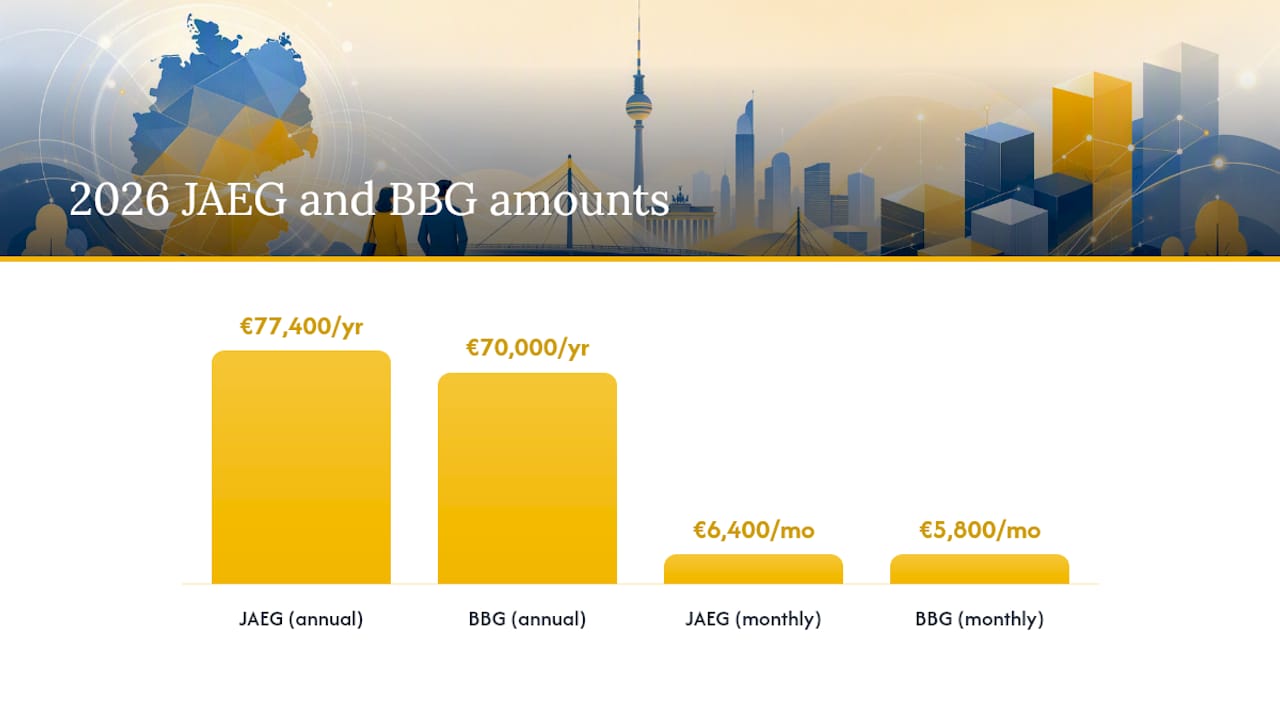
- JAEG (mandatory insurance threshold): approximately seventy-seven thousand euros per year or about six thousand four hundred euros per month
- Beitragsbemessungsgrenze (BBG, contribution assessment ceiling): around seventy thousand euros per year, or roughly five thousand eight hundred euros per month
Both figures come from the Bundesregierung's 2026 contribution ceiling announcement, and both move every year in line with wage growth across Germany. That annual adjustment matters more than most people realize. A salary that clears the JAEG comfortably this year might sit right at the edge next year if the threshold rises faster than your pay does. If you're planning a switch based on a raise that just barely gets you over the line, build in some margin, because the goalposts shift on January 1 each year, not on your work anniversary.
The JAEG and BBG serve different purposes even though they're often confused. The BBG caps how much of your income counts toward GKV contributions. The JAEG decides whether you're required to be in GKV at all. A high earner can sit above the BBG (paying capped contributions) while still being below the JAEG (still obligated to stay in public insurance) for years.
How Does a Salary Increase Trigger Eligibility for PKV?
Timing is where most employees trip up, and it isn't as simple as "get a raise, switch this week." The rule depends on whether you're already employed or starting a new job.
If you're already employed and your salary rises above the JAEG, insurance obligation doesn't end immediately. It ends at the close of the calendar year in which your income first exceeds the threshold, and you become eligible for PKV starting January 1 of the following year, provided your employer expects the higher income to continue, according to reporting on the threshold rules. A raise that takes effect in June still typically means your earliest exit date is the following New Year, not next month.
If you're starting a new job with a salary already above the JAEG, the calculation is different. You can be insurance-free from your very first day, because there's no need to wait for an annual reassessment. The employer's stated contract salary is used from the outset.
Once your Krankenkasse confirms you've crossed the threshold with expected continuation, here's the sequence that follows:
- Your GKV provider sends formal written notification that your insurance obligation is ending.
- You have exactly two weeks from that notice to declare whether you want to leave GKV voluntarily or continue as a voluntary member.
- If you miss the window, you're automatically enrolled as a voluntary GKV member, and the Bundesgesundheitsministerium's guidance on switching makes clear that voluntary membership carries longer notice periods and different cancellation timing, which can delay a future move to PKV by months.
Pro Tip: Mark the two-week deadline the moment the notice arrives, not when you get around to reading your mail. Krankenkassen count the window from the letter's date, not the day you open the envelope.
Which Parts of Your Salary Actually Count Toward the JAEG?
Not every euro on your payslip counts toward the threshold, and this trips up more employees than the timing rules do. The distinction is between income that's regular and predictable versus income that's occasional or one-time.
Components that typically count toward your JAEG calculation:
- Your base monthly salary
- Regularly paid vacation allowance (Urlaubsgeld) if it's contractually guaranteed
- Fixed, recurring bonuses that are part of your employment terms, such as a guaranteed 13th-month payment
Components that are usually excluded:
- One-off performance bonuses tied to a single project or year
- Occasional overtime pay that isn't contractually guaranteed
- One-time profit distributions or discretionary employer gifts
The Barmer's explanation of the JAEG confirms that only regularly recurring components are factored into the annual figure, and that irregular variable pay generally needs a track record of repetition before an insurer treats it as reliable income.
Your employer plays a central role here. HR is responsible for producing an income prognosis, essentially a forward-looking estimate of your annual earnings, which your health insurer then reviews. If that projection looks inflated by a one-time payment, expect your Krankenkasse to ask for clarification or reject it outright. Getting this projection right the first time saves weeks of back-and-forth later.

Your Step-by-Step Checklist After a Raise
Once you know your new salary clears the JAEG, the process runs in a specific order. Skipping a step or acting too early usually just means starting over.
Documents to gather first:
- Your three most recent payslips
- Your current employment contract, including any addendum reflecting the raise
- An employer declaration of expected annual income (your HR department typically issues this on request)
- Your most recent tax assessment, useful if you have side income or are partly self-employed
The sequence to follow:
- Verify with HR that your recurring income, not a one-time bonus, genuinely clears 77,400 € for the year.
- Wait for either your Krankenkasse's formal notification (existing job) or confirm your immediate eligibility with a new employment contract already above the threshold.
- Respond within the two-week opt-out window once the notice arrives; missing it defaults you into voluntary GKV membership.
- Apply to your chosen PKV provider, which will require a health declaration covering your medical history.
Pro Tip: Start comparing PKV tariffs before your two-week window opens, not after. Health insurers can take several days to process applications, and you don't want the clock on medical underwriting running out the same week your GKV deadline does.
If you're unsure whether your specific income mix qualifies, a private health insurance eligibility check can confirm it before you commit to anything with your employer or your Krankenkasse.
GKV Contributions vs. PKV Premiums: What Changes When You Earn More
This is where a salary increase creates a real fork in the road, because the two systems calculate cost in fundamentally different ways.
GKV contributions are percentage-based and capped. You and your employer split a contribution rate calculated as a percentage of your gross salary, up to the Beitragsbemessungsgrenze of 69,750 € per year in 2026. Earn more than that, and your GKV contribution doesn't rise any further, according to the Bundesregierung's contribution assessment guidance. In practice, this means employees already earning above the BBG but below the JAEG have hit their GKV cost ceiling; a raise changes their take-home pay but not their health insurance bill.
PKV premiums work on entirely different logic. Instead of a percentage of income, private insurers price your policy based on your age at entry, your health status, and the coverage level you select. Two people earning identical salaries can pay very different PKV premiums if one is 28 and healthy while the other is 45 with a pre-existing condition.
That structural difference is the real story behind "pkv bei gehaltssteigerung": a raise that pushes you over the JAEG doesn't raise your future PKV premium at all, since premiums are set independently of income. For a stable, high-earning employee, this often creates a long-term financial opening, since GKV contributions would have kept climbing (up to the cap) as a percentage of a rising salary, while a PKV premium locked in young stays comparatively steady, aside from standard age-related and healthcare-inflation adjustments.
A few things are worth weighing carefully before treating that as a clean win:
- Family coverage works differently. GKV covers a non-earning spouse and children for free; PKV typically requires a separate premium for each family member.
- Returning to GKV later gets structurally harder past age 55, according to Handelsblatt's analysis of long-term PKV and GKV trade-offs, so this is a decision to model over decades, not just your current pay bracket.
- Retirement affordability deserves early attention, since PKV premiums are typically higher in retirement when income drops but healthcare needs rise.
None of this makes PKV the wrong move for a high earner who just crossed the JAEG. It does mean the decision benefits from an actual comparison of statutory versus private health insurance rather than a snap judgment based on this year's paycheck alone.
Special Cases: Self-Employed Income, Temporary Spikes, and Multiple Jobs
The general JAEG rules assume one employer and one steady salary. Real income situations are often messier, and the treatment shifts accordingly.
- Self-employed people and freelancers aren't bound by the JAEG at all. They can choose PKV regardless of income level, since the threshold only applies to employees. If they opt for voluntary GKV membership instead, contributions are assessed on their entire economic capacity, not just one income stream, as outlined in the Verbraucherzentrale's guidance on voluntary GKV membership.
- Temporary salary spikes, like a single bumper year from a one-off project, generally don't create lasting JAEG eligibility. Insurers look at expected continuation, so a month or two above threshold without a corresponding contract change usually doesn't move the needle.
- Multiple jobs get combined for JAEG purposes. If you hold two part-time roles that together clear 77,400 € annually, that combined figure is what counts, not each job assessed separately, a principle consistent with how the GKV-Spitzenverband defines income for contribution assessment.
How My Healthcare Broker Helps You Verify Eligibility
Working through JAEG math, employer declarations, and Krankenkasse deadlines in a second language adds friction you don't need during a busy period at work. Myhealthcarebroker offers a free eligibility check that confirms whether your specific income, recurring components included, actually clears the 2026 threshold before you approach HR or your insurer.
Beyond the initial check, the private health insurance calculator lets you model tariff costs against your new salary, so you can see realistic premium ranges before committing. Myhealthcarebroker's advisors work entirely in English, which matters when you're trying to interpret a Krankenkasse notice correctly and respond inside a two-week window. Support continues past the application itself, covering document handling, timing the opt-out correctly, and selecting a tariff built for long-term affordability rather than just this year's premium.
What Employees Consistently Get Wrong About Timing
The mistake I see most often isn't misunderstanding the JAEG figure. It's acting on a raise that hasn't actually been confirmed in writing, then discovering the employer's official income declaration doesn't match the number a manager mentioned verbally. The second most common error is treating a strong bonus year as proof of crossing the threshold, when insurers specifically look for recurring pay.
The third, and most costly, is simply missing the two-week window. Once that passes, you're locked into voluntary GKV membership with longer notice periods, and unwinding that to reach PKV can take considerably longer than doing it right the first time.
My recommendation is straightforward: verify your recurring income projection with HR in writing before you tell your Krankenkasse anything, and think in decades, not just this year's paycheck, when you decide whether PKV fits your long-term plan.
— Marco
Ready to Check Your Eligibility After a Raise?
If your new salary has you wondering whether you actually qualify for private cover, guessing at the JAEG math yourself is the slow way to find out. Myhealthcarebroker's private health insurance calculator gives you a direct read on where your income lands and what tariffs might cost, in minutes rather than after weeks of back-and-forth with a Krankenkasse call center.
As an independent broker, Myhealthcarebroker isn't tied to any single insurer, so the comparison you get reflects your situation, not a sales quota. The eligibility check and application support are free to you, since compensation comes as a standard commission from the insurer once you sign up. If you'd rather talk through your specific numbers than run them yourself, book a free eligibility check and get English-language answers on whether now is the right moment to make the switch.
This article is general information, not a substitute for advice from a qualified doctor. Consult a qualified healthcare professional about your own circumstances before acting on anything here.
Sources
- Bundesregierung — Beitragsbemessungsgrenzen 2026
- FAZ — Grenze private Krankenversicherung (timing guidance)
- Bundesgesundheitsministerium — Wechsel zwischen GKV und PKV