
If you wear quality glasses in Germany and rely on statutory health insurance, you are covering most of the cost yourself. Since 2004, statutory insurers stopped reimbursing adult eyewear except in cases of severe vision impairment. That gap is exactly what premium private eyewear coverage fills. These supplementary plans, known in German as Brillenzusatzversicherung, go well beyond the basics: they cover designer frames, high-index lenses, anti-reflective and scratch-resistant coatings, and even laser eye surgery subsidies, often without requiring any medical justification for your choice of eyewear.
For professionals and expatriates in Germany, the practical upside is real. You choose the frames you want, submit your claim, and get reimbursed up to the plan's limit, according to the allowance and frequency of your plan tier. Luxury designer frames and custom lenses routinely cost more than €1,000, so the right plan can recover a meaningful share of that spend.
Key components typically covered under premium private optical plans:
- Designer and luxury frames, with no restriction to budget collections
- High-index lenses for stronger prescriptions
- Premium coatings: anti-reflective, scratch-resistant, and UV coatings
- Prescription sunglasses, often on the same benefit cycle as regular glasses
- Laser eye surgery, with one-time reimbursements under top-tier plans
- Repair or replacement costs due to breakage or theft
- Routine eye exams, depending on the plan tier
Myhealthcarebroker consultants work through these plan structures with clients daily, comparing tiers across insurers to match coverage to actual eyewear habits and budgets. The sections below cover the full picture: benefits, statutory comparisons, selection criteria, costs, the claim process, and how private insurers differ.

What benefits do premium private eyewear plans actually deliver?
The clearest advantage is claim flexibility. Premium plans allow claims without medical necessity, meaning you can choose luxury frames or high-end lens materials simply because you prefer them. Statutory insurance requires a clinical justification; premium plans do not.
- No medical necessity requirement: Personal preference is a valid reason to claim.
- Higher reimbursement limits: Top-tier plans reimburse up to €330 per benefit cycle, compared to minimal or zero statutory contributions for adults.
- Faster benefit cycles: Premium tiers often allow claims every 24 months, while some base tiers run on 36-month cycles.
- Lens coating coverage: High-index lenses and coatings such as anti-reflective and scratch-resistant layers are included, which statutory insurance rarely touches.
- Laser surgery subsidy: A one-time reimbursement of up to €1,000 for laser eye surgery is available under premium-tier plans.
- Breakage and theft protection: Many plans cover repair or replacement costs when glasses are damaged or stolen, protecting your investment in expensive eyewear.
- Prescription sunglasses: Some plans extend the same benefit cycle to prescription sunglasses, not just everyday glasses.
For expatriates whose vision tends to change with age or lifestyle, the combination of flexible claim triggers and broad product coverage makes these plans particularly practical.
How does premium coverage compare to statutory insurance in Germany?
Statutory health insurance (gesetzliche Krankenversicherung, or GKV) covers adult eyewear only in narrow circumstances, specifically for very high diopter values. For most adults, statutory coverage of glasses ended in 2004. Premium private plans operate on an entirely different basis.
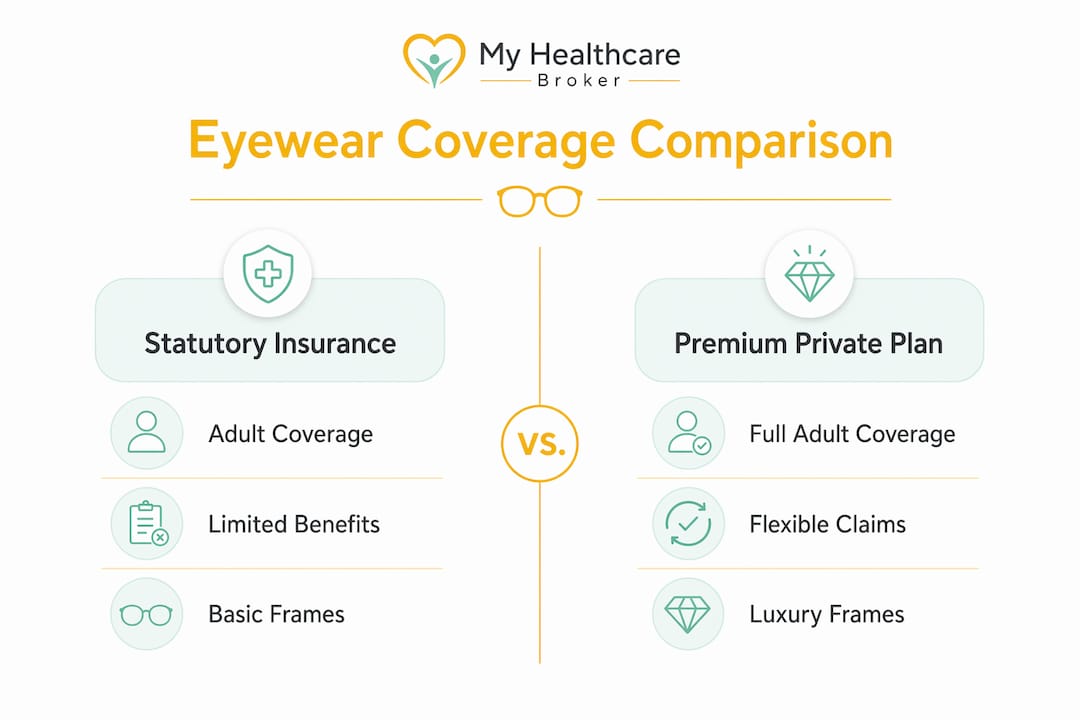
| Feature | Statutory insurance (GKV) | Premium private plan |
|---|---|---|
| Adult eyewear coverage | None, except severe impairment | Yes, routinely covered |
| Medical necessity required | Yes | No |
| Designer frames covered | No | Yes |
| High-index lenses covered | No | Yes |
| Lens coatings covered | No | Yes |
| Reimbursement limit | Minimal or zero for adults | Up to €330 per cycle |
| Claim frequency | N/A for most adults | Every 24–36 months |
| Laser eye surgery | Not covered | Up to €1,000 (one-time) |
| Prescription change clause | N/A | Claims allowed at 0.5 diopter change |
The prescription change clause deserves attention. Under premium plans, if your vision shifts by at least 0.5 diopters, you can claim a new pair before the standard benefit cycle resets. This flexibility matters for anyone whose prescription changes regularly. For a deeper look at how statutory and private vision aid coverage differ, the Sehhilfe expat guide from Myhealthcarebroker walks through the specifics in plain English.
How to choose the right premium optical coverage plan in Germany
Start with your actual eyewear spending. If you regularly buy frames above €300 or prefer progressive or high-index lenses, a base-tier plan with a €155 annual limit will not cover your costs. A Premium-tier plan with a €330 allowance every two to three years is a better fit.
- Assess your spending pattern: Luxury and designer frames often exceed €1,000 combined with lenses, so match the reimbursement ceiling to your real costs.
- Check the benefit cycle: A 24-month cycle suits people who update glasses frequently; a 36-month cycle costs less but reimburses less often.
- Review the prescription change clause: Plans that allow early claims at a 0.5-diopter change are especially useful for expatriates with evolving prescriptions.
- Confirm no medical necessity is required: Not every supplementary plan offers this; verify it explicitly before signing.
- Look for laser surgery coverage: If you are considering LASIK or a similar procedure, a plan with a one-time €1,000 subsidy can offset a significant portion of the cost.
- Evaluate the claim process: Some plans handle claims directly with the optician; others require you to pay upfront and submit receipts. Simpler is better.
- Consider bundled plans: Some insurers package eyewear coverage with dental or outpatient add-ons, which can reduce the overall premium.
Pro Tip: Working with an independent broker like Myhealthcarebroker means you are not limited to one insurer's tier structure. An independent consultant compares plans across providers and flags gaps you might miss, such as waiting periods that delay your first claim or exclusions on specific lens types.
Expatriates in particular benefit from this kind of guidance. German-language policy documents and insurer websites are not always straightforward, and a consultant who explains options in English saves time and prevents costly mismatches. You can explore private insurance options in Germany to get a clearer picture of how eyewear add-ons fit within a broader private health plan.
What do premium eyewear plans cost, and how much do they reimburse?
The reimbursement structure across plan tiers is fairly consistent across major German supplementary insurers. A Basis-tier plan typically reimburses 80% of remaining costs up to €155 per year. A Komfort plan covers 100% of remaining costs up to €175 every 24 months. A Premium-tier plan reimburses up to €330 every 24 to 36 months, or earlier if your prescription changes by at least 0.5 diopters.
Key cost and coverage points to keep in mind:
- Designer and luxury frames regularly exceed €1,000 when combined with quality lenses, so even a €330 reimbursement covers a meaningful portion of the total.
- Laser eye surgery carries a one-time reimbursement of up to €1,000 under premium-tier plans, but typically comes with a 36-month waiting period before you can claim it.
- Waiting periods on standard eyewear benefits vary. Some plans allow immediate claims; others impose a waiting period of several months after the policy start date.
- Lens coatings and special materials are included within the overall reimbursement ceiling, not as separate line items, so a high-cost lens package can consume the full allowance quickly.
- Prescription sunglasses are often covered within the same benefit cycle as regular glasses, which is useful if you wear both.
Industry analysts note that zero-tariff basic insurance models fail to cover the financial gap for anyone buying luxury or high-cost eyewear. If your glasses budget regularly runs above €500, a premium-tier plan pays for itself within the first benefit cycle.
How the claim process works for premium eyewear
The claim process under a private supplementary eyewear plan is generally straightforward, but the exact steps depend on your insurer and plan tier.
Most plans follow this sequence: you purchase your glasses or lenses, collect the itemized receipt from the optician, and submit it to your insurer along with a claim form. Some insurers accept digital submissions through an app or online portal; others still require paper. Reimbursement typically arrives within a few weeks of a complete submission.
A few details that trip people up. First, the receipt must be itemized. A single-line total is usually not enough; the insurer wants to see the frame cost, lens cost, and any coating charges listed separately. Second, if your plan requires a GKV pre-payment (meaning your statutory insurer must first confirm it will not contribute), confirm whether your premium plan waives this requirement. Many do, particularly at the Komfort and Premium tiers. Third, if you are claiming under a prescription change clause, you will need documentation from an ophthalmologist or optometrist confirming the diopter shift.
For laser eye surgery claims, the process is similar but requires the surgical invoice and, in most cases, a pre-authorization request before the procedure. Submit the request to your insurer before booking the surgery, not after.
How private insurers approach premium eyewear coverage in Germany
Private supplementary eyewear plans in Germany generally follow a tiered structure, with Basis, Komfort, and Premium levels offering progressively higher reimbursements and broader coverage. The key differences between insurers show up in the details: reimbursement ceilings, waiting periods, whether the GKV pre-payment requirement is waived, and what extras are bundled in.
Some plans are sold as standalone eyewear policies; others are packaged within broader outpatient or ambulatory supplementary plans. Bundled plans often deliver better value if you also want coverage for specialist visits or preventive care. Standalone eyewear policies are simpler and cheaper if glasses are your only concern.
Waiting periods vary. Some insurers impose a three-month waiting period before you can submit your first eyewear claim; others allow immediate claims from day one. For laser surgery, a 36-month waiting period is common across most premium-tier plans. Flexibility clauses tied to prescription changes are a standard feature at the Komfort and Premium levels, but the minimum diopter threshold (typically 0.5) and the documentation required can differ.
For expatriates navigating international health insurance options, it is worth confirming whether a German supplementary plan covers eyewear purchased abroad, since some plans restrict claims to German opticians. If you travel frequently or split time between countries, that restriction can limit the plan's practical value. Myhealthcarebroker can compare plans across private health insurance companies in Germany and flag these cross-border limitations before you commit.
Key Takeaways
Private supplementary eyewear coverage in Germany is the only practical route for adults who want reimbursement for quality frames, premium lenses, and laser surgery, since statutory insurance stopped covering adult eyewear in 2004.
| Point | Details |
|---|---|
| Statutory coverage ended for adults | Since 2004, GKV no longer reimburses eyewear for most adults, making private plans the only real option. |
| Premium-tier reimbursement | Top-tier plans cover up to €330 per benefit cycle, with claims allowed every 24–36 months. |
| No medical necessity required | Premium plans let you claim based on personal preference, not a clinical diagnosis. |
| Laser surgery subsidy available | One-time reimbursements of up to €1,000 for laser eye surgery are included in premium-tier plans. |
| Prescription change clause | A shift of at least 0.5 diopters allows an early claim before the standard benefit cycle resets. |