
Private Krankenversicherung (PKV) is Germany's private health insurance system, an individually underwritten alternative to the statutory public system (GKV) that offers broader coverage, faster specialist access, and premiums tied to your personal risk profile rather than your income. It tends to suit a specific type of person well.
Who PKV typically works for:
- Employees earning above the mandatory income threshold (the Jahresarbeitsentgeltgrenze, which adjusts annually) who want richer benefits and direct access to senior physicians
- Self-employed individuals and freelancers, who are not subject to mandatory GKV enrollment and must arrange their own coverage
- Civil servants (Beamte), who receive a government subsidy called Beihilfe that makes PKV significantly more affordable than GKV for their situation
When PKV is usually not the right fit:
- Workers with variable or uncertain income who may dip below the threshold
- People planning to start a family soon, since children are not automatically co-insured for free under PKV
- Those uncertain about staying in Germany long-term, given the difficulty of returning to GKV after a certain age
Not sure which category you fall into? An eligibility check takes minutes and gives you a clear answer before you commit to anything.
Key Takeaways
Private Krankenversicherung suits employees above the income threshold, the self-employed, and civil servants who want broader coverage, direct specialist access, and premiums that reflect their individual risk rather than their salary.
| Point | Details |
|---|---|
| Who PKV is for | Employees above the annual income threshold, self-employed individuals, and civil servants with Beihilfe entitlement |
| Entry age matters most | Entering PKV at —–— builds larger ageing reserves, which soften premium increases in later decades |
| Underwriting is real | Pre-existing conditions can lead to surcharges or exclusions; full disclosure on the health questionnaire is legally and practically critical |
| Returning to GKV is hard | Employees over 55 who have been privately insured face significant legal barriers to re-entering the statutory system |
| Myhealthcarebroker | Offers a free, independent eligibility check and tariff comparison in English, covering all major German private insurers |
This article is general information, not a substitute for advice from a qualified financial advisor. Consult a qualified financial professional about your own circumstances before acting on anything here.
Table of Contents
- What is private Krankenversicherung and how does it differ from GKV?
- Who can get private health insurance in Germany?
- What does PKV typically cover, and how do tariffs work?
- How PKV premiums are calculated, and what you can control
- Medical underwriting, pre-existing conditions, and waiting periods
- How to switch from GKV to PKV (and the traps when switching back)
- How to compare PKV tariffs practically
- Applying for PKV: documents, timeline, and what to expect
- How an independent broker helps you navigate PKV
- How PKV compares to supplementary private insurance added to GKV
- Myhealthcarebroker makes the PKV process straightforward
- Sources
What is private Krankenversicherung and how does it differ from GKV?
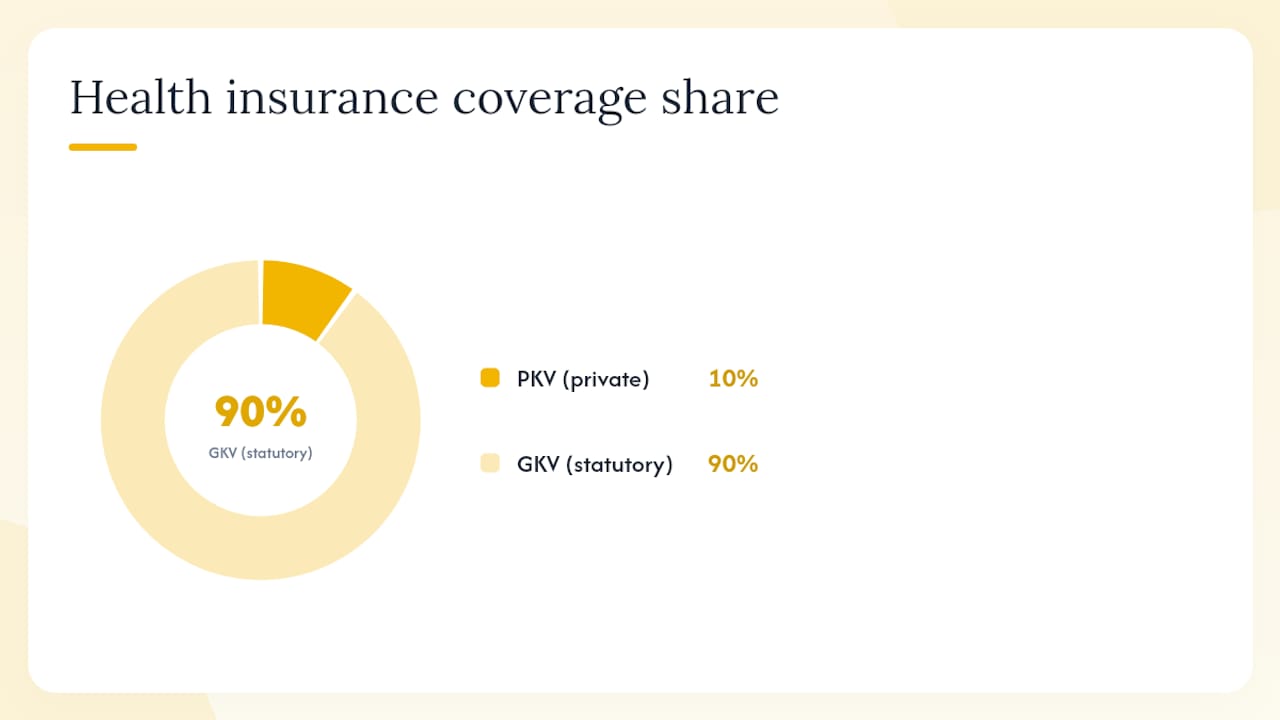
Germany runs a dual health insurance system. About ten percent of people in Germany are privately insured through PKV, while the majority are covered by the statutory GKV. The structural difference between the two goes deeper than just price.
Under GKV, your contribution is a percentage of your gross income, and the system pools risk across the entire insured population. Families are co-insured for free, and your premium has nothing to do with your health history. PKV works on the opposite principle: the equivalence principle, where your premium reflects your individual risk profile and the specific benefits you choose. A 28-year-old in good health pays far less than a 52-year-old with a chronic condition, even for the same tariff package. The Bundesgesundheitsministerium (BMG) explains this cost-reimbursement model in detail, including the social tariff safeguards (Basistarif and Standardtarif) that protect policyholders who can no longer afford standard premiums.
The billing model is also fundamentally different. In GKV, your insurer settles bills directly with contracted providers. In PKV, you typically pay the doctor or hospital yourself and then submit the invoice to your insurer for reimbursement. This gives you access to a wider range of providers, including those who do not hold a GKV contract, but it does require some cash-flow management.
| Feature | PKV (Private) | GKV (Statutory) |
|---|---|---|
| Premium basis | Individual risk and chosen benefits | Percentage of gross income |
| Family coverage | Each family member needs own policy | Spouse/children co-insured for free |
| Billing model | Cost reimbursement (you pay, then claim) | Direct billing between insurer and provider |
| Doctor access | Any licensed physician, including private-only | GKV-contracted providers primarily |
| Employer contribution | Fixed subsidy up to half the premium | Roughly half of total contribution |
Pro Tip: PKV makes the most financial sense when you have a stable, high income, no immediate serious health conditions, and a long-term horizon in Germany. Entering at 30 rather than 40 can save you a meaningful amount over the life of the policy, because ageing reserves built early soften premium increases later.
Who can get private health insurance in Germany?
Eligibility for PKV is not open to everyone. The PKV-Verband outlines the main groups who can opt out of GKV and choose private coverage.
Eligible groups:
- Employees above the income threshold: Once your gross annual salary exceeds the Jahresarbeitsentgeltgrenze for two consecutive years, you gain the right to switch. In 2026, this threshold sits at €73,800 per year. You must remain above it to stay eligible.
- Self-employed and freelancers: Not subject to mandatory GKV enrollment, so they can choose PKV from day one of self-employment.
- Civil servants (Beamte): Entitled to Beihilfe, a government subsidy covering a portion of medical costs (typically 50–70%, depending on family status). PKV is designed to complement Beihilfe, making it the standard choice for this group.
- Students: Can opt for private student tariffs under specific conditions, usually up to age 34 and within a defined study period. These tariffs are often priced well below standard PKV rates.
- Persons with special status: Some groups, such as judges, soldiers, and certain public-sector employees, have access to Beihilfe-like arrangements that make PKV the natural pairing.
Watch out for these eligibility traps:
- A temporary income spike (a bonus year, a short-term contract) does not automatically qualify you. The threshold must be met for two consecutive calendar years before you can switch.
- If you are on a fixed-term employment contract, consider whether your income will remain above the threshold when the contract ends or changes.
- Non-EU nationals on time-limited visas should weigh the long-term implications carefully. PKV is a long-term contract, and returning to GKV later in life is genuinely difficult.
Roughly ten percent of the German population holds PKV coverage, which reflects how selective the eligibility rules are. If you are an expat or international professional, Myhealthcarebroker's private health insurance guidance for Germany covers the foreign-national angle in plain English.
What does PKV typically cover, and how do tariffs work?
PKV tariffs are modular by design. You do not buy a single fixed product; you assemble a package from components, which means your coverage can be precisely matched to your actual health needs and budget.
The core components
Most PKV policies are built around three pillars: outpatient care (GP visits, specialist consultations, diagnostics), inpatient care (hospital stays, surgery), and dental care (check-ups, fillings, prosthetics). Each pillar has its own reimbursement level, and you can choose a higher or lower tier for each independently.
Optional add-ons and riders
Private insurers commonly offer a range of optional extras on top of the base package. Common additions include:
- Premium dental coverage: Higher reimbursement for crowns, implants, and orthodontics, often up to 90–100% of the GOZ (dental fee schedule)
- Private-ward inpatient options: Single or double room in hospital, plus treatment by the chief physician (Chefarzt)
- International emergency coverage: Useful for frequent travelers or those who spend time outside Germany
- Daily sickness benefit (Krankentagegeld): Particularly important for the self-employed, who have no employer to cover sick days
- No-claims refund or bonus schemes: Some tariffs return a portion of premiums if you make no claims in a given year
The Selbstbehalt (deductible) is another lever. Choosing a higher annual deductible lowers your monthly premium, sometimes substantially. This works well if you are generally healthy and want to reduce routine costs while keeping catastrophic coverage intact. You can read more about what PKV typically covers on Myhealthcarebroker's dedicated coverage page.
Pro Tip: If you visit the dentist regularly or anticipate significant dental work, upgrading the dental component of your tariff is almost always worth the extra monthly cost. The GOZ fee schedule allows dentists to charge multiples of the base rate, and without strong dental coverage, a single implant can cost you several thousand euros out of pocket.
How PKV premiums are calculated, and what you can control
PKV premiums are not arbitrary. They follow a defined actuarial logic, and once you understand the main drivers, you can make choices that meaningfully reduce your starting premium and long-term cost.
The main premium drivers
- Entry age: The single biggest factor. Younger entrants pay lower premiums and build larger ageing reserves, which smooth costs over time.
- Health status at application: Insurers review your medical history. Pre-existing conditions can lead to surcharges, exclusions, or in some cases rejection from standard tariffs.
- Chosen benefit level: A tariff with a private ward, 100% dental reimbursement, and no deductible costs significantly more than a leaner package.
- Deductible (Selbstbehalt): Higher deductibles reduce monthly premiums. A €600 annual deductible, for example, can cut your premium noticeably.
- Occupation: Some occupations carry higher risk classifications, which affects pricing.
Ageing reserves (Alterungsrückstellungen)
This is the mechanism that separates PKV from most other insurance products. Because medical costs rise with age, PKV insurers are legally required to build reserves during your younger, healthier years. These Alterungsrückstellungen are invested and drawn down later to offset the higher claims costs of older age, preventing premiums from rising as steeply as they otherwise would. The BMG confirms that insurers can adjust premiums when actual claims deviate substantially from tariff assumptions, but only with certification from an independent trustee. This regulatory check limits arbitrary increases.

Illustrative premium ranges by entry age
The figures below are illustrative only, based on a comparable mid-range benefit package for a healthy individual with no pre-existing conditions. Actual premiums vary by insurer, tariff, and health profile.
The earlier you enter PKV, the more ageing reserves you accumulate, and the more those reserves soften premium increases in your 60s and 70s. Entry age and your chosen deductible are among the biggest levers you can actually control.
Use Myhealthcarebroker's private health insurance calculator to get a personalized estimate based on your age, health profile, and preferred benefit level.
Medical underwriting, pre-existing conditions, and waiting periods
Applying for PKV is not like signing up for a gym membership. Insurers assess your health before they offer you a contract, and the outcome of that assessment shapes your policy terms for years.
How the underwriting process works
Every applicant completes a detailed health questionnaire covering the past five to ten years of medical history, depending on the insurer. Common questions cover chronic conditions, surgeries, medications, mental health treatment, and ongoing specialist care. Based on your answers, the insurer may:
- Accept you at standard rates (the best outcome)
- Apply a risk surcharge on your premium for a specific condition
- Exclude a condition permanently from coverage (e.g., a pre-existing back condition may be excluded from all future back-related claims)
- Impose a waiting period before certain benefits become active
- Decline the application for standard tariffs, though the Basistarif must still be offered under defined conditions
Legal protections and the Basistarif
German law requires every PKV insurer to offer a Basistarif (basic tariff) to eligible applicants who cannot obtain standard coverage. The Basistarif premium is capped at the maximum GKV contribution, and those who qualify as financially needy may pay half that rate. The Standardtarif is a separate, older protection available to long-term PKV policyholders under specific conditions. These safeguards mean that being declined for a standard tariff does not leave you without options, but the Basistarif offers more limited benefits than a standard PKV package.
What insurers may not do:
- Rescind a policy retroactively for undisclosed conditions unless the non-disclosure was intentional or grossly negligent
- Charge unlimited surcharges without actuarial justification
Pro Tip: Disclose everything on your health questionnaire, even conditions that feel minor or resolved. An undisclosed condition discovered at claims time can lead to benefit denial or, in serious cases, policy rescission. Keep copies of all medical records before you apply, and if you are unsure whether something is reportable, ask a broker before submitting.
How to switch from GKV to PKV (and the traps when switching back)
Switching from statutory to private insurance is a one-way door for many people. The steps are manageable, but the long-term consequences deserve careful thought.
Steps to switch from GKV to PKV
- Verify eligibility. Confirm that your gross annual salary has exceeded the Jahresarbeitsentgeltgrenze for two consecutive years, or that you qualify through self-employment or civil-servant status.
- Compare PKV tariffs. Use a broker or comparison tool to identify tariffs that match your health needs and budget. Do not apply to multiple insurers simultaneously without guidance, as multiple health questionnaires can create a paper trail that complicates underwriting.
- Submit your PKV application. Complete the health questionnaire fully and accurately. Provide supporting medical documents if requested.
- Notify your GKV insurer. Once you have written confirmation of PKV acceptance, give your statutory insurer the required notice period (usually two months to the end of a calendar month).
- Inform your employer. Your employer will adjust their contribution to the PKV subsidy, which is capped at half your premium up to a statutory maximum.
- Confirm the start date. Make sure there is no gap between your GKV end date and your PKV start date.
The difficulty of returning to GKV
This is where many people underestimate the stakes. Once you leave GKV and are no longer subject to mandatory GKV enrollment (for example, because your income stays above the threshold or you remain self-employed), returning to GKV is legally restricted. Employees over 55 who want to return to GKV face particular barriers, as the law generally prevents re-entry once you have been privately insured past that age. Exceptions exist for specific life events, such as losing employment or income dropping below the threshold, but these windows are narrow and time-sensitive. Myhealthcarebroker's page on switching from public to private insurance covers the timing rules in detail.
Red flags to watch before switching:
- A temporary contract that may not be renewed at the same salary
- Plans to have children in the next few years (each child needs a separate PKV policy)
- Uncertainty about remaining in Germany beyond five to ten years
How to compare PKV tariffs practically
Comparing PKV tariffs is not like comparing mobile phone plans. The differences between tariffs are often buried in the AVB (Allgemeine Versicherungsbedingungen, or general terms), and a lower premium can hide significant gaps in coverage. Myhealthcarebroker's PKV comparison guide walks through the process step by step.
Key comparison criteria
- Reimbursement rates: What percentage of the GOÄ (medical fee schedule) or GOZ (dental fee schedule) does the tariff cover? Some tariffs cap at 2x the base rate; others go to 3.5x.
- Inpatient room class: Single room, double room, or general ward? Chief physician treatment included?
- Dental limits: Annual cap on dental reimbursement, and whether implants and orthodontics are covered.
- Waiting periods: Are there standard waiting periods for certain services (often three to eight months for dental prosthetics)?
- International coverage: Emergency-only, or full coverage abroad?
- Deductible structure: Annual Selbstbehalt amount and how it interacts with no-claims bonuses.
- Premium adjustment history: How has this insurer's tariff adjusted premiums over the past five to ten years? A low starting premium that jumps 15% every three years is not a bargain.
- Ageing reserve handling: Is the reserve portable if you switch insurers?
Questions to ask your insurer or broker
- What is the reimbursement rate for specialist consultations billed above the 2.3x GOÄ multiplier?
- Is alternative medicine (homeopathy, osteopathy, acupuncture) covered, and to what annual limit?
- How are mental health treatments handled, and is there a session cap?
- What is the process for pre-authorizing expensive treatments?
- Can I adjust my deductible or benefit level later without new underwriting?
- What has been the average annual premium increase for this tariff over the past five years?
Pro Tip: Ask specifically about premium adjustment history for the exact tariff you are considering, not just the insurer's general track record. A well-managed insurer can still have one poorly priced tariff that has required repeated corrections.
Applying for PKV: documents, timeline, and what to expect
A well-prepared application moves faster and reduces the chance of underwriting delays. Most applicants who are organized can complete the process within two to four weeks.
Documents you will typically need
- Valid ID or passport (plus residence permit for non-EU nationals)
- Proof of income: Recent payslips (usually the last three months) or, for the self-employed, a tax assessment notice (Einkommensteuerbescheid)
- Previous insurance statement: A Versicherungsbescheinigung from your current GKV insurer confirming your coverage period
- Medical history records: Relevant specialist reports, discharge summaries, or prescription records for any conditions you disclose on the health questionnaire
- Beihilfe notification letter (for civil servants), confirming your Beihilfe percentage
- Employment contract or confirmation showing your salary and contract type
Typical timeline
Applications with straightforward health histories are usually decided within one to two weeks. If the insurer requests additional medical reports or clarifications, the process can extend to four to six weeks. Once you receive written acceptance, you have a defined window to notify your GKV insurer and confirm your start date with your employer.
Practical tips for a smooth application:
- Gather all medical records before you start filling out the health questionnaire, so you can answer accurately without guessing
- Confirm your employer's process for adjusting the subsidy contribution, as some HR departments need several weeks' notice
- Do not cancel your GKV coverage until you have written PKV acceptance in hand
How an independent broker helps you navigate PKV
Navigating PKV alone, in German, is genuinely difficult. The AVB documents run to dozens of pages, tariff differences are subtle, and the underwriting process has real consequences if handled poorly. An independent broker changes the dynamic considerably.
What a broker does for you
- Eligibility check: Confirms whether you qualify for PKV based on your employment status, income, and residency situation
- Tariff comparison across insurers: An independent broker is not tied to one insurer, so the comparison reflects the actual market rather than a single product lineup
- Health questionnaire guidance: Helps you understand what to disclose and how to present your medical history accurately, reducing the risk of underwriting surprises
- Translation and explanation of AVB: German insurance terms are dense; a broker explains what the clauses actually mean in practice
- Application support: Manages the paperwork, coordinates with the insurer, and tracks the timeline
- Ongoing claims support: If a claim is disputed or a reimbursement is delayed, a broker can intervene on your behalf
Myhealthcarebroker provides all of these services in English, which removes the language barrier that trips up most expats at the research stage. Their English-language comparison resources cover the major German private insurers and help you understand the differences before you speak to anyone. The service is free to you as the client; Myhealthcarebroker receives a regulated commission from the insurer when a policy is placed.
A typical client scenario: an expat software engineer earning above the threshold, new to Germany, and unsure whether their disclosed anxiety treatment from three years ago would affect underwriting. With broker support, the health history was presented clearly, the insurer applied a modest surcharge rather than an exclusion, and the client started PKV coverage within three weeks of first contact. That kind of outcome is hard to replicate without someone who knows both the insurers and the process.
How PKV compares to supplementary private insurance added to GKV
Not everyone who wants better coverage needs to leave GKV entirely. A hybrid approach, staying in GKV and adding supplementary private insurance (Zusatzversicherung), is worth understanding as an alternative.
Supplementary policies can add private dental coverage, a private hospital room, or outpatient extras on top of your GKV baseline. They do not require the same income threshold as full PKV, and they are available to anyone in GKV. The trade-off is that you do not get the full PKV experience: you still operate within the GKV billing framework for most services, and the combined cost of GKV contributions plus Zusatzversicherung premiums can approach full PKV costs for higher earners.
For employees just below the income threshold, or those who want better dental coverage without the commitment of a full PKV switch, supplementary insurance is a practical middle ground. For employees well above the threshold with stable long-term plans in Germany, full PKV typically offers better value and broader access. The public vs. private health insurance comparison on Myhealthcarebroker's site breaks down the cost math for both scenarios.
Myhealthcarebroker makes the PKV process straightforward
Choosing PKV is one of the most consequential financial decisions you will make as a resident in Germany, and the German-language paperwork, actuarial jargon, and underwriting process are genuinely intimidating without support.
Myhealthcarebroker is an independent consultancy, not tied to any single insurer, which means the comparison you get reflects the real market. The service covers the full process: a free eligibility check, tariff comparison across all major German private insurers, health questionnaire guidance, application management, and ongoing support after your policy starts. Everything is handled in English. The service costs you nothing; Myhealthcarebroker receives a fixed, regulated commission from the insurer when your policy is placed.
What you get:
- A clear eligibility verdict based on your actual situation
- A side-by-side comparison of tariffs that fit your health profile and budget
- Plain-English explanations of AVB clauses that matter
- Application support from submission to coverage start
Whether you are a salaried employee above the income threshold, a freelancer arranging coverage for the first time, or a civil servant pairing PKV with Beihilfe, the private health insurance service is built for your situation. Start with the eligibility check to find out where you stand.
One thing I always tell clients before their first eligibility call
The single most useful thing you can do before speaking with a broker is to pull together a simple list of any medical treatments, prescriptions, or specialist visits from the past five years. You do not need formal records at this stage, just a rough chronology. That list makes the health questionnaire conversation far more productive and reduces the chance of an underwriting surprise later.
Timing matters too. If you are approaching the income threshold for the first time, do not wait until January to start the process. Applications take time, and a policy that starts on February 1 rather than January 1 costs you a month of GKV contributions you did not need to pay.
Sources
When you need to verify rules, check premium caps, or understand your legal rights as a PKV policyholder, these are the sources worth bookmarking.
Pro Tip: For Basistarif details and premium caps, go directly to the BMG page rather than relying on insurer marketing materials. The BMG page states the statutory limits clearly, and knowing the cap before you speak to an insurer puts you in a stronger position.