
Health and long-term care insurance is legally mandatory for every resident in Germany, including the self-employed. Your two practical routes are statutory public insurance (GKV, gesetzliche Krankenversicherung) or private health insurance (PKV, private Krankenversicherung). The single most consequential difference: as a self-employed person, you pay the full contribution yourself with no employer sharing the cost. That changes the math considerably compared to salaried life.
Here is what to do right now:
- Confirm whether your income level and prior insurance history make you eligible for PKV.
- Gather your most recent Einkommensteuerbescheid (income tax assessment) — every insurer will ask for it.
- Get an independent eligibility check from an English-speaking advisor before making any irreversible decisions.
Pro Tip: Do not assume you can switch back to GKV later. Once you move to PKV, returning to the statutory system is restricted and often impossible after a certain age or if your income drops. Treat this as a long-term commitment from day one.
Table of Contents
- What should you check and arrange right now?
- GKV vs. PKV: how do the two systems actually work for you?
- Who can actually choose PKV as a self-employed person?
- What other protections do self-employed people need?
- What should you budget for, and how long does the process take?
- How do you decide between GKV and PKV?
- Myhealthcarebroker makes the process clear and manageable
- Key Takeaways
- Why an English broker changes the outcome for most expats
- Trusted sources and official pages to check next
What should you check and arrange right now?
Before you pick a plan or sign anything, run through this checklist. Gaps in coverage can have legal and financial consequences, and some mistakes cannot be undone.
- Residency registration: Confirm your Anmeldung is current. Insurance enrollment requires a registered German address.
- Prior insurance status: Were you in a statutory fund before going self-employed? That history affects your GKV eligibility window and PKV access.
- Income documentation: Locate your most recent Einkommensteuerbescheid. If you are newly self-employed and do not have one yet, you can submit an income estimate to your insurer.
- Previous insurance proof: Any insurer will want a certificate of prior coverage (Versicherungsnachweis) to avoid gaps or retroactive charges.
- Health declarations: PKV applications require a medical questionnaire. Pre-existing conditions can lead to exclusions or premium surcharges, so gather relevant medical records early.
- Temporary cover: If you are switching funds or waiting for PKV underwriting approval, ask about short-term bridging options. Some GKV funds allow provisional enrollment while your application is processed.
Pro Tip: If you are a newly arrived expat needing cover for a visa application, check the German visa insurance requirements before committing to a long-term plan. Visa-compliant cover and long-term optimal cover are not always the same product.
GKV vs. PKV: how do the two systems actually work for you?
The structural differences between the two systems matter far more for self-employed people than for employees. Here is the core of it.

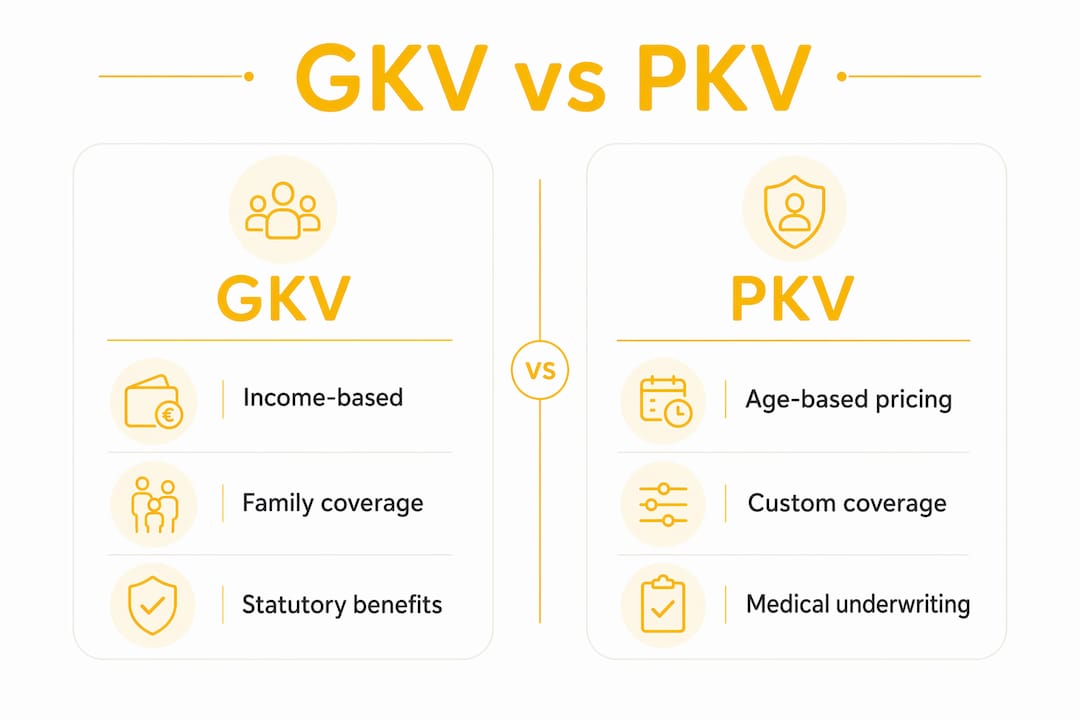
GKV (statutory insurance) calculates your monthly contribution as a percentage of your declared income. BARMER's contribution rates for self-employed members include a base percentage plus an additional contribution. Contributions are calculated on income within set minimum and maximum monthly bases. Critically, GKV covers non-earning family members at no additional cost — your spouse and children are included in your single contribution.
PKV (private insurance) prices premiums by your age at entry, your health status, and the coverage level you choose. Family members are not included; each person needs a separate policy. Underwriting happens upfront, meaning pre-existing conditions can result in exclusions or higher premiums. Younger, healthier entrants can lock in lower initial rates, but premiums tend to rise with age and require lifetime-cost planning.
| Factor | GKV | PKV |
|---|---|---|
| Contribution basis | Percentage of declared income | Age, health, coverage tier |
| Family coverage | Included at no extra cost | Separate premium per person |
| Sick pay | Optional tariff available | Depends on plan |
| Switching back | Possible under conditions | Restricted; often impossible |
| Underwriting | None | Required at application |
For a self-employed person with dependents, GKV's family coverage is a significant financial advantage. For a healthy, younger freelancer without dependents and a high income, PKV can offer broader benefits at a comparable or lower cost. The IHK Berlin guidance is direct on one point: switching back from PKV to GKV is difficult and may be impossible depending on your age and circumstances.
Who can actually choose PKV as a self-employed person?
Eligibility for PKV is not automatic, and the rules differ from those that apply to employees.
For employees, the standard route into PKV requires earning above an annual income threshold, which is updated regularly by authorities. For the self-employed, the rules work differently: you are generally free to choose PKV regardless of income, provided you were not previously a compulsory GKV member. If you were in statutory insurance as an employee before going self-employed, there is a limited window to opt out.
Special categories worth knowing:
- Artists and publicists covered by the Künstlersozialkasse (KSK) have specific GKV contribution rules and may have restricted PKV access.
- Civil servants (Beamte) are traditionally PKV customers due to the Beihilfe subsidy system.
- Expats with prior EU statutory coverage may have different transition rights depending on their home country's bilateral agreements with Germany.
Choosing PKV as a self-employed person is often irreversible. The income threshold that governs employee eligibility does not apply to you in the same way, but your prior insurance history does. If you were in GKV as an employee and recently became self-employed, you typically have a short window to decide. Missing it can lock you into GKV for years.
Pro Tip: Record the exact date your employment ended and your self-employment began. Insurers and the statutory system use these dates to determine your eligibility window. A missed deadline is not recoverable.
What other protections do self-employed people need?
Health insurance is the legal floor, not the full picture. Without an employer, you have no sick pay, no accident coverage, and no occupational disability protection unless you arrange it yourself.
- Long-term care insurance (Pflegeversicherung): Mandatory alongside health insurance. GKV membership automatically includes it; PKV members must purchase a separate private care policy.
- Occupational disability insurance (Berufsunfähigkeitsversicherung, BU): Arguably the most critical protection for self-employed people. If illness or injury prevents you from working in your specific profession, BU pays a monthly benefit. This is not the same as sick pay, which only covers short-term incapacity.
- Professional liability (Berufshaftpflicht): For consultants, IT professionals, lawyers, architects, and many other freelance professions, professional liability is either legally required or commercially essential. A single client claim can exceed years of premium costs.
- Business liability (Betriebshaftpflicht): Covers third-party property damage or personal injury arising from your business activities.
- Voluntary unemployment insurance: Self-employed people can opt into the statutory unemployment system (freiwillige Arbeitslosenversicherung) within the first few years of self-employment. The window is limited, and professional advice strongly recommends evaluating it early.
The self-employed carry the full cost of their own social protection. Budgeting only for health insurance and ignoring disability and liability cover is one of the most common and costly mistakes freelancers make in Germany.
What should you budget for, and how long does the process take?
Cost depends heavily on which system you choose and your personal profile.
For GKV, your monthly contribution scales with your declared income, subject to the minimum and maximum bases. Fail to submit an updated Einkommensteuerbescheid and your fund may retroactively adjust your contributions when the new assessment arrives.
For PKV, brokers and guides typically cite planning ranges: basic plans often start around €350–€550 per month, comfort plans range from about €450–€700, and premium options are commonly between €550–€900 monthly. Actual costs depend on individual factors and insurer quotes. These are planning references, not guarantees; your actual quote depends on age, health, and the specific insurer.
Health insurance premiums for self-employed people in PKV are generally tax-deductible up to the statutory equivalent contribution level (Basisabsicherung). Additional voluntary benefits above that threshold may not be deductible. A tax advisor (Steuerberater) can confirm what applies to your specific situation and income structure.
On timing: getting GKV quotes and enrolling can take one to two weeks if your documents are in order. PKV underwriting typically takes two to six weeks, depending on your health history and the insurer's workload. Factor in additional time if you need to obtain medical records or if the insurer requests further information. For freelancers switching between systems, the termination notice period for your current insurer also applies, usually two months to the end of a calendar year.
How do you decide between GKV and PKV?
Work through these decision anchors before requesting quotes.
Start here:
- Do you have a spouse or children who need coverage? GKV's free family inclusion may outweigh PKV's benefit advantages.
- What is your age and current health status? PKV premiums are set at entry and rise with age; entering at 45 versus 30 produces very different lifetime costs.
- Is your income stable or variable? GKV adjusts with income; PKV does not drop when income falls.
- Do you plan to stay in Germany long-term, or might you leave within a few years? Switching systems mid-career is costly and restricted.
- Do you have pre-existing conditions? PKV underwriting may exclude them or add surcharges.
Questions to ask any insurer or broker:
- What is covered for inpatient versus outpatient treatment, and are specialist visits covered without a GP referral?
- How are premiums adjusted over time, and what triggers a rate increase?
- What dental coverage is included, and what are the annual limits?
- Is there a reimbursement model (you pay first, then claim) or direct billing?
- What are the switching constraints if my circumstances change?
Red flags to watch for:
- Vague or broad exclusion clauses in the policy wording
- Retroactive underwriting clauses that allow the insurer to revisit your health declaration after a claim
- Unclear premium adjustment rules with no cap or escalation limit
When your situation involves dependents, health conditions, high income, or uncertainty about long-term plans in Germany, professional advice pays for itself. An independent broker can run a side-by-side comparison across multiple PKV providers and flag risks that a direct insurer's sales team will not volunteer.
Myhealthcarebroker makes the process clear and manageable
Navigating German insurance as an English-speaking self-employed person means dealing with German-language documents, complex eligibility rules, and decisions that can follow you for decades. Myhealthcarebroker offers a practical alternative: independent, English-language advisory from consultants who are not tied to any single insurer.
The service covers eligibility checks, side-by-side plan comparisons across PKV providers, full application management, and ongoing support after you are enrolled. For self-employed clients, that includes guidance on which insurance costs are likely deductible and how to document them correctly for your tax return. Myhealthcarebroker also publishes up-to-date guidance on the 2027 health insurance reform for self-employed people, so you are not caught off guard by regulatory changes that affect your contributions or eligibility.
The starting point is simple: run an eligibility check to confirm which system you can access, then request a comparison. Have your passport, Anmeldung, most recent tax assessment, and prior insurance certificate ready. The complete English guide on the Myhealthcarebroker site walks you through every step.
Key Takeaways
For self-employed people in Germany, the choice between GKV and PKV is long-term and often irreversible, making an independent eligibility check the single most important first step.
| Point | Details |
|---|---|
| Insurance is mandatory | Health and long-term care insurance is legally required for all residents, including the self-employed. |
| Two routes, different logic | GKV scales with income and covers family for free; PKV is priced by age and health with no free family inclusion. |
| Full cost falls on you | Self-employed people pay the entire contribution with no employer share, making long-term cost forecasting critical. |
| PKV switching is restricted | Moving from PKV back to GKV is difficult and often impossible after certain ages or career changes. |
| Myhealthcarebroker | Provides independent English-language eligibility checks, plan comparisons, and application support for self-employed expats in Germany. |
Why an English broker changes the outcome for most expats
The conventional wisdom is that you can research German health insurance yourself, compare a few PKV quotes online, and make a reasonable decision. For a small number of cases, that is true: a healthy, single freelancer in their late twenties with stable income and no pre-existing conditions can often navigate the basics independently.
But most self-employed expats I speak with are not in that situation. They have variable income, a partner who may or may not be working, health history that needs careful disclosure, and genuine uncertainty about whether they will stay in Germany for five years or fifteen. Those variables interact in ways that a comparison website cannot resolve. A PKV plan that looks affordable at 35 can become a serious financial burden at 55 if premiums escalate and income drops. GKV can look expensive now but protect you against exactly that scenario.
The mistakes that cost people the most are not the ones made from ignorance of the options. They are the ones made from misunderstanding the timing rules: missing the window to opt out of GKV after becoming self-employed, or entering PKV without understanding that a future return to employment may not restore GKV access. These are not edge cases. They are common, and they are avoidable with the right advice at the right moment.
DIY comparison works when the situation is genuinely simple. When it is not, the cost of getting it wrong over a decade of premiums far exceeds the cost of an hour with an independent advisor.
Trusted sources and official pages to check next
Use these resources to verify current thresholds, contribution rates, and eligibility rules before making final decisions. Figures change annually, and the 2027 reform will affect self-employed contribution rules specifically.
| Resource | What it covers |
|---|---|
| BARMER: health insurance for self-employed | GKV contribution rates, minimum/maximum income bases, sick pay options |
| BARMER: private vs. public comparison | PKV vs. GKV overview including the income threshold context |
| IHK Berlin: insurance for the self-employed | GKV/PKV options and switching restrictions explained |
| Myhealthcarebroker: eligibility check | Interactive check to confirm PKV or GKV eligibility in English |
| Myhealthcarebroker: 2027 reform guide | Up-to-date guidance on upcoming regulatory changes for self-employed people |
Before acting on any threshold or rate you read online, verify it against the official insurer or government source for the current year. Contribution rates, income limits, and reform implementation dates are updated regularly, and the difference between last year's figure and this year's can affect your eligibility or your monthly cost.
This article is general information, not professional legal, tax, or insurance advice. Confirm current rules and thresholds with a qualified advisor or the relevant official authority for your specific situation.