
Tariff levels in private health insurance Germany are predefined coverage tiers that determine both the scope of medical benefits and the monthly premium a policyholder pays. The German private insurance system, known as PKV (private Krankenversicherung), organizes these tiers into three broad categories: Basic, Standard, and Comfort or Premium. Each tier carries distinct benefit packages, cost structures, and legal protections. Professionals earning above the 2026 eligibility threshold of €77,400 annually can access PKV, and the tariff level they choose at entry shapes their coverage for years. Myhealthcarebroker helps English-speaking professionals cut through the complexity and select the tier that fits their actual situation.
What are the main tariff levels in private insurance Germany?
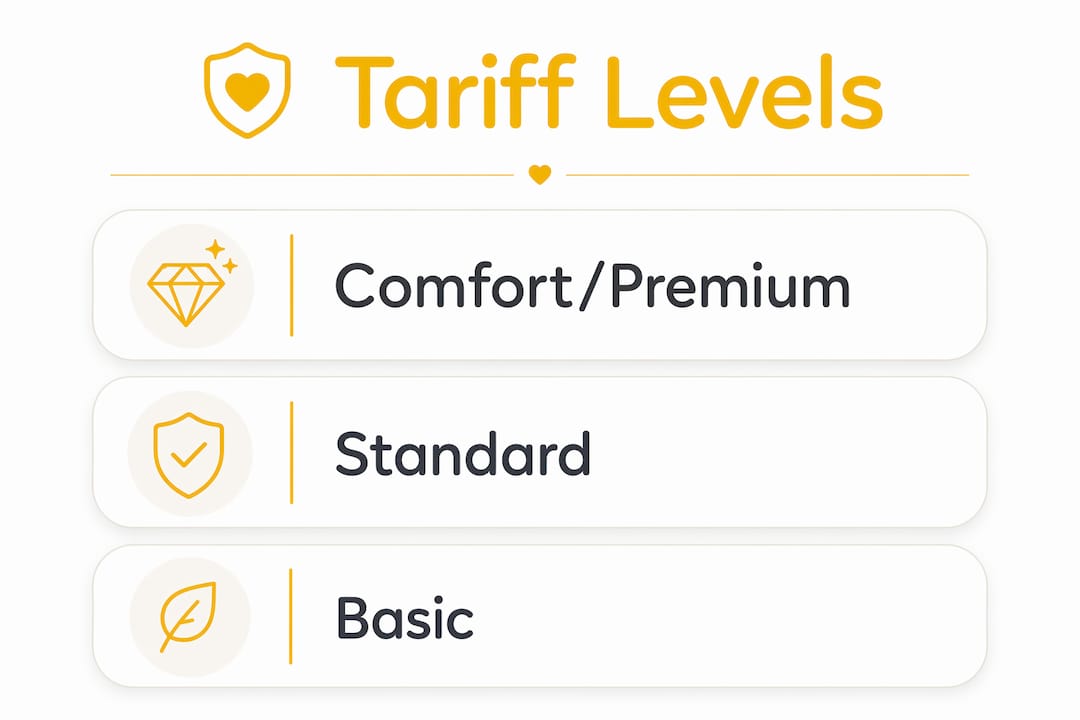
Private health insurance tariffs in Germany fall into three core tiers, each with a distinct benefit scope and price point.

Basic tariff is the floor of the system. It offers statutory-equivalent benefits and functions as an emergency coverage option for people who cannot maintain a higher tier. Premiums are capped at the maximum public insurance contribution, making it the most affordable PKV option. The trade-off is limited benefit flexibility and no access to premium services.
Standard tariff sits in the middle. It delivers stable, mid-level coverage with defined benefit categories, including outpatient care, inpatient treatment in shared rooms, and standard physician billing. Restrictions apply to certain specialist treatments, and the tariff operates under fixed regulatory rules that limit how much insurers can adjust benefits. This tier suits professionals who want predictable costs without sacrificing core medical access.
Comfort and Premium tariffs are where PKV separates itself from public insurance. These tiers typically include:
- Single-room hospital accommodation
- Chief physician treatment (Chefarztbehandlung)
- Broader dental coverage, including high-value prosthetics
- Faster specialist access with no referral requirement
- Analog billing coverage for procedures not explicitly listed in standard fee schedules
Analog billing deserves special attention. It protects policyholders when doctors bill for newer treatments using codes from comparable, listed procedures. Without this feature, those costs fall entirely on the patient.
Pro Tip: When comparing Comfort and Premium tariffs, check whether analog billing is explicitly included. Many professionals overlook this and face unexpected bills for modern diagnostic procedures.
Tariff selection is not infinitely flexible. Age at entry, health status at application, and the insurer's internal tariff catalog all constrain which tiers are available. Switching to a higher tier later typically requires new health underwriting, which can result in exclusions or surcharges.
| Tariff tier | Typical benefits | Best suited for |
|---|---|---|
| Basic | Statutory-equivalent, emergency coverage | Those unable to afford higher tiers |
| Standard | Mid-level inpatient and outpatient care | Cost-conscious professionals |
| Comfort/Premium | Single room, chief physician, analog billing | High earners seeking full coverage |
How have private insurance tariff premiums evolved in 2026?
Premium increases in 2026 have been significant across all PKV tiers. Standard tariff premiums rose by an average of 11.5% in july 2026, with individual cases reaching increases of up to 18%. That scale of adjustment is not a one-off anomaly. It reflects rising healthcare costs, an aging insured population, and updated actuarial assumptions across the industry.
The 2026 income threshold for private insurance eligibility rose by 4.9% to €6,450 per month, or €77,400 annually. This means more employees now qualify for PKV, but it also signals that the system is recalibrating its financial base.
Several factors drive individual premium levels within each tariff tier:
- Age at entry. Younger entry ages lock in lower base premiums and allow more time to build age reserves.
- Health status at application. Pre-existing conditions lead to surcharges or benefit exclusions.
- Tariff scope. A Comfort tariff with single-room hospital coverage costs substantially more than a Standard tariff with shared-room accommodation.
- Deductible level. Higher annual deductibles directly reduce monthly premiums.
- Daily sickness allowance (Krankentagegeld). Adding income protection for illness days increases the total premium.
The deductible lever is particularly powerful. Selecting a deductible between €500 and €1,500 reduces monthly premiums by 15–20%, saving €720 to €960 annually. For a professional paying €400 per month in PKV premiums, that is a meaningful reduction without changing the core benefit structure.
What strategic options exist for optimizing premiums through tariff selection?
The most underused tool in PKV cost management is the legal right to switch tariffs within the same insurer. Under § 204 VVG, policyholders can move to a different tariff within their existing company without submitting to a new health examination. Crucially, all accrued age reserves transfer with the switch. Those reserves function like a pension fund within the insurance contract. Losing them by switching to a new insurer is a significant financial setback that many professionals do not realize until it is too late.
Here are the most effective steps for managing tariff costs strategically:
- Request a free tariff comparison from your insurer. Insurers are legally required to advise policyholders free of charge and compare cheaper tariffs within the same company. This obligation exists to prevent overpayment.
- Raise your annual deductible. Moving from a €500 to a €1,500 deductible cuts premiums by 15–20% without changing your core benefit package.
- Review your tariff before adjustment dates. Timing medical expenses ahead of fixed adjustment dates, such as july 1st, reduces out-of-pocket costs in Standard tariffs where deductibles and treatment catalogs reset.
- Evaluate analog billing inclusion. Confirm that your tariff covers analog billing before committing. Removing this feature to save on premiums can cost far more in uncovered treatment bills.
- Avoid tariffs with inflexible benefit structures. Private insurance flexibility comes from choosing between radically different tariffs, not from adjusting individual benefits within one. Pick a tier that fits your current life stage, not just your current budget.
Pro Tip: If your insurer has not proactively offered a tariff review in the past two years, request one in writing. The legal obligation to advise you exists regardless of whether the insurer initiates the conversation.
A common mistake is treating tariff switching as a last resort. Professionals who review their tariff annually, especially after major life changes like marriage, children, or income shifts, consistently pay less over a 10-year period than those who set their tariff at entry and never revisit it.
How do private tariff levels compare with public health insurance for professionals?
The fundamental difference between PKV and public insurance (GKV) is how premiums are calculated. Private insurance bases premiums on personal risk factors and tariff scope. Public insurance uses a fixed percentage of gross salary, with the employer covering roughly half. That structural difference has major long-term implications.
For a high-earning single professional, PKV almost always delivers better value. The premium is fixed to the tariff, not to income growth. A professional earning €100,000 annually pays the same PKV premium as one earning €120,000 in the same tariff. In GKV, the higher earner pays more, with no additional benefit.
The calculus shifts for families and those with variable income:
- GKV allows free co-insurance for non-earning spouses and children. PKV requires a separate premium for each family member.
- GKV premiums are predictable as a salary percentage. PKV premiums can rise with age and healthcare cost inflation.
- Self-employed professionals with steady income benefit most from PKV. Those with irregular income face premium obligations during low-earning periods without employer support.
Suitability also depends on long-term plans. Returning to GKV from PKV after age 55 is legally difficult and financially costly. Professionals who anticipate career changes, extended parental leave, or early retirement should factor that into their public vs. private decision before switching to PKV.
Public insurance suits families and those with unstable income. Private insurance best fits high-earning singles or self-employed professionals with steady revenue. That is not a generalization. It is the structural reality of how both systems calculate and distribute risk.
Key Takeaways
Choosing the right tariff level in German private health insurance requires understanding both the benefit structure and the long-term cost mechanics, including legal switching rights under § 204 VVG and the impact of deductibles on monthly premiums.
| Point | Details |
|---|---|
| Three core tariff tiers | Basic, Standard, and Comfort/Premium each offer distinct benefits and price points. |
| 2026 premium increases | Standard tariff premiums rose an average of 11.5%, with some cases reaching 18%. |
| Deductible impact | Raising the annual deductible to €1,500 cuts monthly premiums by 15–20%, saving up to €960 per year. |
| § 204 VVG switching rights | Policyholders can switch tariffs within the same insurer without a new health exam or losing age reserves. |
| PKV vs. GKV suitability | Private insurance suits high-earning singles; public insurance suits families or those with variable income. |
Why I think most professionals get their tariff decision wrong
Most professionals I speak with made their tariff choice once, at the point of switching to PKV, and never revisited it. That is the single most expensive mistake in private health insurance management.
The § 204 VVG right to switch tariffs within the same insurer is genuinely powerful. It preserves age reserves, requires no new health underwriting, and can reduce premiums substantially. Yet most policyholders do not know it exists until they are already paying too much. Insurers are legally obligated to advise on cheaper internal tariffs, but they rarely volunteer that conversation.
The other factor I see professionals consistently underestimate is analog billing. It sounds technical, but the practical consequence is simple. Without it, your insurer can decline to cover a treatment your doctor bills using a comparable procedure code. That gap shows up as a surprise invoice, often for several hundred euros.
My honest recommendation is to treat your tariff like a financial product, not a set-and-forget insurance policy. Review it every two years, request a written tariff comparison from your insurer, and check whether your deductible still makes sense given your current health usage. The professionals who do this consistently pay less and get more from their coverage. Those who do not often discover the gap only when they need to make a claim.
— Marco
How Myhealthcarebroker helps you choose the right tariff
Choosing between tariff tiers is not a one-size-fits-all decision. The right level depends on your age, health history, family situation, and income trajectory.
Myhealthcarebroker compares private health insurance companies across Germany as an independent broker, with no tie to any single insurer. The team provides tariff-level analysis in plain English, walks you through deductible scenarios, and explains your § 204 VVG switching rights before you commit to anything. Use the private health insurance calculator to get a real premium estimate based on your tariff preferences and personal profile. From eligibility check to final application, Myhealthcarebroker handles the process in English, start to finish.
FAQ
What are the tariff levels in German private health insurance?
German private health insurance (PKV) has three main tariff levels: Basic, Standard, and Comfort or Premium. Each tier offers a different scope of medical benefits and carries a corresponding premium level.
What is the standard tariff in private insurance Germany?
The standard tariff is a regulated mid-level PKV tier with defined inpatient and outpatient benefits. Premiums in this tier rose by an average of 11.5% in july 2026, with some increases reaching 18%.
Can I switch tariff levels without a new health exam?
Yes. Under § 204 VVG, policyholders can switch to a different tariff within the same insurer without a new health examination, and all accrued age reserves transfer with the switch.
How does raising my deductible affect my premium?
Selecting an annual deductible between €500 and €1,500 reduces monthly premiums by 15–20%, which translates to savings of €720 to €960 per year.
Who qualifies for private health insurance in Germany in 2026?
Employees earning above €77,400 annually (€6,450 per month) qualify to opt into PKV in 2026. Self-employed professionals and civil servants (Beamte) can join PKV regardless of income level.