
With an open referral policy, your GP refers you to a specialist type rather than a named doctor. The insurer then steps in, offering you a shortlist of two or three approved consultants who meet their criteria for clinical quality, location, and agreed fees. That single shift in how referrals work sits at the heart of what is open referral private insurance, and it has real consequences for your choice, your continuity of care, and what you pay each month.
Open referral is now standard across major UK private medical insurers. Bupa pioneered the system in January 2012 for large corporate clients, and Aviva and AXA PPP followed. Together, those three insurers hold over 78% of the UK private medical insurance market by subscription income, so the odds are good that any policy you consider today includes some form of open referral.
Key facts at a glance:
- Your GP writes a referral specifying the specialty, not a consultant's name.
- The insurer provides a shortlist, typically two or three consultants.
- All shortlisted consultants are fee-assured, meaning no unexpected out-of-pocket costs.
- Policies with open referral typically cost less than full-choice plans.
Table of Contents
- How does open referral work in private insurance?
- Open referral vs. named consultant referral: what changes for you?
- Why do insurers use open referral policies?
- Pros and cons of open referral for patients and consultants
- Legal and regulatory considerations for open referral policies
- How to handle disputes over open referral decisions
- Open referral in practice: how it plays out in real policies
- What the data says about open referral's real impact
- Myhealthcarebroker helps you compare plans with clear, unbiased advice
- Key Takeaways
How does open referral work in private insurance?
The process starts at your GP's office. Instead of writing "please refer to Dr. Smith," your GP writes a referral specifying the specialty needed, say, orthopedics or cardiology. You then contact your insurer, who searches their approved network and comes back with a shortlist.

Insurers select consultants based on three main criteria: clinical outcomes, patient feedback, and whether the consultant has agreed to the insurer's fee schedule. That last point matters. Fee-assured consultants agree to cover consultations, tests, and surgeries within the insurer's pricing structure, so you face no shortfall billing.
How the process typically unfolds:
- GP issues an open referral naming the specialty required.
- You call or log in to your insurer's portal to request a shortlist.
- Insurer returns two or three consultants matched to your clinical need and location.
- You choose from the shortlist and book directly.
- All costs are covered within your policy limits, with no balance billing.
One practical upside: open referral pathways often lead to faster bookings because the insurer coordinates scheduling within their network, rather than leaving you to chase a specific consultant's availability independently.
Open referral vs. named consultant referral: what changes for you?
The core difference is who controls the choice of specialist. Under a named consultant referral, your GP or you select a specific doctor by name. Under open referral, the insurer filters that choice first.
| Factor | Open referral | Named consultant referral |
|---|---|---|
| Speed of treatment | Generally faster via insurer coordination | Depends on named consultant's availability |
| Choice of consultants | Insurer shortlist of two or three | Patient or GP selects freely |
| Cost implications | lower premiums; no shortfalls | Higher premiums; possible balance billing |
| Patient autonomy | Limited to approved network | Full choice within policy coverage |
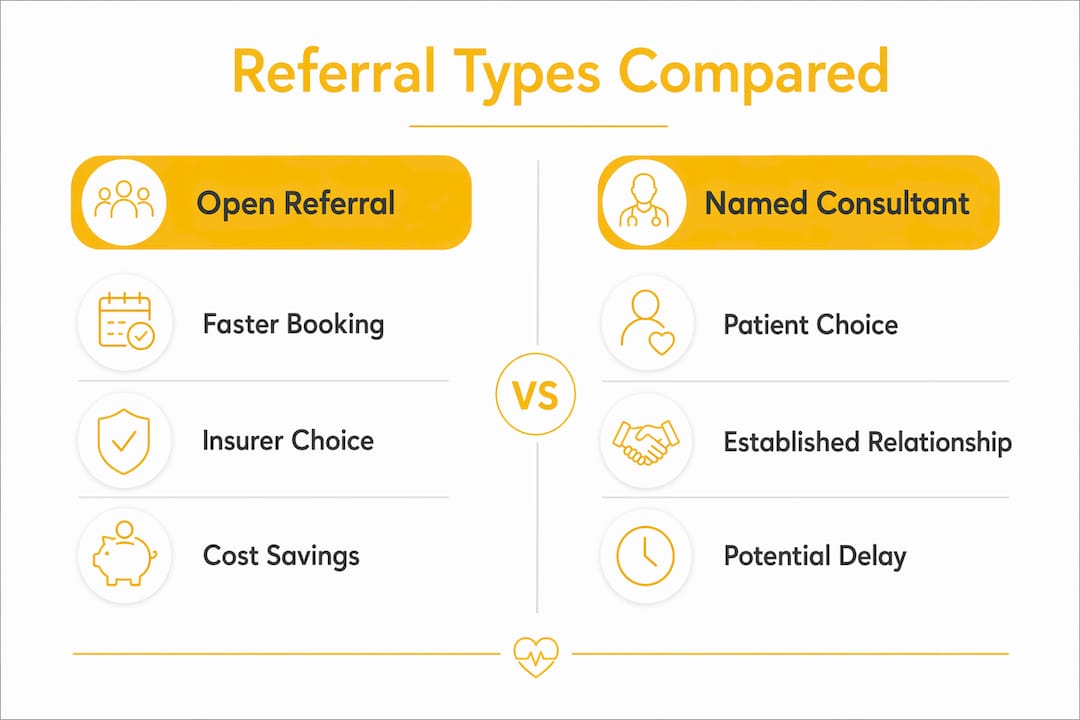
Open referral plans vary in restrictiveness. Some "guided" options offer a genuinely broad network; others funnel you toward a small preferred group. Named referral plans, sometimes called "full choice" or "open choice" plans, let your GP or you pick any consultant, though you may face a shortfall if that consultant charges above the insurer's schedule.
The trade-off is clearest for people who already have an established relationship with a specialist. If your preferred consultant is not on the approved list, an open referral policy will not cover them.
Why do insurers use open referral policies?
Cost containment is the primary driver. Insurers use open referral to steer patients toward consultants who have agreed to fixed fee schedules, removing the unpredictability of open-market consultant pricing. For insurers managing thousands of claims, that predictability is significant.

There is also a data argument. GPs may lack current information on which consultants are performing well in a given specialty, particularly as GP-consultant relationships have weakened over the past decade. Insurers, by contrast, collect outcome data, patient satisfaction scores, and complaint records across their entire network, which they use to curate and update their approved lists.
Insurer benefits in practice:
- Predictable claims costs through negotiated fee schedules.
- Clinical oversight via outcome tracking and patient feedback.
- Reduced shortfall claims, since fee-assured consultants bill within agreed limits.
- Network leverage: large insurers can negotiate discounts because of the volume of referrals they direct.
Public consultant finders on insurer websites only show network-signed consultants. Consultants who do not meet cost or quality thresholds are excluded, even if they are otherwise recognized practitioners.
Pros and cons of open referral for patients and consultants
Open referral is not a straightforwardly good or bad deal. It depends heavily on your health situation and how much you value continuity versus cost.
For patients, the advantages include:
- Lower monthly premiums, often by a meaningful margin.
- No balance billing risk, since all shortlisted consultants are fee-assured.
- Potentially faster access to appointments through insurer scheduling.
- Quality assurance, since network criteria filter for clinical standards.
The disadvantages are real too:
- You cannot choose a consultant outside the approved shortlist without potentially losing coverage.
- Geographic limits can apply, particularly in rural areas with smaller networks.
- Patients with chronic conditions may struggle to retain a consultant they have seen previously if that consultant is not on the current approved list.
- The perception of reduced quality persists, though network criteria actually maintain clinical standards. The real trade-off is continuity, not quality.
For consultants, joining an insurer's approved network brings a steady referral stream, but it requires accepting the insurer's fee schedule, which may be below their standard rates.
Legal and regulatory considerations for open referral policies
In the UK, private medical insurance is regulated by the Financial Conduct Authority (FCA), which requires insurers to treat customers fairly and disclose policy terms clearly. Open referral policies must be explained in plain language in the policy document, including any restrictions on consultant choice.
The Competition and Markets Authority (CMA) has examined private healthcare market practices, including referral restrictions. Insurers are required to be transparent about network limitations so patients can make informed decisions before purchasing a policy. If a policy restricts your choice of consultant, that restriction must be clearly stated in the policy summary, not buried in small print.
From a patient rights perspective, you are entitled to see the criteria an insurer uses to build its approved list. If you believe a consultant was excluded unfairly, you can raise a formal complaint through the insurer's complaints process, and escalate to the Financial Ombudsman Service if unresolved.
How to handle disputes over open referral decisions
If your insurer's shortlist does not include a consultant you need, or if you believe the referral process was handled incorrectly, you have options.
Start by contacting the insurer's clinical team directly. Patients with strong clinical reasons, such as a complex or rare condition requiring a specific specialist, can sometimes request an exception to the standard shortlist. This flexibility is not widely advertised, but it exists and is worth pursuing before accepting a shortlist that does not fit your needs.
If the exception request is denied, escalate through the insurer's formal complaints procedure. Document every conversation, including dates, names, and what was said. If the complaint remains unresolved after eight weeks, you can refer the matter to the Financial Ombudsman Service, which handles disputes between consumers and regulated financial firms, including health insurers.
Pro Tip: Ask your insurer in writing for the specific criteria used to build your shortlist. Insurers are obligated to provide this, and it gives you a factual basis for any exception request or complaint.
Open referral in practice: how it plays out in real policies
The term "open referral" covers a wide range of network structures. Some policies offer a genuinely broad network where most consultants in a given specialty are included. Others operate with a tightly managed preferred list of a handful of consultants per specialty per region.
Consider a straightforward orthopedic referral in a major city. Under a broad open referral network, you might receive a shortlist of three consultants, all with strong outcome records, all within a short distance, and all available within two weeks. That is the system working well. Now consider the same referral in a rural area, or for a rare subspecialty. The shortlist may shrink to one name, or the nearest approved consultant may require significant travel.
For ongoing conditions, the continuity risk is more pronounced. If you are mid-treatment with a consultant and your employer switches insurer, or you change plans, your current consultant may not appear on the new insurer's approved list. Checking whether your existing specialist is network-approved before switching plans is one of the most practical steps you can take.
What the data says about open referral's real impact
The cost savings associated with open referral are well documented. Premiums on open referral plans run lower than equivalent full-choice policies—typically 15–20% less—though the exact savings depend on your plan and circumstances.
The data-driven matching argument also holds up. Insurer analytics draw on outcome records, patient satisfaction data, and complaint histories across thousands of referrals, giving a more current picture of consultant performance than most GPs can maintain. That said, the system is only as good as the data behind it, and network lists are filtered for cost metrics as well as clinical ones.
A few nuances worth knowing:
- The term "open referral" does not guarantee a broad network. Always ask your insurer how many consultants are on the approved list for your specialty in your area.
- Some insurers allow you to use their public consultant finder to check network coverage before you commit to a plan.
- Exception requests for specialist choice, while underutilized, are a legitimate route when clinical need justifies it.
- The range of network restrictiveness varies considerably between insurers, so comparing policies on this dimension specifically is worth the effort.
Myhealthcarebroker helps you compare plans with clear, unbiased advice
Choosing between an open referral plan and a full-choice policy is not just about the premium difference. It is about whether the network covers your specialists, your region, and your likely health needs over the next few years.

Myhealthcarebroker is an independent consultancy that compares private health insurance options across providers, in plain English, without being tied to any single insurer. If you are weighing the premium saving of an open referral plan against the continuity and choice a full-choice policy provides, Myhealthcarebroker can walk you through the specifics of each option for your situation. Use the premium comparison calculator to see how different referral structures affect your actual costs, or get in touch directly for a no-jargon consultation.
Key Takeaways
Open referral private insurance shifts consultant selection from patient and GP to the insurer, delivering lower premiums in exchange for a more managed choice of specialist.
| Point | Details |
|---|---|
| Core definition | Open referral means your GP names a specialty, not a consultant; the insurer provides a shortlist. |
| Premium impact | Open referral plans typically cost 15–20% less than full-choice policies. |
| Fee assurance | All shortlisted consultants are fee-assured, eliminating balance billing risk. |
| Continuity risk | Patients with ongoing conditions may lose access to their current consultant if they switch plans. |
| Myhealthcarebroker | Myhealthcarebroker compares open referral and full-choice plans independently, helping you find the right fit. |