
If you work temporarily from another EU or EEA country (or Switzerland) with an A1 certificate, your German social security and statutory or private cover usually stay intact, though you'll rely on the EHIC for local public care and may face co-payments. Step outside the EU, and German coverage typically stops, so you'll need separate travel or international health insurance with repatriation. First moves: tell your employer, request the A1 if you qualify, check your EHIC, and line up supplemental insurance for anywhere outside the EU.
TL;DR:
- Maintaining German health coverage during an EU or EEA workation requires an A1 certificate, while outside the EU, separate international insurance is necessary.
- The EHIC provides partial public system access within the EU, but does not cover private care, repatriation, or serious emergencies.
- The A1 certificate is valid for up to 24 months, and exceeding this period or staying over 183 days in one country risks losing social security and triggering local tax residency.
- Employers must specify workation policies, request the A1, and confirm occupational accident coverage, while employees should carry EHIC, A1, and proof of employer approval before departure.
- Supplemental insurance should explicitly include repatriation, private treatment, and work-related incidents, with detailed policy scope and territorial coverage checked beforehand.
Table of Contents
- What Workation Krankenversicherung Actually Means for You
- How Health Insurance Works During an EU, EEA, or Swiss Workation
- What Happens to Your Coverage Outside the EU?
- A1 Timelines, the 24-Month Limit, and the 183-Day Tax Trigger
- Employer and Employee Checklist Before You Leave
- Which Policy Features Actually Matter When Buying Supplemental Cover
- What My Healthcare Broker Sees Go Wrong Most Often
- Get Your Workation Coverage Confirmed Before You Book
- Where to Verify the Official Rules Yourself
- Sources
- FAQ
What Workation Krankenversicherung Actually Means for You
A workation means working temporarily from a foreign location while your employment contract, payroll, and social security stay anchored in Germany. That distinction is why "workation krankenversicherung" is its own topic rather than a subset of holiday travel insurance. A vacation triggers no employer obligations. A workation does.
Your employer carries a legal duty of care even when you're sitting on a balcony in Lisbon answering emails, as detailed in practical advice on ergonomics and injury prevention for remote workers. That includes occupational-accident exposure and, depending on the destination, formal notification duties to social security bodies. The rules scale with how long and where you go:
- A short EU trip of a few days rarely changes anything beyond carrying your European Health Insurance Card (EHIC).
- A longer EU posting of several weeks to months usually calls for an A1 certificate.
- Any stay outside the EU raises the stakes considerably, since German statutory and private cover generally does not follow you there.
How Health Insurance Works During an EU, EEA, or Swiss Workation
Inside the EU, EEA, and Switzerland, the system is built to let you keep your German coverage while you work abroad temporarily. The A1 certificate is the document that makes that official. It confirms you remain under German social security rather than the host country's system, and it's typically valid for postings of up to 24 months. German health insurers such as TK treat a workation as a posting for social-security purposes, which means your employer is often the one who has to apply for the A1, not you.
The EHIC handles the medical side, but only partially. It grants access to medically necessary treatment under the host country's public system. It does not cover private clinics, and it will not pay to fly you home if something goes seriously wrong. Expect local co-payments too.
There's one more form worth knowing, and it's often confused with the A1: the S1, which applies if you actually relocate your residence rather than just work temporarily from abroad, registering you in the host country's healthcare system instead of Germany's.
Before you leave, gather:
- Your A1 certificate (if the trip qualifies as a posting).
- Your EHIC.
- A written employer confirmation of the arrangement.
- Proof of your current German insurance status.
Pro Tip: Apply for the A1 as early as possible. Processing can take weeks, and traveling without one risks a gap in social-security coverage that's a headache to fix retroactively.
What Happens to Your Coverage Outside the EU?
German statutory (GKV) and private (PKV) health insurance are built around EU/EEA and Swiss coordination rules. Step outside that zone, and both types of cover generally stop applying, full stop. Bilateral agreements with a handful of non-EU countries do exist, but they're the exception rather than the rule, so check the Your Europe portal or the relevant embassy before you assume anything is covered.
This gap is exactly why standard travel or corporate health plans catch people off guard. Many exclude work-related incidents entirely, and dedicated workation cover exists specifically to close that hole. A policy that's actually fit for purpose should include:
- Emergency medical treatment abroad.
- Repatriation and medical evacuation.
- A duration that matches (or exceeds) your actual trip.
- Explicit wording covering work-related incidents, not just leisure activities.
One detail practitioners flag often: even holding an A1 certificate doesn't remove the need for supplemental cover, because A1 and EHIC were never designed to include repatriation or private treatment anywhere, EU or otherwise. Deciding who buys that supplemental policy, you or your employer, should happen before departure, not after a claim.
A1 Timelines, the 24-Month Limit, and the 183-Day Tax Trigger
Two clocks matter here, and they run independently of each other.
- The A1 posting limit. Coverage under an A1 is normally capped at 24 months. If your workation runs longer, you need to apply for an extension well before that window closes, not after.
- The 183-day tax threshold. Spend more than 183 days in a single country within a relevant period, and you risk triggering local tax residency, which can pull your income into that country's tax system. Many employers set internal day caps well below 183, sometimes as tight as 30 to 90 days per rolling 12 months, precisely to stay clear of that line.
- Non-compliance consequences. Miss these thresholds and you're looking at potential back payments, fines, or a shift in who's liable for an occupational accident that happens on foreign soil, something legal advisors flag as a real employer exposure.
Keep a simple travel log: dates, location, HR sign-off, and any A1 paperwork. It's tedious, but it's the only defense if a tax authority or social-security office ever asks you to prove where you actually were.
Employer and Employee Checklist Before You Leave
Both sides have homework here, and skipping it is how coverage gaps happen.
For the employer:
- Put the workation policy in writing, including day caps.
- Request the A1 certificate if the trip qualifies as a posting.
- Confirm occupational-accident and liability coverage actually extends to the destination.
For the employee:
- Carry your EHIC and A1 copy.
- Get a travel insurance certificate that names repatriation explicitly.
- Keep written proof of employer approval and emergency contact details on hand.
Pro Tip: If nobody can tell you clearly who pays for an emergency room visit in Portugal versus Thailand, escalate to HR before you book flights, not after you're standing in a foreign clinic.
Which Policy Features Actually Matter When Buying Supplemental Cover
Territorial scope is the detail people skip and regret. Check the actual country list and exclusions in the policy wording, plus how long the cover lasts and whether it renews automatically if your trip extends.
- Repatriation and medical evacuation should be named explicitly, not implied.
- Work-activity wording matters: a policy written for leisure travel may exclude anything that happens while you're "working," which defeats the purpose of a workation policy.
- Occupational-accident riders matter if your role involves any physical activity at all, even something as mundane as commuting to a co-working space.
- PKV clients specifically should request written confirmation of territorial scope, since using an outside travel policy can sometimes affect premium-bonus arrangements tied to your main tariff.
If you do need to file a claim from abroad, keep every receipt, get medical reports in writing, and have them translated if the destination language isn't English or German. Insurers move faster with a complete paper trail.
What My Healthcare Broker Sees Go Wrong Most Often
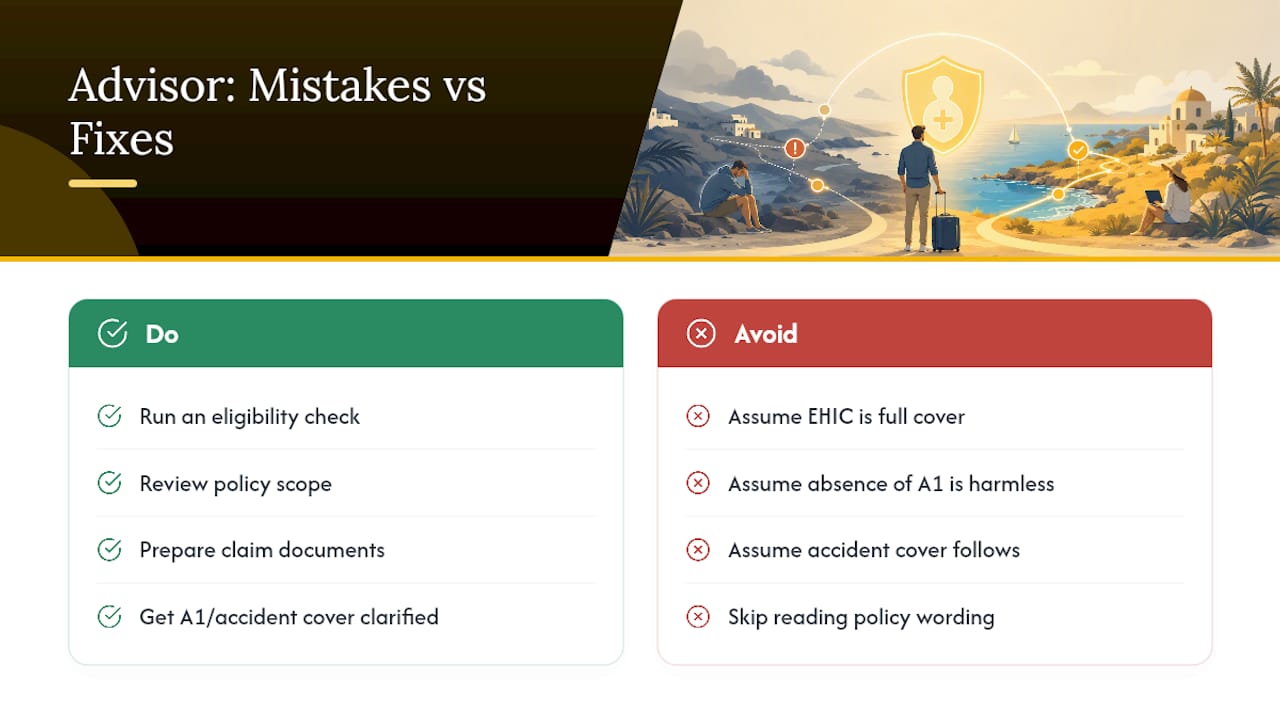
The most common mistake isn't malicious, it's assumption. People assume the EHIC is a full insurance policy. It isn't. They assume no A1 means no consequence. It does. They assume occupational-accident cover automatically follows them abroad. It often doesn't.
An advisor's real value is speed: a quick eligibility check, a policy-scope review that flags the gaps you'd otherwise discover mid-trip, and document prep that turns a multi-week bureaucratic tangle into a short checklist. Most of the damage in this space happens quietly, months later, when a claim gets denied over wording nobody read closely the first time.
— Marco
Get Your Workation Coverage Confirmed Before You Book
An independent insurance consultancy can help you navigate A1 forms, EHIC limits, and PKV territorial fine print. Such consultants compare private and public health insurance options across the German market and clarify whether your existing policy actually protects you on a workation, or where it doesn't.
This matters most for expat employees, high earners, and anyone whose HR department can't answer the A1 or EHIC question with confidence. We run eligibility checks in plain English, review your policy's territorial and work-activity wording, and handle the paperwork if a switch or supplement makes sense. If you're planning a stay abroad and want clarity before you fly, start with a free eligibility check or explore your options on our private health insurance in Germany page.
Where to Verify the Official Rules Yourself
For the primary sources behind A1 and EHIC rules, check the Your Europe social security coordination page for country-by-country coverage, and the DVKA application portal for exception agreements and cross-border social security forms.
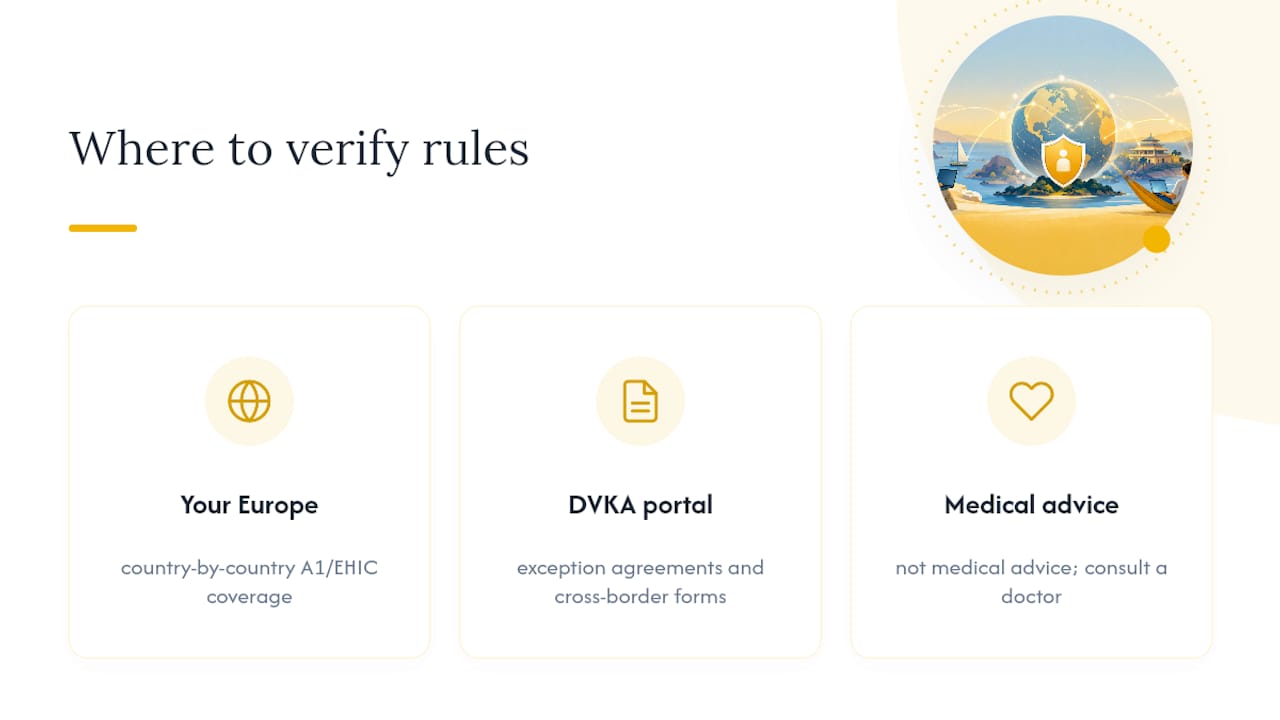
This article is general information, not a substitute for advice from a qualified doctor. Consult a qualified healthcare professional about your own circumstances before acting on anything here.
Sources
- Your Europe – Social security and benefits (country coverage)
- TK – Workation im Ausland: What employers need to know
- WorkMotion – How to manage travel health insurance for workations
FAQ
Is Health Insurance Automatically Covered During Work and Travel?
No. Work and Travel participants and workation employees need to actively confirm coverage. Inside the EU, an A1 certificate plus EHIC usually keeps you covered; outside the EU, you generally need separate international medical insurance.
How Is a Workation Taxed in Germany?
Your German tax status typically continues as normal for shorter stays, but spending more than 183 days in one country can trigger local tax residency there, which is why most employers cap workation days well below that threshold.
Is a Workation in an EU Country Legally Allowed?
Yes, workations within the EU, EEA, and Switzerland are legally permitted, but they're treated as a posting for social-security purposes, so employers typically need to request an A1 certificate on your behalf.
Where Is a Workation Actually Allowed?
Most employers permit workations across the EU, EEA, and Switzerland with an A1 certificate, and some extend approval to non-EU destinations if the employee arranges compliant international medical and repatriation insurance and stays within employer-set day limits.