
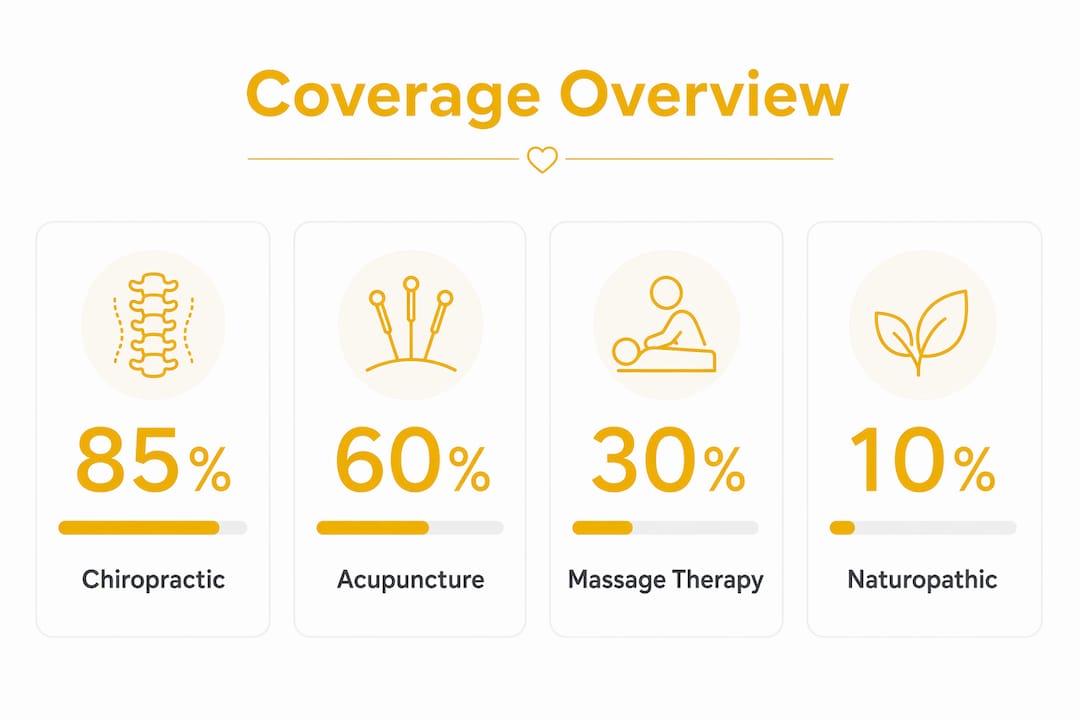
Private health insurance in the US typically covers chiropractic care and acupuncture, but most other alternative therapies sit in a gray zone where coverage depends on your specific plan, your state, and whether your provider is licensed. Here is what you can realistically expect:
- Chiropractic care is covered nationwide, usually with annual visit limits and copays
- Acupuncture coverage has expanded, particularly for chronic pain, migraines, and nausea, and is now covered in many states plus Medicare for certain conditions
- Naturopathic medicine is covered mainly in states with licensing mandates, such as Washington, Oregon, and Connecticut
- Massage therapy is rarely covered unless a physician prescribes it as part of a physical therapy plan
- Therapies like homeopathy, functional medicine, and IV nutrient infusions are almost universally excluded from standard private plans
- Most plans require medical necessity documentation and a licensed provider before approving any alternative treatment
- Pre-authorization is frequently required, and skipping that step is one of the most common reasons claims get denied
Your plan type also matters. PPO plans tend to offer more flexibility for out-of-network alternative providers, while HMO plans usually restrict you to a defined network and require referrals. High-deductible health plans paired with a Health Savings Account (HSA) can offset costs for therapies your plan does not fully cover.
What does private insurance actually require to cover alternative medicine?
Coverage approval for complementary therapies rarely comes automatically. Private plans typically require medical necessity documentation and a licensed provider before they will reimburse a single session.
- Medical necessity: Your insurer needs documentation showing the treatment addresses a diagnosed condition, not general wellness. A letter from your primary care physician explaining why, say, acupuncture is appropriate for your chronic lower back pain carries real weight.
- Provider licensing: Coverage often hinges on whether your practitioner holds a state license. A licensed chiropractor (DC) or licensed acupuncturist (LAc) is far more likely to be reimbursable than an unlicensed wellness practitioner offering the same service.
- Pre-authorization: Many plans require you to get approval before your first appointment. Skipping this step is the fastest way to receive a denial letter after the fact.
- Diagnosis specificity: Some plans limit alternative medicine benefits to particular conditions, such as chronic pain, cancer-related nausea, or post-surgical recovery. A vague diagnosis of "stress" rarely qualifies.
- Plan document review: Insurer policies vary widely enough that two plans from the same company can have different rules. Reading your Summary of Benefits and Coverage (SBC) is not optional if you want to avoid surprises.
The core tension here is real. Patient demand for integrative treatments is rising, but insurers classify many alternative therapies as experimental when clinical evidence does not meet their internal standards. That classification shifts the financial risk squarely onto you.
Which alternative therapies does private insurance usually cover?
Coverage is not uniform across modalities. Some treatments have earned a reliable place in most private plans; others remain firmly out-of-pocket territory.

Chiropractic care
Chiropractic is the most consistently covered alternative therapy in the US. Coverage mandates exist in all states, though annual visit caps and per-visit copays are standard. Plans typically require treatment to be medically necessary rather than maintenance-based.
Acupuncture
Coverage for acupuncture has grown considerably over the past several years, driven partly by the opioid crisis and a push toward non-pharmacological pain management. Coverage in many states plus Medicare for specific conditions reflects that shift. Chronic pain, chemotherapy-induced nausea, and migraines are the most commonly approved indications. Expect visit limits and, in many cases, a requirement that the acupuncturist hold a state license or that treatment be supervised by a physician.
Naturopathic medicine
Naturopathic doctors (NDs) are licensed in multiple states, but insurance coverage for their services is far patchier. States like Washington, Oregon, and Connecticut, which have strong naturopathic licensing mandates, tend to offer broader coverage. Outside those states, most private plans treat naturopathic visits as out-of-pocket expenses regardless of the ND's credentials.
Massage therapy
Massage is sporadically covered, and the bar is high. Plans that do cover it generally require a physician's prescription and restrict reimbursement to sessions that are part of a documented physical therapy or rehabilitation plan. Standalone massage for relaxation or general wellness does not qualify.
Rarely or never covered therapies
Functional medicine consultations, IV nutrient therapies, homeopathy, and most wellness-oriented treatments are almost universally excluded from standard private plans. Insurers view these as lacking sufficient clinical evidence, which places them in the experimental category and outside the scope of covered benefits.
How to manage costs when your plan does not cover everything
Out-of-pocket spending on alternative therapies adds up quickly, but several strategies can soften the financial impact without requiring you to change plans entirely.
- HSA and FSA accounts: Tax-advantaged accounts like Health Savings Accounts and Flexible Spending Accounts let you pay for IRS-approved medical expenses with pre-tax dollars. Acupuncture and chiropractic are generally eligible; check IRS Publication 502 for the current list of qualifying expenses. Your plan administrator can confirm specifics.
- Out-of-network reimbursement: If your plan includes out-of-network benefits (common in PPO plans), you may receive partial reimbursement even when your provider does not accept insurance directly. Submit the claim yourself with an itemized receipt and a superbill from your provider.
- Fee negotiation: Many alternative practitioners will negotiate their rates, especially for cash-pay patients. Confirming expected costs before your first appointment, and comparing typical charges using tools like the FAIR Health cost lookup, helps you avoid surprise bills.
- Supplemental riders: Some insurers offer optional riders or add-on plans that expand alternative medicine benefits beyond the base plan. These are worth asking about during open enrollment, particularly if you use chiropractic or acupuncture regularly.
- Claims documentation: Keep itemized receipts, superbills with diagnosis codes (ICD-10), and any written correspondence with your insurer. A well-documented claim is harder to deny and easier to appeal if it is initially rejected.
Pro Tip: Ask your provider for a superbill after every session. A superbill includes the procedure code (CPT), diagnosis code (ICD-10), and provider credentials. Without it, your insurer has no basis for reimbursement, even if the treatment is technically covered.
What limited coverage actually means for your wallet
Partial coverage can feel like a win until you do the math. Annual visit caps and copays mean that even "covered" therapies can generate real out-of-pocket costs over the course of a year.
- Many alternative therapies are classified as experimental by insurers, leading to outright denials rather than partial coverage. The NCCIH notes that this classification shifts financial risk to patients and results in frequent exclusions.
- Private plans are generally more inclusive than public insurance, but the gap between plans is wide. A PPO from one insurer may cover 30 acupuncture visits per year; another plan may cap it at 10.
- Even when coverage exists, high copays or coinsurance rates can make frequent visits expensive. A $40 copay for twice-weekly chiropractic adds up to over $4,000 annually before you factor in your deductible.
- Provider credential mismatches are a common source of claim denials. If your plan requires a licensed acupuncturist and your provider holds a different credential, the claim will likely be rejected regardless of the treatment's effectiveness.
- Supplemental plans designed specifically for complementary medicine benefits exist but require careful comparison. The coverage details matter far more than the insurer's brand name.
How to verify your alternative medicine coverage before you book
Confirming coverage before your first appointment takes about 30 minutes and can save you hundreds of dollars. Here is how to do it properly.
- Call member services: Contact the number on the back of your insurance card and ask specifically whether your intended therapy is covered, what the visit limit is, and whether your provider is in-network. Get the representative's name and note the date and time of the call.
- Request written pre-authorization: For any therapy that is not routine, ask your insurer for written pre-authorization before treatment begins. This written approval is your strongest protection against a denial after the fact. Some German private plans refer to this as a Kostenübernahmeerklärung, a formal written cost-coverage declaration, and the principle applies equally in US plans.
- Review your plan documents: Your Summary of Benefits and Coverage (SBC) and the full plan document (Evidence of Coverage) list exclusions, visit limits, and prior authorization requirements. These are available through your insurer's member portal.
- Track all communications: Keep a written log of every conversation with your insurer, including the date, the representative's name, and what was confirmed. If a claim is later denied, this log is your starting point for an appeal.
- Understand provider qualification requirements: Some plans require that alternative treatments be ordered or supervised by an MD, even when performed by a licensed alternative practitioner. Confirm this before booking, since a healthcare provider's qualifications directly affect whether your insurer will reimburse the visit.
Pro Tip: Request a letter of medical necessity from your physician before starting any alternative treatment. This letter, which explains why the therapy is medically appropriate for your condition, significantly strengthens your claim and is often the deciding factor in borderline coverage decisions.
How coverage compares across major US private insurers
No two private insurers handle alternative medicine the same way, and the differences are meaningful enough to influence which plan you choose during open enrollment.

Most large national insurers cover chiropractic and acupuncture as standard benefits, but the terms vary considerably. Some plans set visit limits as low as 10 per year for acupuncture; others allow 30 or more. Copay amounts, coinsurance rates, and whether a referral is required all differ by plan and by state.
PPO plans consistently offer the most flexibility for alternative medicine. You can typically see out-of-network providers and submit claims for partial reimbursement, which matters when your preferred acupuncturist or naturopath does not participate in any insurance network. HMO plans are more restrictive: you generally need a referral from your primary care physician, and out-of-network visits are not covered at all.
High-deductible health plans (HDHPs) paired with an HSA are worth considering if you use alternative therapies regularly. The lower monthly premium frees up cash, and the HSA lets you pay for a broader range of therapies with pre-tax dollars, including some that your plan does not cover directly. The tradeoff is that you pay full cost until you meet your deductible, which can be steep in the early months of the year.
State insurance mandates create geographic variation that is easy to overlook. A plan sold in Washington State must cover licensed naturopaths; the same insurer's plan sold in Texas has no such obligation. If access to naturopathic or integrative medicine is a priority, your state's mandate landscape shapes your options as much as the insurer's own policies do.
Alternative medicine coverage is ultimately driven by the specific plan contract rather than the insurer's brand. Two plans from the same company, sold in the same state, can have meaningfully different benefits depending on whether you chose the base plan or a plan with an enhanced complementary medicine rider.
Additional insights on navigating US alternative medicine insurance
Understanding how insurers make coverage decisions gives you a real advantage when you are trying to get reimbursed.
- Evidence-based criteria drive insurer decisions: Insurers evaluate alternative therapies against clinical research standards. Treatments with strong peer-reviewed evidence, such as chiropractic for low back pain or acupuncture for chronic pain, are more likely to be covered than those with limited published research.
- HSA and FSA accounts are underused: Many people with high-deductible plans do not fully use their HSA for alternative medicine. IRS Publication 502 lists eligible expenses, and the list is broader than most people realize, covering acupuncture, chiropractic, and certain prescribed supplements.
- Rider policies deserve attention at enrollment: Open enrollment is the right time to ask whether your insurer offers a complementary medicine rider. These add-ons can meaningfully expand your benefits for a modest additional premium, particularly if you use acupuncture or naturopathic services regularly.
- Pre-authorization prevents most disputes: The majority of alternative medicine claim denials are avoidable. Getting written approval before treatment, keeping detailed records, and submitting claims with complete documentation resolves most issues before they become appeals.
- State mandates create real geographic inequality: Access to covered alternative medicine varies significantly by state. Residents of mandate states like Washington, Oregon, and Connecticut have broader access to covered naturopathic and acupuncture services than residents of states with no such requirements. If you are relocating or choosing between plans across state lines, this is worth factoring in.
Myhealthcarebroker helps you find private coverage that fits your health priorities
Navigating private health insurance in Germany as an English speaker is genuinely complicated, especially when you want a plan that covers more than the basics. Myhealthcarebroker is an independent consultancy that compares private health insurance options across providers in Germany and guides you to the plan that fits your actual situation, including your interest in complementary and integrative treatments.

Unlike going directly to an insurer, Myhealthcarebroker is not tied to any single provider. That means the advice you get reflects what is genuinely available across the market, not what one company wants to sell you. If coverage for alternative therapies matters to you, that context shapes the comparison from the start. The process is conducted in clear English, from your first eligibility check through to your final application, with ongoing support afterward. You can start with an eligibility check to see which private plans you qualify for, or use the private health insurance calculator to get a sense of costs before committing to anything.
Key Takeaways
Private health insurance in the US covers chiropractic and acupuncture most reliably, but coverage for other alternative therapies depends heavily on your plan type, state mandates, and whether you meet medical necessity and provider licensing requirements.
| Point | Details |
|---|---|
| Chiropractic and acupuncture lead coverage | Chiropractic is covered nationwide; acupuncture coverage has expanded in many states plus Medicare for specific conditions. |
| Medical necessity is the key qualifier | Insurers require documented medical necessity and a licensed provider before approving most alternative treatments. |
| HSA and FSA accounts extend your coverage | Tax-advantaged accounts let you pay for IRS-approved alternative therapies with pre-tax dollars, reducing net cost. |
| State mandates shape your access | States like Washington, Oregon, and Connecticut mandate broader coverage for naturopathic medicine than non-mandate states. |
| Myhealthcarebroker compares plans for you | As an independent consultancy in Germany, Myhealthcarebroker matches you to private plans that align with your health priorities, including complementary care coverage. |