You must have health insurance in Germany from the day you arrive, no exceptions and no grace period. That leaves two systems to choose between: statutory (GKV) and private (PKV). Your immediate move is a proper eligibility check, either through an official English-language resource like GKV-Spitzenverband or the Bundesgesundheitsministerium, or by talking to an English-speaking advisor such as My Healthcare Broker.
TL;DR:
- Only applicants earning over approximately €6,450 monthly in 2026 can qualify for private health insurance, with income-based eligibility checked before applying.
- Pre-existing conditions heavily influence private insurance costs and acceptance chances, often resulting in higher premiums, exclusions, or rejection.
- Never cancel your statutory insurance before receiving full and binding approval from a private insurer to avoid gaps in coverage and legal penalties.
- Family members in GKV are covered at no extra cost, whereas PKV requires separate premiums for each person, often making GKV more affordable for families.
- Independent, English-speaking brokers provide essential guidance on eligibility, market comparisons, and navigating the complex insurance system without language barriers.
Table of Contents
- Englischsprachige Krankenversicherung Beratung: GKV vs PKV Explained
- Who Qualifies for PKV, and Who Is Stuck With GKV?
- How to Enroll: Documents, Steps, and What to Expect
- What GKV and PKV Actually Cost
- Where to Find Trustworthy English-Language Help
- Mistakes That Cost English Speakers Real Money
- Why Independent, English-Language Advice Actually Matters
- Get an English Eligibility Check From Myhealthcarebroker
- Where to Verify the Rules Yourself
- Sources
- FAQ
Englischsprachige Krankenversicherung Beratung: GKV vs PKV Explained
Germany runs two parallel insurance systems, and understanding which one applies to you is the whole game. Gesetzliche Krankenversicherung (GKV), or statutory health insurance, is a membership system where contributions scale with your income and cover your family at no extra charge. About 90% of the population belongs to a GKV fund, and benefits are fixed by law under the Fifth Book of the Social Code (SGB V), which means every statutory insurer must offer the same core package of doctor visits, hospital care, prescriptions, and preventive checks.
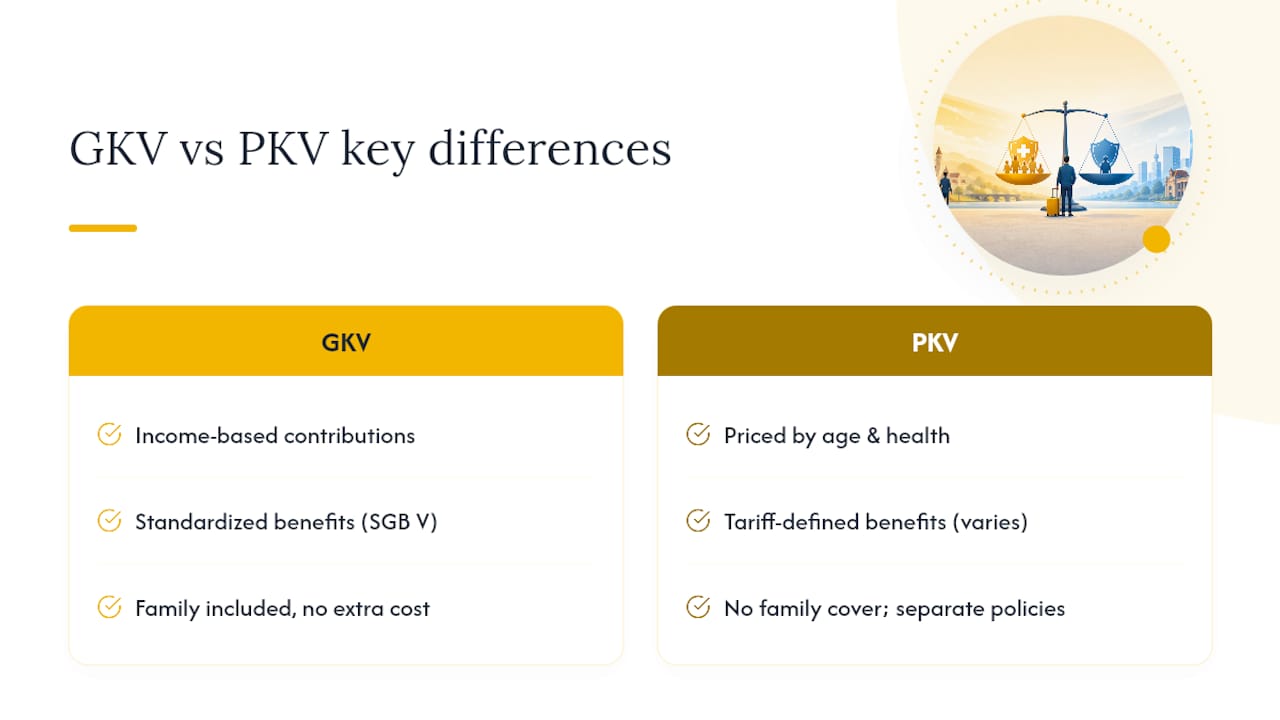
Private Krankenversicherung (PKV) works completely differently. It is a private contract, priced according to your age and health at the time you sign up, and governed by insurance contract law (VVG) rather than SGB V. Each tariff defines its own benefits, so two PKV policies can look nothing alike. There is no free family coverage in PKV. Every adult and every child need a separate policy, each underwritten and priced on its own terms.
Knowing which system you fall into changes everything downstream, from your monthly cost to how easily you can switch jobs later. If you want the fuller breakdown, this guide to statutory versus private insurance walks through the mechanics in more detail.
Who Qualifies for PKV, and Who Is Stuck With GKV?
Access to PKV is not a preference, it is a rule. Employees only qualify once their gross salary clears the annual income threshold, known as the JAEG. For 2026, that threshold sits at €77,400 per year, or roughly €6,450 a month, and you generally need to expect that income for a full calendar year before an insurer treats you as eligible.
Self-employed people and freelancers can usually choose PKV regardless of income, though a handful of professions face special rules. Civil servants (Beamte) sit in a distinct category with subsidized private cover. Students face tighter limits and often land in a specific student-rate GKV or PKV plan. Anyone below the threshold can still join GKV voluntarily.
Pre-existing conditions matter enormously for PKV. Underwriting can mean higher premiums, exclusions on specific treatments, or in some cases a flat rejection, something GKV never does since it accepts members regardless of health history.
How to Enroll: Documents, Steps, and What to Expect
Once you know which system fits, the process itself is fairly mechanical if you have the right paperwork ready.
What you will need:
- Valid passport or national ID
- Proof of address registration (Anmeldung) from your local registration office
- Employment contract or an official job confirmation letter
- Recent pay slips, or a tax assessment notice if you are self-employed
For GKV: Sign up directly with a fund, often through an online portal, and many major insurers publish English pages for exactly this purpose. Confirmation of membership usually arrives almost immediately, though your physical insurance card (Gesundheitskarte) typically takes a few weeks to reach you by mail.
For PKV: The process runs slower and requires more caution. Insurers first run an anonymized risk pre-enquiry, checking likely outcomes without your name attached, followed by a full health questionnaire if you proceed. Underwriting can take anywhere from a few days to several weeks depending on your health history.
Pro Tip: Never cancel your GKV membership until you hold a binding written acceptance from the PKV insurer, not just a quote. A pending application is not a guarantee.
What GKV and PKV Actually Cost
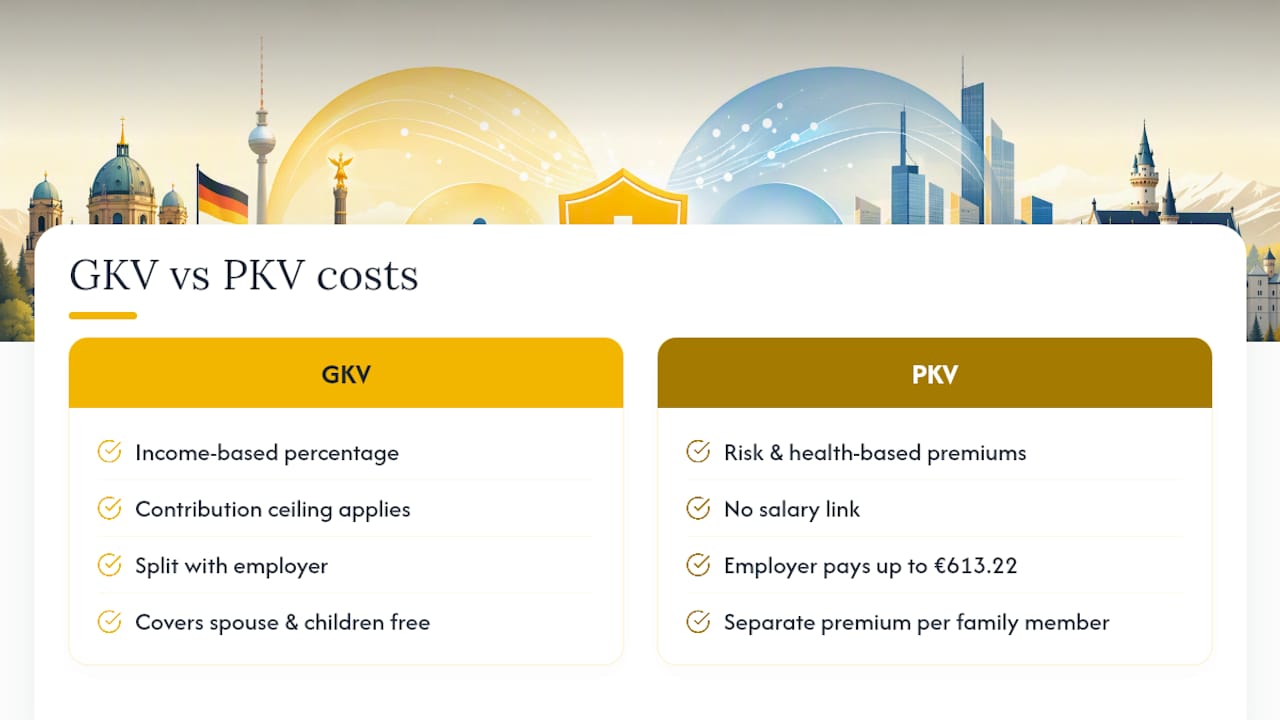
GKV contributions are a fixed percentage of your gross income, currently split between you and your employer, plus an additional contribution rate (Zusatzbeitrag) that varies slightly by fund. The math is simple: the more you earn up to a contribution ceiling, the more you pay, but the benefits catalogue stays identical no matter which fund you choose.
PKV premiums work in reverse. Your entry age, health status, chosen tariff scope, and deductible level set your price, and that price has nothing to do with your salary. Employers still contribute toward PKV, but only up to a capped amount, roughly €613.22 per month outside Saxony for combined health and long-term care insurance.
Family situations tip the math further. GKV covers a non-working spouse and children under one contribution at no added cost. PKV charges a separate premium for every family member, which is often the single biggest factor pushing expats with kids or a non-working partner back toward GKV.
Where to Find Trustworthy English-Language Help
You do not have to navigate this system in German, and you should not have to guess your way through it either. A few channels consistently deliver reliable English support:
- Municipal welcome centres, such as Berlin's Willkommenszentrum, which offer free basic guidance on GKV onboarding.
- English-language pages run directly by major statutory insurers, useful for straightforward sign-ups.
- Independent brokers who compare across multiple insurers rather than one product line.
When you talk to any advisor, ask directly about their scope of service, whether they charge you anything, whether they are tied to a single insurer, how they handle your data, and whether they can point to past client outcomes. Municipal centres work well for basic GKV questions. Complex family situations, PKV underwriting, or international relocations usually call for a broker who can run comparisons you cannot easily do yourself, and firms outside Germany's borders, like Geneva Insurance Group, offer a useful outside benchmark for what good independent advice should look like.
Mistakes That Cost English Speakers Real Money
The single most damaging mistake is canceling your GKV membership before your PKV acceptance is fully binding. Miss that sequencing and you risk an uninsured gap, which carries legal consequences in Germany.
A few other red flags deserve your attention:
- Switching from PKV back to GKV becomes extremely difficult once you pass age 55, so treat a PKV decision as a long-term commitment, not a trial run.
- Underwriting surprises catch people off guard. Run an anonymized pre-enquiry first to see likely outcomes before you formally apply.
- Be wary of any advisor who pushes one insurer without showing you a real market comparison. That is a conflict of interest, not advice.
Why Independent, English-Language Advice Actually Matters
Most of the expat cases I see share a pattern: someone made a fast decision under pressure, usually right after a job offer, without realizing GKV and PKV are largely irreversible choices once family plans or age enter the picture. A software engineer choosing PKV at 28 faces a very different calculation than the same person at 52 with two kids.
The value of independent advice is structural, not just linguistic. An advisor tied to one insurer has no incentive to tell you when a competitor's tariff fits your health profile better. Some independent brokers compare across the market and explain the tradeoffs in plain English, then stay reachable after you sign, because most people's situations change and their coverage should be revisited, not set once and forgotten.
— Marco
Get an English Eligibility Check From Myhealthcarebroker
There are services offering independent comparison across major private and public insurers, run entirely in English, and at no cost to the client.
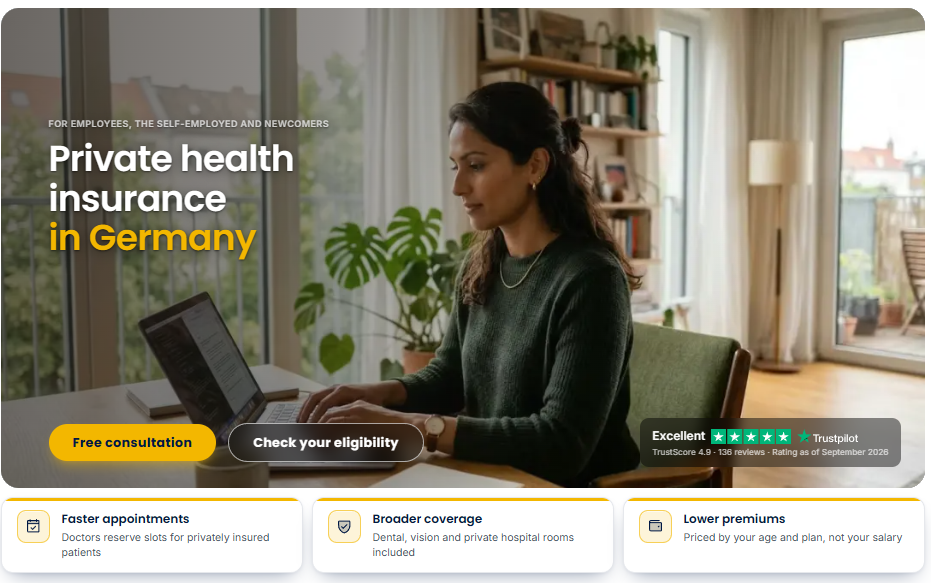
The process starts with a free eligibility check to confirm whether GKV or PKV fits your income and situation, followed by an anonymized pre-enquiry across relevant PKV tariffs if that route applies to you. Some brokers handle the comparison, paperwork, and application process, and may be available afterward if your circumstances shift. With the right documents, you can move through much of the process without dealing with German-language forms.
Start with the free eligibility check to see where you stand, or explore the full range of private and public insurance options available to newcomers in Germany.
Where to Verify the Rules Yourself
- GKV-Spitzenverband — English information: official statutory insurance body, covering benefits and membership rules.
- Bundesgesundheitsministerium benefits guide: federal breakdown of what GKV actually covers.
- European Commission EHIC guidance: rules on cross-border coverage within the EU/EEA.
- Berlin Willkommenszentrum health page: municipal English-language onboarding support.
- Myhealthcarebroker eligibility check: practical next step to confirm your GKV or PKV options.
This article is general information, not a substitute for advice from a qualified doctor. Consult a qualified healthcare professional about your own circumstances before acting on anything here.
Sources
- Information in English — GKV-Spitzenverband
- Private Health Insurance in Germany: PKV Decision Guide
- Health Insurance in Germany for Expats: GKV vs PKV Guide (2026)
- European Health Insurance Card — European Commission
FAQ
Is Foreign Health Insurance Recognized in Germany?
Generally, no, unless it meets specific German legal standards for scope and duration, which most travel or home-country policies do not. Newcomers almost always need to enroll in GKV or PKV shortly after arrival, and a short-term EU/EEA policy under the EHIC framework covers only temporary visits, not residency.
What Is "Gesetzliche Krankenkasse" Called in English?
It translates to "statutory health insurance fund" or simply "public health insurance provider." This is the GKV system, and it covers about 90% of Germany's population under one standardized benefits catalogue.
Where Can I Get International Health Insurance?
You can get English-language guidance through independent brokers such as Myhealthcarebroker, which compares private and public insurance options across the whole market, or directly through insurer English portals and municipal welcome centres. For genuinely international coverage, look at PKV tariffs specifically, since many include worldwide travel benefits that go beyond what the EHIC offers within the EU/EEA.
What Insurance Options Exist for Foreign Language Students in Germany?
Language students typically need a specific student health insurance policy, either a public student rate or a private tariff designed for that visa category. Requirements depend heavily on visa type and enrollment status, so a tailored eligibility check is the fastest way to confirm which option applies to your situation.