
If you're privately insured in Germany, you generally will not receive the statutory electronic health-insurance card, known as the eGK. That card belongs to the public system. Private customers get a different toolkit instead: an insurer ID card in some cases, access to a HealthID and the electronic patient record, insurer apps, and a reimbursement process that works on a "pay then claim back" basis rather than direct billing.
None of this means you're less covered. It means the paperwork works differently, and knowing that now saves you a confused conversation at a pharmacy counter later.
- Private insurers issue their own ID cards, but these are optional and don't replicate every eGK function
- A HealthID gives you access to digital health services and the electronic patient record
- Reimbursement usually means you pay the provider first, then submit the invoice to your insurer
- Your next move: request a HealthID from your insurer, or run a Risikovoranfrage before applying, and get English-language help from Myhealthcarebroker if the process feels murky
Key Takeaways
Privately insured customers in Germany use a HealthID, ePA access, and insurer apps instead of the statutory eGK, and reimbursement usually requires paying first and claiming back.
| Point | Details |
|---|---|
| No statutory eGK for private customers | Private insurers issue optional ID cards, but these don't replicate direct billing or eGK functions. |
| Set up your HealthID early | Apply through your insurer right after acceptance to unlock ePA access and digital services. |
| Run a Risikovoranfrage first | This anonymous check reveals likely acceptance and pricing without creating a record tied to your name. |
| Request proof-of-cover promptly | Employers and authorities often need this document within days of your policy approval. |
| Get independent help | Myhealthcarebroker runs eligibility checks and market comparisons in English at no cost to you. |
Table of Contents
- German Green Card Basics: How the eGK and Private Cards Differ
- What Digital Tools Replace the Statutory Card?
- How Do You Check Eligibility and Get Proof of Cover?
- Practical Tips From an Independent Broker
- What Mistakes Slow Down Private Insurance Claims?
- How Myhealthcarebroker Simplifies Your Application
- Frequently Asked Questions
- Sources
German Green Card Basics: How the eGK and Private Cards Differ
The eGK does more than prove you have coverage. For statutory members, it enables direct billing at the point of care, stores personal profile data, and can carry emergency information plus the European Health Insurance Card on the back. Swipe it at the doctor's office, and the practice bills your insurer directly. No invoice, no waiting for money back.
Private cover runs on a different logic:
- Your insurer may issue an ID card, but it typically confirms who you are rather than triggering automatic billing.
- Outpatient visits usually work on reimbursement: you pay the bill, then send it to your insurer for repayment.
- Direct billing does happen for private patients, most often during inpatient hospital stays, where an assignment of claims can be arranged in advance.
- Travel cover is not automatic. Because private cards don't include EHIC functionality by default, you need to request a travel certificate separately before you leave the country.
Practically, that means budgeting for upfront costs at a general practitioner's office, but not necessarily at the hospital. It also means a quick call to your insurer before any trip abroad, rather than assuming the plastic in your wallet covers you the way the eGK covers a statutory member.
What Digital Tools Replace the Statutory Card?
Private customers aren't left with a paper trail and a fax machine. The German digital health system was built to include everyone, and three tools do the heavy lifting.
- HealthID. Privately insured people apply directly through their insurer to get one, and it functions as your digital identity across health apps and platforms.
- Electronic patient record (ePA). Once your HealthID is active, your private insurer can grant you ePA access, and you use an online check-in flow to let a practice view your records before an appointment, instead of handing over a physical card.
- Insurer apps. Most private insurers now run apps that let you photograph an invoice and submit it for reimbursement on the spot.
Pro Tip: Set up your HealthID and insurer app in the same week you get your acceptance letter. Waiting until your first doctor's visit means scrambling for login credentials while you're also trying to explain your symptoms in German.
Turnaround on digital claims tends to beat the old mail-in process by a wide margin, since scanning and submitting through an app cuts out postal delays entirely. That single habit change is often the biggest quality-of-life upgrade a new private customer makes.
How Do You Check Eligibility and Get Proof of Cover?
Getting from "I think I qualify for private insurance" to "I have a signed policy and a document to show my employer" follows a predictable sequence. Skip a step and you risk delays or a rejected application.
- Confirm eligibility first. Employees need income above the JAEG threshold, while self-employed people and freelancers face separate rules; check where you stand before you get attached to a particular insurer.
- Run a Risikovoranfrage. This is an anonymous, non-binding check that insurers use to give you a likely acceptance decision and premium estimate without creating a permanent record tied to your name.
- Submit your application once you've compared offers, including full medical history and any pre-existing conditions the insurer needs to underwrite the policy accurately.
- Request your proof-of-cover document. Employers, landlords, and immigration offices often want this in hand within days of approval, so ask your insurer explicitly and don't assume it arrives automatically.
Pro Tip: Ask for the Risikovoranfrage results in writing. If your health situation changes slightly before you formally apply, having the anonymous quote on record helps your broker negotiate faster the second time around.
Most insurers turn around a clean application within one to two weeks, longer if your medical history needs follow-up questions.

Practical Tips From an Independent Broker
Marco and the team at Myhealthcarebroker run these applications daily, and a few habits consistently separate the smooth cases from the frustrating ones.
Anonymous market checks protect you more than most people realize. Running a Risikovoranfrage across several insurers before you commit means a rejection or a loaded premium never attaches to your name. If one insurer quotes a high surcharge for a knee injury from years ago, you simply try another. Apply directly first, though, and that history follows you into every future negotiation.
Health declarations deserve real attention, not a rushed checkbox exercise. Underreporting a condition can void a claim years later, while overreporting can inflate your premium unnecessarily. A broker who reads the fine print on deductibles and waiting periods usually finds a policy that fits your actual risk tolerance, not just the cheapest headline number.
- Compare at least three insurers through an anonymous check before signing anything
- List every diagnosis and treatment from the last five years, even minor ones
- Choose a deductible you can comfortably cover in a bad year, not just an average one
- Set up your insurer's app before your first claim, not after
Pro Tip: If you're facing a planned hospital stay, ask your insurer to confirm direct billing with the hospital's finance office in advance. It's a five-minute phone call that saves you from fronting thousands of euros.
Reimbursement speed usually comes down to how quickly you submit paperwork through the app rather than any negotiation with the insurer itself.
What Mistakes Slow Down Private Insurance Claims?
Most delays trace back to the same handful of assumptions, and each one has a straightforward fix.
- Assuming a private card works like the eGK for billing. It usually doesn't outside inpatient stays. Check the hospital's billing policy before admission, not during check-in.
- Waiting too long to request a HealthID or ePA access. Ask for both the moment your application is accepted, so the digital tools are live before you need them.
- Skipping the Risikovoranfrage. Applying blind risks a surprise loading or rejection that becomes part of your record. The anonymous check costs you nothing and reveals the same information privately.
- Forgetting travel documentation. Because private cards don't carry EHIC coverage automatically, request a travel certificate before every trip abroad rather than after you need care.
Marco's Quick Advice for Newcomers
If you take one thing from this article, run a Risikovoranfrage before you touch a formal application. It's anonymous, it's free, and it tells you exactly where you stand with multiple insurers before any rejection can attach to your name. Most of the frustration I see from new clients traces back to skipping this step. Reach out to us in English, and we'll walk you through it before you commit to anything.
How Myhealthcarebroker Simplifies Your Application
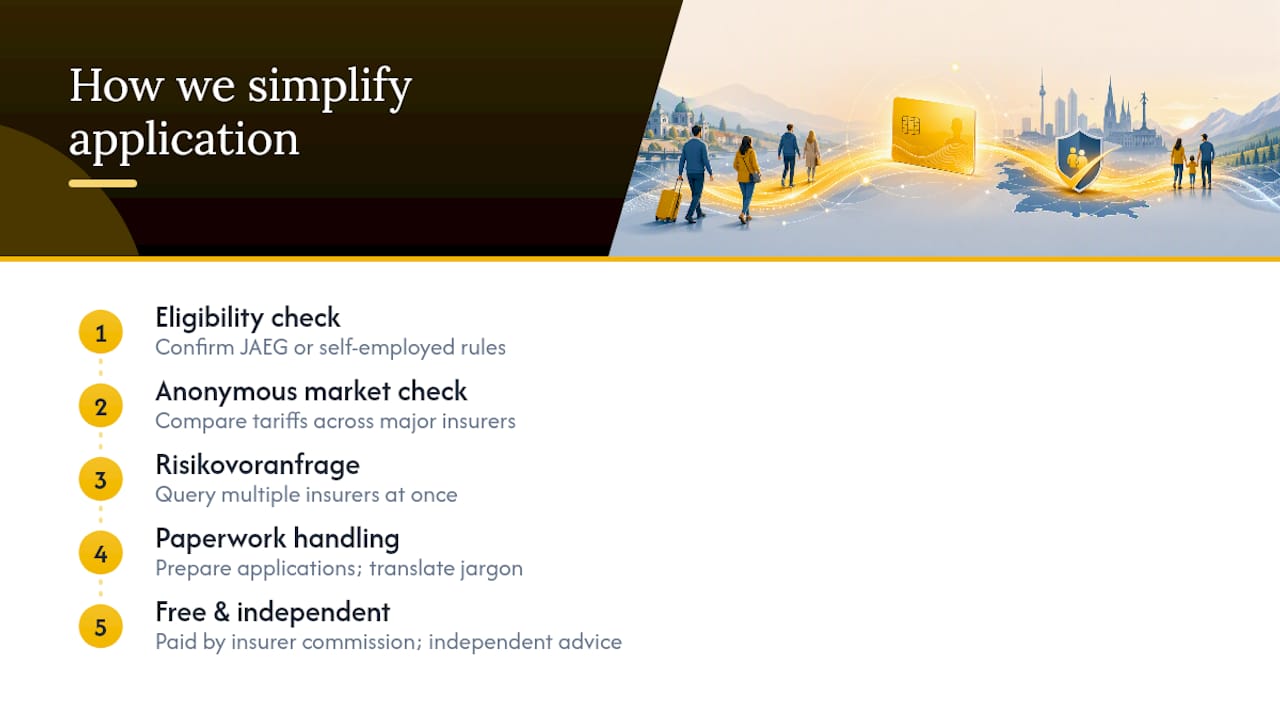
Myhealthcarebroker exists because comparing German private insurers in a language you didn't grow up speaking wastes time you don't have. We run the anonymous market check across major insurers, compare tariffs against your actual health situation, and handle the application paperwork so you're not translating underwriting jargon at midnight.
Our eligibility check confirms whether you qualify under the JAEG or self-employed rules before you spend a minute comparing plans. From there, we run the Risikovoranfrage across multiple insurers at once, something most people don't realize they can request through a single broker rather than contacting each company separately. The service costs you nothing, since we're paid a regulated commission by the insurer once you sign, and our advice stays independent because we're not tied to any single provider.
Ready to see where you stand? Try our private health insurance calculator for an instant premium estimate, or reach out through our advice page for a free English-language eligibility check.
Frequently Asked Questions
Do privately insured people in Germany get the eGK? No. The eGK is issued to statutory (GKV) members. Private customers rely on insurer-issued ID cards, a HealthID, and app-based tools instead.
What is a HealthID and how do I get one? A HealthID is your digital identity for German health services. Private customers apply for it through their insurer, and it unlocks access to the electronic patient record and related apps.
Does private insurance cover travel the same way the eGK does? Not automatically. The eGK carries EHIC functionality on the back for statutory members, but private cards require a separate travel certificate request before you travel.
How fast can I get reimbursed as a private patient? Submitting invoices through your insurer's app is typically much faster than mailing paper claims, since digital submission skips postal handling entirely.
What is a Risikovoranfrage and why does it matter? It's an anonymous, non-binding inquiry that shows your likely acceptance and premium across insurers before you formally apply, protecting you from a permanent record if one insurer quotes a high loading.
This article is general information, not a substitute for advice from a qualified financial advisor. Consult a qualified financial professional about your own circumstances before acting on anything here.