
Whether you can choose private health insurance as a GmbH shareholder or managing director comes down to one question: are you legally an employee, or are you self-employed? Under SGB IV §7(1), a managing director who takes instructions and is integrated into the company's daily operations is treated as a dependent employee, which usually means compulsory statutory insurance (GKV). A shareholder with real, enforceable control (a blocking minority, decisive voting power, freedom from instruction) can often qualify for private health insurance (PKV) instead. The vast majority of people in Germany rely on the statutory system, so being the exception requires proof, not just a job title, and the DRV (German Pension Insurance) has the final word.
Three checks tell you where you likely stand before you spend money on legal advice:
- Review your actual shareholding percentage and voting rights, not just your title.
- Check your articles of association for a documented blocking minority or veto power.
- Start a DRV status-determination request, or get a broker to run an eligibility check first.
Key Takeaways
A GmbH shareholder's health insurance choice depends entirely on whether SGB IV §7(1) and DRV review classify them as an employee or as self-employed.
| Point | Details |
|---|---|
| Status decides eligibility | Employees generally must join GKV; controlling shareholders may qualify for PKV. |
| Paperwork beats titles | Courts weigh documented voting rights and blocking minorities, not informal influence. |
| Get a DRV determination early | Since April 2022, status checks are often mandatory and avoid backdated contribution claims. |
| Prepare your documents first | Articles of association, contracts, and remuneration structure should be ready before applying. |
| Myhealthcarebroker runs pre-checks | The broker reviews your governing documents and packages PKV applications in English. |
Table of Contents
- GmbH Shareholder Insurance Germany: How Status Gets Decided
- What Your Status Means for GKV vs PKV Eligibility
- How to Get an Official DRV Status Determination
- Documents to Gather Before You Apply for PKV
- Mistakes That Trigger Back Payments and Delays
- How Myhealthcarebroker Handles Your Eligibility Check
- Frequently Asked Questions
- Sources
GmbH Shareholder Insurance Germany: How Status Gets Decided
Germany's social insurance law doesn't care what your business card says. It cares whether you're "subject to instructions" and "integrated" into someone else's work organization, the two tests written into SGB IV §7(1). If both apply to you, you're an employee for social-security purposes, even if you also happen to hold shares.
In practice, authorities and courts look at a specific set of indicators, not vague impressions:
- Capital participation above 50%, or a documented blocking minority that lets you veto unwelcome decisions.
- Freedom over your own working hours, location, and how you organize your role.
- Variable, success-based pay rather than a fixed monthly salary.
- Sole representation authority (acting alone for the company, not just alongside co-directors).
- Fixed vacation entitlements, sick pay, or other employer-style benefits, which all point the other way, toward dependency, according to guidance from the Handelskammer Hamburg.
An externally hired managing director with no shares is almost always treated as an employee, according to IHK Berlin. A shareholder-managing director sits in murkier territory, and the Federal Social Court has spent years refining the abstract criteria used to sort out these cases, weighing formal legal power over informal influence every time.
Pro Tip: Courts look for legally enforceable powers written into your articles of association, not for how much informal say you actually have in meetings. If your blocking minority isn't spelled out in a signed document, it doesn't count.
What Your Status Means for GKV vs PKV Eligibility
Your social-security classification isn't an abstract legal label. It decides which insurance system you're allowed into.
If you're classified as a dependent employee, you're generally required to join statutory health insurance (GKV), along with mandatory contributions to pension, unemployment, nursing care, and accident insurance, the same five pillars that cover most of the country. If you're classified as self-employed, or a controlling shareholder, that compulsory GKV requirement usually falls away, opening the door to private health insurance if you also clear the standard PKV entry rules (income above the annual threshold, no pre-existing conditions that trigger heavy loadings, and so on).
A few consequences worth knowing before you assume either path applies to you:
- Former employees can sometimes keep voluntary statutory coverage even after their status changes, so leaving GKV isn't always all-or-nothing.
- Crossing the income threshold matters for employees considering PKV, but it's irrelevant if you're already classified as self-employed.
- Misclassification carries real financial exposure. If a status review later finds you should have been paying into GKV and pension insurance all along, the GmbH can face retroactive claims for both employer and employee contributions, according to Haufe.
Pro Tip: When an insurer or broker asks about your employment status, answer consistently with what your paperwork actually shows. A verbal claim of "I run the company" means nothing if your contract reads like an employment agreement.
How to Get an Official DRV Status Determination
Guessing your status is a bad long-term strategy. Germany has a formal process for settling it, and since April 1, 2022, it's often not optional.
- Who starts it. Since that date, collecting authorities (the bodies that gather social contributions) must initiate a mandatory status-determination procedure under §7a SGB IV for shareholding managing directors in many cases. You, or your company, can also request it proactively.
- What gets reviewed. The DRV examines your articles of association, shareholder register, service or employment contract, and any minutes that show how instructions actually flow inside the company.
- What it looks like in practice. Expect the process to take weeks rather than days once submitted, and outcomes hinge heavily on how cleanly your paperwork supports your claimed status.
- Why timing matters. Waiting until after a dispute, a dismissal, or an insurer's underwriting question is the worst time to discover you were classified incorrectly. Back payments for both employer and employee shares, plus interest, can follow a late finding.
A broker or employment-law specialist can assemble your status file in advance and, where needed, help present the evidence to the DRV before problems surface.
Documents to Gather Before You Apply for PKV
Preparation beats improvisation here. Before you approach an insurer, a broker, or the DRV itself, pull together the following:
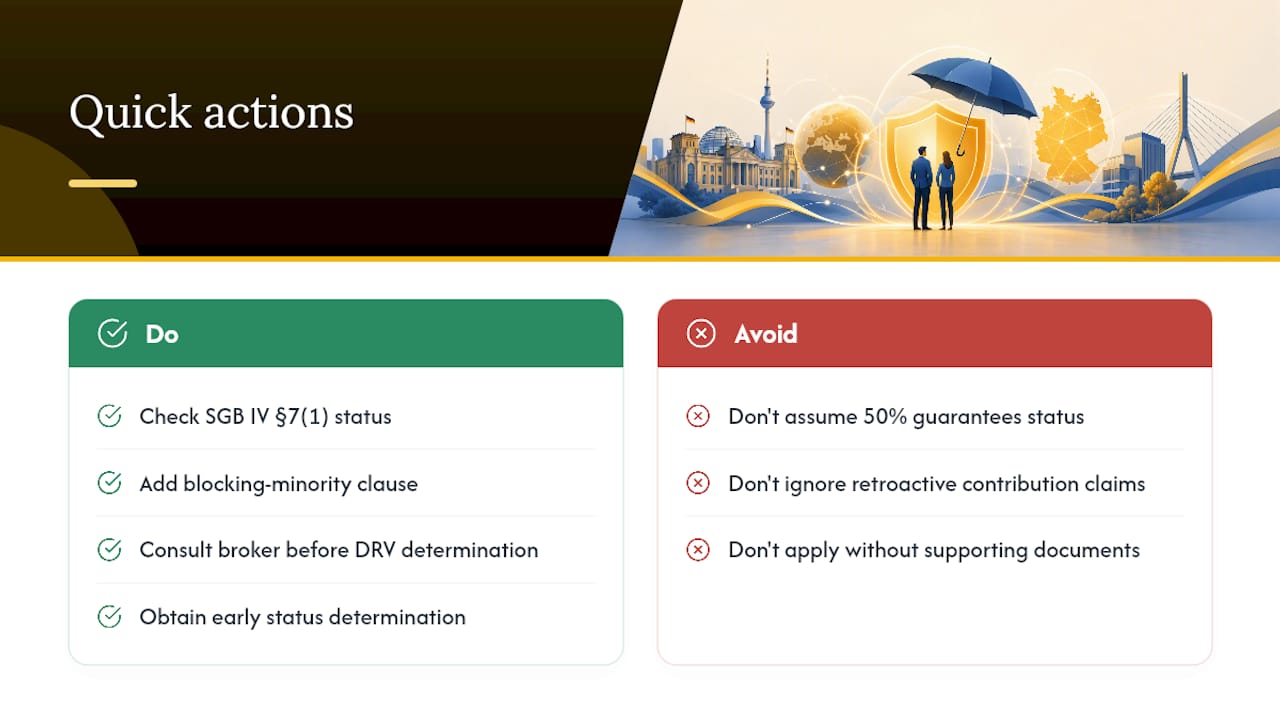
- Your articles of association, with particular attention to voting rights and any blocking-minority clause.
- The shareholder register showing your exact percentage and class of shares.
- Your service or employment contract, including how remuneration is structured (fixed salary versus profit-dependent pay).
- Minutes or records that show whether you're actually free from instruction in daily decisions.
- Any documentation of sole representation authority or dismissal-for-cause protections written into your role.
Flag anything ambiguous rather than hoping it goes unnoticed. A vague or missing blocking-minority clause is exactly the kind of gap that recent case law has started to test, particularly for 50/50 shareholding structures once assumed to guarantee self-employed status automatically.
When you talk to a broker or insurer, ask direct questions: how do they verify your employment status, what documentation does PKV underwriting actually require, and can they offer conditional onboarding while a DRV determination is still pending? A pre-check on eligibility built around this same documentation is often what speeds up underwriting on the insurer's side too.
Pro Tip: Get a broker to run an eligibility pre-check before you change your shareholding percentage or sign a new contract. Adjusting either afterward to fix a status problem is far harder than getting it right the first time.
Mistakes That Trigger Back Payments and Delays
The costliest errors here are almost always avoidable, and they repeat across cases:
- Assuming the title "managing director" settles the question. It doesn't. Self-employed status depends on documented voting power and freedom from instruction, not what's printed on a business card.
- Relying on informal control ("everyone knows I run things") instead of legally enforceable rights written into the articles of association.
- Waiting for a dispute, audit, or dismissal to trigger a DRV review instead of requesting one early.
- Failing to document your remuneration structure and shareholder powers clearly enough for a PKV application to hold up under scrutiny.
Each of these is a paperwork problem with a paperwork solution, if you address it before an authority forces the issue.
How Myhealthcarebroker Handles Your Eligibility Check
Sorting out your status and finding the right policy shouldn't require translating German legal text at 11 p.m. Myhealthcarebroker runs a practical eligibility pre-check for PKV that looks at exactly what the DRV would look at: your articles of association, shareholder rights, and contract terms, before you commit to anything.
From there, the support is hands-on rather than generic. That includes reviewing your governing documents for the blocking-minority language that actually matters, helping prepare a status file if you need a formal DRV determination, and packaging your application so an insurer sees a complete, consistent picture the first time rather than a patchwork that invites follow-up questions. Everything runs in plain English, with ongoing support after you're enrolled, not just up to the point of signature. If you're unsure where you stand, check your eligibility for private health insurance directly rather than guessing based on your job title.
Why early clarity matters more than people assume
The pattern I've seen play out again and again is simple: shareholders wait until an insurer, an auditor, or an ex-business-partner forces the status question, and by then the fix is expensive. Getting a clear read on your control rights before you apply for PKV, or before you restructure your shareholding, is cheaper in every case than untangling it retroactively. Myhealthcarebroker's English-language advisory work exists precisely because most shareholder-managing directors get this paperwork wrong the first time, not because the rules are impossible to meet.
Frequently Asked Questions
Can a GmbH shareholder always choose private health insurance? No. Eligibility depends on your social-security status under SGB IV §7(1), not on being a shareholder alone. You need enforceable control, such as a blocking minority or majority voting power, plus freedom from instruction.
What happens if the DRV decides I was actually an employee all along? The GmbH can face retroactive claims for unpaid employer and employee contributions, plus interest, according to Haufe. Early status determination avoids this exposure entirely.
Does a 50% shareholding automatically guarantee self-employed status? Not reliably anymore. Recent court decisions have challenged that assumption, so explicit blocking-minority clauses in the articles of association matter more than the raw percentage.
Can non-German residents who are GmbH shareholders get private health insurance? Yes, if their social-security status supports it and they meet standard PKV entry conditions. The same SGB IV §7(1) test applies regardless of nationality or residency history.
Should I talk to a broker before or after the DRV determination? Before, if possible. A broker can run an eligibility pre-check and help organize your documentation so your DRV file and your PKV application tell a consistent, defensible story.
This article is general information, not a substitute for advice from a qualified financial advisor. Consult a qualified financial professional about your own circumstances before acting on anything here.
Sources
- Status of managing director — IHK Berlin
- Social security contributions for managing directors of a limited liability company (GmbH) | Stripe