
Pflegezusatzversicherung (German for "supplementary nursing care insurance") is a private top-up policy that fills the gap between what Germany's statutory long-term care system pays and what care actually costs. The closest U.S. equivalent is Long-Term Care Insurance (LTCI). One critical point up front: Medicare and Medigap do not cover long-term custodial care, so neither maps to this German product.
TL;DR:
- What it covers: Nursing care at home or in a facility, paid caregivers, some assistive devices — not room and board or non-care medical costs.
- Key limitation: Germany's statutory care system leaves a significant out-of-pocket gap; this policy is designed to close it, but premiums can rise over time.
- Next step: If you're a U.S. resident, compare standalone LTCI policies or hybrid life/LTC products with a licensed agent before assuming any German policy applies to your situation.
Table of Contents
- What does Pflegezusatzversicherung actually cover?
- How does U.S. long-term care coverage compare?
- Who should seriously consider a supplementary care policy?
- What drives premiums and when do benefits actually pay?
- What are your alternatives if you don't buy a policy?
- Questions to ask before you sign anything
- Key Takeaways
- Why cross-border care planning is harder than it looks
- How Myhealthcarebroker can help you navigate German insurance
- Useful sources and where to verify the details
What does Pflegezusatzversicherung actually cover?
Germany's statutory long-term care insurance (gesetzliche Pflegeversicherung) only partly covers total care costs. Private supplementary care insurance exists specifically to bridge that shortfall.
The care gap is real and often large. Out-of-pocket costs for ambulatory (home-based) care in common care grades can reach significant monthly amounts. Inpatient nursing facility costs frequently run substantially above what statutory insurance pays. Without a supplementary policy, those amounts come directly from your savings or assets.
Three product designs exist, each with different tradeoffs:
- Pflegetagegeld (daily allowance): pays a fixed daily amount regardless of actual costs, giving maximum flexibility on how you spend it.
- Pflegekostenversicherung (cost reimbursement): reimburses documented care expenses up to a set maximum; less flexible but directly tied to real costs.
- Pflegerentenversicherung (care pension): structured as life insurance, paying a monthly pension for life once a care need is confirmed; premiums generally don't increase, but benefits are fixed at contract start unless a dynamic adjustment clause is included.
Benefits are triggered by Germany's official care grades (Pflegegrade 1–5), which assess functional impairment. Most policies require at least care grade 2 before full benefits pay out; some pay partial amounts at grade 1. Typical exclusions across all three models include accommodation and meals in care facilities, non-care medical treatment, and most assistive devices beyond a basic list.
How does U.S. long-term care coverage compare?
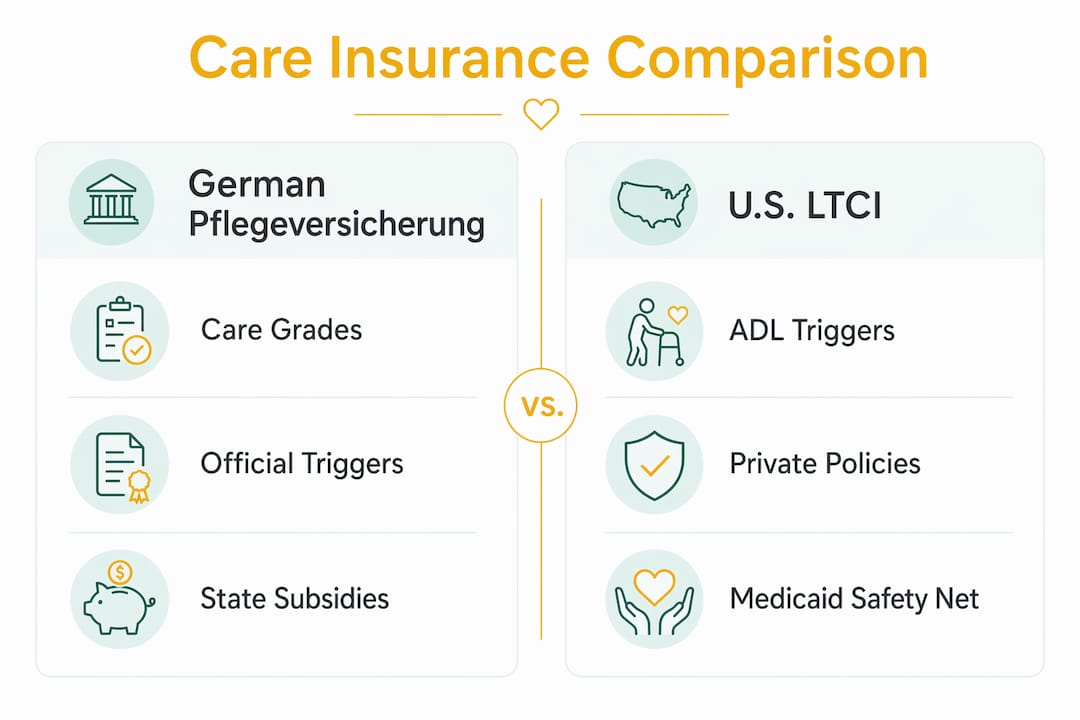
The German product and U.S. LTCI share the same core purpose: covering care costs that standard health insurance won't touch. But they operate under entirely different legal systems, and the differences matter for any cross-border decision.

Medigap plans help pay Original Medicare's copayments and deductibles. They do not cover long-term custodial care, nursing home stays, assisted living, or home health aides beyond skilled care. Confusing Medigap with a care supplement policy is one of the most common cross-border planning mistakes.
U.S. LTCI policies typically trigger benefits when a person cannot perform a set number of Activities of Daily Living (ADLs) such as bathing, dressing, or eating, or when cognitive impairment is diagnosed. German care grades use a broader functional scoring system, but the underlying intent is similar. For cross-border planning, map German Pflegegrade triggers to U.S. ADL triggers when comparing policies.
Medicaid is the U.S. means-tested safety net that does cover long-term care, but only after most personal assets are spent down to state-defined thresholds. It is not a purchased insurance product; eligibility rules vary significantly by state.
| Coverage type | What it covers | Typical payer | Eligibility / trigger |
|---|---|---|---|
| German Pflegezusatzversicherung | Care costs above statutory benefit | Private insurer | Care grade 2–5 (statutory assessment) |
| U.S. Long-Term Care Insurance | Home care, assisted living, nursing facility | Private insurer | 2+ ADL limitations or cognitive impairment |
| Medicare / Medigap | Hospital, medical, skilled nursing (short-term) | Federal + private | — |
| U.S. Medicaid | Long-term custodial care | State + federal | Means-tested; asset spend-down required |
Who should seriously consider a supplementary care policy?
A supplementary care policy makes the most sense when several conditions align. Stiftung Warentest recommends addressing liability coverage, occupational disability insurance, and a solid retirement plan before buying a Pflegezusatzversicherung, because for many people those protections deliver more value per premium dollar.
Consider a policy more seriously if you:
- Are in your 40s or 50s and in good health (premiums rise sharply with age and health conditions).
- Have moderate assets you want to protect from care costs without relying on Medicaid spend-down.
- Have limited family support available for informal caregiving.
- Are planning to live or retire in Germany, where the statutory system's gaps are well-documented.
- Want to preserve the choice of care provider and location rather than defaulting to whatever Medicaid covers.
A policy is less likely to make sense if you:
- Have substantial liquid assets and genuinely prefer self-funding.
- Are already engaged in Medicaid planning with an elder law attorney.
- Have not yet secured disability insurance or adequate retirement savings.
Supplementary policies also protect family members from financial pressure. In Germany, spouses carry an obligation to contribute to care costs, and adult children may be required to contribute if their gross annual income exceeds €100,000.
What drives premiums and when do benefits actually pay?
The single biggest cost lever is your age at application. Entering a policy at 45 costs considerably less per month than entering at 60, but it also means decades of premiums before you're likely to need benefits. That long-term commitment deserves careful thought.
Other primary cost drivers include your health status at underwriting, the daily benefit amount or monthly pension you select, the benefit period (lifetime vs. a fixed number of years), and whether you add an inflation or dynamic adjustment clause. Policies without dynamic adjustment may look affordable today but deliver benefits worth far less in real terms 20 years from now.
Pro Tip: Watch how "contribution waiver" is defined in any policy you review. Policies that stop requiring premiums once you reach a defined care grade often offset that feature with higher initial pricing or tighter dynamic benefit clauses. Read the contract language carefully, not just the marketing summary.
Waiting periods are common. Many policies require a qualifying period of several months after purchase before any benefit is payable. Once a care need is confirmed, the assessment process itself takes time. Budget for a gap between when care begins and when the first payment arrives.
Premium increases over the policy's life are a recognized consumer risk. Consumer litigation in Germany shows that insurers can raise premiums when actuarial conditions change, and successful legal challenges are limited. That risk is real whether you hold a German policy or a U.S. LTCI policy; the long-term care insurance market has faced pricing pressure on both sides of the Atlantic.
What are your alternatives if you don't buy a policy?
No single strategy works for everyone. The right mix depends on your assets, family situation, and risk tolerance.
| Strategy | How it works | Key tradeoff |
|---|---|---|
| Dedicated savings / self-funding | Set aside liquid assets specifically for care costs | Full control; full exposure if costs exceed savings |
| Hybrid life/LTC product | Life insurance with an LTC rider; unused LTC benefit pays as death benefit | More flexible than standalone LTCI; typically higher premium |
| Reverse mortgage | Converts home equity to income for care costs | Reduces estate; requires homeownership with sufficient equity |
| Medicaid planning | Legal asset structuring with an elder law attorney | Requires advance planning; strict look-back rules apply |
| VA benefits | Aid and Attendance benefit for qualifying veterans | Eligibility-limited; covers some home and facility care |
| Family caregiving | Informal care by relatives | Reduces financial cost; significant burden on caregivers |
Germany's state-subsidized Pflege-Bahr program offers a €5 monthly government subsidy when you contribute at least €10 per month toward a qualifying daily allowance policy. Access is broader because insurers cannot require a medical exam under this program. However, benefits are limited, premiums are still expected to rise, and the coverage rarely closes the full care gap. For U.S. residents, this program has no domestic equivalent and does not transfer across borders.
For practical U.S.-focused guidance on LTCI claims and coverage basics, reviewing what triggers a claim and how reimbursement works is a useful starting point before you meet with an agent.
Questions to ask before you sign anything
Whether you're evaluating a German policy or a U.S. LTCI product, these questions cut through the marketing language:
- Benefit triggers: What exactly qualifies as a care need? How many ADLs (U.S.) or which care grade (Germany) must be reached before benefits start?
- Waiting period: How long after a care need is confirmed before the first payment is made?
- Inflation protection: Are benefits indexed to inflation, or fixed at today's amounts?
- Premium increases: Under what conditions can the insurer raise your premium, and by how much?
- Portability: If you move between countries, does the policy remain valid? German policies generally do not follow you to the U.S., and vice versa.
- Contribution waiver: At which care grade do premium payments stop, and is that clause guaranteed or conditional?
- Home care coverage: Does the policy cover informal care provided by family members, or only licensed professionals?
- Claims process: What documentation is required, and within what timeframe must you file after a care need arises?
For underwriting, expect questions about your current health status, any chronic conditions, recent hospitalizations, and medications. Applying while healthy and younger gives you the best chance of approval at a standard rate.
If you're planning to live in Germany, understanding what private health insurance covers in that system is the right first step before layering on supplementary care products.
Key Takeaways
Pflegezusatzversicherung fills the care cost gap that Germany's statutory system leaves open; the closest U.S. equivalent is Long-Term Care Insurance, and neither Medicare nor Medigap covers custodial care.
| Point | Details |
|---|---|
| German term defined | Pflegezusatzversicherung is a private top-up policy covering care costs above Germany's statutory benefit. |
| Closest U.S. equivalent | U.S. Long-Term Care Insurance (LTCI) serves the same purpose, triggered by ADL limitations or cognitive impairment. |
| Medicare/Medigap limitation | Medicare and Medigap do not cover long-term custodial care; a separate LTCI or Medicaid plan is required. |
| Buy younger, pay less | Premiums rise with age and health status; entering a policy in your 40s or 50s lowers cost but creates a long-term commitment. |
| Myhealthcarebroker guidance | Myhealthcarebroker helps English-speaking expats compare German supplementary care and private health options with independent, jargon-free advice. |
Why cross-border care planning is harder than it looks
Most articles on this topic treat Pflegezusatzversicherung as a straightforward product to explain and move on. The harder truth is that the jurisdictional mismatch between German and U.S. insurance law creates real planning traps that a product description alone won't help you avoid.
German care grades and U.S. ADL triggers are conceptually similar but legally distinct. A policy that pays at Pflegegrad 2 in Germany does not automatically translate to a benefit trigger a U.S. insurer would recognize. If you hold both a German supplementary policy and a U.S. LTCI policy, the coordination of benefits between them is not automatic and may require separate claims processes in two countries.
The other underappreciated issue is premium sustainability. Entering a policy young looks smart on paper, but a 40-year premium commitment is only valuable if the insurer remains solvent, the policy terms hold, and your financial situation doesn't change. Self-funding or a hybrid product may actually offer more resilience for some readers, not because the insurance is bad, but because flexibility has real value over a 30–40 year horizon.
The right answer is almost never "buy the policy" or "skip it entirely." It's a structured comparison of your specific assets, family situation, and likely care scenario, ideally with both a U.S. elder law attorney and a German insurance specialist in the room.
How Myhealthcarebroker can help you navigate German insurance
If you're moving to Germany or evaluating German health and care coverage in English, Myhealthcarebroker offers independent, broker-level guidance with no insurer ties. The practical difference: you get a comparison across providers, not a pitch for one.
For expats, the first question is usually whether you need private health insurance in Germany at all, and how supplementary care products fit alongside it. Myhealthcarebroker walks you through eligibility, product differences, and contract wording in plain English, so you're not guessing at German-language policy documents. For U.S.-specific questions on Medicaid planning or estate protection, you'll need a licensed U.S. elder law attorney; Myhealthcarebroker focuses on the German side of that equation.
Ready to get clarity on your German coverage options? Book a consultation and get straightforward answers without the jargon.
This article is general information, not legal, financial, or insurance advice. Confirm current rules with the relevant authorities or a qualified professional for your specific situation.
Useful sources and where to verify the details
State Medicaid rules vary significantly. Always check your state's Medicaid agency for current eligibility thresholds and asset rules, as federal guidelines set a floor but states set the details.
- Medicare.gov — Medigap: Official U.S. source for what Medicare Supplement plans cover and exclude, including the explicit exclusion of long-term custodial care.
- gesund.bund.de — Pflegezusatzversicherung: Germany's federal health portal with plain-language explanations of all three supplementary care product models and the Pflege-Bahr subsidy program.
- Stiftung Warentest: Germany's leading independent consumer testing organization; their analysis of supplementary care insurance includes premium risk warnings and prioritization advice.
- Germany Handbook — Pflegeversicherung: Practical expat-focused overview of Germany's statutory care system and the role of private supplementary policies.
- Your state Medicaid agency: Search "[your state] Medicaid long-term care" for current eligibility rules, asset limits, and look-back periods specific to where you live.