
Canceling your private health insurance (PKV) in Germany follows a clear statutory framework, but the exact deadline depends on which type of termination applies to your situation. Under § 205 Abs. 1 VVG, the standard PKV Kündigungsfrist is three months to the end of the insurance year — for most insurers, that means your written termination must arrive by September 30 for the contract to end on December 31. Special circumstances shorten that window considerably: a contribution increase gives you just two months from the date you receive the insurer's notice (§ 205 Abs. 4 VVG), and switching to statutory health insurance (GKV) allows retroactive cancellation up to three months back (§ 205 Abs. 2 VVG).
Before you write a single word of your termination letter, check three things in your contract:
- Insurance year definition: Does your insurer use the calendar year (January 1 to December 31) or a contract year running from your start date?
- Minimum contract duration: Many policies require you to stay for one to two years before ordinary termination is possible.
- Notice address: Terminations sent to the wrong address or department can be treated as not received.
Quick example: Your insurer uses the calendar year. The contract ends December 31. Your termination letter must be received by the insurer no later than September 30. If you mail it on September 29 and it arrives October 2, you have missed the deadline.
Key Takeaways
The most important rule in PKV cancellation is this: your termination letter must arrive at the insurer three months before the end of the insurance year, and it is only effective once you provide proof of new coverage when requested.
| Point | Details |
|---|---|
| Ordinary notice period | Three months to the end of the insurance year; September 30 for most calendar-year insurers. |
| Special termination window | Two months from receipt of a contribution-increase notice; termination takes effect when the increase would have applied. |
| GKV-entry retroactive right | Cancel up to three months back after GKV obligation begins; proof must be provided within two months of insurer's written request. |
| Proof requirement | A missing Mitgliedsbescheinigung makes the termination legally void; order it before sending your letter. |
| Myhealthcarebroker | Offers free, English-language deadline checks, document preparation, and transition support for PKV cancellations in Germany. |
Table of Contents
- What Is the PKV Kündigungsfrist and How Do You Calculate It?
- When Can You Use a Special Termination Right?
- How to Write a Valid Termination Letter and What Proof You Need
- What Happens If You Miss a Deadline or Fail to Provide Proof?
- Special Cases: Civil Servants, Anwartschaft Policies, Tariff Switches, and Students
- A Practical Perspective on PKV Cancellations
- Myhealthcarebroker Helps You Get the Cancellation Right
- Sources
What Is the PKV Kündigungsfrist and How Do You Calculate It?
The statutory basis is § 205 Abs. 1 VVG: ordinary termination of a PKV policy requires three months' notice to the end of the insurance year. That sounds simple, but "insurance year" is where most people get tripped up.
Calendar year vs. contract year
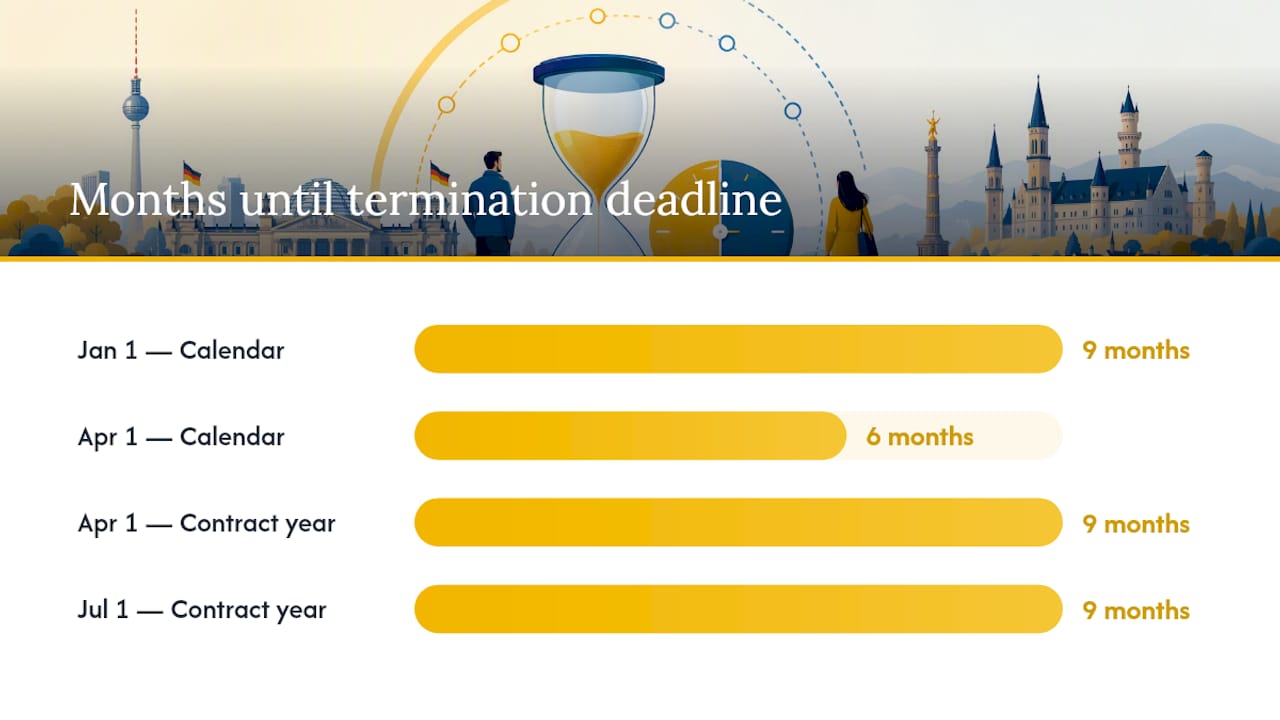
According to the PKV-Verband, many insurers define the insurance year as the calendar year, making December 31 the standard end date and September 30 the last day your termination can arrive. Some insurers, however, define the insurance year as 12 months from your policy start date. If your policy started on April 1, your insurance year ends March 31, and your termination must arrive by December 31.
| Contract start | Insurance year definition | Insurance year end | Termination must arrive by |
|---|---|---|---|
| January 1 | Calendar year | December 31 | September 30 |
| April 1 | Calendar year | December 31 | September 30 |
| April 1 | Contract year (12 months from start) | March 31 | December 31 |
| July 1 | Contract year (12 months from start) | June 30 | March 31 |
Minimum contract terms
Many PKV contracts include a minimum duration of one or two years. During that period, ordinary termination is not possible regardless of the notice period. If your policy started on January 1, 2025, and carries a two-year minimum term, the earliest you can ordinarily terminate is December 31, 2026, with your letter arriving by September 30, 2026. Consumer guides consistently flag this as one of the most common reasons terminations fail: the policyholder sends a valid letter on time but the minimum term has not yet expired.
What to verify in your contract documents:
- The exact definition of "Versicherungsjahr" (insurance year)
- The minimum contract duration clause ("Mindestvertragsdauer")
- The correct postal address for terminations (often different from the general correspondence address)
- Whether the contract requires a specific form of wording or reference number
Pro Tip: Call or email your insurer and ask them to confirm in writing which date your insurance year ends and when the next ordinary termination window opens. Keep that written confirmation. If a dispute arises later, you have documented evidence of what the insurer told you.
When Can You Use a Special Termination Right?
Ordinary termination is not your only option. German law grants policyholders specific extraordinary termination rights in three main scenarios, each with its own timeline.
Contribution increases and benefit reductions (§ 205 Abs. 4 VVG)
When your insurer raises premiums or reduces covered benefits, you have the right to terminate within two months of receiving the change notice. The termination takes effect at the moment the higher premium or reduced benefit would have applied, so you do not pay the increased rate even for a partial month.
Timing example: You receive a letter on November 1 stating that your premium will rise from January 1. Your two-month window runs until December 31. Your termination letter must arrive at the insurer by that date. If it does, the contract ends December 31 and you never pay the higher rate.
Handelsblatt's coverage of PKV special termination rights confirms this: the right begins on receipt and must be exercised within two months, with the termination effective at the time the premium would have risen.
Becoming subject to statutory insurance (§ 205 Abs. 2 and Abs. 6 VVG)
If you become legally required to join the GKV — for example, because your income drops below the Versicherungspflichtgrenze or you start a new job that triggers mandatory GKV membership — you can cancel your PKV retroactively for up to three months after the GKV obligation began. This is one of the most valuable rights in the system, because it eliminates double contributions during the transition.
Step-by-step process:
- Confirm your GKV start date with your new statutory insurer.
- Send your PKV termination letter immediately, stating the retroactive end date (the day before your GKV coverage began).
- Obtain your Mitgliedsbescheinigung (GKV membership certificate) from your new insurer as quickly as possible.
- Submit the Mitgliedsbescheinigung to your PKV insurer within two months of any written request they make for proof.
- Keep copies of every document and every piece of correspondence, with dates.
The official BMG guidance on switching between GKV and PKV confirms that immediate switches are possible in narrowly defined circumstances and that statutory requirements govern the timing of both systems.
Should you use the special right or wait for ordinary termination? If a contribution increase is modest and you are already close to your ordinary termination window, waiting may be simpler. But if the increase is substantial or you need to switch systems quickly, the two-month special window is worth using. The key difference: ordinary termination gives you more time to arrange replacement coverage; the special right is faster but requires you to act immediately.
How to Write a Valid Termination Letter and What Proof You Need
A PKV termination must be in writing. That is a hard legal requirement, not a formality. Verbal notices, emails without a qualified electronic signature, and informal messages do not satisfy the statutory form requirement and will be rejected.
Your termination letter needs to include:
- Your full name, address, and policy number
- A clear, unambiguous declaration that you are terminating the contract
- The termination date you are requesting (end of insurance year, or retroactive GKV date)
- Your signature
Courts have found that letters lacking a clear declaration of intent — for example, letters that only "request information about termination" — are not valid terminations. Keep the wording direct: "Hiermit kündige ich den Versicherungsvertrag [policy number] fristgerecht zum [date]."
Required proof documents
The documents you need depend on the type of termination:
- Ordinary termination: No proof required at the time of sending, but your new insurer's membership certificate may be requested later.
- GKV-entry termination: A Mitgliedsbescheinigung from your new statutory insurer, confirming your coverage start date.
- Civil servant (Beamte) termination: Written confirmation of Heilfürsorge entitlement from your employer.
Under § 205 Abs. 6 VVG, if the insurer requests proof of new insurance in writing, you have two months to provide it. Miss that window and the termination becomes legally ineffective, as confirmed by insurance law specialists: without the required follow-on proof, the old contract continues to bind you.
How to send the letter
Finanztip recommends sending your termination by registered mail (Einschreiben mit Rückschein). This gives you a timestamped receipt proving the letter arrived before the deadline. A standard Einschreiben (without return receipt) proves you sent it but not that it was delivered; the return receipt version proves both. Keep the postal receipt and the signed return card permanently.

Pro Tip: Request your Mitgliedsbescheinigung from your new insurer or employer on the same day you send your termination letter. Processing can take one to two weeks, and you need the document in hand before your PKV insurer's two-month proof deadline runs out.
What Happens If You Miss a Deadline or Fail to Provide Proof?
Missing the ordinary three-month deadline does not void your right to terminate. It simply pushes your earliest termination date to the next insurance year end. Your contract stays in force, premiums remain due, and you start the process again for the following year.
Missing the proof deadline after a GKV-entry termination is more serious. Under § 205 Abs. 6 VVG, if you do not provide the Mitgliedsbescheinigung within two months of a written request, the termination is legally ineffective. The PKV contract revives as if you never terminated it, and you owe all premiums from the retroactive date forward.
Two realistic scenarios:
Scenario A — Missed September 30 deadline: You send your termination letter on October 3 for a calendar-year insurer. It arrives October 5. The termination is invalid for December 31 of that year. Your contract runs for another full year. Your next ordinary termination window opens September 30 of the following year. Action: confirm the missed deadline in writing with your insurer, note the next valid date, and set a calendar reminder for August 31 to give yourself a full month's buffer.
Scenario B — Late GKV proof: You terminated your PKV retroactively when you joined GKV on March 1. Your PKV insurer sent a written proof request on April 15. The two-month deadline is June 15. You submit the Mitgliedsbescheinigung on June 20. The termination is ineffective. Your PKV contract continues, and you owe premiums from March 1 onward. Action: contact your insurer immediately, explain the delay, and request a goodwill extension in writing. If the insurer refuses, escalate to the PKV-Ombudsmann.
Escalation steps when the insurer disputes your termination
- Send a written request asking the insurer to state its position on the termination's validity.
- Gather all evidence: postage receipts, return cards, copies of letters, and proof of new insurance.
- File a complaint with the PKV-Ombudsmann, the industry's no-cost arbitration body. The Ombudsmann handles disputes up to €10,000 and can compel insurers to respond formally.
- If the Ombudsmann cannot resolve the dispute, consult a specialist in insurance law (Fachanwalt für Versicherungsrecht). German courts have ruled on § 205 VVG cases extensively, and a specialist can assess whether the insurer's position is legally defensible.
Special Cases: Civil Servants, Anwartschaft Policies, Tariff Switches, and Students
Not every PKV policyholder follows the standard path. Several groups face different rules or have better alternatives than full termination.
-
Civil servants (Beamte) with Heilfürsorge: If you become entitled to full Heilfürsorge coverage through your employer, you can terminate your PKV immediately, without waiting for the ordinary notice period. You need written confirmation of the Heilfürsorge entitlement from your employer as proof. The PKV-Verband and the PKV-Ombudsmann both provide guidance on civil-servant termination cases.
-
Anwartschaftsversicherungen (dormant policies): These are reduced-premium policies that preserve your PKV entry conditions while you are temporarily ineligible for full PKV coverage (for example, during parental leave or a period of GKV membership). Terminating an Anwartschaft follows the same § 205 VVG rules, but you should weigh the long-term cost carefully: canceling it permanently means losing the age-related reserves (Alterungsrückstellungen) you have built up, which raises your future premiums significantly.
-
Tariff switch within the same insurer: Under § 204 VVG, you have the right to switch to a comparable tariff within your current PKV insurer without terminating the contract. This preserves your Alterungsrückstellungen and avoids a new health assessment. For many policyholders facing a premium increase, a tariff switch is a better option than full termination. See PKV premium optimization strategies for how this works in practice.
-
Self-employed individuals: You are not subject to mandatory GKV, so the GKV-entry special termination right rarely applies to you. Your only route is ordinary termination or the contribution-increase special right. The timing trap for self-employed policyholders is assuming the insurance year matches the calendar year without checking the contract first.
-
Students: Student PKV policies often carry specific minimum terms and lower premiums tied to student status. When you graduate or exceed the age limit for student tariffs, your policy terms change automatically. Check whether that change triggers a Sonderkündigungsrecht. For students considering private health insurance options, the transition timing from student to standard tariff is a common source of confusion.
A Practical Perspective on PKV Cancellations
The single most underestimated risk in PKV cancellations is not missing the September 30 deadline. Most people know about that one. The real trap is the proof requirement. Policyholders send a perfectly valid, on-time termination letter and then assume the job is done. Weeks later, the insurer sends a written request for the Mitgliedsbescheinigung. The policyholder misses it, perhaps because it arrives during a busy period or gets lost in a pile of German-language mail. The two-month clock runs out. The termination is void.
At Myhealthcarebroker, we see this pattern regularly among expats who are managing a GKV transition alongside a job change, a visa renewal, and a move. The German-language proof request from the PKV insurer does not look urgent. It often arrives as a standard letter with no bold warnings. By the time someone translates it and understands what it is asking for, the window has closed.
The fix is simple: order your Mitgliedsbescheinigung before you send the termination letter, not after. That way, you can attach it to the termination itself and eliminate the proof deadline entirely. Finanztip makes the same recommendation, and it is the single most practical step you can take to protect your termination.
Myhealthcarebroker Helps You Get the Cancellation Right
Navigating PKV termination deadlines in a second language, while managing everything else that comes with living and working in Germany, is genuinely difficult. Myhealthcarebroker offers practical, English-language support for every step: calculating your exact termination deadline based on your contract's insurance year, preparing your termination letter with the correct wording, and obtaining the right proof documents before you need them.
This is not formal legal advice. It is hands-on, practical assistance from independent consultants who work with PKV policies every day. The service is free to you as a client; Myhealthcarebroker is paid a regulated commission by the insurer only when a policy is arranged. Whether you are canceling to switch to public health insurance, moving to a new PKV, or simply exploring your options, the process starts with a free eligibility check that typically takes the same day. You can also access full concierge support at Myhealthcarebroker if you want someone to handle the paperwork end-to-end. Start with a free consultation at Myhealthcarebroker and get clarity on your deadline today.
Sources
These are the authoritative sources to verify the rules covered in this article. Government and statutory sources carry the highest legal weight; consumer-advice sites are useful for practical guidance and templates.
- Ablehnung und Kündigung der PKV
- Kündigung der privaten Krankenversicherung
- Private Krankenversicherung kündigen: Fristen & Vorlage
This article is general information, not a substitute for advice from a qualified financial advisor. Consult a qualified financial professional about your own circumstances before acting on anything here.