
PKV premium optimization for high earners is the practice of using legal tariff switching rights, premium relief riders, and tax deductions to reduce private health insurance costs without sacrificing coverage quality. Germany's private health insurance system, known as PKV (Privatekrankenversicherung), sets premiums based on your entry age, health status, and tariff choice, not your income. That single fact opens a set of tools that statutory GKV members never access. This guide covers the key mechanisms: the § 204 VVG tariff switch right, the Beitragsentlastungstarif (BET) rider, and the tax deductibility rules under § 10 EStG.
How are PKV premiums calculated for high earners?
PKV premiums depend on five factors: entry age, individual health underwriting, tariff scope, deductibles (Selbstbeteiligung), and optional riders. Income plays no role whatsoever. That distinction matters because it means a high earner and a mid-level employee with identical health profiles pay the same base premium for the same tariff.
Entry age is the most powerful pricing variable. The younger you are when you sign up, the lower your base premium, and the larger the age reserves (Altersrückstellungen) you build over time. Those reserves act as a buffer against steep premium increases as you get older.

Optional riders add meaningful cost. A Krankentagegeld rider, which pays a daily benefit if you cannot work due to illness, can add €50–€150 per month depending on the benefit level you choose. Matching this rider accurately to your actual income protection needs avoids overpaying for coverage you do not need.
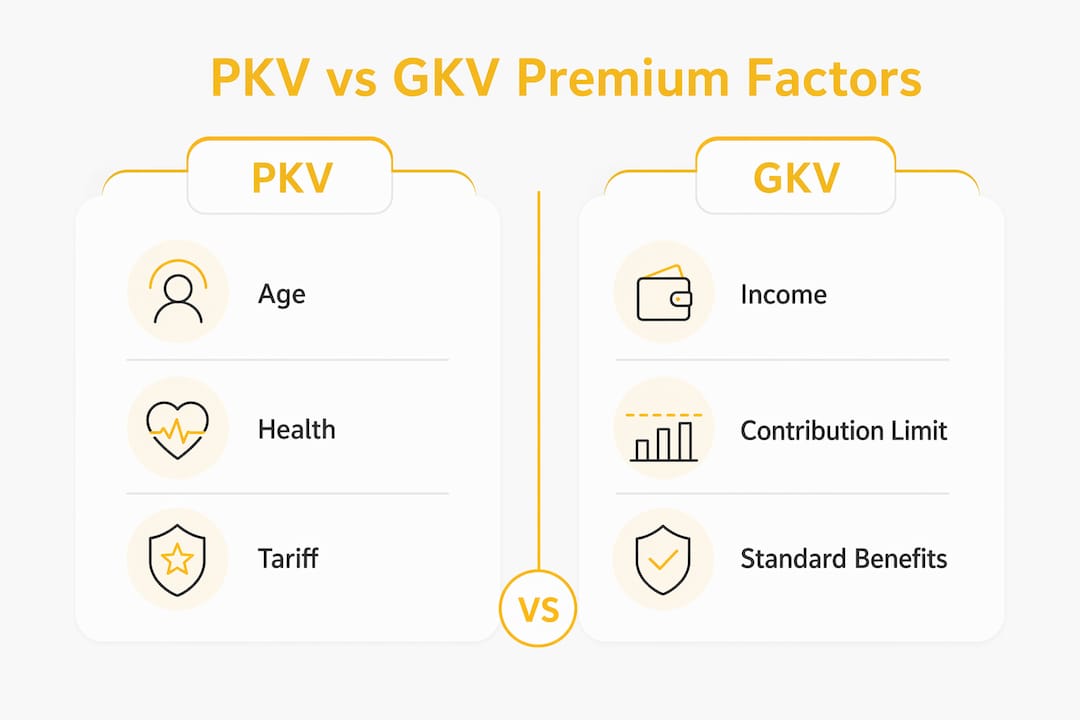
The table below shows how PKV and GKV differ on the factors that drive cost.
| Factor | PKV | GKV (statutory) |
|---|---|---|
| Premium basis | Age, health, tariff | Income (up to contribution ceiling) |
| Income effect | None | Direct |
| Deductible option | Yes (Selbstbeteiligung) | No |
| Optional riders | Yes | No |
| Age reserves | Yes (Altersrückstellungen) | No |
What legal rights let you reduce PKV premiums without losing coverage?
The single most powerful tool for premium management is the tariff switch right under § 204 VVG. This law gives every PKV policyholder the right to switch to a different tariff within the same insurer, with no new health underwriting, as long as the new tariff offers comparable or lower benefits. Your accumulated Altersrückstellungen carry over in full.
That last point is critical. Switching insurers entirely means starting fresh with new health checks and losing your age reserves. An internal tariff switch under § 204 VVG preserves everything you have built. The right route depends on your insurer's long-term premium track record and your current health profile.
The catch is that insurers are legally required to show you their full tariff catalogue, but they often highlight options that protect their own margins. An independent review of the complete catalogue is the only way to find the genuinely best alternative. Most policyholders who rely on insurer-suggested options miss better tariffs that exist in the same catalogue.
The steps below give you a practical framework for executing a tariff switch.
- Request your insurer's complete tariff catalogue in writing, citing § 204 VVG.
- Compare all available tariffs against your current one, focusing on premium difference and benefit changes.
- Engage an independent broker to review options your insurer may not have highlighted.
- Submit a formal tariff switch request once you identify the best alternative.
- Confirm in writing that your Altersrückstellungen carry over to the new tariff.
Pro Tip: Review your tariff options every 3–5 years. Insurer catalogues evolve, and periodic tariff reviews keep your contract matched to your actual needs while capturing newer, lower-cost tariff structures.
How does the Beitragsentlastungstarif (BET) rider reduce retirement premiums?
The Beitragsentlastungstarif, commonly called BET, is a contractual rider you add to your PKV policy specifically to reduce your premium once you retire. You pay a small additional amount each month during your working years, and those contributions build a reserve that offsets your premium in retirement. Think of it as pre-funding a discount on your future health insurance bill.
A BET rider typically reduces retirement-era PKV premiums by €250–€500 per month, depending on your entry age and how long you contribute. That is a meaningful reduction for retirees whose income drops sharply after leaving employment.
Key facts about BET worth knowing:
- You can add a BET rider at any point during your policy, including mid-career, with no new health underwriting required.
- Starting earlier builds a larger reserve and produces a bigger retirement reduction, but adding BET at age 45 or 50 still delivers real savings.
- The Altersrückstellungen mechanism already helps stabilize premiums for aging cohorts, but BET stacks on top of that, giving you a second layer of cost control.
- BET reserves are insurer-specific and do not transfer if you switch insurers, which is one reason internal tariff switching often makes more sense than changing providers.
The strategic case for BET is straightforward. Retirement is when PKV premiums feel most burdensome because your income falls while your healthcare use rises. Adding BET now, even if you are in your late 40s, softens that blow considerably. Myhealthcarebroker regularly helps clients model the exact monthly cost of adding BET against the projected retirement savings to confirm whether the math works for their situation.
What tax strategies help high earners maximize PKV cost efficiency?
German tax law offers high earners a direct financial benefit on their PKV premiums. Under § 10 Abs. 1 Nr. 3 EStG, the Basisabsicherung portion of your PKV premium, roughly 80–90% of the total, is fully tax-deductible without a cap. This deductibility was introduced through the Bürgerentlastungsgesetz in 2010 and applies to the basic coverage component that mirrors what statutory GKV would provide.
For high earners in the top income tax bracket, that deduction translates into a real reduction in effective premium cost. The comfort riders you add on top, such as single-room hospital accommodation or extended dental coverage, do not qualify for the same unlimited deduction. Tax deductibility caps are often exhausted by the Basisabsicherung portion alone, meaning additional voluntary riders yield no further tax advantage for most PKV members.
A less commonly used tactic is premium prepayment. Under § 10 Abs. 1 Nr. 3 Satz 5 EStG, you can prepay up to three years of PKV premiums in a single tax year and deduct the full amount in that year. This works well in years when your income is unusually high, such as a bonus year or a year with a large capital gain.
Practical tax tips for PKV holders:
- Confirm with your tax advisor which portion of your premium qualifies as Basisabsicherung each year, as insurers provide this breakdown on request.
- Use the Günstigerprüfung: the German tax office automatically calculates whether the standard deduction or the actual premium deduction benefits you more.
- Coordinate prepayment decisions with your tax advisor before december 31 to capture the deduction in the correct tax year.
- Do not assume comfort riders add tax value. Focus deduction planning on the Basisabsicherung component.
Pro Tip: Ask your insurer for the annual Basisabsicherung certificate (Bescheinigung). This document confirms the deductible portion of your premium and is required for your tax return. Many policyholders skip this step and leave money on the table.
What step-by-step process should high earners follow to optimize PKV premiums?
Effective premium management combines tariff switching, BET, deductible adjustment, and tax planning into a single coordinated review. The table below summarizes the four core actions and their primary benefit.
| Action | Primary benefit |
|---|---|
| Tariff switch (§ 204 VVG) | Lower monthly premium, preserved reserves |
| BET rider addition | Reduced retirement-era premium |
| Deductible increase | Immediate premium reduction |
| Premium prepayment | Concentrated tax deduction in high-income year |
The process works best when you treat it as a structured review rather than a one-off fix.
- Analyze your current tariff. Pull your policy documents and identify your current tariff name, monthly premium, deductible level, and active riders. This baseline tells you where the savings potential sits.
- Request the full tariff catalogue. Write to your insurer citing § 204 VVG and ask for all available alternative tariffs. Do not accept a shortlist. You need the complete catalogue.
- Run an independent comparison. An independent broker reviews the full catalogue and compares internal options against the potential benefit of switching insurers. The right route depends on your insurer's premium history and your health profile.
- Add or top up BET. If you do not have a BET rider, model the cost against projected retirement savings. If you already have one, check whether increasing the contribution level makes sense given your age and retirement timeline.
- Align with tax planning. Coordinate any contract changes and prepayment decisions with your tax advisor before the end of the tax year. Timing matters for capturing the full deduction.
The most common mistake is accepting the first alternative tariff your insurer suggests. Insurers are legally obliged to offer the full range under § 204 VVG, but their default recommendation often protects their revenue. An independent full-catalogue review is the only way to be confident you are getting the best available option.
Key Takeaways
PKV premium optimization for high earners works through three legal and financial levers: the § 204 VVG tariff switch right, the Beitragsentlastungstarif rider, and strategic use of § 10 EStG tax deductibility.
| Point | Details |
|---|---|
| Premiums ignore income | PKV pricing depends on age, health, and tariff, giving high earners direct control over cost. |
| § 204 VVG tariff switch | You can switch tariffs within your insurer with no health checks and full reserve carryover. |
| BET rider saves at retirement | A BET rider typically reduces retirement premiums by €250–€500 per month. |
| Tax deductibility is uncapped | The Basisabsicherung portion (roughly 80–90%) is fully deductible under § 10 EStG. |
| Review every 3–5 years | Regular tariff reviews keep your contract efficient as insurer catalogues evolve. |
Why most high earners leave PKV savings on the table
From my experience working with high-earning professionals and expatriates in Germany, the pattern is almost always the same. People sign up for PKV when they first become eligible, choose a solid tariff, and then never look at it again. Five years later, they are paying a premium that no longer reflects either the market or their actual needs.
The insurer is not going to call you and suggest a cheaper tariff. That is not how the business works. What I have seen repeatedly is that a proper § 204 VVG review, done independently, finds meaningful savings that the policyholder had no idea existed. The legal right is there. The tools are there. The problem is awareness.
BET is the other area where I see consistent underuse. People hear "retirement planning" and assume it is something to think about at 55. The math says otherwise. Every year you delay adding BET is a year of reserve-building you cannot recover. I have seen clients in their late 40s add BET and still generate retirement savings that cover several months of premiums. It is not too late, but earlier is always better.
The tax angle surprises people most. The idea that you can prepay three years of premiums and deduct the full amount in a single high-income year is genuinely useful for anyone with variable earnings. Most policyholders have never heard of it. A good tax advisor and an independent broker working together can make a real difference to your effective annual cost.
PKV is not a set-and-forget product. It rewards the people who treat it as a dynamic contract and review it regularly.
— Marco
How Myhealthcarebroker helps you get more from your PKV
Myhealthcarebroker works with high-earning professionals and expatriates across Germany to review PKV contracts, identify tariff switch opportunities under § 204 VVG, and model BET rider additions against projected retirement savings. As an independent broker, Myhealthcarebroker is not tied to any single insurer, which means every recommendation comes from a full-catalogue review, not a shortlist shaped by insurer margins.
If you are paying more than you should for private health insurance in Germany, or if you have never had your tariff independently reviewed, a consultation with Myhealthcarebroker is the practical next step. The team advises in clear English, handles the German-language paperwork, and coordinates with your tax advisor where needed. You can also use the PKV cost calculator to get an initial read on your premium position before booking a call.
FAQ
What is PKV premium optimization for high earners?
PKV premium optimization is the process of reducing your private health insurance costs through tariff switching under § 204 VVG, adding a Beitragsentlastungstarif rider, and using tax deductions under § 10 EStG. High earners benefit most because their income tax bracket makes the Basisabsicherung deduction more valuable.
Can I switch PKV tariffs without a new health check?
Yes. Under § 204 VVG, you have a statutory right to switch tariffs within your current insurer with no new health underwriting, as long as the new tariff offers comparable or lower benefits. Your Altersrückstellungen carry over in full.
When should I add a Beitragsentlastungstarif rider?
Adding BET as early as possible builds the largest reserve, but adding it in your late 40s or early 50s still produces meaningful retirement premium relief. No new health underwriting is required at any age.
How much of my PKV premium is tax-deductible?
The Basisabsicherung portion, roughly 80–90% of your total PKV premium, is fully deductible under § 10 Abs. 1 Nr. 3 EStG without a cap. Comfort riders above that level typically yield no additional tax benefit.
How often should I review my PKV tariff?
A tariff review every 3–5 years keeps your contract matched to your needs and captures newer, lower-cost tariff structures as insurer catalogues evolve. An independent broker review gives you access to the full catalogue, not just insurer-recommended options.