
Under Germany's statutory health insurance system (GKV), most prescription medications are covered, and your out-of-pocket cost is capped at 10% per pack, with a minimum of €5 and a maximum of €10. These rules are set by federal legislation under the Social Code Book V (SGB V) and apply uniformly across every sickness fund, as the German Federal Ministry of Health (Bundesministerium für Gesundheit, BMG) confirms. Private insurance (PKV) works differently: you pay the pharmacy upfront and file for reimbursement, with no Festbetrag (reference price) ceiling applied. Your first action right now: check your insurance card or ask your HR team whether you are on GKV or PKV, then read the relevant section below.
The single most important number for GKV members: your annual co-payments are capped at 2% of your gross income (1% if you are chronically ill). Once you hit that threshold, you pay nothing more for the rest of the calendar year. Myhealthcarebroker can help you confirm your status and understand what that cap means in euros for your salary level.
Key facts at a glance:
- Co-payment rule: 10% of the medication price, minimum €5, maximum €10 per pack; never more than the actual cost of the drug.
- Annual cap: 2% of gross annual income for most adults; 1% for chronically ill patients.
- Children under 18 are fully exempt from prescription co-payments.
- OTC medications are generally not covered under GKV for adults.
- PKV members pay the full pharmacy price upfront and submit receipts for reimbursement.
Table of Contents
- How does prescription coverage in Germany actually work?
- Which expats are covered, and what do you need to register?
- What are the exact co-payments and how do you stop paying once you hit the cap?
- From prescription to pharmacy: what actually happens at each step
- What GKV usually does not cover — and common surprises for expats
- A practical checklist for getting a prescription filled in Germany
- When does private insurance (PKV) make sense for prescription needs?
- Key Takeaways
- What expats consistently get wrong about German prescriptions
- Myhealthcarebroker makes German health insurance clear for expats
- Official sources and further reading
How does prescription coverage in Germany actually work?
Germany's system splits into two tracks, and which track you are on determines everything about how your prescriptions are handled.
GKV (statutory health insurance) covers most prescription drugs listed by the Joint Federal Committee (G-BA). When you hand over your prescription, the pharmacist bills your sickness fund directly. You pay only the statutory co-payment at the counter. The Festbetrag system sets a reference price for groups of therapeutically similar drugs; if your prescribed medication is priced above that reference, you pay the difference on top of the standard co-payment. Pharmacists are also required to dispense generics under Rabattverträge (discount contracts) that your sickness fund has negotiated with manufacturers, which is why the brand on your medication box can change between refills.
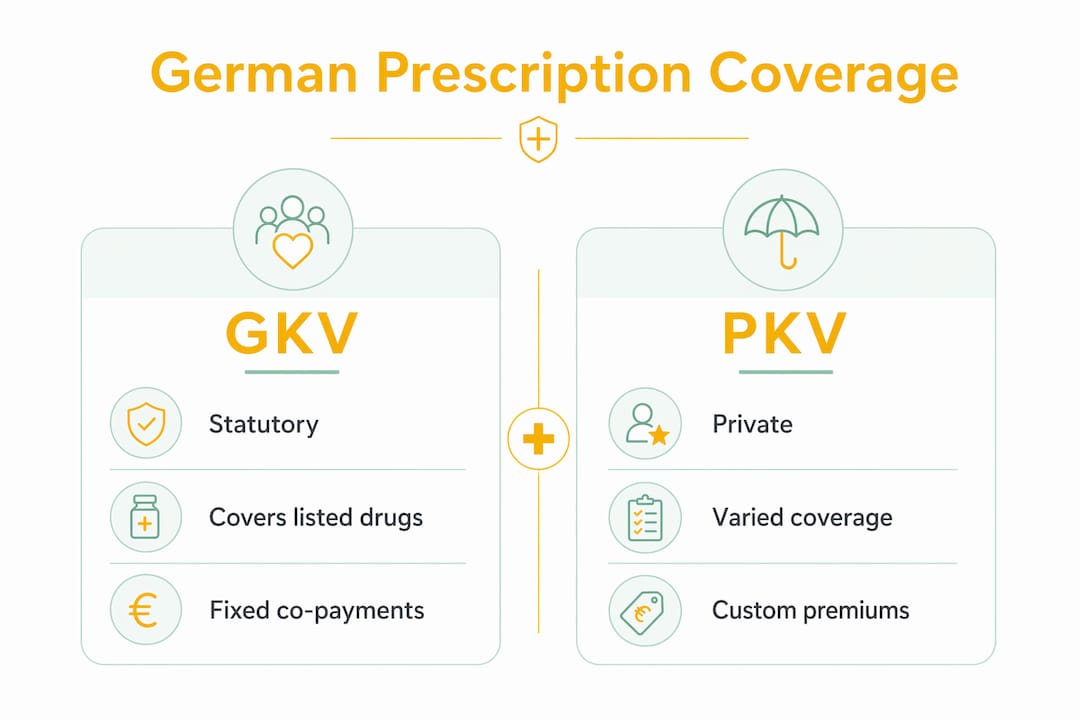
PKV (private health insurance) generally reimburses the actual billed price rather than a capped reference amount. No mandatory generic substitution applies, so you receive the brand your doctor prescribed. The catch: you pay the pharmacy in full at the point of sale and then submit the receipt to your insurer for reimbursement. Depending on your plan's terms, that process can take days or weeks.
A few terms worth knowing:
- GKV: Gesetzliche Krankenversicherung, statutory (public) health insurance.
- PKV: Private Krankenversicherung, private health insurance.
- Festbetrag: The reference price GKV will pay for a drug group; anything above it comes out of your pocket.
- Zuzahlung: Your statutory co-payment at the pharmacy.
- Aut-idem: A box on the prescription form; if the doctor crosses it out, the pharmacist cannot substitute a generic.
Which expats are covered, and what do you need to register?
Most employees in Germany earning below the annual income threshold are automatically enrolled in GKV through their employer. Higher earners above that threshold, civil servants, and the self-employed can opt into PKV. Students often qualify for subsidized GKV rates. If you are a freelancer or contractor, your options differ and are worth reviewing carefully before you register.
Steps to confirm your coverage and access prescriptions:
- Check your employment contract or HR onboarding documents to identify your insurer and insurance type.
- Confirm you have received your electronic insurance card (elektronische Gesundheitskarte, eGK) — you need it at every doctor visit and pharmacy.
- Register with a local GP (Hausarzt) as soon as possible; most specialists require a referral.
- Ask your HR team or insurer whether the e-prescription (elektronisches Rezept) system applies to your practice, as paper forms are being phased out.
- If you are on an EHIC from another EU country for a short stay, note that similar co-payment rules apply, though additional fixed fees may apply in cross-border contexts.
Documents to carry:
- Electronic insurance card (eGK) or proof of enrollment letter.
- Passport or national ID.
- Employer confirmation letter (useful in the first weeks before your card arrives).
- Pharmacy receipts from every prescription purchase — you will need these to track your annual cap.
What are the exact co-payments and how do you stop paying once you hit the cap?
The statutory co-payment rule is straightforward: a fixed proportion of the medication's retail price is paid by patients, subject to a minimum and maximum limit per pack. The co-payment can never exceed the actual cost of the drug.

Examples illustrate how co-payments are calculated for medications at different price points using minimum and maximum co-payment limits.
The annual protection cap is where many expats leave money on the table. Once your total co-payments across all health services reach 2% of your gross annual income (1% for chronically ill patients), your sickness fund issues an exemption card (Befreiungsausweis). From that point, you pay zero co-payments for the rest of the calendar year.
To apply, contact your sickness fund directly, submit your collected pharmacy receipts as proof, and request the exemption card. Many expats miss this entirely because the process is not automatic. Your fund will not send you a reminder.
Pro Tip: Start a simple spreadsheet on January 1 with one row per pharmacy visit. Log the date, medication name, and co-payment amount. When your running total approaches 2% of your gross income, contact your sickness fund immediately to apply for the exemption card rather than waiting until after you have already overpaid.
From prescription to pharmacy: what actually happens at each step
The everyday workflow is simpler than it sounds once you know the sequence.
For GKV members:
- Your doctor issues a prescription, either as a pink paper Kassenrezept or, increasingly, as an e-prescription sent directly to a pharmacy of your choice.
- A standard paper Kassenrezept is valid for about 28 days from the date of issue. If you miss that window, you need a new prescription.
- At the pharmacy, the pharmacist checks your sickness fund's Rabattvertrag list and dispenses the contracted generic unless the doctor has crossed out the Aut-idem box.
- You pay the co-payment (€5–€10) and receive a receipt. Keep it.
- The pharmacy bills your sickness fund directly for the remainder.
For PKV members:
- Your doctor issues a blue Privatrezept.
- You pay the full medication price at the pharmacy and collect the itemized receipt.
- Submit the receipt to your private insurer, either via their app, online portal, or by mail.
- Reimbursement arrives according to your policy terms, typically within a few weeks.
Receipt checklist to maintain:
- Prescription type (pink Kassenrezept, blue Privatrezept, or e-prescription confirmation).
- Medication name, pack size, and retail price.
- Co-payment amount paid.
- Pharmacy name, date, and invoice number.
- Running annual co-payment total (GKV members tracking toward the cap).
What GKV usually does not cover — and common surprises for expats
GKV covers prescription-only medications listed by the G-BA. That sounds broad, but the exclusions catch a lot of newcomers off guard.
Common exclusions:
- OTC medications (ibuprofen, paracetamol, cough syrup, antacids) are not reimbursed for adults, even when a doctor recommends them.
- Lifestyle medications, including erectile dysfunction drugs, appetite suppressants, and hair-growth treatments, are explicitly excluded.
- Eyewear and vision aids are limited or excluded for adults under standard GKV.
- Medications priced above the Festbetrag trigger an extra out-of-pocket surcharge on top of the standard co-payment.
Exceptions worth knowing:
- Children under 12 and adolescents with developmental disorders can receive OTC medications on prescription at GKV's expense.
- OTC drugs used as standard therapy for serious conditions (such as certain cancer treatments) may be covered when the G-BA has designated them as such.
- Some sickness funds voluntarily reimburse a fixed annual amount for OTC drugs written on a green prescription (Grünes Rezept) as an optional extra benefit. Check your fund's website.
A frequent mistake: assuming that because your doctor prescribed something, your insurance will pay for it. In Germany, the G-BA list and the Festbetrag system determine coverage, not the doctor's recommendation alone. Always ask your pharmacist whether the prescribed drug is at or below the Festbetrag before you fill it.
A practical checklist for getting a prescription filled in Germany
Confirm your insurance type before your first doctor visit. Everything else flows from that.
- Carry your eGK (or enrollment letter) to every appointment and pharmacy visit.
- Tell your doctor upfront if you have a medical reason to stay on a specific brand; ask them to cross out the Aut-idem box on the prescription if substitution would be clinically problematic.
- Fill paper prescriptions within 28 days; schedule refill appointments accordingly, especially around holidays or travel.
- Collect and file every pharmacy receipt in a dedicated folder or digital scan.
- Calculate your running co-payment total against 2% of your gross income. When you are close, contact your sickness fund to apply for the exemption card.
- For PKV members: submit receipts to your insurer promptly; delays can complicate reimbursement timelines.
Pro Tip: If a pharmacist substitutes a brand you have previously had a reaction to, you can ask them to document the therapeutic equivalence issue and contact your doctor for a new prescription with the Aut-idem box crossed out. Keep a note from your pharmacy as supporting evidence.
When does private insurance (PKV) make sense for prescription needs?
PKV can work well for expats who need specific brand-name medications, take drugs that exceed the Festbetrag, or want faster access without generic substitution. The tradeoff is real: you front the full cost at the pharmacy and wait for reimbursement, which requires discipline and cash flow.
Before choosing PKV for prescription-related reasons, consider:
- Long-term medication needs: If you take a high-cost branded drug regularly, PKV's lack of Festbetrag limits could save you money over time.
- Reimbursement tolerance: Are you comfortable paying several hundred euros upfront and waiting weeks for reimbursement?
- Premium trajectory: PKV premiums can rise significantly with age or health changes, which affects the long-term math.
- Employment status: Only employees above the income threshold, the self-employed, and civil servants can freely choose PKV. Most standard employees are locked into GKV.
The honest reality: PKV prescription coverage is often more generous in theory, but the upfront payment requirement and variable reimbursement timelines mean it suits organized, financially stable professionals more than it suits everyone. A broker who models your actual prescription costs against both systems gives you a clearer answer than any general comparison.
For a detailed look at private health insurance options in Germany, Myhealthcarebroker offers independent comparisons across providers.
Key Takeaways
Under Germany's federal health insurance rules, GKV members pay a statutory co-payment of 10% per prescription pack (€5 minimum, €10 maximum), with total annual co-payments capped at 2% of gross income (1% for chronically ill patients).
| Point | Details |
|---|---|
| Statutory co-payment | 10% per pack, minimum €5, maximum €10; never exceeds the actual drug cost. |
| Annual cap protection | Co-payments are capped at 2% of gross income; apply for an exemption card once you reach the threshold. |
| OTC exclusions | GKV generally does not cover OTC medications for adults; budget separately for common remedies. |
| PKV prescription handling | PKV members pay upfront and file for reimbursement; no Festbetrag applies, so prescribed brands are covered. |
| Myhealthcarebroker | Myhealthcarebroker offers independent eligibility checks and plan comparisons to help expats choose the right coverage for their prescription needs. |
What expats consistently get wrong about German prescriptions
The most common mistake I see is not the co-payment itself. It is the annual cap. Expats who take regular medications often overpay for months because they do not know the exemption card exists, or they assume the sickness fund will notify them automatically. It will not. The application is your responsibility, and every receipt you fail to keep is money you cannot recover.
The second pattern is assuming that PKV is automatically better for prescriptions. It can be, but only if your specific medications exceed the Festbetrag regularly and your cash flow can absorb upfront pharmacy costs. For expats on standard GKV with common medications, the statutory system is often more predictable and less administratively demanding.
Myhealthcarebroker works with expat professionals who are navigating exactly these decisions, whether that means confirming GKV eligibility, modeling PKV costs against actual prescription needs, or helping with the exemption card application process. If you are managing chronic medications, switching insurers, or simply unsure which system applies to you, a one-to-one review saves time and often money.
Myhealthcarebroker makes German health insurance clear for expats
Sorting out prescription coverage in Germany takes more than reading a summary. The Festbetrag rules, Rabattvertrag substitutions, and annual cap applications all interact in ways that vary by insurer, income level, and medication type. Myhealthcarebroker cuts through that complexity with independent, English-language advice and no ties to any single insurer.
Whether you need a quick eligibility check, a side-by-side comparison of GKV and PKV options, or hands-on help applying for a co-payment exemption card, Myhealthcarebroker's team handles it in plain English. The concierge service is designed for exactly this: a one-to-one review of your situation, your medications, and your coverage options, so you leave with a clear answer rather than more questions. Book your consultation at Myhealthcarebroker today.
Official sources and further reading
Use these primary sources to verify rules, download forms, and check current Festbetrag lists:
- gesund.bund.de — Medication costs, reimbursement, and co-payments: The federal health portal's English-language page covering the exact co-payment rules, exemption card process, and Aut-idem guidance. Start here.
- BMG — Arzneimittel (Bundesgesundheitsministerium): The Federal Ministry of Health's page on prescription drug coverage, Festbetrag rules, and OTC exclusions. Search for "Zuzahlung" and "Befreiungsantrag" to find exemption application instructions.
- Commonwealth Fund — Germany country profile: An English-language overview of the statutory system and how co-payments are set at the federal level.
- European Commission — EHIC guidance for Germany: Relevant for EU nationals on short stays or cross-border care situations.
This article is general information, not professional insurance or medical advice. Rules and thresholds can change; confirm current figures with your sickness fund, the BMG, or a qualified advisor for your specific situation.