
Six actions determine whether your private insurance claim gets paid quickly or gets stuck for weeks: check your tariff before you book, get advance approval for anything expensive, collect originals and duplicates at the provider, submit a clean cover sheet with your bank details, use your insurer's app for speed, and escalate immediately if something goes wrong. Follow those private insurance claims process best practices in order, and most claims clear within a few weeks. Skip any one of them and you risk a rejection letter that takes another month to untangle.
Private health insurance in Germany runs on the Kostenerstattungsprinzip, the reimbursement principle. You are the customer of the doctor, not your insurer. That single fact explains almost every friction point expats run into, and it is why the checklist below matters more than most new policyholders expect.
Key Takeaways
The claims process rewards preparation more than persistence: check your tariff first, document everything twice, and escalate the moment something stalls.
| Point | Details |
|---|---|
| Check tariff before booking | Confirm deductible, referral, and multiplier rules before any treatment. |
| Request HKP for big costs | Get written advance approval for major dental, hearing, or outpatient procedures. |
| Duplicate every document | Photograph originals before they leave your hands. |
| Submit through the fastest channel | Use the insurer's app with a complete cover sheet attached. |
| Escalate without delay | Contact billing, then insurer, then the Versicherungsombudsmann if needed. |
Keep a rolling twelve-month digital folder of every claim, invoice, and confirmation email. If you want a template to start from or a professional to review your tariff, Myhealthcarebroker offers English-language support at no cost to you, since the service is funded by the insurer, not the client.
Table of Contents
- Private Insurance Claim Steps: The Quick-Reference Checklist
- What Should You Do Before, During, and After Treatment?
- Templates You Can Copy for Faster Submission
- Which Policy Terms Actually Decide Your Reimbursement?
- When Should You Request Advance Approval?
- How Long Does Reimbursement Actually Take?
- When Do You Need a Broker, Translator, or Lawyer?
- Why Administrative Discipline Protects Your Money
- Where to Verify These Rules Yourself
- Frequently Asked Questions
- Sources
Private Insurance Claim Steps: The Quick-Reference Checklist
Use this before your next appointment, and again the moment a bill lands in your inbox.
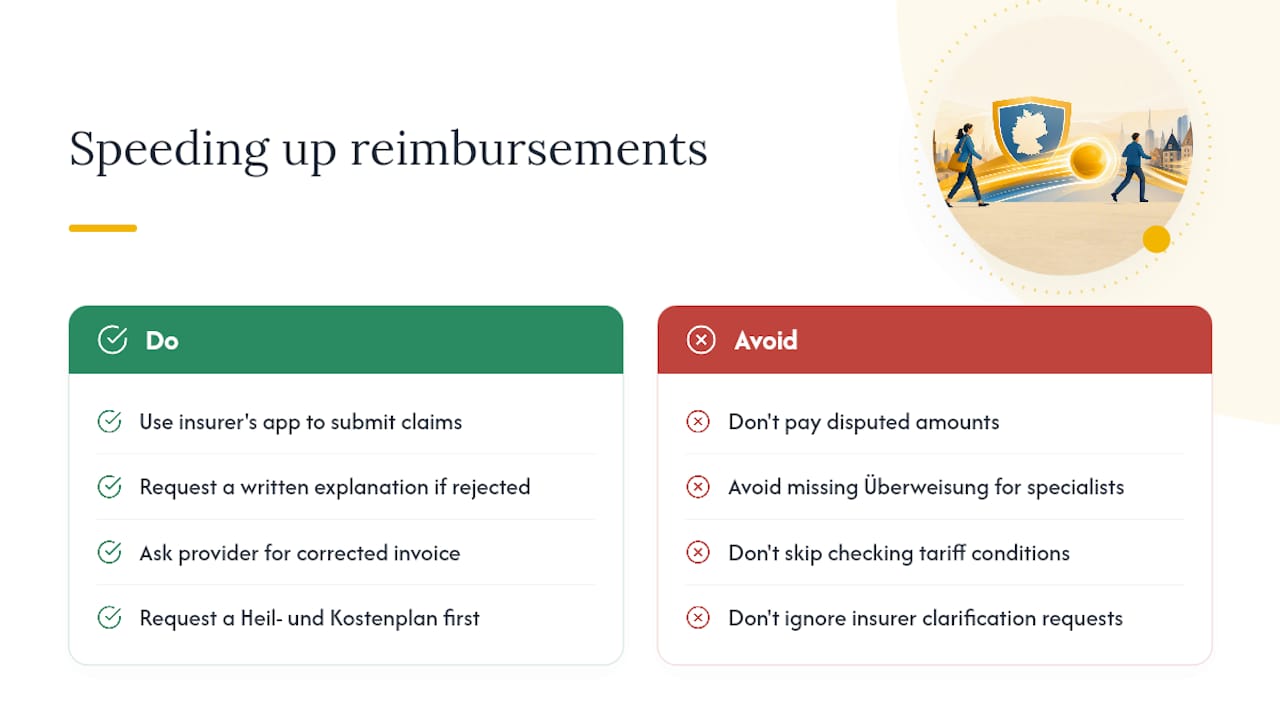
- Check your tariff first. Confirm your deductible (Selbstbeteiligung), whether the treatment needs a referral (Überweisung) or prescription (Rezept), and what fee multiplier your plan actually covers.
- Request advance approval for big-ticket items. Dental work, prostheses, hearing aids, and major procedures should go through a Heil- und Kostenplan before you book.
- Confirm private billing at the front desk. Tell reception you are privately insured so the invoice is issued correctly under GOÄ or GOZ codes from the start.
- Get originals and ask for a duplicate. Keep the original for your insurer and a photographed or scanned copy for your own files.
- Submit a cover sheet. List your policy number, IBAN, provider name, invoice dates, and total amount alongside the invoice.
- Use the fastest submission channel. Insurer apps typically outpace email and post, and clean invoices matching tariff codes are approved quickly.
- Track your timeline. Note the submission date and reference number so you know when to follow up.
- Escalate without delay if rejected. Contact the provider's billing office first, then your insurer, then the Versicherungsombudsmann if the dispute stalls.
| Point | Details |
|---|---|
| Confirm tariff terms early | Check deductible, referral, and multiplier rules before booking any treatment. |
| Request advance approval | Submit a Heil- und Kostenplan for expensive procedures before the appointment. |
| Duplicate every invoice | Keep a copy of every original document before it leaves your hands. |
| Submit with a cover sheet | Attach policy number, IBAN, and invoice total to speed up processing. |
| Escalate through the right channel | Use the insurer, then Myhealthcarebroker or the Versicherungsombudsmann if stuck. |
If you would rather have someone interpret your specific tariff before a claim goes sideways, Myhealthcarebroker reviews policy wording in plain English. And when a dispute genuinely stalls, the Versicherungsombudsmann offers a free, formal escalation route outside the insurer's own complaints desk.
What Should You Do Before, During, and After Treatment?
The claims process actually starts before you ever see a doctor. Most rejections trace back to a missed step at one of three points: booking, the appointment itself, or the paperwork afterward.
- Before care: Pull up your AVB (Allgemeine Versicherungsbedingungen) and check whether the treatment needs a referral, a prescription, or falls under a deductible you haven't yet met. For anything above a few hundred euros, request a Heil- und Kostenplan so the insurer confirms coverage in writing before you commit.
- At the provider: State clearly that you are privately insured when you book. Ask the practice to confirm it will bill under GOÄ (doctors) or GOZ (dentists) rather than a public-tariff rate. Before you leave, request the invoice and any referral or prescription paperwork, since these documents rarely get mailed later without a reminder.
- After care: Build a cover sheet with your policy number, IBAN, provider name, invoice date, and total. Submit through your insurer's app or photo-upload feature, since that channel is typically the fastest route to approval, and note the confirmation or reference number somewhere you'll actually find it again.
Pro Tip: Photograph every original invoice the moment you receive it, before it goes in an envelope or a drawer. A simple folder structure by month, backed up to cloud storage, has saved more claims than any app feature.
Outpatient care in Germany typically means you pay first and claim reimbursement afterward, and pharmacy receipts get submitted as a separate line item from the doctor's invoice, not bundled together. Miss that distinction and your claim can bounce back for reformatting alone.
Templates You Can Copy for Faster Submission
A cover sheet does not need to be elaborate. It needs to contain the same six data points every time so your insurer's claims processor can match invoice to policy in seconds rather than minutes.
- Cover sheet basics: policy number, full name, IBAN, provider name and address, invoice date(s), total amount, and a one-line description of the service if the invoice itself is unclear.
- First submission email or app note: "Attached is an invoice from [Provider] dated [date] for [service]. Policy number: [XXXX]. Requesting reimbursement to IBAN [XXXX]. Please confirm receipt."
- Follow-up after two weeks of silence: "I submitted a claim on [date], reference [XXXX], and have not yet received confirmation or payment. Could you confirm the current status and expected timeline?"
- Originals vs. copies: send the original invoice to your insurer, keep a photographed duplicate for your own records, and never discard the original until reimbursement clears.
- Non-German invoices: attach a brief English or German translation if the provider's paperwork is in another language; some insurers will accept a plain-text summary rather than a certified translation for smaller claims.
- Pharmacy receipts: submit these separately from doctor invoices, since insurers process them under a different line item than outpatient treatment costs.
Pro Tip: Save your cover sheet as a reusable template with blank fields for date, provider, and amount. Filling in four blanks takes thirty seconds; building a new document from scratch each time invites errors.
Myhealthcarebroker keeps a downloadable checklist and cover-sheet template for clients working through their first few claims, and it pairs well with prescription coverage guidance if pharmacy reimbursement is part of your situation.
Which Policy Terms Actually Decide Your Reimbursement?
Your AVB is where the real rules live, and most of the vocabulary in it will be unfamiliar even to fluent English speakers, because German insurance contracts use precise legal terms that don't translate cleanly.
- Kostenerstattungsprinzip: you are the contracting party with your doctor, not your insurer, and invoices follow GOÄ or GOZ fee schedules rather than a flat public rate.
- Selbstbeteiligung: your deductible. Claims under this threshold are yours to pay outright, and submitting them anyway can still count toward annual premium-refund bonuses on some tariffs.
- Fee multipliers (Steigerungssatz): GOÄ and GOZ allow doctors to bill above the base rate up to a capped multiplier; anything above that cap needs written justification, and your tariff may only reimburse up to a specific factor.
- Missing Überweisung or Rezept: a missing referral or prescription is one of the most common, and most avoidable, reasons for a reduced or denied claim.
- Tariff exclusions: some plans exclude specific treatments (alternative medicine, certain devices) outright regardless of medical necessity.
Pro Tip: Search your policy PDF for the word "Erstattung" (reimbursement) and "Ausschluss" (exclusion) to jump straight to the clauses that matter. If the wording is unclear, ask your insurer or a broker for a plain-English summary before you commit to a treatment plan, not after.
Health questions at application time also shape what your tariff will later cover, since private tariffs vary widely and are underwritten individually rather than pooled the way public insurance is.
When Should You Request Advance Approval?
The Heil- und Kostenplan exists specifically to protect you from expensive surprises, and experts consistently recommend it for anything with real financial stakes.
- Identify high-cost treatments early. Major dental work, dentures or implants, hearing aids, and complex outpatient procedures almost always warrant an advance cost estimate.
- Ask the provider for a written Heil- und Kostenplan before scheduling, detailing the treatment, expected cost, and billing codes.
- Submit the HKP to your insurer and wait for written confirmation of what they will cover, which typically clarifies any multiplier caps or exclusions in advance.
- Keep the approval letter and reference it when confirming the appointment with your provider, so both sides know the coverage terms going in.
- Most insurers respond to an HKP within a couple of weeks, faster than a post-treatment dispute would ever resolve.
- A written approval in hand is your strongest defense if a later invoice gets questioned.
- Skipping this step is the single most common reason high-cost claims get contested after the fact.
How Long Does Reimbursement Actually Take?
Most private insurers move fast when the paperwork is clean. App-based submissions with correctly matched tariff and GOÄ codes are typically approved within days, while anything needing clarification can stretch to fourteen business days. Overall, expect reimbursement by bank transfer within one to three weeks for a standard outpatient claim. Hospital stays work differently: inpatient care is usually billed directly to the insurer, though chief physician fees or optional extras (Wahlleistungen) can still land on your desk separately.
When a claim gets reduced or rejected, the reason usually falls into one of five categories:
- Missing referral or prescription documentation
- A service excluded under your specific tariff
- A GOÄ or GOZ multiplier dispute above your plan's cap
- Incomplete cover sheet or mismatched policy details
- A provider billing code that doesn't match the treatment description
| Priority | Action |
|---|---|
| First | Ask the insurer for a detailed written reason for the reduction. |
| Second | Request a corrected invoice or medical justification from the provider. |
| Third | Resubmit with the provider's justification attached. |
| Fourth | Escalate to the Versicherungsombudsmann if the dispute remains unresolved. |
Pro Tip: If the disputed amount is significant, do not pay the invoice outright while the dispute is active. German consumer protection allows for Streitverkündung, involving both doctor and insurer formally, and if the provider's position holds up, your insurer is still obligated to reimburse you even after the fact.
When Do You Need a Broker, Translator, or Lawyer?
Most claims resolve with the steps above. A smaller number need outside help, and knowing which kind matters as much as knowing when.
- Large disputed bills (several hundred euros or more) where the insurer's written explanation still doesn't add up.
- Repeated rejections on the same type of treatment, suggesting a tariff misunderstanding rather than a one-off error.
- GOÄ or GOZ multiplier disputes that require someone fluent in German billing codes to argue effectively.
- Non-German invoices or medical records that need accurate translation, not just a rough summary.
- Tight payment deadlines where you need someone to intervene with the insurer before a bill goes to collections.
A broker interprets your tariff, negotiates directly with the insurer, and helps resubmit corrected claims. A translator ensures medical terminology carries over accurately, which matters more than most people expect since a mistranslated diagnosis code can trigger an automatic rejection. A lawyer becomes relevant only for formal disputes, litigation, or Streitverkündung proceedings that have gone past informal escalation.
Independent advisors consistently see the same pattern: policyholders who treat claims administration as seriously as they treat the medical care itself lose far less money to avoidable rejections.
Myhealthcarebroker supports English-language claim communication, reviews cover sheets and submission templates before they go out, and steps in when a dispute needs someone who reads GOÄ codes for a living.
Why Administrative Discipline Protects Your Money
I have watched enough expat claims move through the system to notice a pattern: the people who lose money on private insurance almost never lose it to bad luck. They lose it to a missing referral, a cover sheet without an IBAN, or an invoice that sat in a drawer for six weeks before anyone thought to submit it.
The tariff terminology is genuinely confusing at first. GOÄ multipliers, Selbstbeteiligung thresholds, the distinction between a Rezept and an Überweisung, none of it is intuitive if you didn't grow up navigating the German system. But the mechanics reward consistency more than expertise. A policyholder who submits every invoice within a week, keeps duplicates, and asks for advance approval on anything expensive will out-perform someone with a deeper theoretical understanding of GOÄ who lets paperwork pile up.
Treat your claims folder the way you'd treat a tax file, not an afterthought. That single habit shift, more than any tariff loophole, is what keeps high earners from quietly losing money to their own disorganization.
Where to Verify These Rules Yourself
- The Versicherungsombudsmann publishes guidance on formal disputes and Streitverkündung procedures.
- The Kostenerstattungsprinzip glossary explains the legal basis under §192 VVG in plain terms.
- Myhealthcarebroker's guide to health insurance for newcomers covers onboarding basics that shape your claims habits from day one.
- Trust your insurer's own AVB, official Ombudsman decisions, and Verbraucherzentrale advice over generic forum posts when a rule genuinely matters to your bottom line.
Frequently Asked Questions
How long does private insurance reimbursement usually take in Germany? Most straightforward claims submitted through an insurer's app are processed within days, while items needing clarification can take up to fourteen business days. Overall, expect bank transfer reimbursement within one to three weeks for a standard outpatient claim.
What happens if my private insurer rejects a claim? Request a detailed written explanation, then involve the provider's billing office for a corrected invoice or medical justification. If the dispute continues, escalate to the Versicherungsombudsmann rather than paying the disputed amount outright.
Do I need a referral for every treatment to get reimbursed? Not always, but a missing Überweisung is one of the most common reasons for reduced or denied claims, especially for specialist visits. Check your specific tariff conditions before booking.
When should I request a Heil- und Kostenplan? Request one before any major dental work, prosthetics, hearing aids, or complex outpatient procedure. It gives you written confirmation of coverage before you commit financially.
Can Myhealthcarebroker help me submit or dispute a claim? Yes. Myhealthcarebroker offers English-language guidance on tariff interpretation, cover-sheet templates, and escalation support at no direct cost to the client, since compensation comes from the insurer.
This article is general information, not a substitute for advice from a qualified financial advisor. Consult a qualified financial professional about your own circumstances before acting on anything here.
Sources
- How to Submit a Claim to Your Private Health Insurer | TheGoodBroker
- Kostenerstattungsprinzip — PKV Glossary | TheGoodBroker
- Verbraucherzentrale
- Paying Medical Expenses/Health Insurance Claims in Germany It can get complicated – How To Germany
- Private Health Insurance in Germany: Good & Affordable Coverage for Expats | Stiftung Warentest