
Sonderausgabenabzug insurance is defined as the tax deduction of specific private insurance contributions under German income tax law, formally governed by § 10 EStG. For expat professionals in Germany, this deduction directly reduces taxable income, which lowers the final tax bill at your marginal rate. Mandatory health insurance and long-term care insurance contributions qualify for full deduction without any upper limit in 2026. Understanding how this works gives you a concrete financial advantage at tax filing time, and missing it means leaving real money on the table.
What insurance contributions qualify for Sonderausgabenabzug?
Mandatory contributions to basic health and long-term care insurance are fully deductible without limit as Sonderausgaben in 2026. That means every euro you pay toward your statutory health coverage or mandatory long-term care premium counts against your taxable income, with no cap applied.
Other insurance types face annual deduction limits. Employees and civil servants can deduct up to €1,900 per year for non-mandatory insurances such as liability, accident, or term life policies. Self-employed professionals get a higher cap of €2,800 per year, reflecting the fact that they pay the full premium without employer subsidy. Jointly assessed spouses or registered partners double these limits, so a married couple where both work as employees can claim up to €3,800 combined.

The German tax office automatically applies a lump-sum allowance of €36 for single filers and €72 for jointly assessed couples, deducted from taxable income without any receipts. This lump sum is applied by default unless you file to claim higher actual expenses with documentation. For most expats paying meaningful health insurance premiums, actual expenses will far exceed this threshold, making it worth reporting real figures.
One rule catches many people off guard. Basic health insurance contributions take priority for full deduction. If those contributions alone already exceed the cap for other insurance types, you cannot stack additional deductions on top for supplementary or comfort coverage. The system protects basic coverage first and treats everything else as secondary.
Pro Tip: If you hold both statutory and supplementary insurance, list your mandatory contributions separately on your tax return. This preserves the full deduction for basic coverage and keeps your supplementary premiums visible for any remaining cap space.
| Insurance type | Deduction limit (single) | Deduction limit (jointly assessed) |
|---|---|---|
| Mandatory health and long-term care | Unlimited | Unlimited |
| Other insurances (employees) | €1,900/year | €3,800/year |
| Other insurances (self-employed) | €2,800/year | €5,600/year |
| Lump-sum allowance (no receipts) | €36/year | €72/year |
How does Sonderausgabenabzug interact with German tax filing rules?
The first eligibility requirement is straightforward. You must be the contract holder and bear the economic burden of the premium to claim the deduction. If someone else pays your premium, you cannot deduct it, even if the policy covers you.
Employer contributions create a specific complication that trips up many expats. Employer-paid premiums are only deductible by you personally if they appear as taxable income on your payslip. When an employer pays your health insurance premium and does not list it as taxable income, that payment blocks your personal deduction claim entirely. Check your payslip carefully before filing.
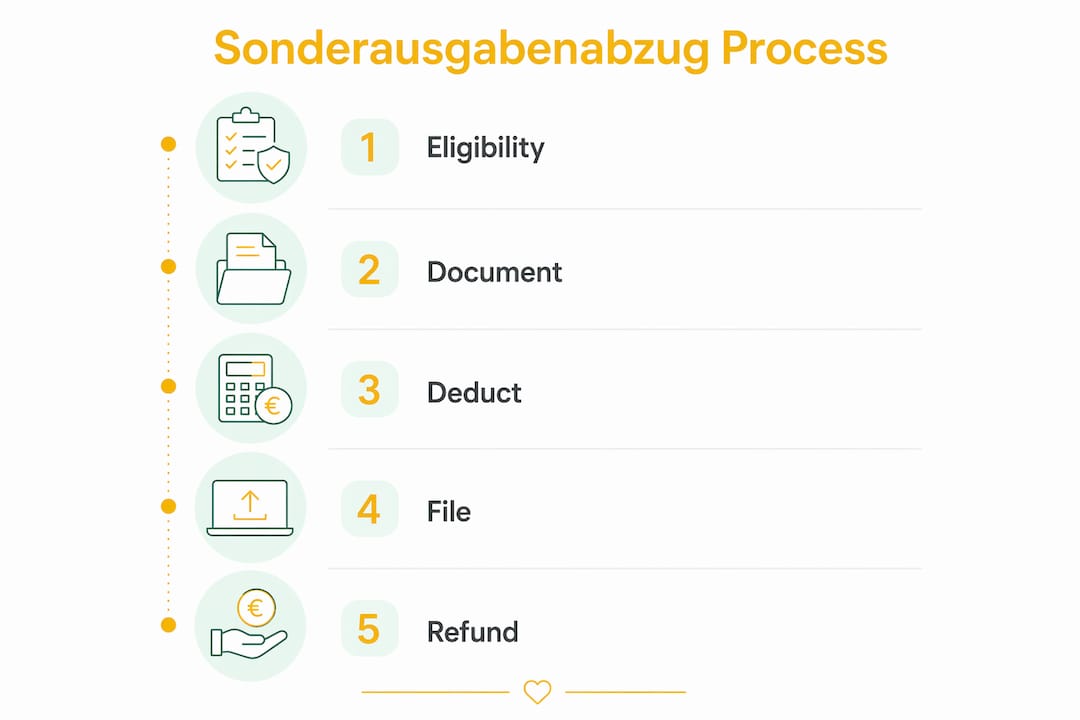
The outflow principle, known in German as the Abflussprinzip, governs timing. Deductions apply in the calendar year the payment is made, not the period the insurance coverage spans. If you prepay a premium in december for the following year's coverage, the deduction belongs to the year of payment.
Refunds also affect your deduction. If your insurer reimburses part of your premium, that refund reduces the amount you can deduct for that year. You must declare refunds in your tax return, and failing to do so is a common audit trigger.
- You must be the named policyholder on the insurance contract.
- The premium must come from your own funds, not reimbursed by a third party before filing.
- Employer contributions only count if listed as taxable income on your payslip.
- Deductions apply in the year of payment, regardless of coverage period.
- Refunds received must be subtracted from your reported deductible expenses.
Pro Tip: Keep a simple spreadsheet tracking monthly premium payments and any refunds received. At year end, the totals are ready for your tax return without hunting through bank statements.
What are the tax implications for expat professionals in Germany?
Sonderausgaben reduce your taxable income directly, not your tax bill by a fixed amount. Many taxpayers miss refunds because they do not realize this distinction. The actual tax saving depends on your marginal rate: the higher your income, the more each euro of deduction saves you.
For a concrete example, consider an expat earning above the top income tax bracket threshold in Germany. A €5,000 deduction from mandatory health and long-term care contributions reduces taxable income by €5,000. At the top marginal rate, that translates to a meaningful reduction in the final tax liability. The math rewards higher earners more, which is why tax advisors emphasize voluntary filing for Sonderausgaben as often advantageous.
Common pitfalls among expats include:
- Assuming employer-paid premiums are automatically deductible without checking the payslip.
- Forgetting to report insurance refunds, which reduces the deductible base.
- Claiming supplementary or comfort coverage deductions when basic contributions already exceed the cap.
- Defaulting to the lump-sum allowance when actual premiums are significantly higher.
- Missing the private health insurance tax savings available through proper documentation of private plan contributions.
Pension contributions add another layer. Statutory pension contributions are deductible up to €29,344 for singles and €58,688 for couples in 2025/2026, with 100% recognition. Combining pension and health insurance deductions in a single tax return can produce a substantial reduction in taxable income for expats who plan ahead.
How can expats optimize health insurance choices for better tax efficiency?
Choosing the right health insurance plan affects more than your monthly premium. It directly shapes how much you can deduct as Sonderausgaben. The key distinction is between basic coverage, which qualifies for unlimited deduction, and supplementary or comfort coverage, which falls under the capped category.
Private health insurance in Germany can be structured so that the basic component qualifies for full deduction while comfort add-ons are treated separately. Understanding this split before you sign a policy matters. A plan that bundles everything into one premium may obscure how much of it is actually deductible at the unlimited rate.
Practical steps for expats optimizing their insurance and tax position:
- Request a written breakdown from your insurer showing the basic coverage premium separately from any supplementary elements.
- Confirm whether your employer's contribution appears as taxable income on your payslip before filing.
- If you are self-employed, use the higher €2,800 cap for non-mandatory insurances and document every eligible policy.
- File a voluntary tax return even if not required. Voluntary filing is often advantageous since deductions reduce taxable income and provide higher benefits for taxpayers in higher brackets.
- Review your coverage annually, as premium changes affect your deductible amount each year.
| Coverage type | Deductibility | Filing approach |
|---|---|---|
| Basic statutory health insurance | Unlimited | Report actual premium paid |
| Mandatory long-term care insurance | Unlimited | Report actual premium paid |
| Supplementary or comfort coverage | Capped (€1,900/€2,800) | Report only if cap not exceeded by basic contributions |
| Employer-paid premium (taxable on payslip) | Deductible | Confirm payslip entry before filing |
| Employer-paid premium (not on payslip) | Not deductible | Do not claim |
Myhealthcarebroker works with expats across Germany to identify which plan structure maximizes deductible contributions. As an independent consultancy, Myhealthcarebroker compares private health insurance options across providers and explains the tax implications of each in plain English.
Pro Tip: Ask any insurer for a "Beitragsbescheinigung" (contribution certificate) at year end. This document lists your paid premiums by category and is exactly what the tax office expects as proof.
Key Takeaways
Sonderausgabenabzug insurance deductions reduce taxable income directly, and expats who document their mandatory health and long-term care contributions correctly capture the most significant tax benefit available under § 10 EStG.
| Point | Details |
|---|---|
| Mandatory contributions are unlimited | Basic health and long-term care premiums are fully deductible with no annual cap in 2026. |
| Other insurances face caps | Employees deduct up to €1,900/year; self-employed professionals deduct up to €2,800/year. |
| Employer payments require scrutiny | Employer-paid premiums only qualify if listed as taxable income on your payslip. |
| Outflow principle governs timing | Deductions apply in the year of payment, not the year of coverage. |
| Higher earners benefit most | Deductions reduce taxable income, so the saving scales with your marginal tax rate. |
What I've learned advising expats on German tax deductions
The single most common mistake I see is expats treating Sonderausgabenabzug as a minor administrative detail rather than a genuine financial lever. A mandatory health insurance premium of several thousand euros per year, fully deductible without limit, can produce a tax saving that rivals a month's rent in Munich or Frankfurt. That is not a rounding error.
The second pattern I notice is over-reliance on the lump-sum allowance. The €36 default is essentially a placeholder for people with no real insurance costs. Any expat paying a meaningful premium should be filing actual expenses with documentation. The gap between €36 and a real annual premium is enormous.
I also caution expats against assuming that because their employer "handles" the insurance, the deduction is automatic. Employer-paid premiums blocked from personal deduction are one of the most frequently misunderstood rules in this area. Check the payslip. If the employer contribution does not appear as taxable income, you cannot claim it, and trying to do so creates problems with the tax office.
The broader lesson is that German tax law rewards people who file carefully and proactively. Voluntary filing, proper documentation, and understanding the priority rules between basic and supplementary coverage are the three habits that separate expats who capture full deductions from those who leave money behind year after year.
— Marco
How Myhealthcarebroker helps expats get the most from their coverage
Choosing a health insurance plan in Germany without understanding its tax implications is like buying a car without knowing the fuel costs. The monthly premium is only part of the picture.
Myhealthcarebroker helps expat professionals in Germany select health insurance plans that fit both their coverage needs and their tax situation. As an independent consultancy, Myhealthcarebroker compares private options across providers and explains exactly which premium components qualify for full Sonderausgabenabzug deduction and which fall under the capped categories. Whether you are checking health insurance for your German visa or reviewing your existing plan for better tax efficiency, the advice is in clear English and free of jargon. Get in touch for a personalized consultation.
FAQ
What is Sonderausgabenabzug insurance in simple terms?
Sonderausgabenabzug insurance refers to the deduction of specific insurance contributions, primarily mandatory health and long-term care premiums, from your taxable income under German tax law (§ 10 EStG). It reduces the income the tax office uses to calculate your bill, not the bill itself by a fixed amount.
Are mandatory health insurance contributions fully deductible in Germany?
Yes. Mandatory contributions to basic health and long-term care insurance are fully deductible without any upper limit as Sonderausgaben in 2026. Other insurance types face annual caps of €1,900 for employees and €2,800 for self-employed individuals.
Can expats claim Sonderausgabenabzug if their employer pays the premium?
Only if the employer contribution appears as taxable income on the payslip. Employer-paid premiums that are not listed as taxable income block the personal deduction entirely.
When does the Sonderausgabenabzug deduction apply?
The outflow principle means deductions apply in the calendar year the payment is made, regardless of which coverage period the premium relates to. Refunds received in the same year reduce the deductible amount.
Is it worth filing a voluntary tax return to claim Sonderausgabenabzug?
Yes, particularly for higher earners. Since deductions reduce taxable income rather than the tax directly, the saving scales with your marginal rate, making voluntary tax filing often advantageous for expat professionals in Germany.