
Use your Steuer‑ID (also called the IdNr) for most personal tax matters. Use your Steuernummer when the Finanzamt asks for a specific case reference, usually on tax returns and self-employment paperwork. The Steuer‑ID is your permanent, lifelong personal number. The Steuernummer is a file number tied to your case at a particular tax office, and it can change if you move or start a business.
You can find both numbers faster than you might think:
- Steuerbescheid (income tax assessment): both numbers usually appear near the top.
- Lohnsteuerbescheinigung (annual wage tax statement from your employer): shows your Steuer‑ID.
- BZSt allocation letter: the original notice mailed when your Steuer‑ID was issued.
- ELSTER account: logged-in users can see both numbers under their profile.
Missing one? Contact the Bundeszentralamt für Steuern (BZSt) for a Steuer‑ID reissue, or your local Finanzamt for a Steuernummer lookup.
Key Takeaways
Your Steuer‑ID stays with you permanently and covers most personal tax needs, while your Steuernummer only appears once a specific Finanzamt case exists.
| Point | Details |
|---|---|
| Default to Steuer‑ID | Use this 11-digit number for ELSTER, employer reporting, and most electronic tax forms. |
| Steuernummer comes later | The Finanzamt assigns it automatically once you file your first return or register a business. |
| Check paperwork first | Your Steuerbescheid and Lohnsteuerbescheinigung usually list both numbers already. |
| Freelancers register proactively | Submit the Fragebogen zur steuerlichen Erfassung through ELSTER as soon as you go self-employed. |
| Lost numbers take weeks | BZSt mails Steuer‑ID reissues by post only, so plan several weeks ahead. |
This article is general information, not a substitute for advice from a qualified financial advisor. Consult a qualified financial professional about your own circumstances before acting on anything here.
Table of Contents
- What Is a Steuer Nummer and Who Issues It?
- How Is the Steuer‑ID Different From the Steuernummer?
- Where Can I Find My Tax Number Right Now?
- How Do You Get a Steuernummer as an Employee or Freelancer?
- What If You Lose a Number or Spot a Mistake?
- Practical Tips for Internationals Dealing With Finanzamt
- Navigating German Tax Registration Alongside Health Insurance
- The Real Bottleneck Isn't the Number, It's the Timing
- Sources
What Is a Steuer Nummer and Who Issues It?
A Steuernummer is your local Finanzamt's internal file reference, not a national ID. It gets assigned the moment a tax case actually exists for you, usually triggered by your first income tax return, a business registration, or a freelance filing. Before that point, you simply don't have one yet, and that's normal.
Format varies by German state, which surprises a lot of newcomers expecting one national standard. Historically, Steuernummern ran 10 to 11 digits depending on the Bundesland, formatted with slashes (like 12/345/67890). For electronic transmission, tax authorities convert this into a unified 13-digit bundesschema, which standardizes the state code, office number, and personal file digits into one machine-readable string.
One detail that trips people up: you can hold more than one Steuernummer at the same time. A separate number often applies to VAT registration versus income tax, and the ELSTER portal's guidance on locating your Steuernummer walks through exactly how these formats differ by state.
- Assigned only once a tax case opens (return filed, business registered).
- Format length and structure differ by federal state.
- The 13-digit bundesschema exists purely for electronic exchange.
- You may legitimately have multiple Steuernummern for different tax types.
How Is the Steuer‑ID Different From the Steuernummer?
The Steuer‑Identifikationsnummer, or Steuer‑ID, is a completely different animal. The Bundeszentralamt für Steuern issues this eleven-digit number once, at birth or upon registering residency in Germany, and it stays with you for life. It doesn't change when you move cities, switch jobs, or get married. Your Steuernummer, by contrast, can change with any of those events since it's tied to a specific Finanzamt and case.
Here's the practical breakdown:
| Feature | Steuer‑ID | Steuernummer |
|---|---|---|
| Issued by | BZSt | Local Finanzamt |
| Length | 11 digits | 10–13 digits (varies) |
| Permanence | Lifelong, never changes | Can change with case or address |
| Typical use | Employer reporting, ELSTER login, prefilled forms | Tax return filing, invoicing, Finanzamt correspondence |
Pro Tip: When a form or online portal simply asks for "your tax number" without specifying which one, default to the Steuer‑ID. Tax professionals increasingly treat it as the primary personal identifier for electronic processes, since it never expires or gets reissued.
Where Can I Find My Tax Number Right Now?
Before calling anyone, check the paperwork you likely already have at home. Most people locate both numbers within minutes once they know where to look.
- Check your most recent Steuerbescheid. Both your Steuer‑ID and Steuernummer typically sit near the top of the first page, often in the header block alongside your name and address.
- Pull your Lohnsteuerbescheinigung. Your employer's annual wage statement lists your Steuer‑ID, usually in the upper section near your personal details.
- Log into ELSTER. Once registered, your account dashboard displays both numbers under your saved profile information.
- Look for the original BZSt letter. This was mailed when you first registered your address in Germany, or shortly after birth for German-born residents.
If none of that turns anything up, the BZSt can resend your Steuer‑ID, though for privacy and security reasons it only delivers this by postal mail, never email, which typically takes a few weeks. Employers, banks, and insurers often already hold your Steuer‑ID on file for reporting purposes, but they're generally restricted from sharing it with third parties on your behalf due to data protection rules.
How Do You Get a Steuernummer as an Employee or Freelancer?
The process looks different depending on your situation, but none of them require you to chase down a number before you actually need it.
- Employees and new filers: File your first income tax return using only your Steuer‑ID. Leave the Steuernummer field blank if you don't have one yet. The Bavarian tax office confirms that the Finanzamt assigns a Steuernummer automatically during processing, then mails it to you with your assessment.
- Self-employed and freelancers: Register using the Fragebogen zur steuerlichen Erfassung (Questionnaire for Tax Registration), submitted through ELSTER or on paper. You'll need details like your expected income, business activity, and start date. This form specifically triggers Steuernummer assignment for invoicing and VAT purposes.
- Proactive requests: If you need a Steuernummer before your first return is due, such as for an urgent business contract, contact your local Finanzamt directly by phone or email. Explain that you need to open a tax case and reference your Steuer‑ID in the message.
- While waiting: Freelancers who must invoice clients immediately often issue provisional invoices noting "Steuernummer wird nachgereicht" (tax number to follow) while their Fragebogen is being processed, though this should be treated as a stopgap, not a habit.
Timing varies by region and season, but a few weeks is typical for standard processing. If you're navigating this alongside other registration steps as a newly arrived professional, our guide to health insurance for freelancers in Germany covers several administrative tasks that tend to overlap with tax registration timing.
Pro Tip: Don't try to obtain a Steuernummer speculatively "just in case." Employees especially waste time chasing a number the Finanzamt will assign automatically the moment they file. Wait for the process to trigger it.
What If You Lose a Number or Spot a Mistake?
Losing track of either number happens more often than you'd think, especially after a move or a change in filing status. The fix depends on which number went missing.
- Lost Steuer‑ID: Request a reissue from the BZSt using their online form. You'll need to verify your identity, and the response arrives by mail only, so budget several weeks.
- Lost Steuernummer: Contact your local Finanzamt directly, including your Steuer‑ID and, if possible, a copy of a prior Steuerbescheid as proof of your case.
- Married couples filing jointly: Spouses often receive a single joint Steuernummer rather than two separate ones, which can confuse couples used to individual numbers.
- Address changes: Moving to a new Finanzamt's jurisdiction can trigger a new Steuernummer, even though your Steuer‑ID stays the same.
Practical Tips for Internationals Dealing With Finanzamt
Working with German tax offices in a second language adds friction most guides skip over. A little preparation goes a long way.
Before reaching out, gather your passport or residence permit, your most recent Steuerbescheid, your Lohnsteuerbescheinigung, and proof of registration (Anmeldung) if you're newly arrived. Having these ready before you call or email saves a round trip.
- Use a clear subject line like "Anfrage Steuernummer" or "Request for Tax Number" so staff can route your message quickly.
- Include your Steuer‑ID in the first line of any email; it lets the Finanzamt locate your file even if you don't yet have a Steuernummer.
- Keep your message short: state your situation, what you need, and your contact details.
Pro Tip: If your German is limited and you're registering as a freelancer, a consultant can prepare your Fragebogen zur steuerlichen Erfassung in German and often gets a faster reply than a self-submitted English inquiry.
Navigating German Tax Registration Alongside Health Insurance
If you're untangling your Steuernummer at the same time as choosing health coverage, you're not alone. Most internationals hit both administrative hurdles in their first few months in Germany, often within the same week they're setting up a bank account and registering their address.
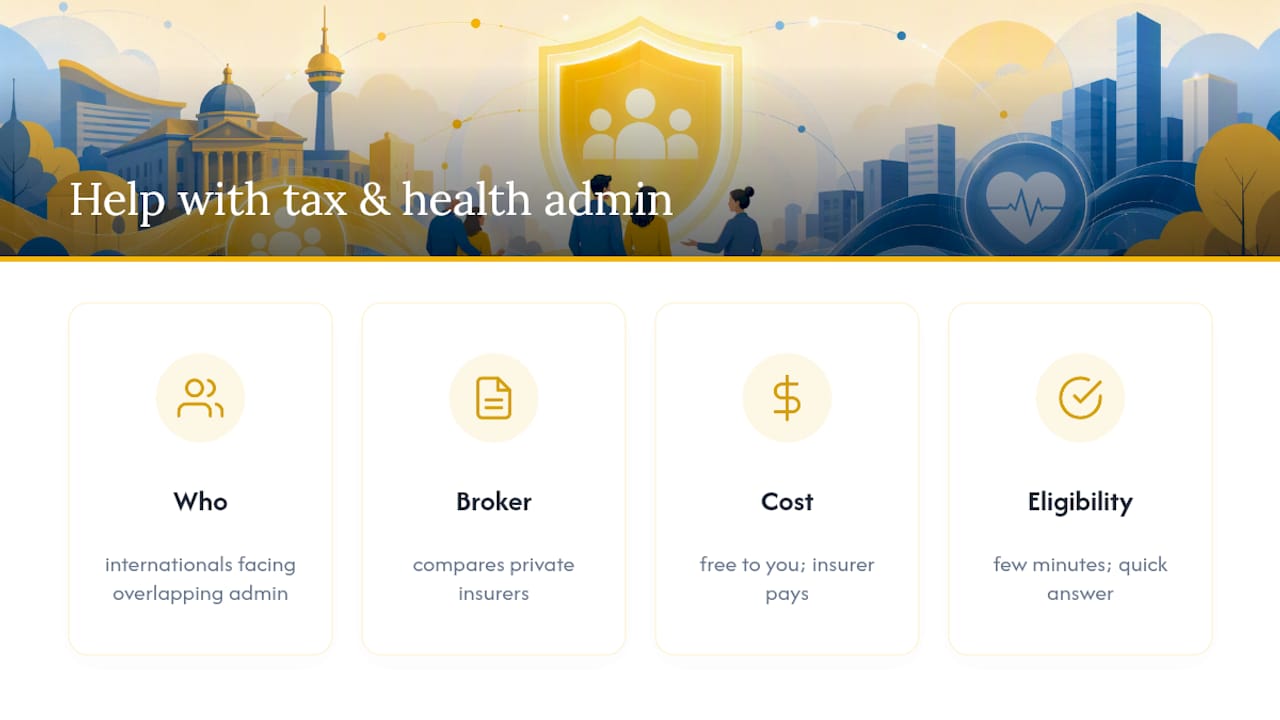
Myhealthcarebroker works with expats and high-earning professionals navigating exactly this kind of overlapping paperwork. As independent consultants, we compare private health insurance options in Germany across providers and explain, in plain English, which plan actually fits your income level and visa status. The service costs you nothing since we're paid by the insurer, not by you, and we handle the German-language forms so you don't have to guess at translations while you're also chasing down tax numbers.
If you're unsure whether you even qualify for private coverage yet, our eligibility check takes a few minutes and gives you a straight answer before you commit to anything.
The Real Bottleneck Isn't the Number, It's the Timing
Most confusion around the Steuernummer doesn't come from the concept itself. It comes from people trying to obtain one before the system is ready to issue it. Employees especially waste real time emailing Finanzamt offices asking for a Steuernummer they'll receive automatically the moment their first return processes.
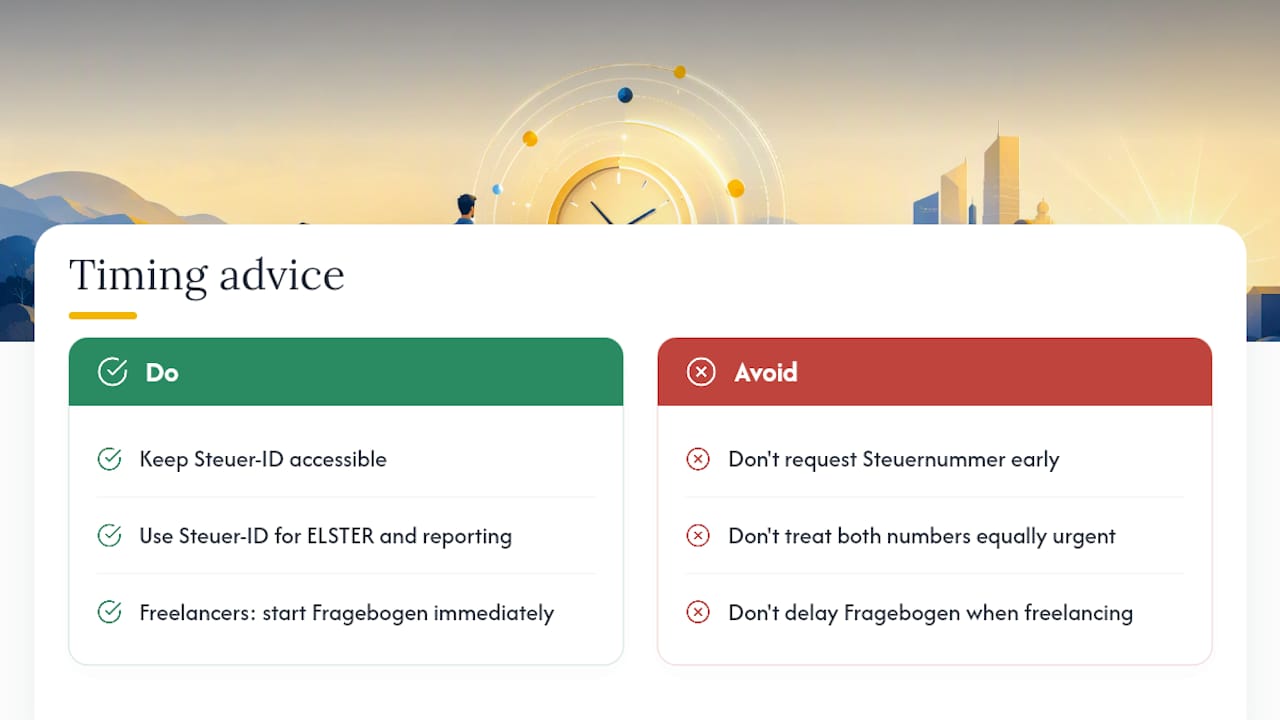
The conventional advice online tends to treat both numbers as equally urgent, when in practice the Steuer‑ID does almost all the heavy lifting for individuals. You'll use it for ELSTER logins, employer reporting, and most digital tax interactions. The Steuernummer only becomes relevant once you're filing returns, invoicing as a freelancer, or dealing with VAT.
If there's one thing worth prioritizing, it's getting your Steuer‑ID sorted early and keeping it accessible, since nearly every other tax interaction in Germany traces back to it. Freelancers are the exception. They genuinely benefit from starting the Fragebogen process the moment they know they're going self-employed, rather than waiting until an invoice is overdue.
— Marco
Sources
- BZSt - The identification number
- ELSTER - Wo ist meine Steuernummer?
- Steuernummer - Bayerisches Landesamt für Steuern
- Simple Germany - Tax number Germany