The Anmeldung is the legal process of registering your residential address with your local registration authority, and as an expat you must complete it within the statutory timeframe to access banks, tax IDs, and health insurance. It is the single administrative task that unlocks nearly everything else on your relocation checklist.
Here is what you need to know right away:
- You typically have 14 days from moving into a new home to register, under the Bundesmeldegesetz (BMG), the federal law that governs residence registration.
- You register in person at your local Bürgeramt (citizens' registration office), and you walk out with a Meldebescheinigung, your proof of registration.
- Without that document, you cannot open a bank account, receive your tax ID, or in most cases enroll in health insurance.
- Myhealthcarebroker works with expats every week who are stuck mid-relocation because this one step got delayed.
Key Takeaways
Completing Anmeldung within the legal window is the single step that unlocks banking, tax ID issuance, payroll, and health insurance enrollment in Germany.
| Point | Details |
|---|---|
| Register within 14 days | Book your Bürgeramt appointment as soon as you have a signed lease, since availability can lag past the deadline. |
| Get the Wohnungsgeberbestätigung early | Ask your landlord for this document the day you sign, since it's a legal requirement under § 19 BMG. |
| Online registration has limits | The federal online route requires a German eID and BundID account, so most newcomers must register in person. |
| Meldebescheinigung unlocks everything else | Banks, tax ID mailing, payroll, and insurers all depend on this single certificate. |
| Pair Anmeldung with insurance planning | Myhealthcarebroker helps expats run health insurance eligibility checks alongside registration, so onboarding doesn't stall waiting on paperwork. |
Table of Contents
- What Is Anmeldung for Expats, and Why Does It Matter?
- Who Needs to Register, and What's the Deadline?
- What Documents Do You Need for Anmeldung?
- How to Book and Attend Your Bürgeramt Appointment
- Can You Register for Anmeldung Online?
- What Happens Right After You Register
- Ummeldung and Abmeldung: Moving Within Germany or Leaving
- Fixing Common Anmeldung Problems
- Frequently Asked Questions
- Sources
What Is Anmeldung for Expats, and Why Does It Matter?
Germany runs on population registers, and the Bundesmeldegesetz is the law that keeps them accurate. Every time you move, the state needs to know where you live, and the local registration office (Bürgeramt, Ordnungsamt, or Einwohnermeldeamt depending on the city) is the body that records it. The BMG requires that registration authorities issue a written or electronic registration certificate on request, and that certificate, the Meldebescheinigung, is what proves to everyone else that you legally live where you say you do.
That single piece of paper triggers a cascade of other administrative steps. Banks want it before opening an account. Your employer needs it to process payroll correctly. Health insurers ask for it during enrollment. Even a basic mobile phone contract often requires it. Skip Anmeldung, and you are effectively locked out of daily life in Germany, not because any one office is being difficult, but because the entire system assumes you have already registered.
Missing the deadline carries real financial risk too. Relocation guides consistently report that late registration fines can run into the hundreds of euros in practice, though enforcement varies by city and circumstance. The more common cost isn't the fine, though. It's the weeks lost waiting on a bank account or a paycheck that never arrives because payroll couldn't be processed without your Meldebescheinigung.
Who Needs to Register, and What's the Deadline?
There is no citizenship exemption. Whether you're an EU citizen, a non-EU professional on a work visa, or a student on a temporary residence permit, if you have a fixed address in Germany, you must register it. The registration authority does not care where your passport was issued.
The standard deadline is 14 days from your move-in date. A few things to watch for:
- Berlin nuance: Berlin's own guidance and long appointment backlogs mean many newcomers book their Bürgeramt slot before they even land, as appointments might only be available after the usual registration deadline. Officials in Berlin generally do not penalize you for a late appointment if you booked promptly and can show your booking confirmation.
- Second homes: If you keep a primary residence elsewhere in Germany and take a second home in another city, that also requires registration, filed as a secondary residence.
- Staying with family or friends: Even a temporary stay with relatives typically counts as your residence if you're living there, not just visiting.
- Short-term accommodation: Hotels and short-term corporate housing usually don't trigger Anmeldung, but once you sign a lease or move into a fixed address, the clock starts.
When in doubt, register. The downside of registering too early is essentially zero; the downside of registering late is fines and stalled admin.
What Documents Do You Need for Anmeldung?
The paperwork is short, but each piece has to be exactly right, and one of them depends entirely on someone else showing up on time.
- Valid passport or national ID card. This has to be the original, not a copy.
- Completed Anmeldeformular (registration form), available at the Bürgeramt or, in many cities, downloadable in advance so you can fill it out before your appointment.
- Wohnungsgeberbestätigung, the landlord's confirmation of your move-in date. This is the document that trips people up most often.
Your rental contract alone will not satisfy the registration office. Since 2015, § 19 of the BMG has required a separate, signed landlord confirmation, and a lease is not a legal substitute for it, even though it feels like it should be. Your landlord is legally obligated to provide the Wohnungsgeberbestätigung within two weeks of your move-in, and both the BMG and local registration offices treat this as a firm requirement, not a courtesy.
If you're bringing civil documents like a marriage certificate or birth certificate into other parts of the relocation process (tax filings, dependent visas, insurance applications), some offices will ask for a certified translation. Anmeldung itself rarely requires this, but keep certified copies on hand since you'll likely need them soon after.
Pro Tip: Ask your landlord for the Wohnungsgeberbestätigung the same day you sign your lease, not the week before your Bürgeramt appointment. Landlords in high-demand cities are often slow to respond, and you cannot register without it.

How to Book and Attend Your Bürgeramt Appointment
Booking the appointment is often the hardest part of Anmeldung, harder than the appointment itself.
- Find your local office. Search your city's name plus "Bürgeramt" or "Anmeldung Termin" to find the correct booking portal. Larger cities have multiple branch offices, and availability differs sharply between them.
- Book as early as possible. In cities with heavy demand, appointment slots can be booked out for multiple weeks, so start looking the moment you have a fixed address, even before you've fully moved in.
- Bring every document, printed and complete. Missing a single signature on the Wohnungsgeberbestätigung is one of the most common reasons appointments get rejected on the spot.
- Arrive on time, and expect a short wait even with an appointment. Some offices run behind schedule regardless of your booking slot.
At the desk, the process itself is quick. A clerk checks your documents against the Anmeldeformular, confirms your personal data, and has you sign the register. If everything is in order, you receive your Meldebescheinigung on the spot, no waiting period, no mailed follow-up. The whole appointment usually takes 10 to 15 minutes once you're called.
If your city's booking system shows nothing available for weeks, a few strategies help:
- Check neighboring district offices within the same city; smaller branches often have more openings than the central one.
- Many booking portals release canceled slots at random times, so checking daily (or using a cancellation-tracker tool some cities offer) can turn up an earlier date.
- Some offices allow walk-ins for Anmeldung specifically, even without an appointment, though you may wait several hours. Call ahead to confirm this before showing up.
Avoid paid third-party services that promise to "secure" appointments for a fee. Anmeldung appointments are free and government-run; anyone charging you to book one is either scalping a public service or running a scam.
Can You Register for Anmeldung Online?
Germany does offer a federal online registration route through Wohnsitzanmeldung, but it comes with real limits that most first-time expats run into immediately.
The process follows three phases: you submit your data and upload your Wohnungsgeberbestätigung online, the registration authority reviews and verifies it, and you receive a digital, tamper-evident Meldebestätigung, with the option to update your electronic ID remotely.
To use it, you need:
- An eID-capable identity document with the online ID function activated
- The AusweisApp installed on your phone or computer
- A BundID account, the federal government's authentication portal for high-trust digital services
- A CAN number, printed on German ID cards, to complete verification
That last requirement is the sticking point. The CAN number only exists on German identity documents, which means most first-time arrivals from abroad, holding a foreign passport with no German eID history, cannot use the online path at all. The online route works well for people already living in Germany who are relocating within the country and already hold a German ID. If you are arriving from abroad for the first time, plan to register in person.
What Happens Right After You Register
Your Meldebescheinigung arrives the moment your appointment ends, handed to you at the counter. Everything else follows from there, though not all on the same timeline.
- Tax ID (Steuer-ID): This gets mailed automatically to your registered address, usually within two to six weeks. You cannot request it faster; the system processes it on its own schedule.
- Bank accounts: Most banks require your Meldebescheinigung before opening an account, since it's their proof of your legal address.
- Employer payroll: HR departments typically need a copy to set up your salary payments correctly, and delays here can mean a late first paycheck.
- Health insurance: Both public and private insurers ask for your Meldebescheinigung during enrollment, and this is often the step that catches people off guard, since insurance timing has its own dependencies. If you're weighing your options, our guide to health insurance for newcomers breaks down what to expect.
- Church tax (Kirchensteuer): The Anmeldeformular includes a line asking about religious affiliation. Selecting a recognized denomination triggers automatic church tax withholding, typically 8 to 9 percent of your income tax, depending on the state. If you leave it blank or select "none," you avoid it entirely.
Pro Tip: If you're unsure about your religious affiliation status or simply don't want church tax withheld, leave that field blank at registration. Correcting it afterward means a separate declaration at your local tax office, and it's far easier to get right the first time.
Ummeldung and Abmeldung: Moving Within Germany or Leaving
Ummeldung is what you file when you move to a new address within Germany, it's not a brand-new Anmeldung, but an update to your existing registration. Abmeldung is what you file when you leave Germany entirely, or in some cases when you move abroad permanently.
- For Ummeldung, bring your new Wohnungsgeberbestätigung and ID to your new district's Bürgeramt, and register within 14 days of the move, the same deadline as a first registration.
- For Abmeldung, notify your local registration office of your departure date, ideally shortly before you leave. Some cities allow this online; others require an in-person visit.
- Before you go, work through a short departure checklist: inform your health insurer of your exit date, close or transfer bank accounts as needed, and tell your employer so your final payroll and tax paperwork are processed correctly.
Skipping Abmeldung when you leave can create tax complications later, since German authorities may still consider you a resident for tax purposes until they receive it.
Fixing Common Anmeldung Problems
A landlord who drags their feet on the Wohnungsgeberbestätigung is the single most common holdup expats report. If two weeks pass with no response, send a written request citing your legal need for the document, and if that fails, some Bürgeramt staff will accept a temporary registration with a promise to submit the confirmation later, though this varies by office and isn't guaranteed.
For long Bürgeramt waits, check neighboring district offices, join local expat forums where people share canceled slots, and avoid any paid appointment-booking service, since the appointments themselves are always free.
Name-format mismatches (particularly for expats with non-Latin script names or multiple surnames) sometimes require a certified translation of your passport, so ask your registration office in advance if your documents look unusual. If you lose your Meldebescheinigung, request a replacement directly from the office that issued it. It's a routine reprint, not a bureaucratic ordeal.
Pro Tip: Take a photo of your Meldebescheinigung the moment you receive it, and store a digital copy in cloud storage. Banks and insurers often accept a clear scan for initial applications while you track down the physical original.
How Anmeldung shapes your health insurance timeline
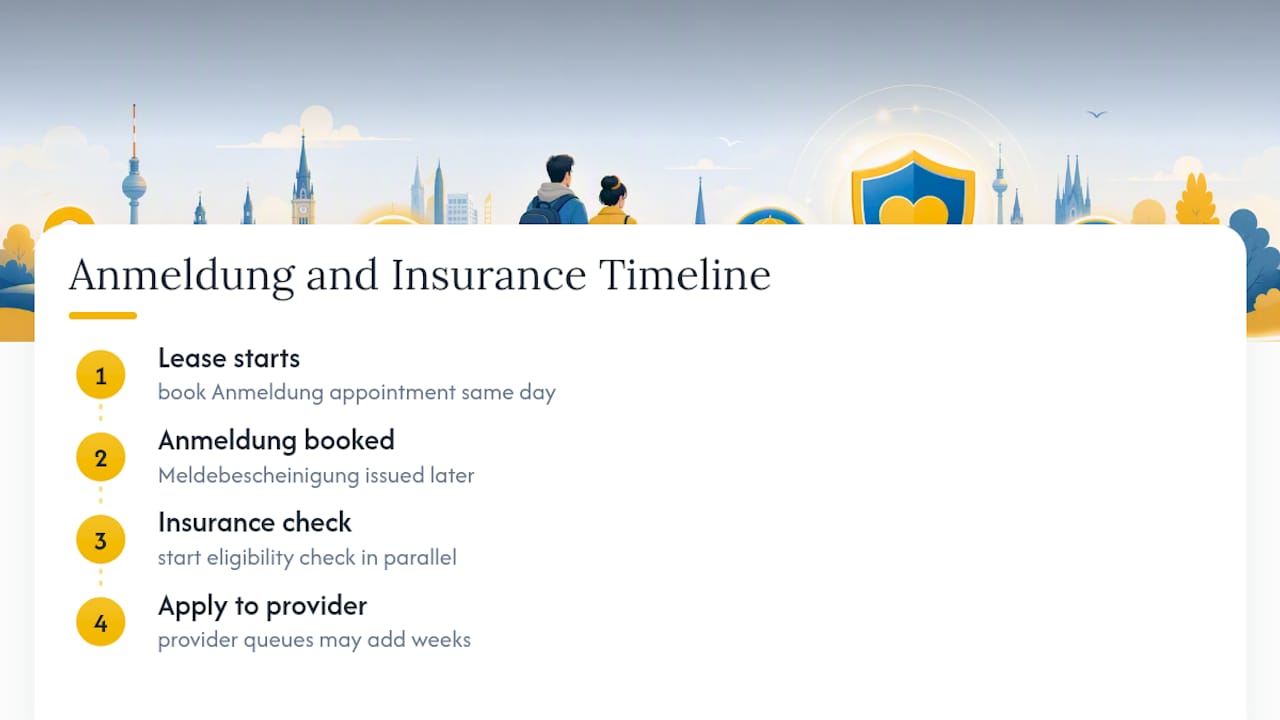
The sequence we recommend to clients is simple: get your Anmeldung appointment booked the day your lease starts, then start your health insurance eligibility check in parallel rather than waiting for the Meldebescheinigung to land in hand. The biggest timing mismatch we see is expats who wait until registration is fully done before even looking at insurance options, then discover their preferred provider has a multi-week processing queue on top of that. Clients who run both tracks at once consistently finish onboarding faster and see fewer applications rejected for missing documentation.
Getting your health insurance sorted once you're registered
Once your Meldebescheinigung is in hand, the insurance clock is officially running, and insurers will ask for it as part of your application. Myhealthcarebroker exists for exactly this stage: we're an independent consultancy that compares plans across major private and public insurers in Germany, and we walk you through eligibility, paperwork, and submission entirely in English.
Unlike navigating insurer websites solo in a language you may not read fluently, our team runs your eligibility check first, so you're not wasting weeks applying to a plan you don't qualify for. We compare options across providers, explain the tradeoffs in plain terms, and handle the application itself, including how your Meldebescheinigung and other documents get submitted correctly the first time. The service costs you nothing, since we're paid a fixed commission by the insurer once you sign up.
If you've already got your Meldebescheinigung or expect it soon, start your eligibility check on our health insurance broker page and we'll walk you through the plans that actually fit your situation.
Frequently Asked Questions
What is Anmeldung for expats in Germany? Anmeldung is the mandatory process of registering your residential address with your local registration authority. It's required under the Bundesmeldegesetz and produces a Meldebescheinigung, the certificate you need for banking, tax, and insurance purposes.
How long do I have to complete Anmeldung after moving? The standard deadline is 14 days from your move-in date, though Berlin's appointment backlogs often mean officials accept a booking confirmation as proof you tried to register on time.
Can I complete Anmeldung entirely online? Only if you already hold a German eID-capable identity document, have the AusweisApp installed, and have a BundID account. Most first-time arrivals from abroad don't meet these requirements and must register in person.
What happens if I don't register in time? You risk fines, and more immediately, you'll be blocked from opening a bank account, receiving your tax ID, or enrolling in health insurance until you complete registration.
Do I need the Wohnungsgeberbestätigung if I already have a signed lease? Yes. A rental contract is not a legal substitute for the landlord's Wohnungsgeberbestätigung, which has been a separate legal requirement since 2015 under § 19 of the BMG.