
Beihilfe is a state reimbursement benefit for civil servants in Germany, not an insurance policy. It covers a fixed percentage of your medically necessary costs, and the rest is your responsibility to insure separately.
The split usually looks like this:
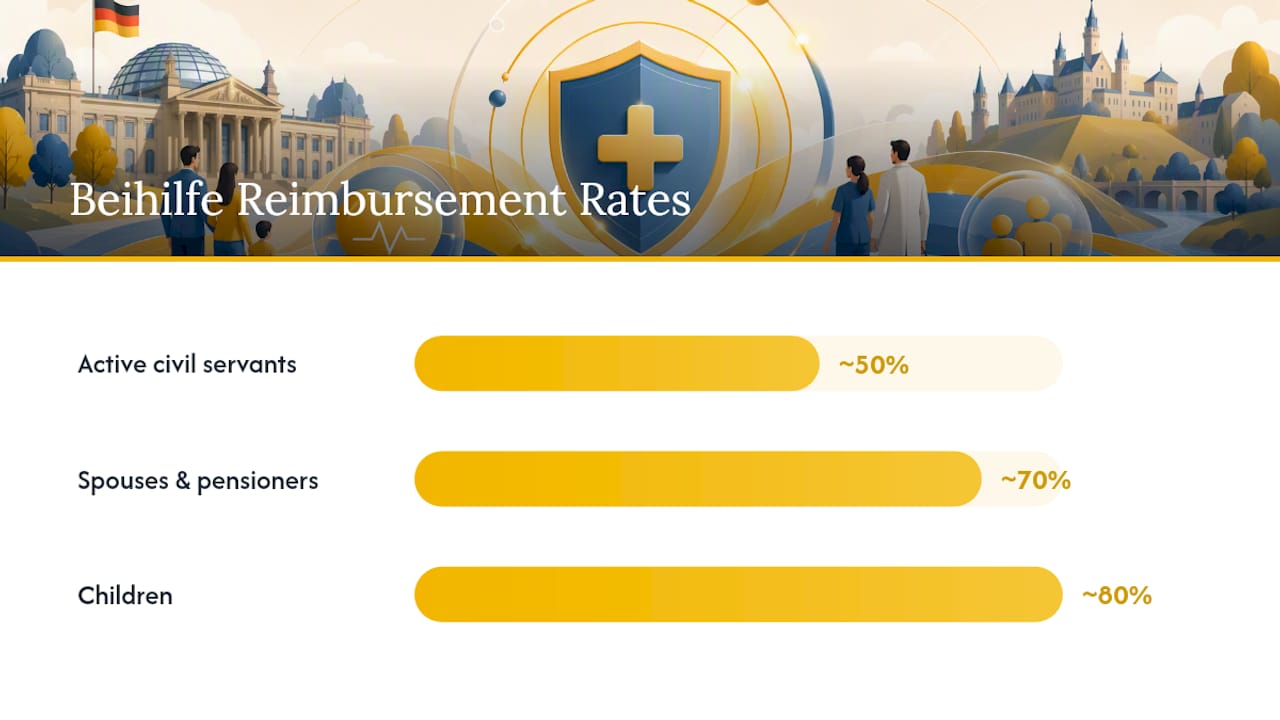
- Active civil servants: around 50% reimbursed
- Spouses and pensioners: around 70%
- Children: around 80%
That gap is why most Beamte carry a private residual tariff built specifically to plug it, though a small number of states now let you take a flat-rate ("pauschale") payment toward statutory insurance instead. Before you buy anything, check your employer's specific Beihilfeverordnung. The federal rules set the baseline, but your state may run the numbers differently.
Key Takeaways
Beihilfe reimburses a defined percentage of medical costs for civil servants, and the uninsured remainder requires a separate private tariff or a pauschale alternative.
| Point | Details |
|---|---|
| Beihilfe is reimbursement, not insurance | It pays back a set share of costs after you've already paid the provider directly. |
| Rates vary by family status | Active employees typically see around 50%, spouses/pensioners around 70%, children around 80%. |
| State rules override the federal default | Your Landesbeihilfeverordnung can change percentages, exclusions, and forms. |
| Pauschale is a real alternative | Some states offer a flat-rate GKV contribution instead of the traditional reimbursement model. |
| Myhealthcarebroker matches tariffs to your gap | Independent, English-language comparison across insurers helps you close your specific residual cost without guesswork. |
Authoritative statutes and practical resources
- Bundesbeihilfeverordnung (BBhV) — full table of contents
- BBhV §46 on measurement of Beihilfe
- Beihilferecht in Bund und Ländern overview
- Check your Landesbeihilfeverordnung and your Dienstherr's HR contact for state-specific forms
- Statutory vs private health insurance guide for broader context on how PKV and GKV compare
This article is general information, not a substitute for advice from a qualified financial advisor. Consult a qualified financial professional about your own circumstances before acting on anything here.
Table of Contents
- What Is Beihilfe Under German Law, and Who Qualifies?
- How Much Does Beihilfe Actually Reimburse?
- What Beihilfe Covers and Where the Gaps Show Up
- Beihilfe, PKV, and GKV: How the Pieces Fit Together
- How to Claim Beihilfe Without Losing Weeks to Paperwork
- Choosing a Beihilfe-Compliant Private Tariff
- Where an Independent Broker Fits Into This Process
- Compare Tariffs Without Guessing at the Fine Print
- Sources
What Is Beihilfe Under German Law, and Who Qualifies?
The legal backbone is the Bundesbeihilfeverordnung (BBhV), the federal regulation that defines who counts as Beihilfe-eligible and how reimbursement rates get calculated. Federal civil servants fall under the BBhV directly. State employees fall under their own Landesbeihilfeverordnung, which borrows the federal structure but can set different percentages, exclusions, or administrative processes. If you're a teacher in Bavaria versus a federal tax official in Berlin, the paperwork and the math won't be identical.
Eligibility generally extends to three groups:
- Beamte (active civil servants) across federal and state administrations
- Versorgungsempfänger (retired civil servants drawing a pension)
- Eligible relatives, typically a spouse and children, subject to income thresholds
The mechanics are straightforward once you've done it once. You visit a doctor or hospital as a private patient, receive an itemized invoice, and submit that invoice to your Beihilferecht processing office (the Beihilfestelle). They calculate your reimbursement based on your Bemessungssatz, or measurement rate, and pay out the covered share.
This is a fundamentally different model from statutory health insurance (GKV), where the insurer pays providers directly and you rarely see an invoice. Beihilfe puts you in the middle of the transaction: you pay first, then claim back. That single structural difference is what makes residual private insurance necessary for almost every Beamter.
How Much Does Beihilfe Actually Reimburse?
The commonly cited reimbursement bands are around 50% for active civil servants, 70% for spouses and pensioners, and 80% for children, though your state's Beihilfeverordnung can deviate from these figures.
Statistic Callout: The formal calculation method sits in BBhV §46, which governs how the Beihilfebemessungssatz is set for each eligible person. It's worth reading that section directly if your family situation is unusual, since the percentage isn't always a flat number tied to your job title alone.
Family status changes your entitlement in ways that catch people off guard. Getting married, having a child, or retiring can all shift your Bemessungssatz, sometimes mid-year. A few things that move the needle:
- Marriage can add a dependent at the 70% rate, assuming income limits are met.
- A new child typically qualifies at 80%, pending documentation.
- Retirement shifts your own rate from the active-employee band to the pensioner band.
Here's a quick worked example. Beihilfe pays $1,000, leaving $1,000 as a residual cost. That residual gap, whatever it lands on for your specific case, is exactly what your private tariff needs to close.
What Beihilfe Covers and Where the Gaps Show Up
Beihilfe generally covers medically necessary ambulatory and inpatient treatment, maternity care, and a defined list of aids and remedies, but the coverage isn't unconditional. The BBhV's annexes (Anlage lists) spell out caps, exclusions, and specific rules that determine what actually gets reimbursed.
Coverage typically includes:
- Doctor visits and medically necessary outpatient treatment
- Hospital stays at the standard ward level
- Maternity and childbirth-related care
- Prescribed medications and a defined list of medical aids
Common gaps that catch people off guard:
- Dental laboratory costs, which are frequently only partially reimbursed under BBhV §46
- Certain aids and appliances beyond the listed Anlage items
- Some therapies and remedies that fall outside the approved catalog
- Hospital comfort upgrades, like a private room or chief physician treatment
Since Landesverordnungen can add or remove items from these lists, the only reliable way to know your exact coverage is to read your specific state's regulation rather than assume the federal baseline applies unchanged. A tariff that fits a colleague in another Bundesland may leave real gaps in yours.
Beihilfe, PKV, and GKV: How the Pieces Fit Together
Combining Beihilfe with a residual private tariff is often cheaper than either full private insurance or statutory coverage, because the private policy only insures the uninsured remainder rather than the whole cost. That's the standard route for most Beamte, and it's why civil-servant tariffs tend to carry noticeably lower premiums than a standard PKV policy bought without Beihilfe backing.
There's a second path worth knowing about: pauschale Beihilfe. A handful of states now offer this as an alternative, where instead of the traditional reimbursement model, your employer pays a flat-rate contribution toward statutory insurance (GKV) premiums, similar to how a private-sector employer splits GKV contributions. Some state programs deviate meaningfully from the federal default here, so availability depends entirely on where you work.
Weighing the two options comes down to a few factors:
- Cost predictability. Residual PKV premiums can rise with age and claims history; GKV contributions under pauschale scale with income instead.
- Coverage depth. PKV residual tariffs generally offer richer benefits (private rooms, broader dental) than GKV.
- Reversibility. Switching from PKV back to GKV later in life is restricted once you're past certain age and income thresholds, while pauschale keeps you inside the statutory system.
- Family situation. Larger families or applicants with pre-existing conditions sometimes find pauschale more economical, since GKV doesn't medically underwrite dependents the way PKV does.
Pro Tip: Don't assume residual PKV is automatically the better deal just because it's the traditional route. If you have several children or a health condition that would trigger underwriting loadings, run the pauschale numbers before signing anything.
How to Claim Beihilfe Without Losing Weeks to Paperwork
Filing a Beihilfe claim isn't complicated, but small errors are the main reason reimbursements get delayed or bounced back.
- Collect the itemized invoice from your provider, with diagnosis codes and treatment dates clearly listed.
- Fill out your state's specific Beihilfe application form (these vary by Bundesland, so don't reuse an old federal template).
- Attach receipts, medical reports, and any prescription documentation the claim requires.
- Submit everything to your Beihilfestelle, digitally where your state accepts electronic submissions.
Processing typically takes a few weeks, though it can stretch longer during high-volume periods. Clean, itemized invoices and correctly completed forms measurably speed up approval.
The most common mistakes worth avoiding:
- Submitting a summary receipt instead of a full itemized invoice
- Using the wrong state's form after a transfer or relocation
- Missing a required medical justification for aids or remedies
Your Dienstherr's HR office or your state's Beihilfe portal will have the current forms and contact details if you're not sure where to send a claim.
Choosing a Beihilfe-Compliant Private Tariff
Picking the right residual tariff means comparing a handful of specific features rather than shopping on price alone.
- Dental lab coverage, since this is one of the most frequent gaps in Beihilfe itself
- Inpatient choices, including whether chief physician treatment or a single room is included
- Deductibles, which trade a lower monthly premium for higher out-of-pocket exposure
- Waiting periods before certain benefits activate
- Age-rating structure, since underwriting and long-term premium risk don't disappear just because the tariff is residual
Insurers generally coordinate payment order with Beihilfe automatically. You submit the same invoice to both, and each pays its contractual share, though the sequencing and subrogation details differ slightly by insurer.
Price mostly comes down to four levers: your age at entry, current health status, how broad the benefit scope is, and the deductible you choose. A 28-year-old entering with no pre-existing conditions will see a very different quote than someone joining at 45 with a chronic condition on file.
Pro Tip: Ask any insurer or broker directly how their tariff treats dental lab costs and hospital comfort upgrades. Those two categories are where Beihilfe gaps hurt the most, and tariffs vary widely on how generously they close them.
Where an Independent Broker Fits Into This Process
Sorting through Landesverordnungen, tariff structures, and English-language paperwork gets complicated fast, especially if you're new to the German system. An independent broker can run an eligibility check, review your applicable Beihilfeverordnung, compare Beihilfe-compliant tariffs across insurers, and help you complete the application without guesswork.
That support matters most in a few specific situations:
- Complex family cases involving multiple dependents or mixed employment status
- Deciding between residual PKV and pauschale Beihilfe
- Limited German-language comfort with insurer paperwork
- Pre-existing conditions that affect underwriting outcomes
A civil servant's checklist for getting this right
Start with your Beihilfeverordnung, not with a tariff brochure. Know your exact percentage and your family's status before you compare a single policy. Keep copies of every invoice, form, and piece of correspondence you send to your Beihilfestelle. A missing document is the single most common reason claims stall.
Revisit your coverage at every life event. Marriage, a new child, or retirement all shift your Bemessungssatz, and a tariff that fit two years ago might leave a wider gap today than you'd expect.
— Marco
Compare Tariffs Without Guessing at the Fine Print
Myhealthcarebroker gives you what most Beihilfe guides can't: a real comparison across every major private insurer, run against your specific Beihilfeverordnung, in plain English. Instead of piecing together dental lab exclusions and age-rating tables on your own, an independent consultant checks your eligibility, matches your family's percentage band to a tariff that actually closes your residual gap, and walks the application through with you.
Because Myhealthcarebroker isn't tied to any single insurer, the comparison covers the full private market rather than one company's product line, and the service costs you nothing since compensation comes from the insurer once a policy is signed. If you want a starting number before anything else, run your numbers through the private health insurance calculator or book a free eligibility check to see which Beihilfe-compliant tariffs fit your situation.
Sources
- Bundesbeihilfeverordnung (BBhV) — Inhaltsübersicht
- Beihilferecht in Bund und Ländern: Einleitung (Stand 07/2025)
- Civil Servant Insurance in English: Germany 2026