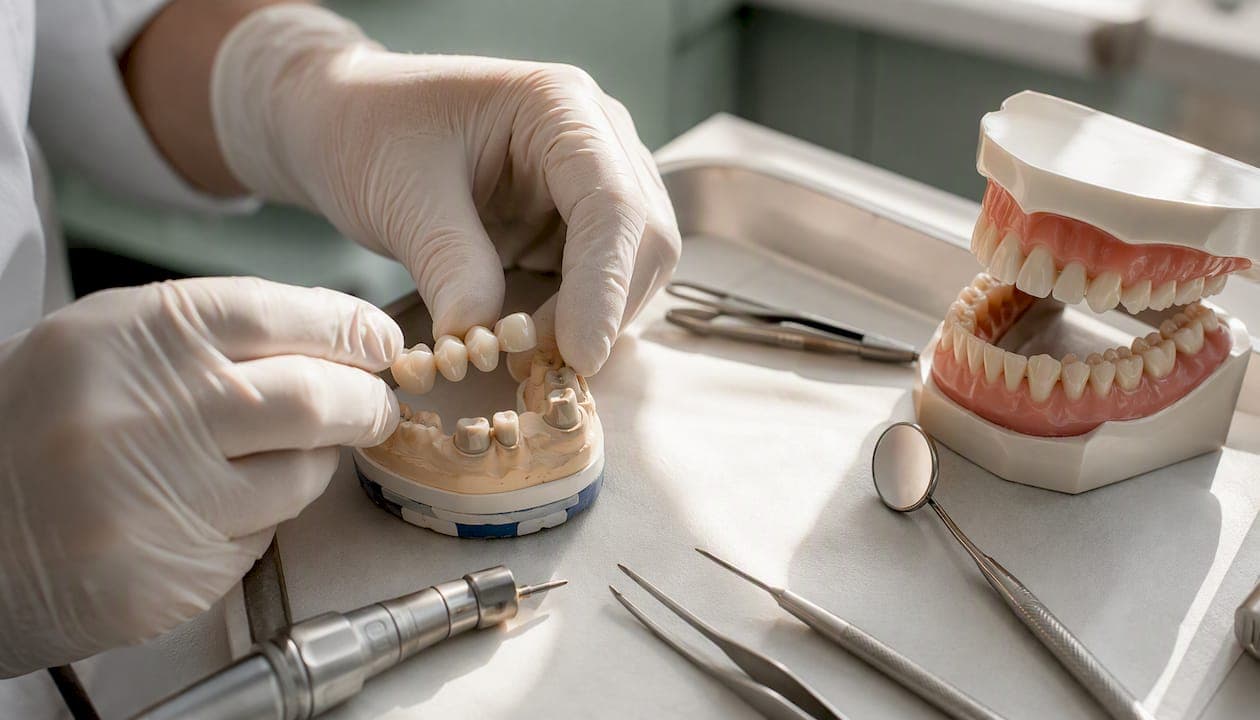
Zahnersatz (pronounced "tsahn-er-zatz") is the German word for dental prosthetics: any restoration that replaces missing teeth or rebuilds heavily damaged tooth structure. In everyday dentist conversations, you'll hear it used for crowns, bridges, dentures, and implant-supported restorations alike. If your German dentist hands you a form with "Zahnersatz" at the top, they're talking about one of these:
- Krone (crown): a cap fitted over a damaged tooth
- Brücke (bridge): a fixed span replacing one or more missing teeth
- Prothese (denture): a removable full or partial replacement
- Implantat (implant): a titanium root with a crown on top
Three terms you'll encounter almost immediately in the German system: statutory health insurance (GKV), the Heil- und Kostenplan (treatment and cost plan), and the Festzuschuss (fixed subsidy). Understanding these three words will make every insurance and billing conversation much easier.
Table of Contents
- What are the main types of Zahnersatz?
- What happens during treatment, from first appointment to final fitting?
- How is Zahnersatz paid for in Germany?
- Key Takeaways
- Why the Festzuschuss system rewards preparation more than most people realize
- How Myhealthcarebroker helps you understand your dental coverage in Germany
- Useful sources
What are the main types of Zahnersatz?
Dental prosthetics in Germany fall into three practical categories. No single option is universally best; the right choice depends on how many teeth are missing, your bone structure, your budget, and your dentist's clinical assessment.
- Implant-supported solutions (implantatgetragener Zahnersatz): A titanium post is surgically placed into the jawbone and topped with a crown, bridge, or overdenture. Modern implant-supported restorations can closely match natural teeth and help prevent the bone loss that often follows tooth extraction, though they involve surgery and higher upfront costs.
Beyond these three categories, combined solutions exist. A telescopic prosthesis uses a double-crown system: inner crowns are cemented onto natural teeth, and the removable outer frame clicks onto them. An implant-retained overdenture snaps onto two or more implants for better stability than a conventional denture. These hybrid options are worth asking about when you have some remaining teeth but not enough for a conventional bridge.
What happens during treatment, from first appointment to final fitting?
Successful prosthetic treatment often requires thorough diagnostics, particularly for implants or complex reconstructions involving multiple teeth. Here's the typical sequence:
- Submission to your insurer: You submit the plan to your GKV or private insurer. The insurer confirms the subsidy amount, and that confirmation is valid for six months — treatment should begin within that window.
Typical timelines: a single crown takes two to four weeks from impression to final fitting. A multi-unit bridge runs roughly the same. Implant treatment spans several months overall, since the implant needs three to six months to integrate with the bone before the crown is placed. For a full overview of implant procedures and workflows, including bone grafting when needed, a dedicated clinical guide covers the steps in detail.
How is Zahnersatz paid for in Germany?
Germany's statutory health insurance (GKV) uses a befundorientierter Festzuschuss system: rather than covering a percentage of your actual bill, the insurer pays a fixed subsidy toward the cost of the standard medically adequate treatment (Regelversorgung) for your specific dental finding. You pay the difference, especially if you choose a higher-quality material or technique.
The subsidy levels work like this:
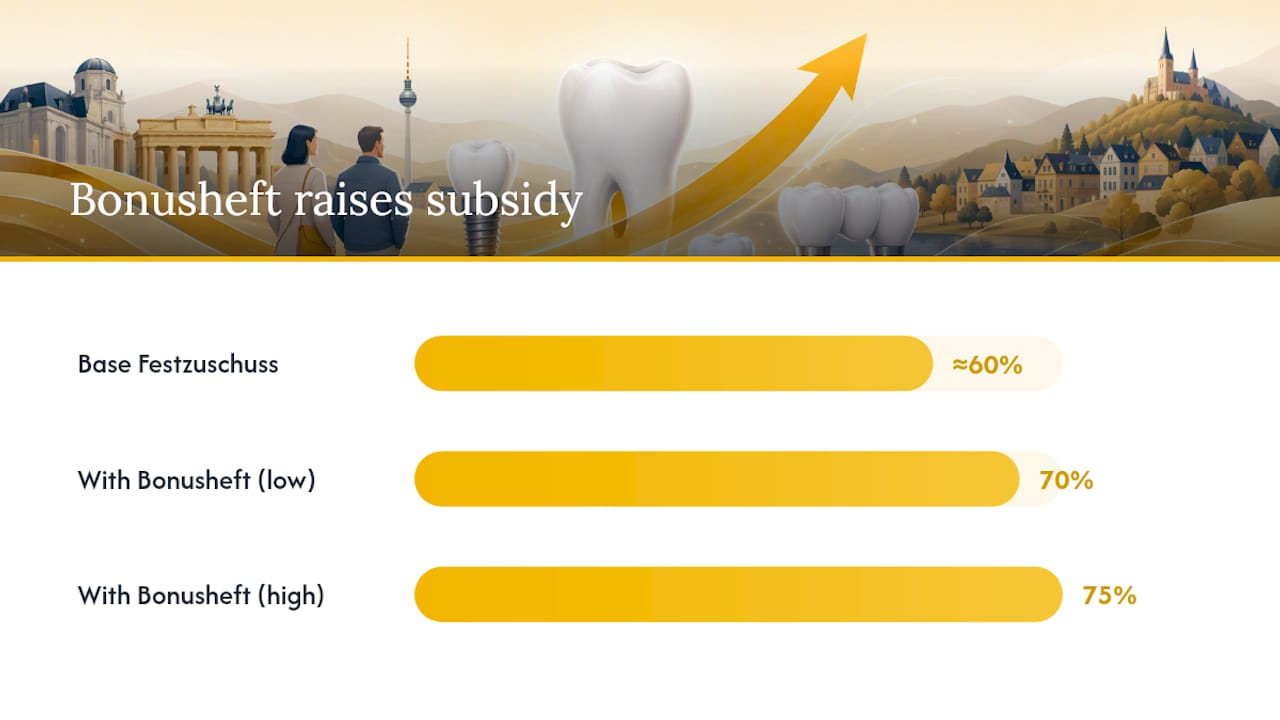
- Base rate: GKV covers roughly 60% of the Regelversorgung cost for your specific finding.
The Festzuschuss covers the Regelversorgung cost, not your entire bill. If you choose a zirconia crown instead of the standard metal-ceramic option, you pay the Festzuschuss difference plus the full cost difference between the two materials out of pocket.
Private insurance follows different rules entirely. Policies are billed under the GOZ (dental fee schedule), and many private plans cover a higher share of implant costs or premium materials. Implants frequently fall outside Regelversorgung and are billed privately even for GKV members, meaning you pay most or all of the implant cost yourself unless you have supplemental dental insurance.
Pro Tip: Before any work begins, ask your dentist to prepare the Heil- und Kostenplan and submit it to your insurer. Never start treatment without the insurer's written confirmation of the Festzuschuss. Getting a second opinion on the treatment plan is also reasonable for any multi-tooth or implant case.
For a clear comparison of what private health insurance covers versus the GKV Festzuschuss, Myhealthcarebroker's English-language guide breaks down the key differences.
Key Takeaways
Zahnersatz is the German term for dental prosthetics, and understanding the Festzuschuss and Heil- und Kostenplan before treatment starts is the single most important step for managing costs under the German system.
| Point | Details |
|---|---|
| Core definition | Zahnersatz means dental prosthetics: crowns, bridges, dentures, and implant-supported restorations. |
| Three main categories | Fixed (crowns, bridges), removable (dentures), and implant-supported solutions cover most clinical situations. |
| GKV subsidy levels | The base Festzuschuss covers roughly 60% of the Regelversorgung cost; a complete Bonusheft raises it to 70%–75%. |
| Heil- und Kostenplan first | Always get the insurer's written confirmation of the subsidy before treatment begins; the approval is valid for six months. |
| Myhealthcarebroker | Myhealthcarebroker helps English speakers in Germany compare private and public insurance options to understand what their plan covers for Zahnersatz. |
Why the Festzuschuss system rewards preparation more than most people realize
The conventional advice is to "check your insurance before treatment." That's true, but it undersells how much the German Zahnersatz system actually rewards people who plan ahead rather than react.
The Bonusheft is a good example. Most expats arrive in Germany without one and spend years not realizing that every missed annual checkup is quietly costing them 10–15 percentage points of future subsidy. By the time a crown or bridge is needed, the difference between a complete booklet and a blank one can be several hundred euros out of pocket. The system is designed to incentivize prevention, and it does, but only if you know the rule exists.

The Heil- und Kostenplan is the other underused tool. Many patients treat it as paperwork rather than as a negotiating and planning document. You can ask your dentist to include alternative treatment options on the same plan, compare what the Festzuschuss covers for each, and make a genuinely informed decision about materials and cost before a single tooth is prepared. Skipping that step and choosing a premium option at the chair is how patients end up surprised by a four-figure bill.
Private dental supplemental insurance (Zahnzusatzversicherung) is worth considering for anyone planning implants or expecting complex restorative work. The GKV Festzuschuss rarely covers implants as Regelversorgung, which means the surgical and prosthetic costs land almost entirely on the patient. A supplemental policy taken out well before treatment is needed can soften that considerably.
How Myhealthcarebroker helps you understand your dental coverage in Germany
Sorting out whether your health plan actually covers a planned Zahnersatz treatment is harder than it should be, especially when the paperwork is in German and the rules differ between GKV and private insurance.
Myhealthcarebroker offers clear, English-language advice on private health insurance in Germany, including how different plans treat dental prosthetics, implants, and supplemental coverage. As an independent broker, Myhealthcarebroker compares options across all major insurers rather than steering you toward one provider. Whether you want to check your eligibility for private coverage, understand what your current plan subsidizes for Zahnersatz, or apply for a plan that covers more than the GKV standard, the process is handled in plain English from start to finish. Use the eligibility check to see which options are available to you, or reach out directly for a personalized consultation.
This article is general information, not professional dental or insurance advice. Confirm current subsidy rules and coverage details with your insurer or a qualified dental professional before starting treatment.
Useful sources
- zahnersatz — Haufe
- Department of Prosthodontics — University Hospital Düsseldorf
- Brücke, Krone, Implantat: Welche Unterschiede gibt es beim Zahnersatz? | Verbraucherzentrale
- Zahnersatz Möglichkeiten: Alle Arten im Überblick 2026
- Zahnersatz | ERGO
- Zahnersatz & Bonusheft: KZVB
- Dental prosthetics — smileDentity