
Private Krankentagegeld replaces your net income when illness keeps you off work, and it exists precisely because statutory Krankengeld often falls short. Self-employed professionals, privately insured employees, and high earners above the contribution ceiling face the biggest gaps and need this cover most. Your next move is simple: calculate your monthly shortfall and check whether your Karenzzeit actually matches when your employer or GKV coverage runs out.
TL;DR:
- Private Krankentagegeld provides full income replacement for self-employed, high earners above the contribution ceiling, and privately insured employees after statutory benefits end.
- The payout depends on your chosen daily rate, the waiting period, and your medical certification, with claims requiring continuous documentation and no retroactive declarations.
- Timing your Karenzzeit to match your employer or statutory coverage expiration minimizes unpaid gaps, especially for self-employed individuals with no wage continuation.
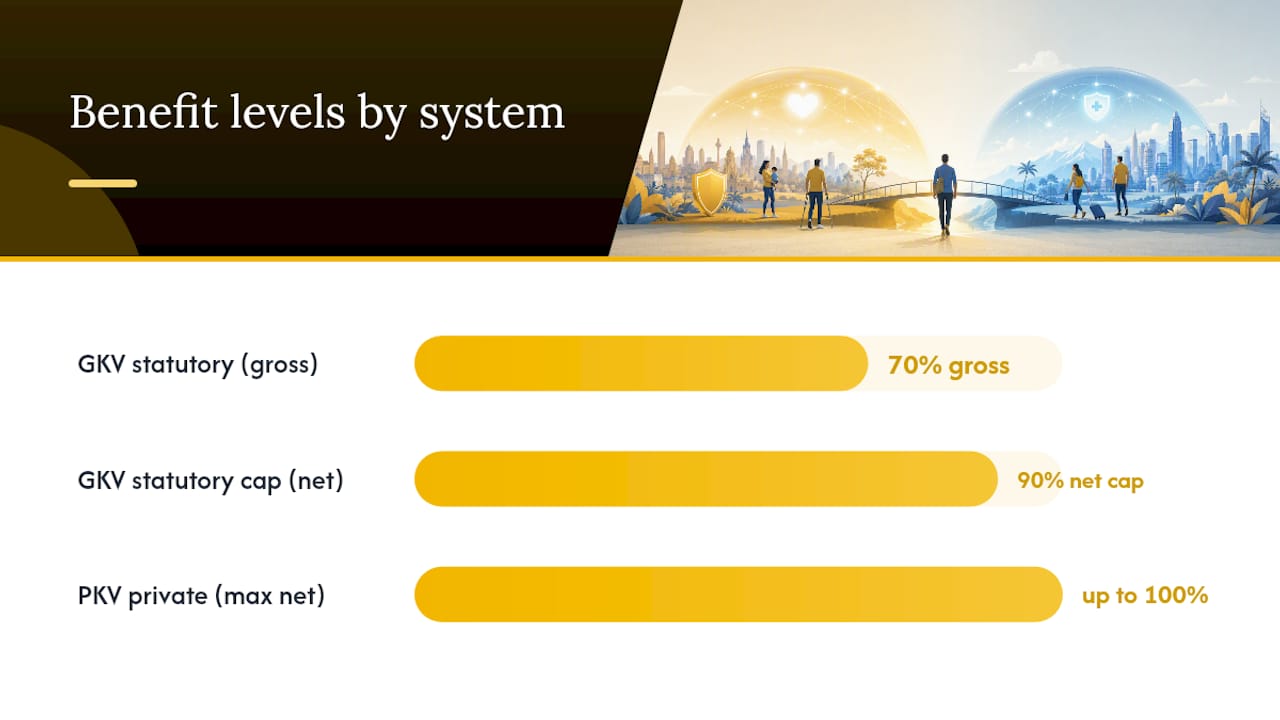
- Statutory Krankengeld caps at 70% of gross income up to 90% of net income within the contribution ceiling, creating a gap for earnings above that threshold which private Tagegeld fills.
- Proper calculation of your coverage involves assessing your fixed costs, statutory benefits, and savings buffer, with flexible tariffs offering future rate adjustments without new underwriting.
Table of Contents
- What Is Krankentagegeld in the PKV and How Does It Work?
- Who Actually Needs Private Krankentagegeld?
- How Much Krankentagegeld Actually Gets Paid
- When Payment Starts and How Long It Lasts
- PKV vs. GKV: The Practical Differences That Matter
- How to Calculate the Right Tagesgeld and Karenzzeit
- Legal, Tax, and Claim Pitfalls to Watch For
- A Broker's Checklist for Getting This Right
- When I'd Actually Recommend Buying or Increasing Cover
- How Myhealthcarebroker Makes This Easier
- Where to Verify These Figures Yourself
- Sources
What Is Krankentagegeld in the PKV and How Does It Work?
Krankentagegeld is a private daily-benefit insurance that pays you a fixed amount for everyday you're medically certified as unable to work. You choose two things when you buy it: the daily rate and the waiting period, called the Karenzzeit. Once both are set, your insurer pays out for as long as the certified Arbeitsunfähigkeit continues, subject to your policy terms.
There are real boundaries here. Insurers won't let your day rate exceed your average net income from the last twelve months, and they generally do not accept retroactive declarations of Arbeitsunfähigkeit. That means the clock starts the day your doctor signs the certificate, not the day you first felt sick.
What this looks like in practice:
- You select a day rate based on your actual living costs.
- Your waiting period can range from a few days to several weeks, depending on your job situation.
- Claims require an ongoing Arbeitsunfähigkeitsbescheinigung from your doctor, renewed regularly.
- Payment stops once you're medically fit again or if the condition becomes a permanent occupational disability, which shifts the issue into Berufsunfähigkeitsversicherung territory instead.
Pro Tip: Book your doctor's appointment the same day symptoms start. Waiting even 48 hours to get certified can push your effective payout date back and cost you real money during the gap.
Who Actually Needs Private Krankentagegeld?
Not everyone needs this coverage at the same intensity, but three groups face genuine exposure.
- Self-employed professionals carry the sharpest risk. There's no employer paying your salary while you recover, so income can stop on day one of illness. A short Karenzzeit, even at a higher premium, is usually worth it.
- Privately insured employees get six weeks of employer-paid Lohnfortzahlung, so a Tagegeld starting around day 43 is common and cost efficient.
- High earners run into the Beitragsbemessungsgrenze, the income ceiling above which statutory benefits stop scaling. Earn well beyond that ceiling, and your GKV Krankengeld replaces a shrinking share of your actual income.
- Edge cases worth flagging: students on limited hours, part-time workers with modest fixed costs, and employees under collective agreements offering employer top-ups may need less extra cover, or none at all.
If you fall into one of the first three groups, treat this as a coverage gap to close, not a nice-to-have add-on.
How Much Krankentagegeld Actually Gets Paid
Statutory and private systems calculate payouts completely differently, and the gap between them is where most underinsurance happens.
Under the GKV, Krankengeld pays 70% of gross income, capped at 90% of net income, with the daily amount also capped by the contribution ceiling. Earn above that ceiling, and the percentage effectively shrinks relative to your actual paycheck.
Private Krankentagegeld works differently: you set the day rate yourself, up to your net income average from the past year. There's no percentage formula working against you, just the boundary that your total payout can't exceed what you'd have earned working.
Here's how that plays out for two readers:
- An employed software engineer earning €5,500 gross monthly hits the GKV cap well before reaching 70% of that figure in real terms, leaving a monthly shortfall that a private Tagegeld can close.
- A self-employed consultant earning €4,000 net monthly has zero statutory safety net and needs a day rate around €130 to fully replace lost income, split across a realistic Karenzzeit.
The core number to remember: Statutory Krankengeld tops out at 90% of net income, but only within the Beitragsbemessungsgrenze. Everything you earn above that ceiling gets no statutory replacement at all, which is exactly the gap private Krankentagegeld is built to fill.
When Payment Starts and How Long It Lasts
Timing decisions here aren't cosmetic. They directly determine whether you have income on the days that matter most.
Employees typically get six weeks of Lohnfortzahlung from their employer before any Krankengeld or Tagegeld kicks in, which is why aligning your Karenzzeit to day 43 is the standard, sensible choice. Self-employed readers have no such buffer and often choose a Karenzzeit of just a few days, accepting a higher premium in exchange for immediate protection.
Duration diverges sharply between the two systems. Private Krankentagegeld generally continues paying as long as medical Arbeitsunfähigkeit persists, with no fixed cutoff written into most contracts. Statutory Krankengeld, by contrast, is capped at 78 weeks within a three-year period for the same illness, after which you're on your own regardless of how you feel.
- No retroactive claims exist in the private system, so a delayed doctor visit simply extends your unpaid stretch.
- Continuous certification matters. Gaps in documentation can reset or interrupt your claim.
Pro Tip: If you're self-employed and unsure whether to pick a 14 or 42-day Karenzzeit, run both premiums against six months of your actual bank statements. The cheaper option only makes sense if your savings genuinely cover the wait.
PKV vs. GKV: The Practical Differences That Matter
The two systems aren't just priced differently. They're built on entirely different legal foundations.
Statutory Krankengeld is a legal entitlement under SGB V. You don't design it, you simply qualify or you don't. Private Krankentagegeld is a voluntary contract you negotiate, which means more flexibility but also more responsibility to set it up correctly.
- Rates and caps: GKV pays 70% gross capped at 90% net, bounded by the contribution ceiling. PKV lets you name your own rate up to net income, with no percentage penalty.
- Duration: GKV stops at 78 weeks per three-year block. PKV generally continues through the full period of certified incapacity.
- Eligibility: GKV applies automatically to qualifying statutory members. PKV requires an application, underwriting, and ongoing premium payments.
- Interaction: Some readers keep a GKV Wahltarif for baseline protection while adding private Tagegeld to close the ceiling gap, particularly useful for high earners who want both a statutory floor and a private top-up.
Choosing between them, or combining both, usually comes down to income level and risk tolerance. Compare the two systems in more depth in this guide to statutory versus private health insurance in Germany.
How to Calculate the Right Tagesgeld and Karenzzeit
Getting the number right takes fifteen minutes with a bank statement and a calculator. Here's the sequence.
- List every fixed monthly obligation: rent, loan payments, your PKV premium, pension contributions, and anything else that doesn't pause when you're sick.
- Estimate any statutory Krankengeld you'd receive, if GKV applies to you at all, and subtract it from your total obligations to find the real monthly shortfall.
- Divide that shortfall by 30 to land on a daily rate target, then check it against your insurer's net-income cap and adjust for the difference in social-insurance contributions between employment types.
- Pick your Karenzzeit based on your savings buffer. If you have three months of expenses saved, a longer waiting period at a lower premium usually makes financial sense.
When you're comparing policy wording, look for adjustability. Some PKV tariffs allow you to raise your insured day rate every few years without a new health check, which matters enormously if your income is likely to grow. Avoid contracts that lock your rate for good or that bundle Krankentagegeld awkwardly with Berufsunfähigkeitsversicherung in ways that create coverage gaps between the two.
Pro Tip: Ask your insurer directly whether rate increases require fresh underwriting. A "yes" here can cost you thousands later if a health condition develops between now and your next raise.
Legal, Tax, and Claim Pitfalls to Watch For
A few contractual details trip up otherwise well-prepared policyholders.
Private Krankentagegeld is tax-free, which is a genuine advantage over ordinary income. Statutory Krankengeld is also tax-free on paper, but it's subject to the progression proviso, meaning it can push up the tax rate applied to your other income for that year.
- Report income changes to your insurer. Insurers can adjust or dispute your insured sum if your declared net income no longer matches reality.
- Insurers generally reserve the right to reclaim underpaid contributions for up to three years if a mismatch surfaces later.
- The most common claim disputes involve gaps in doctor certification or ambiguity about whether treatment was truly continuous.
- If a dispute escalates, the PKV-Ombudsmann offers a free, independent review before you need to involve a lawyer.
One overlooked figure: insurers can look back three years on contribution mismatches, so keeping your income declarations current isn't a bureaucratic afterthought.
A Broker's Checklist for Getting This Right
The single most common mistake seen across client meetings is a Karenzzeit that doesn't match the reader's actual safety net, either too short and overpriced, or too long and leaving weeks of unpaid exposure. Experts consistently advise matching your waiting period to your existing wage continuation before signing anything.
Before a broker consultation, bring:
- Recent proof of net income (payslips or, for the self-employed, tax assessments).
- A rough monthly budget covering fixed costs and family obligations.
- Details of your current PKV tariff, if you already have one.
- Any existing Berufsunfähigkeitsversicherung, so overlaps can be spotted early.
A broker's real value here is negotiating adjustability into your contract, securing the right to raise your day rate later without fresh medical underwriting. That single clause can save you from being locked into today's income level for the rest of your career.
Pro Tip: Bring your last two payslips and one sentence describing your five-year career plan. That's usually enough for a broker to model three realistic Tagegeld scenarios on the spot.
When I'd Actually Recommend Buying or Increasing Cover
If you're self-employed with under three months of savings, buy Krankentagegeld now, not after your first bad flu season. If you're a high earner with a mortgage well above the Beitragsbemessungsgrenze, your GKV safety net is thinner than it looks on paper, and a private top-up closes that gap cleanly. If you're an employee with no employer top-up beyond the statutory six weeks, a modest Tagegeld starting at day 43 is often the cheapest peace of mind you'll ever buy. For expats and high earners juggling unfamiliar German paperwork, a broker review tends to pay for itself many times over in avoided mistakes.
— Marco
How Myhealthcarebroker Makes This Easier
Working out your exact Tagegeld need and finding a tariff with the right adjustability clauses is exactly the kind of detail that's easy to get wrong alone, especially when you're reading German policy wording as a second language. Myhealthcarebroker gives you a genuine comparison across major private insurers rather than a single company's pitch, in plain English, at no cost to you since we're paid through standard broker commission, not a client fee.
Start by running your numbers through our private health insurance calculator to get a realistic premium and Tagegeld estimate before you talk to anyone. If you want a second opinion on an existing policy or you're weighing insurers for the first time, our private health insurance advisory service walks through eligibility, tariff comparison, and application paperwork with you directly. Book a free consultation and bring your payslips. We'll tell you honestly whether your current Karenzzeit actually protects you.
Where to Verify These Figures Yourself
For the latest contribution ceilings and statutory rules, check the Bundesgesundheitsministerium directly, review SGB V provisions on Krankengeld, and contact the PKV-Ombudsmann for independent dispute guidance before escalating any claim.
Sources
- Krankengeld GKV: Alles zu Anspruch, Höhe und Dauer
- Privates Krankentagegeld: Das sollten Sie wissen
- Krankentagegeldversicherung: Ist Krankentagegeld sinnvoll? | Finanztip
- Bundesgesundheitsministerium — contributions and guidance pages