
Under § 19 of the German Insurance Contract Act (VVG) you must truthfully answer every health question your private insurer puts to you in writing, right up until you sign your contract declaration. You don't have to volunteer anything beyond what's actually asked in text form. Get it wrong, though, and the consequences range from a quiet premium adjustment to the insurer voiding your entire policy, depending on whether the mistake was innocent, careless, or intentional.
TL;DR:
- Most disclosure disputes stem from misunderstandings or incomplete answers, not outright lies, and can often be prevented by careful record-keeping before applying.
- Disclosure periods vary: three years for minor issues, five for recurring conditions, and up to ten years for chronic or psychiatric treatments; answers must be based on the insurer's written questions.
- Insurers' remedies depend on the mistake's severity, with gross negligence risking policy termination or premium adjustments, and fraud potentially leading to contract voidance.
- The insurer must provide a clear warning before applying most remedies; missing or vague warnings often result in losing dispute cases.
- Insurers have a limited window of one month to challenge breaches after learning of them, with longer deadlines for deliberate deception, but only if they issued a proper written warning.
Table of Contents
- Understanding the PKV Anzeigepflicht Under § 19 VVG
- What You Actually Have to Disclose, and How Far Back
- The Real Consequences of Getting It Wrong
- Deadlines and the Insurer's Duty to Warn You Properly
- How Insurers Investigate Claims After the Fact
- A Practical Checklist Before You Apply
- Why Most Disclosure Disputes Are Avoidable
- Primary Sources and Further Reading
- Sources
- FAQ
Understanding the PKV Anzeigepflicht Under § 19 VVG
The vorvertragliche Anzeigepflicht (pre-contractual disclosure obligation) is the legal duty that sits at the heart of every German private health insurance application. Section 19 VVG obliges you to disclose known, risk-relevant circumstances, but only the ones the insurer actually asks about in text form. It's a narrower duty than many applicants assume.
Two contract models matter here. Under the "Antragsmodell," your disclosure duty runs until you submit the application. Under the "Invitationsmodell," it runs until the insurer's offer becomes binding through your contract declaration. Either way, the clock stops at that signature, not before.
There's a second requirement most applicants never hear about: the insurer must warn you, separately and in text form, about what happens if you get an answer wrong. Without that written warning, called the Belehrung, the insurer's rights to punish a disclosure error are seriously limited. A few things follow directly from the statute:
- You only owe answers to questions actually posed in text form, not to anything the insurer might wish it had asked.
- The insurer needs a distinct, clearly presented warning notice for most of its remedies to apply.
- Your duty covers what you knew at the time, not conditions you were genuinely unaware of.
What You Actually Have to Disclose, and How Far Back
Insurers ask about diagnoses, hospital stays, ongoing treatments, regular medication, and psychotherapy, almost always within a defined time window rather than your entire medical history. Legal guidance on PKV disclosure breaches notes that look-back periods typically run over a multi-year range varying with the condition and insurer's form.
Roughly speaking, the ranges break down like this:
- 3 years: minor or resolved issues, such as a one-off infection or a short course of physical therapy.
- 5 years: recurring complaints, allergies, or conditions with a moderate chance of returning.
- 10 years: chronic conditions, psychiatric treatment, surgeries, and anything with a lasting risk profile.
If a past treatment falls inside the period the insurer is asking about and you are not sure whether it counts, disclose it. Keep a copy of what you submitted and when. The IHK's overview of the reformed VVG confirms that disclosure is strictly limited to the insurer's own written questions; nothing legally requires spontaneous confessions about issues never asked about. That said, insurers can and do phrase questions broadly ("any treatment for back pain in the last 5 years"), so read each question literally and answer completely within its scope. Our guide on applying for private health insurance in Germany walks through how these questions typically get phrased on real application forms.
The Real Consequences of Getting It Wrong
Insurers don't have a single punishment for disclosure errors. What happens next depends almost entirely on how the mistake occurred.
- No fault at all. If you genuinely didn't know about a condition, no valid remedy applies against you.
- Light negligence. The insurer's options are narrow here, typically limited to adjusting your contract going forward rather than voiding it.
- Gross negligence. The insurer can terminate the contract or retroactively adjust premiums and coverage terms, per § 19 VVG's remedy provisions.
- Intent or arglist (fraudulent deception). This is the harshest tier. The insurer can void the contract entirely (Anfechtung) or rescind it (Rücktritt), often denying claims retroactively.
Beyond outright rescission, insurers frequently reach for a quieter tool: Vertragsänderung, a retroactive change to premiums or a benefit exclusion, applied when the insurer would still have offered coverage, just on different terms, had it known the truth from the start. That's often the more common outcome than a full policy cancellation.
The practical fallout can be uncomfortable even before a final decision. Reimbursements may be frozen while the insurer reviews your file. You might face a retroactive bill for premium differences going back years. And if a contract is voided outright, you're suddenly shopping for alternative coverage under time pressure, often with a disclosure problem now attached to your history.
Pro Tip: If an insurer challenges your original application, don't assume the worst outcome automatically applies. Ask them, in writing, which specific remedy they're invoking and why. The distinction between "gross negligence" and "arglist" changes your options considerably.
Deadlines and the Insurer's Duty to Warn You Properly
Insurers don't have unlimited time to challenge your disclosures, and they don't have unlimited grounds either. Once an insurer learns of a possible breach, it generally has one month to act. Miss that window, and the right to invoke most remedies lapses.
Beyond that, broader statutory deadlines apply:
- For most nondisclosure cases, a limitation period of a few years from contract start applies.
- For intentional deception or arglist, a significantly longer limitation period applies, allowing insurers more time to act on fraud.
None of this matters, though, if the insurer never gave you a proper Belehrung. Court practice, as summarized in commentary on § 19 VVG, has repeatedly required that this warning be clearly placed and worded, not buried in fine print. A missing or vague Belehrung is one of the most common reasons insurers lose disclosure disputes outright.
How Insurers Investigate Claims After the Fact
Most disclosure disputes don't surface at application time. They surface later, when you file a claim, and the insurer notices it relates to something that might predate your contract. This is when the file gets reopened.
A typical investigation involves:
- A comparison between your claim's medical codes and your original application answers.
- A request for a Schweigepflichtentbindung, the medical release that lets the insurer pull records directly from your doctors.
- A review focused heavily on the first three years of coverage, since that's when pre-existing conditions are statistically most likely to resurface.
Practitioner observations from legal case reviews note that insurers pay particular attention to claims involving chronic or psychiatric conditions, precisely because these are the ones most likely to show a documented history predating the application.
Pro Tip: You don't have to sign a blanket medical release. Ask the insurer to limit the Schweigepflichtentbindung to specific providers, dates, or conditions related to the claim. A narrower release protects the rest of your medical history from unrelated scrutiny.
A Practical Checklist Before You Apply
Most disclosure disputes are preventable with a bit of preparation before you ever submit a form. Work through these steps in order:
- Gather your medical records covering whatever period the insurer's form asks about, so you're answering from documentation, not memory.
- Answer only what's written in text form. Keep a saved copy or screenshot of every question and your response.
- Consider an anonymous Risikovoranfrage. This lets you check which tariffs remain available to you based on honest answers, without creating a formal record tied to your name. Broker guidance on this practice treats it as one of the safest pre-application steps available.
- Request written confirmation that all health questions were delivered in text form, and keep your copy of the Belehrung.
- Limit any Schweigepflichtentbindung you sign to specific dates or providers wherever the insurer allows it.
If your medical history is complicated, if you've been denied coverage before, or if you suspect an insurer misapplied one of these rules, get a broker or lawyer involved before you sign anything. This is exactly where a health insurance broker’s role fits in: offering eligibility checks, anonymized risk queries where available, and English-language support reading through the actual forms, so the paperwork doesn't quietly work against you later. You can start with our complete guide to health insurance in Germany if you're still mapping out your options.
Why Most Disclosure Disputes Are Avoidable
The applicants who run into trouble almost never lied outright. Most of the disputes we see stem from someone genuinely misreading a question, assuming a minor issue from years ago didn't count, or not realizing their old physiotherapy sessions fell inside the insurer's look-back window. The law is actually more forgiving than people expect, provided you can show the mistake wasn't willful.
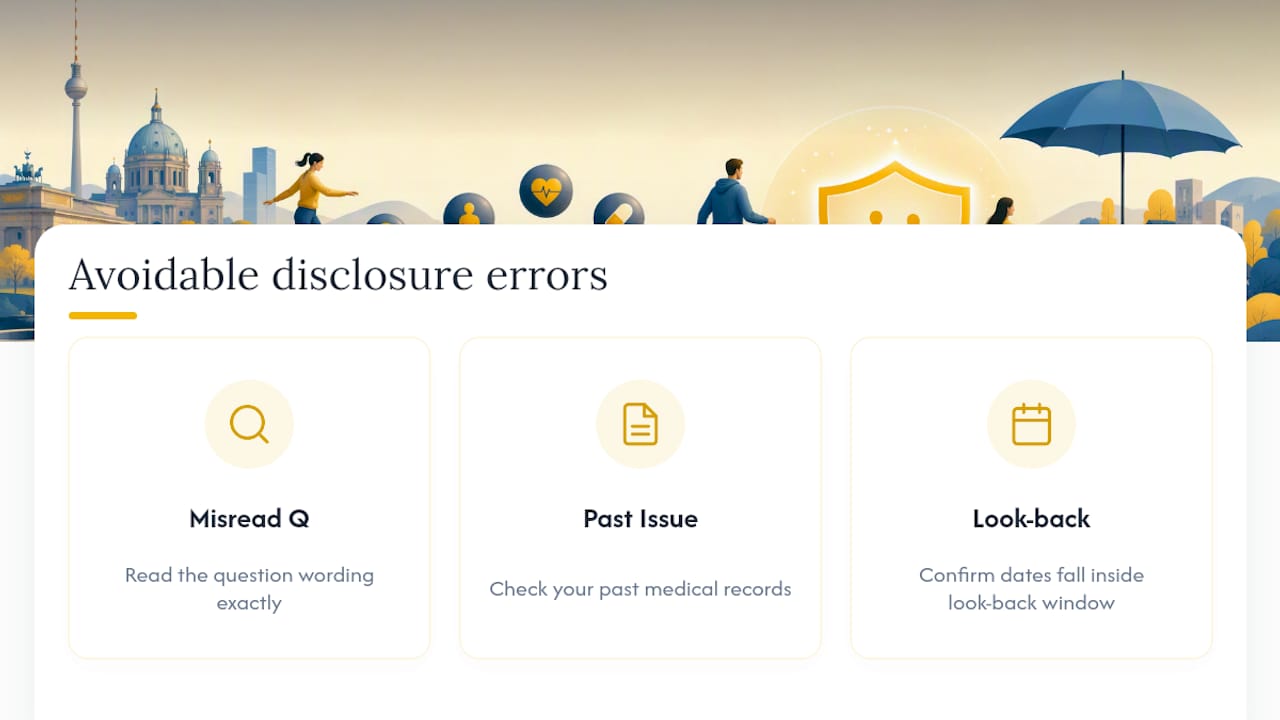
The fix is almost always the same: get your records in order before you apply, not after a claim gets challenged. A short conversation before submission catches ninety percent of the ambiguity that turns into a dispute two years down the line.
If you're staring at a German application form and unsure how to answer a question honestly without over-disclosing, that's worth a conversation before you sign anything, not after.
— Marco
Primary Sources and Further Reading
For the statutory language itself, read § 19 VVG directly. For plain-language context, the IHK's overview of the VVG reform and VIS Bayern's explainer on disclosure duties are both solid starting points. For contested cases, consult a lawyer specializing in insurance contract law rather than relying on general guidance alone.
This article is general information, not a substitute for advice from a qualified lawyer. Consult a qualified legal professional about your own circumstances before acting on anything here.
Sources
- IHK — Das neue Versicherungsvertragsgesetz (overview)
- Anwalt
- VIS Bayern — Vorvertragliche Anzeigepflicht (explanatory overview)
FAQ
Is private health insurance mandatory in Germany?
No single insurer is mandatory, but everyone in Germany must carry health coverage, either public or private, depending on eligibility. Private insurance itself isn't compulsory; having valid coverage of some kind is.
What are the deadlines for a breach of the pre-contractual disclosure duty in PKV?
Insurers generally have one month to act after learning of a breach, with an overall limit of 3 years for most cases and 10 years for intentional deception or arglist. These deadlines run from the contract's start date, not from when the insurer happens to notice the issue.
Why does my private health insurer ask me to sign a Schweigepflichtentbindung?
Insurers use this medical release to pull records directly from your doctors when reviewing a claim, usually to check whether a condition existed before your policy began. You can often negotiate its scope down to specific providers or dates rather than signing a blanket release.
How long is the limitation period for incorrect statements in private health insurance?
The standard limitation period is 3 years for negligent misstatements, extending to 10 years when the insurer can show deliberate deception. A missing written warning (Belehrung) from the insurer can shorten or eliminate these rights entirely, regardless of the underlying mistake.