
A return from PKV to GKV is not freely permitted. It is only possible once you become subject to statutory insurance obligation again, meaning your income drops below the JAEG, you draw ALG I, you enroll as a student, or you qualify for family insurance. If you're over 55, this path narrows sharply. Start by checking the JAEG, gathering payroll or benefit records, and calling your target Krankenkasse before you touch your PKV contract.
TL;DR:
- Returning to GKV from PKV is only possible if your income falls below the JAEG threshold of 77,400 € for 2026 and this reduction appears permanent for at least three months.
- Dropping below the income limit often requires deliberate actions like adjusting salary through entgeltumwandlung or requesting temporary part-time work (brückenteilzeit).
- For self-employed individuals, requalification depends on securing a bona fide employment contract with ongoing income that exceeds self-employment profits, not just occasional work.
- Most late attempts fail after age 55 due to a five-year membership requirement, making early planning critical for future switching options.
- The switch process demands careful documentation, timely notifications to employers and Krankenkassen, and awareness of high hidden costs attached to leaving private coverage, especially loss of age-related reserves.
Table of Contents
- Quick Eligibility Checklist: Run This First
- The Employee Pathway: Dropping Under the JAEG and Other Triggers
- Self-Employed and Freelancers: What Actually Qualifies as a Return Path
- Special Cases: Age 55+, Family Insurance, Students, and Returnees From Abroad
- Administrative Steps and Timeline: Documents, Deadlines, and Notifications
- Financial Consequences and Alternatives to Switching
- Common Pitfalls and Risky Shortcuts to Avoid
- When to Get Professional Help With Your PKV to GKV Switch
- Where to Verify These Rules Yourself
- How and When You Can Actually Return: An Editorial Take
- Sources
Quick Eligibility Checklist: Run This First
Before reading further, run through these questions honestly. They will tell you whether a pkv rückkehr gkv move is realistic for your situation or whether you're better off exploring alternatives inside your current plan.
- Are you under 55, and have you had GKV membership at any point in the last five years? (This matters because the older cutoff rule blocks most late attempts.)
- Is your annual gross income likely to fall below the JAEG threshold, set at 77,400 € for 2026?
- Are you about to receive ALG I, start studying, or become eligible for family insurance through a spouse or parent?
- If you're self-employed, are you planning to take on a main occupation that's subject to social security contributions?
If you answered "yes" to two or more of these, a return is plausible and worth pursuing seriously. If everything comes back "no," switching back this year is very unlikely, and your energy is better spent optimizing your current PKV setup.
The Employee Pathway: Dropping Under the JAEG and Other Triggers
The Jahresarbeitsentgeltgrenze, or JAEG, is the annual income ceiling that determines whether an employee must be privately insured. Cross below it and the door to GKV opens. For 2026, the general threshold sits at 77,400 €. A lower, special threshold applies to some people whose PKV contracts predate 2003, so check your paperwork if that applies to you.
Not every income dip counts. Krankenkassen distinguish between a permanent reduction and a temporary blip. A single low paycheck won't trigger anything. As a practical rule, the change needs to look set to last beyond three months and reflect your genuine, ongoing earning pattern, not a one-off bonus year or a slow quarter.
Two employer-side levers matter here. Entgeltumwandlung lets you convert part of your salary into pension contributions, which lowers your taxable and contribution-relevant income within legal caps, and can nudge you under the JAEG. Brückenteilzeit gives many employees a legal right to temporary part-time hours, which is a cleaner, more provable way to drop your annual salary than an informal arrangement with your employer.
- Model your projected annual income against the JAEG using your actual payroll figures, not estimates.
- Get written confirmation from HR on the salary change and its expected duration.
- Apply for brückenteilzeit or adjust your entgeltumwandlung contributions where eligible.
- Notify your employer of the insurance obligation once it's confirmed, since they must report the change.
- Watch your Krankenkasse's response window closely, since choosing a fund typically must happen within two weeks of the obligation starting.
Pro Tip: Run the payroll projection at least two to three months before you expect to fall under the JAEG. Krankenkassen want to see a credible, forward-looking pattern, not a scramble after the fact.
Self-Employed and Freelancers: What Actually Qualifies as a Return Path
For self-employed people, the road back to GKV almost always runs through taking on employment that's subject to social security contributions as your main occupation, not a side gig. Handelsblatt's practitioner guidance notes that Krankenkassen scrutinize this closely, comparing income streams over time rather than accepting a single favorable month.
To qualify, you'll typically need:
- A genuine employment contract with a real employer, not a token arrangement.
- Payslips showing your employed income consistently outweighs your self-employment profit.
- A self-employed business that, if continued as a side activity, stays below the minijob earnings threshold and employs no staff of significance.
If you're shifting to self-employment as a secondary activity, structure it deliberately: keep records showing the employment came first and dominates your income, and hold onto contracts, tax assessments, and payslips going back several months. Krankenkassen have seen the shortcuts before, and thin documentation is the fastest way to get an application rejected.
Special Cases: Age 55+, Family Insurance, Students, and Returnees From Abroad
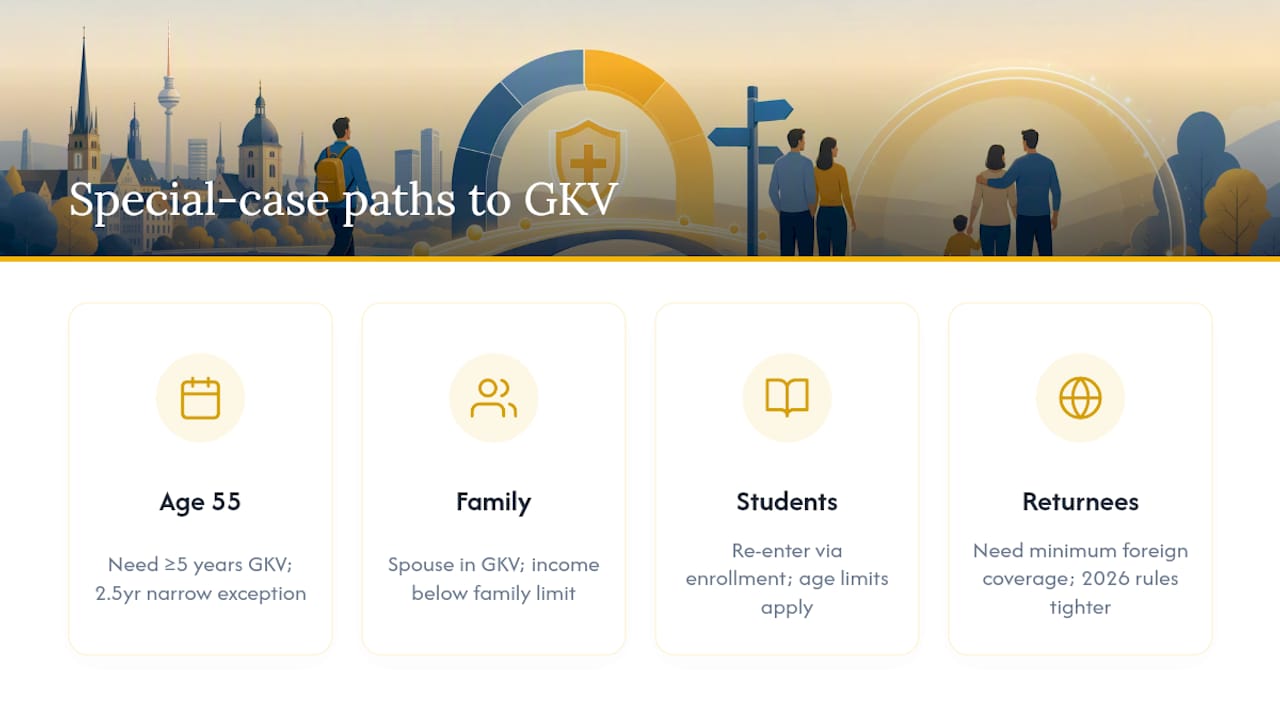
Turn 55 and the door mostly closes. The rule requires GKV membership for at least five of the last five years, or continuous private coverage isn't enough on its own, alongside a shorter two-and-a-half-year lookback that applies in narrower circumstances, per Finanztip's analysis. This single rule blocks the majority of late-career switch attempts, regardless of income changes.
Family insurance offers a genuine side door if your spouse or partner is GKV-insured and your own income stays under the family-insurance limit, and under the minijob threshold if you work part time.
Students re-entering GKV usually do so through enrollment itself, though age limits apply, and many end up switching again once employment starts after graduation.
Returnees from abroad face minimum foreign-insurance duration rules, and Gesund outlines which countries' systems count toward eligibility. Be cautious of "EU-registration" schemes claiming to unlock GKV membership on paper alone. Rules tightened further starting in 2026, and these arrangements are increasingly treated as red flags rather than shortcuts.
Administrative Steps and Timeline: Documents, Deadlines, and Notifications
Once your trigger event happens, whether that's a confirmed income drop, an ALG I award, or a new job offer, the clock starts. Here's the sequence:
- Confirm the trigger event with documentation (payroll projection, ALG I notice, employment contract).
- Choose a Krankenkasse within the two-week window that typically applies once insurance obligation begins.
- Have your employer submit the required notification confirming your new status.
- Start your GKV membership and request written proof of enrollment.
- Present that proof to your PKV insurer within roughly three months to cancel retroactively and avoid double coverage.
Keep these documents ready: employment contract, recent payslips, the ALG I notice if applicable, your GKV enrollment confirmation, and a marriage certificate if you're applying through family insurance. If your Krankenkasse denies the switch, you can request a written explanation and appeal. The Verbraucherzentrale offers free guidance on next steps, and unresolved disputes can eventually go to the Sozialgericht.
Financial Consequences and Alternatives to Switching
Leaving PKV means leaving your Altersrückstellungen behind. These age-related reserves, built up over years to keep your premiums stable later in life, stay with your private insurer and don't transfer to GKV. If you ever return to PKV, you'll typically start building reserves again from scratch at your new, older age, which usually means higher premiums than you'd have paid by staying continuously insured.
The contribution logic also flips. GKV bases your contribution on income, currently around 14.6% plus a fund-specific Zusatzbeitrag, split with your employer. PKV bases premiums on your risk profile: age, health, and chosen benefits. That's why GKV often looks cheaper at lower incomes, but it isn't automatically the better deal for everyone, especially higher earners with good health.
If a full switch isn't available to you, consider:
- Changing your PKV tariff or provider to reduce your premium without leaving the system.
- Moving into the Basistarif or Standardtarif, which cap costs closer to GKV levels.
- Raising your deductible to lower monthly premiums.
- Setting up an Anwartschaftsversicherung to preserve your Altersrückstellungen if you're planning a future move.
Before acting on any of this, run the numbers through a PKV versus GKV calculator using your actual income and age, not rough estimates.
Common Pitfalls and Risky Shortcuts to Avoid
The biggest mistake is treating a return to GKV as a paperwork exercise rather than a genuine change in circumstances. Consumer-protection bodies have flagged several recurring traps:
- EU-registration-only schemes that claim to unlock GKV eligibility without any real change in employment or residence. Tightened rules since 2026 make these both riskier and less effective than the marketing around them suggests.
- Canceling PKV before GKV membership is confirmed, which can leave you with no valid coverage at all if the switch falls through.
- Thin or inconsistent documentation, which Krankenkassen are trained to catch by comparing income patterns over months, not weeks.
Pro Tip: If an adviser promises a guaranteed switch regardless of your actual income or employment status, treat that as a warning sign, not reassurance. Legitimate routes always trace back to a real, provable change in your circumstances.
When to Get Professional Help With Your PKV to GKV Switch
Borderline cases deserve a second pair of eyes. If you're close to 55, unsure whether your lookback years qualify, moving from self-employment into employment, returning from abroad, or you've already had an application rejected, the details matter more than the general rule.
Independent consultancies can help with eligibility assessment, payroll projection modeling, a document checklist tailored to your case, and direct liaison with your Krankenkasse or PKV insurer. Before reaching out, gather your recent payslips, your current PKV policy details, and any correspondence about the trigger event you're relying on. For a full picture of how private and public insurance compare in your situation, an independent review often catches details a quick online search misses.
Where to Verify These Rules Yourself
For binding answers, go directly to the Bundesgesundheitsministerium's guidance on GKV and PKV switching, TK's employee-specific rules, and Finanztip's practical breakdown. If your case is borderline, your Krankenkasse's own decision is the one that counts, so call them before making irreversible moves.
How and When You Can Actually Return: An Editorial Take
Most advice on this topic treats the JAEG threshold as the whole story. It isn't. The real decision point for most employees comes down to whether they can document a credible, sustained income change, and that's a payroll and timing problem as much as a legal one. Entgeltumwandlung and brückenteilzeit get mentioned constantly, but few articles walk through how to actually sequence them against the twelve-month calculation Krankenkassen use.
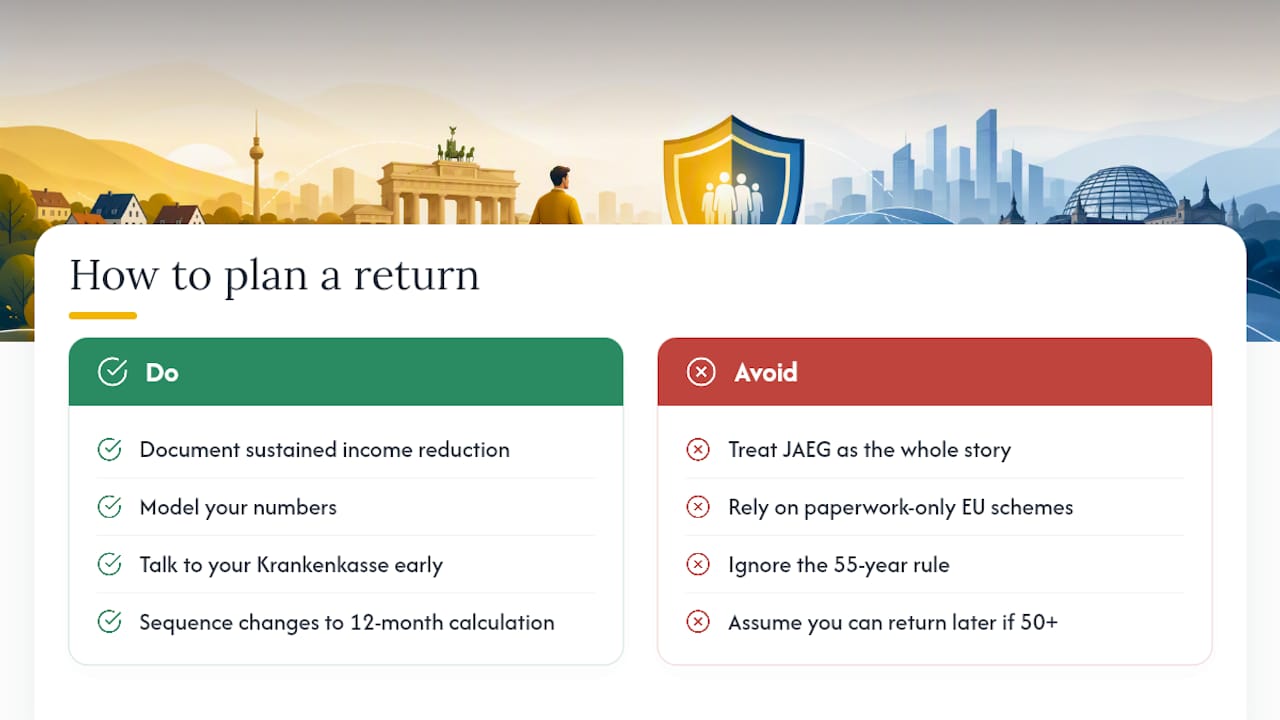
The bigger blind spot is the 55-year rule. It quietly disqualifies more people than the JAEG ever will, and it deserves far more attention than the single sentence it usually gets. If you're 50 and thinking about this "eventually," the lookback clock is already running against you.
My honest read: the paperwork-only EU schemes making the rounds are a distraction from the two paths that actually work, genuine income reduction or genuine unemployment. Skip the shortcuts. Model your numbers, talk to your Krankenkasse early, and treat the Altersrückstellungen you'd forfeit as a real cost, not a footnote.
— Marco
This article is general information, not a substitute for advice from a qualified financial advisor. Consult a qualified financial professional about your own circumstances before acting on anything here.
Sources
- Wechsel zwischen GKV und PKV | Bundesgesundheitsministerium
- Wechsel von der privaten Krankenversicherung in die GKV | Finanztip
- Verbraucherzentrale: Wechsel von PKV in GKV
- Wann Beschäftigte in die gesetzliche Krankenversicherung zurückkehren können | TK
- Von der PKV in die GKV | Handelsblatt