
Private health insurance suits young, healthy high earners, civil servants (beamte), and financially stable self-employed professionals far better than it suits families with one income or older applicants. Employees need a gross annual salary above the 2026 threshold of €77,400 to qualify, while self-employed people and civil servants can typically apply regardless of income. The trade-off is consistent across every serious analysis: stronger individual benefits today, against real premium escalation and administrative rigidity later.
TL;DR:
- The main long-term risk of PKV is rising premiums with age, with one in three policyholders experiencing annual increases that can compound over decades.
- Families with dependents face high additional costs since PKV offers no free coverage for spouse and children, unlike GKV, which includes them at no extra charge.
- Eligibility for employees depends on earning above €77,400 gross per year in 2026, while self-employed and civil servants can apply regardless of income.
- The system’s reimbursement model requires upfront payments, paperwork, and waiting periods, making claims more cumbersome than in the public system.
- Reversing the switch to public insurance after age 55 is nearly impossible, making early, careful cost and risk projections essential before choosing PKV.
Table of Contents
- PKV Vorteile Nachteile: The Quick Summary
- What Are the Real Advantages of PKV in Germany?
- What Are the Disadvantages and Long-Term Risks of PKV?
- PKV vs GKV: How Do They Compare on What Matters?
- Who Actually Benefits From Switching to PKV?
- How Do PKV Premiums and Ageing Reserves Actually Work?
- Who Is Eligible to Switch, and How Does the Process Work?
- Your Decision Checklist Before Switching to PKV
- Common PKV Mistakes and How an Independent Broker Helps
- Is PKV Actually Worth It? An Editorial Take
- How Myhealthcarebroker Makes This Decision Easier
- Sources
PKV Vorteile Nachteile: The Quick Summary
Before diving into the details, here are the facts that matter most for anyone weighing the switch:
- Eligibility threshold: employees must earn above €77,400 gross per year in 2026 to leave the public system; self-employed people and civil servants generally bypass this rule.
- Main advantage: contractually fixed benefits, faster specialist appointments, and access to chief physician treatment and private hospital rooms.
- Main disadvantage: no free family coverage, meaning every child and non-working partner needs a separate paid tariff.
- Underwriting risk: pre-existing conditions can trigger premium surcharges, benefit exclusions, or outright rejection.
- Long-term risk: premiums tend to climb with age, and returning to GKV after age 55 is close to impossible, even during financial hardship.
- Next step: request tariff quotes from several insurers, run a cost projection covering the next 20 to 30 years, and compare it honestly against what you would pay under GKV.
Treat that last point as the real decision driver. A tariff that looks like a bargain at 32 rarely stays that way at 62, and the system is not built to let you reverse course once you have committed.
What Are the Real Advantages of PKV in Germany?
The appeal of private insurance is not abstract. It shows up in the doctor's waiting room, the hospital admissions desk, and the benefits booklet you get when you sign.
Contractually guaranteed benefits sit at the center of the pitch. Once you sign a tariff, the insurer cannot unilaterally strip out coverage the way public funds sometimes trim optional extras. Top-tier PKV tariffs commonly include single-room hospital accommodation, treatment by the chief physician (Chefarztbehandlung), high-end dental prosthetics, and alternative medicine coverage that GKV either excludes or reimburses only partially.

Faster access to specialists is the benefit most clients notice first. Private patients frequently get appointments in days rather than the weeks that public patients sometimes wait for orthopedists, dermatologists, or MRI slots. A detailed look at specialist access under private insurance shows how this plays out across different medical specialties in practice.
Income-independent premiums at entry work in favor of high earners. GKV contributions scale with salary up to the contribution ceiling, but PKV premiums are calculated from your age, health status, and chosen tariff at the point of entry. A healthy 28-year-old software engineer earning €90,000 can often lock in a lower starting premium than they would pay in the public system, since their contribution has nothing to do with their paycheck.
Beamte (civil servants) get a specific structural advantage. Through Beihilfe, the state covers a fixed percentage of medical costs (often 50 to 70 percent depending on family status), and a PKV tariff only needs to cover the remainder. This combination is usually the cheapest and most comprehensive option available to that group, which is why most civil servants in Germany carry private coverage rather than public.
Premium refunds and flexible extras round out the picture. Many tariffs offer a no-claims bonus (Beitragsrückerstattung) if you submit zero claims in a calendar year, and you can often choose a self-pay deductible to lower your monthly premium or add dental top-up coverage separately.
Pro Tip: Don't assume the cheapest entry-level tariff gives you comparable coverage to a mid-range GKV plan. Some budget PKV tariffs skimp on psychotherapy sessions or home nursing care, so read the benefits schedule line by line before comparing price tags.
A short list of what strong tariffs typically include:
- Single or double hospital rooms with treatment by senior consultants
- Full reimbursement for high-end dentures and orthodontics
- Shorter waiting times for specialist referrals and elective procedures
- Optional deductibles that lower monthly premiums for healthy applicants
- Annual premium refunds for claim-free years
What Are the Disadvantages and Long-Term Risks of PKV?
The downside of private insurance rarely shows up in year one. It accumulates over decades, which is exactly why so many people underestimate it when they sign.
Family coverage is the first shock for many switchers. GKV includes a spouse and children at no extra cost when household income stays below a set threshold. PKV has no equivalent. Every family member needs an individual tariff, and a child's premium alone can run into the hundreds of euros monthly depending on the insurer and coverage level. Anyone planning a family should read through the specifics of private health insurance for families before assuming the math will work out the same way it did as a single applicant.

Underwriting turns your health history into your price tag. Before acceptance, PKV insurers ask detailed questions about pre-existing conditions, past surgeries, and ongoing treatments. Consumer protection groups warn that this can lead to risk surcharges, permanent exclusions for specific conditions, or rejection outright. Someone managing a chronic illness like diabetes or a mental health condition may find PKV substantially more expensive, or simply unavailable at standard terms.
Premiums rise with age, and this is where the long-term math gets uncomfortable; for a general analogy on how premium mechanics work, see how private health insurance premiums work in Australia. WirtschaftsWoche's analysis confirms that ageing reserves exist precisely to cushion this increase, but they do not eliminate it. Rising healthcare costs, medical inflation, and insurer-specific claims experience all push premiums upward over a policyholder's lifetime, regardless of how carefully the reserves were built.
Roughly one in three PKV policyholders faces a premium adjustment in a given year, according to industry reporting cited by WirtschaftsWoche, and increases can compound meaningfully over a 20 to 30 year horizon.
Administrative friction is a daily reality, not a one-time hurdle. PKV generally works on a reimbursement model: you pay the doctor or hospital directly, then submit the invoice to your insurer for reimbursement. That means keeping receipts, filing claims, and occasionally waiting weeks for money back, compared to the direct billing that GKV patients rarely think about.
Switching back to GKV is nearly a one-way door. Once you pass age 55, returning to the public system is essentially off the table, even if your income drops or your health deteriorates. Financial hardship is not accepted as grounds for reversal. Treat the decision as close to permanent from the moment you sign.
Common disadvantages worth weighing before you commit:
- No free coverage for a spouse or children, each needs a separate tariff
- Health questionnaires can trigger surcharges, exclusions, or rejection
- Premiums climb with age despite ageing reserves being built in
- Claims require upfront payment and paperwork, not automatic billing
- Reversing the decision after 55 is rarely possible under German rules
PKV vs GKV: How Do They Compare on What Matters?
Choosing between the two systems comes down to four practical dimensions: how much you pay, who's covered, how much flexibility you get, and how quickly you can see a doctor.
| Dimension | GKV (Public) | PKV (Private) |
|---|---|---|
| Contribution basis | Percentage of gross income, capped at the contribution ceiling | Fixed by age, health, and tariff at entry, independent of income |
| Family coverage | Spouse and children included free under income limits | Each family member needs a separate paid tariff |
| Employer support | Employer pays roughly half automatically | Employer contributes toward employee-side PKV premiums, similar split |
| Benefit flexibility | Standardized catalog, limited optional extras | Highly customizable, but quality varies sharply by tariff |
| Specialist access | Often slower, especially for non-urgent referrals | Generally faster, particularly for private billing patients |
| Long-term cost path | Rises with your income and the contribution rate | Rises with age and medical inflation, harder to predict |
Handelsblatt's comparison makes the point plainly: there is no universal winner. GKV tends to work better for families and employees whose income sits closer to the average, since the free family coverage and income-based structure absorb life changes gracefully. PKV tends to work better for beamte with Beihilfe support, young healthy high earners without dependents, and self-employed professionals who value guaranteed benefits and faster access over cost predictability.
The employer contribution deserves a second look here. Employees under PKV still get a subsidy toward their premium from their employer, structured similarly to the GKV split, so the income-independence of PKV pricing doesn't mean employees are shouldering the full cost alone.
Who Actually Benefits From Switching to PKV?
Some readers will recognize themselves immediately in these profiles. Others will realize the fit isn't as clean as they assumed.
- Civil servants (beamte): Beihilfe covers most costs, making a complementary PKV tariff usually cheaper and more comprehensive than GKV.
- Young, healthy high earners without dependents: Lower entry premiums, strong benefits, and decades to build ageing reserves before costs climb.
- Established self-employed professionals with stable income: No JAEG income threshold applies, and predictable income supports predictable premium payments.
- Students under specific conditions: Some student tariffs offer low-cost coverage, though the terms differ meaningfully from adult PKV, worth checking on a dedicated student insurance page.
Borderline cases need extra scrutiny before signing anything. Someone planning a family within the next five years should model the added cost of insuring a spouse and children before switching. Anyone within 10 to 15 years of retirement should be especially cautious, since Stiftung Warentest's review of PKV confirms that the closer you are to the age-55 cutoff, the higher the stakes of getting the decision wrong.
How Do PKV Premiums and Ageing Reserves Actually Work?
Your PKV premium isn't a flat number quoted once and forgotten. It's built from your age and health at entry, then adjusted over time as insurers recalculate costs across their entire risk pool.
Ageing reserves (Altersrückstellungen) are the mechanism insurers use to soften this. Part of every premium you pay while young and healthy gets set aside specifically to offset the higher medical costs expected as you age. It's a legally mandated cushion, and it genuinely reduces the shock of getting older within the system. But WirtschaftsWoche's reporting is direct about the limits: reserves ease the increase, they don't cancel it. Medical inflation, new treatments, and demographic shifts within an insurer's customer base can all push contributions upward regardless of how well-funded the reserves are.
That's worth remembering, because transferring ageing reserves between insurers only partially protects you if you want to switch tariffs later. For contracts started after 2009, a portion of your reserves is portable, but confirm the exact transfer terms in any new offer before assuming your years of saved buffer move with you intact.
Before signing anything, check the tariff terms for three specific features: the self-pay deductible level, whether a Beitragsentlastungstarif (a contribution-relief rider) is available to pre-fund lower premiums in retirement, and how the insurer's historical premium increases compare to competitors over the past decade. This last point rarely gets asked, but it's one of the most revealing questions you can pose to an insurer.
Pro Tip: Ask any insurer for their average contribution increase over the last 10 years across comparable tariffs, not just their marketing brochure. Some companies have a demonstrably better track record of cost discipline than others, and that history tends to repeat.
A quick checklist for evaluating the cost mechanics:
- Confirm whether the tariff includes a contribution-relief rider for retirement years
- Ask about the insurer's 10-year track record on premium increases
- Verify how much of your ageing reserve is transferable if you switch tariffs later
- Model your premium at ages 45, 55, and 65 using the insurer's own projections
Who Is Eligible to Switch, and How Does the Process Work?
Eligibility rules are strict for employees but far looser for two other groups.
Employees need gross annual income above the 2026 JAEG threshold of €77,400 to leave GKV. Self-employed people and civil servants generally sidestep this rule entirely and can apply to PKV regardless of income level.
- Confirm eligibility. Check your income against the current JAEG threshold, or confirm your self-employed or civil servant status qualifies you independently.
- Gather documentation. Insurers typically require income proof, a completed health questionnaire, and sometimes medical records for pre-existing conditions.
- Complete underwriting. The insurer reviews your health questionnaire and returns a decision: standard acceptance, acceptance with a surcharge, exclusion of specific conditions, or rejection.
- Time your notice to GKV carefully. German law sets specific notice periods for leaving public insurance, and starting PKV coverage without a gap requires coordinating both dates precisely.
- Finalize your start date. Once approved, your PKV policy activates on the agreed date, and you're responsible from that point for the reimbursement-based claims process.
Your Decision Checklist Before Switching to PKV
Run through these questions in order rather than jumping straight to a premium quote.
- Is your income stable and likely to stay above the eligibility threshold if you're an employee, or reliably steady if you're self-employed?
- Do you plan to start or grow a family in the next five to ten years, and have you priced that into a PKV scenario?
- What does your career path look like if you might return to lower-paid employment or unemployment, since that can complicate staying in PKV?
- What does your current health picture look like, honestly, including any conditions that might trigger a surcharge or exclusion?
- How close are you to the age-55 cutoff, after which reversing the decision becomes extremely difficult?
- Does your employer or Beihilfe program support PKV contributions the way it would support GKV?
- Have you built a retirement savings plan that accounts for rising premiums decades from now?
Finanztip's guidance distills this down to five core criteria: income, age, health, family plans, and occupation. Run a genuine 20 to 30 year cost projection against these factors before signing, and request quotes from multiple insurers rather than accepting the first offer.
Pro Tip: If two or more of these questions give you an uncertain answer, that's a signal to consult an independent broker before committing rather than after. The cost of a wrong decision compounds for decades; the cost of an extra conversation is free.
Common PKV Mistakes and How an Independent Broker Helps
The most expensive mistakes in this decision are quiet ones. They don't announce themselves at signing, they show up 15 years later.
Accepting the cheapest entry-level tariff without checking its benefit schedule is a frequent trap. Some budget tariffs reduce coverage for psychotherapy or home nursing care below what GKV would offer, which only becomes obvious when you actually need that care. Ignoring the transferability of ageing reserves when comparing offers is another common error, since a lower headline premium can hide a worse long-term reserve structure.
An independent broker's actual workflow addresses both problems directly: running your eligibility check, requesting multiple tariff offers side by side, comparing long-term contribution scenarios rather than just entry prices, and evaluating exactly how much of your ageing reserve would transfer under each offer. Myhealthcarebroker builds that comparison across providers in the German market, documenting the likely contribution path for each option before you sign anything.

Is PKV Actually Worth It? An Editorial Take
The honest answer is that PKV rewards people who can afford to think in decades, not years. If you're young, healthy, and childless, the entry premium looks fantastic, and it genuinely is fantastic, right up until the point where age catches up with the risk pool you're in. The mistake I see people make most often isn't choosing PKV. It's choosing it based on a single number, the monthly premium at signup, without asking what that number becomes at 50 or 60.
Families deserve extra caution here. The free family coverage under GKV is worth more than most people credit it for, especially once you price out insuring a spouse and two kids under separate PKV tariffs. If your situation is genuinely complex, whether that's a chronic health condition, an unpredictable self-employed income, or a family plan on the horizon, get a second opinion from someone who isn't selling you a specific insurer's product. Run the 20-year scenario before the 2-year one.
— Marco
How Myhealthcarebroker Makes This Decision Easier
Myhealthcarebroker exists for exactly this moment: when the pros and cons on paper still leave you unsure which system actually fits your income, your family plans, and your risk tolerance. As independent consultants, not tied to any single insurer, we compare tariffs across the German market and translate the fine print into plain English, so you're not guessing which contribution-relief rider actually matters or whether your ageing reserves will transfer cleanly.
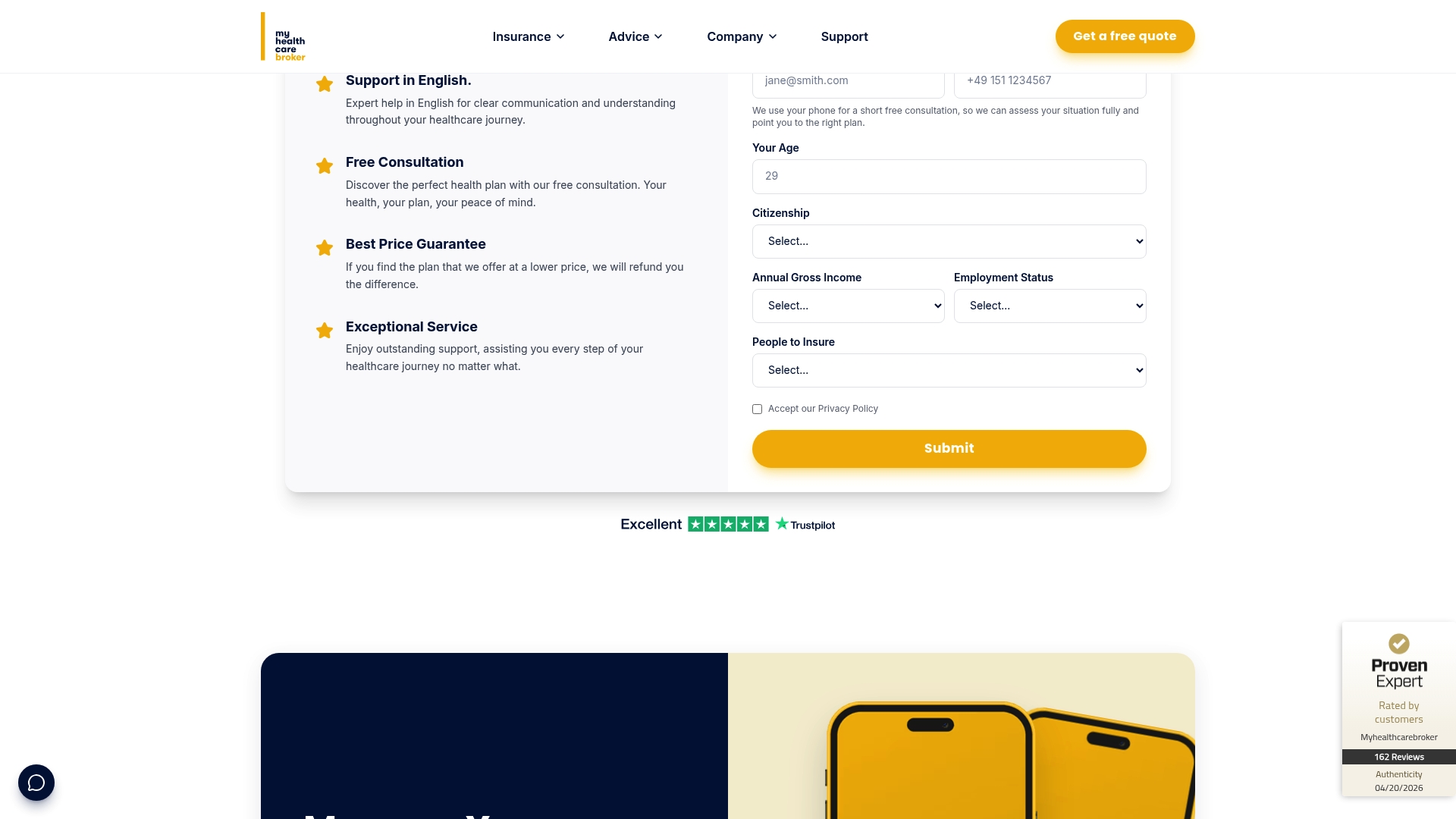
Our service covers the full path: an eligibility check against the current JAEG threshold, side-by-side tariff comparisons, English-language guidance through the health questionnaire, and support with the actual application once you've decided. If you want to see how your numbers play out before committing to anything, run your figures through our private health insurance calculator or explore how private health insurance works in Germany in more detail. From there, book a free consultation and we'll walk through your specific situation together, no pressure, no obligation to sign with anyone.
Sources
- Gesund
- WirtschaftsWoche — Private Krankenversicherung: Vorteile & Nachteile
- Handelsblatt — PKV or GKV: What is better?
- Verbraucherzentrale — Private Krankenversicherung: not sensible for everyone