
If you receive Arbeitslosengeld I, you're usually enrolled in statutory health insurance automatically, whether you want it or not. The main way out is proving five straight years of prior private coverage, or turning 55. If either applies, file for exemption within two weeks of your ALG I claim starting. Miss that window, and the Krankenkasse decision often becomes hard to undo.
TL;DR:
- Staying in private health insurance during unemployment depends on having at least five years of prior private coverage or being 55 or older; missing exemption deadlines can result in automatic GKV enrollment.
- The government covers statutory health contributions during ALG I payments, but exemptions must be filed within two weeks; delays risk paying unnecessary premiums or losing private coverage options.
- Eligibility for exemption from statutory insurance requires five years of private coverage if under 55, but older workers can qualify regardless of prior duration due to the 55+ exception.
- The government caps its subsidy based on statutory contribution rates, often leaving higher-tier private tariffs with significant out-of-pocket costs during unemployment.
- Returning to private insurance after unemployment is easiest through maintaining an Anwartschaft or reapplying before deadlines, but switching to GKV may reset premiums and underwriting, affecting long-term costs.
Table of Contents
- What Happens if You Claim Arbeitslosengeld I (ALG I)?
- When You Can Remain in PKV: The Five-Year Rule and the 55+ Exception
- How the Employment Agency Pays: Subsidy Caps and Payment Mechanics
- Practical Options While Unemployed: Stay in PKV, Switch to GKV, or Hold a Tariff
- Timing, Forms, and Deadlines You Must Meet
- After Unemployment: Returning to Work, Self-Employment, or Staying in GKV
- Practical Checklist and Scenarios for Common Reader Profiles
- Why This Decision Matters Beyond the Immediate Premium
- How Myhealthcarebroker Helps You Navigate This Decision
- Sources
What Happens if You Claim Arbeitslosengeld I (ALG I)?
The moment your ALG I payments begin, German law places you into a statutory Krankenkasse by default. This isn't a suggestion. It's an automatic administrative step tied to receiving the benefit, and it happens regardless of how many years you spent privately insured beforehand.
During this period, the Bundesagentur für Arbeit takes over your health insurance contributions. You don't pay the statutory premium yourself while collecting ALG I. That coverage generally continues even through a Sperrzeit (a benefit suspension period for those who, say, quit without good cause), since the insurance obligation and the benefit payment aren't identical legal mechanisms.
Here's what matters practically, according to guidance from the Bundesagentur für Arbeit:
- Automatic GKV enrollment starts from day one of ALG I, not from your application date.
- The Agency pays statutory contributions directly during this period.
- Health coverage typically continues even during a Sperrzeit.
- You have a two-week window to apply for exemption from GKV at your chosen Krankenkasse.
- If exemption is granted, you then have three months to cancel your private policy without gaps in cover.
Those two windows, two weeks and three months, are the ones that trip people up. Miss the first and you're stuck in GKV for that unemployment spell. Miss the second and you risk paying for insurance you no longer need.
When You Can Remain in PKV: The Five-Year Rule and the 55+ Exception
Staying privately insured while unemployed isn't automatic. You have to earn the right to opt out of statutory coverage, and German law sets a narrow path for doing it.
The core requirement: you must have been privately insured for the five years immediately preceding your unemployment. The Bundesagentur für Arbeit's own guidance confirms this is strictly enforced for anyone under 55. Gaps count against you. So does a recent switch from GKV to PKV that falls short of the five-year mark, even by months.
There's a separate, more forgiving path for older workers. If you're 55 or above, you typically qualify for Versicherungsfreiheit (insurance freedom) regardless of how long you've held private cover, because the legal assumption shifts at that age: returning to GKV becomes structurally harder, so the rules protect your existing PKV arrangement instead.
Consider three quick scenarios:
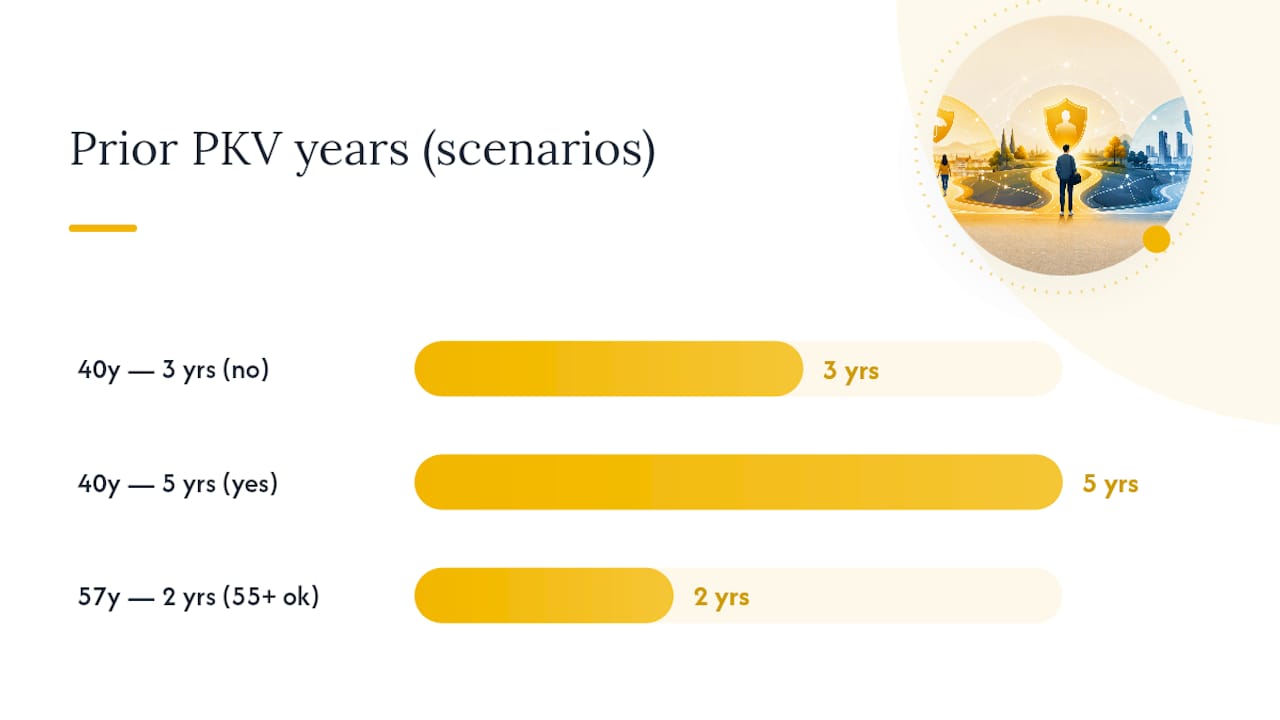
- 3 years of prior PKV, age 40: Doesn't meet the threshold. Default GKV enrollment applies.
- 5 years of prior PKV, age 40: Meets the requirement. Exemption is available if filed on time.
- 2 years of prior PKV, age 57: The five-year test doesn't matter here. The 55+ exception typically covers this case.
Pro Tip: Check your policy start date now, not when you're already filing unemployment paperwork. If you're at four years and eight months, timing your exemption application even a few weeks later could change your entire outcome.
How the Employment Agency Pays: Subsidy Caps and Payment Mechanics
The Bundesagentur für Arbeit doesn't cover your full PKV premium if you're exempted from GKV. It pays up to a capped amount, tied to what it would have spent on statutory health and long-term care contributions for you. Anything above that cap comes out of your own pocket.
Verivox notes that this gap is common among people holding higher-tier PKV tariffs, since premiums built around comprehensive coverage or younger-age pricing often exceed the statutory equivalent.
The numbers to watch, as illustrative examples for 2026:
- The BA's contribution is generally benchmarked to the current GKV general contribution rate plus the long-term care insurance rate, applied to a reference income figure, not your actual PKV premium.
- Family members covered under your PKV policy may only receive Agency support under specific conditions, so a household plan can create a wider shortfall than a single policy would.
Payment mechanics vary by insurer. Some arrangements have the Agency paying your Krankenkasse or PKV provider directly. Others reimburse you after you've paid, which means a cash-flow gap and, if your circumstances change retroactively, a real risk of having to refund an overpayment.
Practical Options While Unemployed: Stay in PKV, Switch to GKV, or Hold a Tariff
Once you know whether you qualify for exemption, four realistic paths open up. Each fits a different financial and career situation.
- Stay in PKV under exemption. You keep your existing coverage, doctors, and age-based reserves, but you absorb any premium above the BA's cap. This works best if the gap is small or you expect a fast return to employment.
- Switch to GKV. Your contributions become income-based (and the Agency covers them during ALG I), but re-entering PKV later usually means fresh underwriting: new health questions, possible exclusions, and premiums reset to your current age. Switching from public to private insurance later is far easier than switching back.
- Hold an Anwartschaft (waiting policy). This preserves your accumulated age-related reserves and your right to your current tariff without paying full premiums, useful if you expect to return to high income or self-employment within a defined period.
- Move to a cheaper PKV tariff or the Basistarif. Some insurers let you downgrade temporarily rather than exit entirely, which can close much of the gap between your premium and the BA's subsidy cap.
Pro Tip: Anwartschaft tends to make financial sense when you're confident you'll return to a PKV-eligible income within a year or two. If that return is uncertain, the ongoing waiting-policy fee can end up costing more than a temporary switch to GKV would have.
Timing, Forms, and Deadlines You Must Meet
Every unemployment spell resets the clock. A Befreiungsbescheid (exemption notice) from a previous period of unemployment doesn't carry over automatically to a new one, so you'll need to reapply each time you file for ALG I again.
The relevant form is BA II SV 2, used to document and process contributions or reimbursements tied to your exemption or insurance-freedom status. Present your Befreiungsbescheid to your Krankenkasse promptly once it's issued.
- File your exemption application within two weeks of your ALG I claim starting.
- Once exempted, you have three months to cancel your PKV policy if you're switching away from it, or to confirm continuation if you're staying.
- Keep proof of both filings; a missed deadline usually defaults you into GKV for that entire unemployment period.
- If you cancel retroactively, ask your insurer directly how overlapping payments will be refunded, since practices vary by provider.
| Deadline | Action | Consequence of Missing It |
|---|---|---|
| 2 weeks from ALG I start | File exemption request with Krankenkasse | Automatic GKV enrollment stands |
| 3 months after exemption | Confirm or cancel PKV policy | Risk of paying for unused or duplicate cover |
| Each new unemployment spell | Refile Befreiungsantrag | Prior exemption doesn't carry forward |
After Unemployment: Returning to Work, Self-Employment, or Staying in GKV
What happens next depends heavily on your new income and employment type. If you return to salaried work above the Jahresarbeitsentgeltgrenze, you regain the option to hold private insurance again. Fall below it, and voluntary GKV membership typically becomes your default path.
- Reinstating a paused PKV policy through Anwartschaft usually avoids new health checks and preserves your original age-based reserves.
- Starting a fresh PKV contract without a held tariff generally means new underwriting, which can mean higher premiums or exclusions if your health has changed.
- Self-employment reopens PKV eligibility in most cases, since the statutory insurance obligation tied to employee status no longer applies.
- Family members on your policy face the same underwriting question you do. A gap in continuous coverage affects the whole household's terms, not just yours.
For a full walkthrough of the paperwork involved, see this guide on switching back to private insurance.
Practical Checklist and Scenarios for Common Reader Profiles
Three situations cover most readers asking about PKV during unemployment:
- Short-term job loss, under 55, five-plus years in PKV: File your exemption request immediately. You're likely eligible to stay privately insured with minimal disruption.
- Long-term or uncertain unemployment, under five years in PKV: Expect automatic GKV enrollment. Compare the cost of a temporary Anwartschaft against simply staying in GKV until your situation stabilizes.
- Age 55 or older, any PKV history: You typically qualify for Versicherungsfreiheit. Confirm this with your insurer and Krankenkasse before assuming automatic enrollment applies.
One-page checklist: gather your ALG I notice, proof of PKV history (policy start date), your Befreiungsbescheid once issued, and the BA II SV 2 form. Contact your Krankenkasse first, then your PKV provider.
Pro Tip: If you're unsure which scenario fits, an eligibility check settles it faster than reading through insurer fine print alone.
Why This Decision Matters Beyond the Immediate Premium
The five-year rule and the 55+ exception aren't just bureaucratic hurdles. They determine whether you keep age-related reserves that took years to build, or start over with new underwriting at whatever age you eventually reapply. That difference compounds over decades, not months.
Too many people treat the exemption deadline as a formality and default into GKV without weighing what they're giving up. Acting within that two-week window preserves options; missing it closes them, sometimes permanently for that unemployment spell. If your situation is anywhere near the edge of these rules, get a second opinion before the clock runs out.
— Marco
How Myhealthcarebroker Helps You Navigate This Decision
Myhealthcarebroker is the alternative to guessing your way through Krankenkasse paperwork alone: we check your specific eligibility for exemption, estimate the likely gap between your PKV premium and the Agency's subsidy cap, and walk you through the BA II SV 2 filing in plain English, not insurer jargon.
We compare private and public options across Germany's major insurers, so if GKV genuinely makes more sense for your situation, we'll tell you that too. Our advice is free to you; we're paid a fixed, regulated commission by the insurer only when you sign a policy through us. There's no cost to finding out where you stand.
If job loss is on the horizon or already here, start with a free eligibility check to see whether the five-year rule or the 55+ exception applies to you, and what your realistic monthly cost looks like either way.
Sources
- Merkblatt: Übernahme und Erstattung von Beiträgen zur Kranken-, Pflege- oder Rentenversicherung bei Befreiung von der Versicherungspflicht bzw. bei Versicherungsfreiheit
- Private Krankenversicherung bei Arbeitslosigkeit — Verivox