
A Risikozuschlag is a permanent surcharge that private health insurers (PKV) add to your monthly premium to cover the extra medical costs expected from a pre-existing condition. Insurers set it either when you first apply or when you switch to a higher-benefit tariff, never later just because you get sick. If one shows up on your offer, pull together your medical records now and consider running an anonymous pre-check or talking to a broker before you sign anything.
TL;DR:
- Risikozuschläge are not necessarily permanent and can be reassessed if your health improves significantly and sustainably.
- Surcharges typically range from 10% to over 50% of the normal premium, depending on the severity and control of the condition.
- They are only applied at the start of the contract or when switching to a higher-benefit tariff, not during ongoing policy periods.
- The calculation is based on the insurer's assessment of your Normalbeitrag, and clarifying this can reveal potential payment differences.
- Full disclosure, medical documentation, and a formal §41 VVG request are crucial for seeking a reduction or removal of a surcharge.
Table of Contents
- What Legal Principle Lets PKV Charge a Risikozuschlag?
- How Is the Risikozuschlag Calculated?
- What Surcharge Percentage Is Normal for My Condition?
- When Can an Insurer Actually Impose a Surcharge?
- How Do You Reduce or Remove a Risikozuschlag Under §41 VVG?
- What Happens If You Hide a Pre-Existing Condition?
- What Should You Check Before Applying for PKV With a Pre-Existing Condition?
- When Should You Accept a Surcharge and When Should You Fight It?
- Get Help With Your PKV Risikozuschlag From Myhealthcarebroker
- Where to Verify These Rules Yourself
- Sources
What Legal Principle Lets PKV Charge a Risikozuschlag?
Private health insurance in Germany runs on the Äquivalenzprinzip, the equivalence principle. Unlike statutory insurance (GKV), where your contribution depends on income, your PKV premium is priced against your personal risk: age, health history, and expected future claims. A Risikozuschlag exists because the insurer believes your individual claims history will cost more than the standard tariff assumes, and the surcharge is meant to close that gap.
This is not arbitrary. The law gives you a route back if your health situation improves.
- The Äquivalenzprinzip ties your premium to your individual risk profile, not a shared community rate.
- A Risikozuschlag compensates the insurer for statistically expected extra costs tied to a specific diagnosis.
- §41 VVG gives you the legal right to request a recalculation once the risk that justified the surcharge has genuinely gone away.
That last point matters more than most applicants realize. A surcharge is not necessarily permanent. It is a snapshot of risk taken at one point in time.
How Is the Risikozuschlag Calculated?
Insurers calculate the surcharge on your Normalbeitrag (the standard base premium for your tariff, age, and sex), not on your Zahlbeitrag (what you actually pay after any government subsidies or contribution relief kick in). Confusing the two is the single most common calculation mistake applicants make when trying to check whether an offer is fair, as Covago's breakdown of PKV surcharge math points out.
Here is how it typically works:
- The insurer determines your Normalbeitrag for the chosen tariff, say €400 a month.
- It assesses your health questionnaire and assigns a percentage loading based on diagnosis severity, a typical low-end percentage for a mild, well-controlled condition.
- It multiplies: €400 x 10% = €40.
- It adds that €40 to your Normalbeitrag, giving a final premium of €440 a month before any other adjustments.
Pro Tip: Ask every insurer explicitly whether their quoted surcharge is a percentage of the Normalbeitrag or a fixed euro amount. Some insurers round to the nearest euro or apply tiered percentage bands instead of a clean multiplication, and that difference can shift your final premium by €10 to €30 a month.
What Surcharge Percentage Is Normal for My Condition?
Surcharges usually fall within a broad percentage range of the Normalbeitrag, though severe or chronic diagnoses can push higher, according to Allianz's overview of pre-existing conditions in PKV. Where your case lands depends heavily on the specific diagnosis, how well it is controlled, and which insurer is underwriting it.
- 10–20% band: mild, well-managed conditions such as treated hay fever, mild myopia, or a single resolved orthopedic issue.
- 20–50% band: ongoing conditions like controlled hypertension, moderate obesity, or recurring back problems requiring regular physical therapy.
- 50%+ band: chronic or high-cost conditions such as diabetes requiring insulin, psychiatric treatment history, or certain cardiovascular diagnoses.
Insurers vary widely even within the same band for an identical diagnosis. If one quote comes back noticeably higher than others for the same condition, that is a strong signal to get a second opinion rather than assume it is the market rate.
When Can an Insurer Actually Impose a Surcharge?
An insurer can only set a Risikozuschlag at two specific moments: when you first apply for the contract, or when you request a change to a tariff with higher benefits, as Verivox explains in its guide to the PKV Risikozuschlag. Outside of those two windows, an insurer generally cannot slap a new surcharge on you just because you develop a health condition mid-contract.
- Surcharges are applied at contract start or when changing to a higher-benefit tariff.
- Later health developments generally do not allow new surcharges.
- Special programs sometimes cap surcharges for specific groups, under varying terms.
Knowing this timing rule protects you from being told a surcharge applies when, legally, it should not.
How Do You Reduce or Remove a Risikozuschlag Under §41 VVG?
§41 VVG lets you formally request that your insurer recalculate your premium once the risk behind your surcharge has permanently disappeared. This is not automatic. You have to make the case, and insurers want durable proof, not a good month.
- Gather written medical confirmation from your treating doctor stating the condition is resolved or stable without treatment.
- Collect supporting test results (bloodwork, imaging, specialist reports) that back up the doctor's statement.
- Document a sustained medication-free or symptom-free period, as required by the insurer and condition, to demonstrate durable recovery.
- Submit a formal written request to your insurer citing §41 VVG and attaching the full evidence package.
- Expect a review period of several weeks to a few months, with the possibility of retroactive premium adjustment if approved.
Court cases on this topic show mixed outcomes, and legal analysis of §41 VVG claims confirms that insurers weigh the permanence of your recovery heavily before granting relief.
Pro Tip: File your §41 request in writing, by registered mail or with a delivery receipt if possible. A verbal call to customer service does not create the evidence trail you need if the insurer disputes your claim later.

What Happens If You Hide a Pre-Existing Condition?
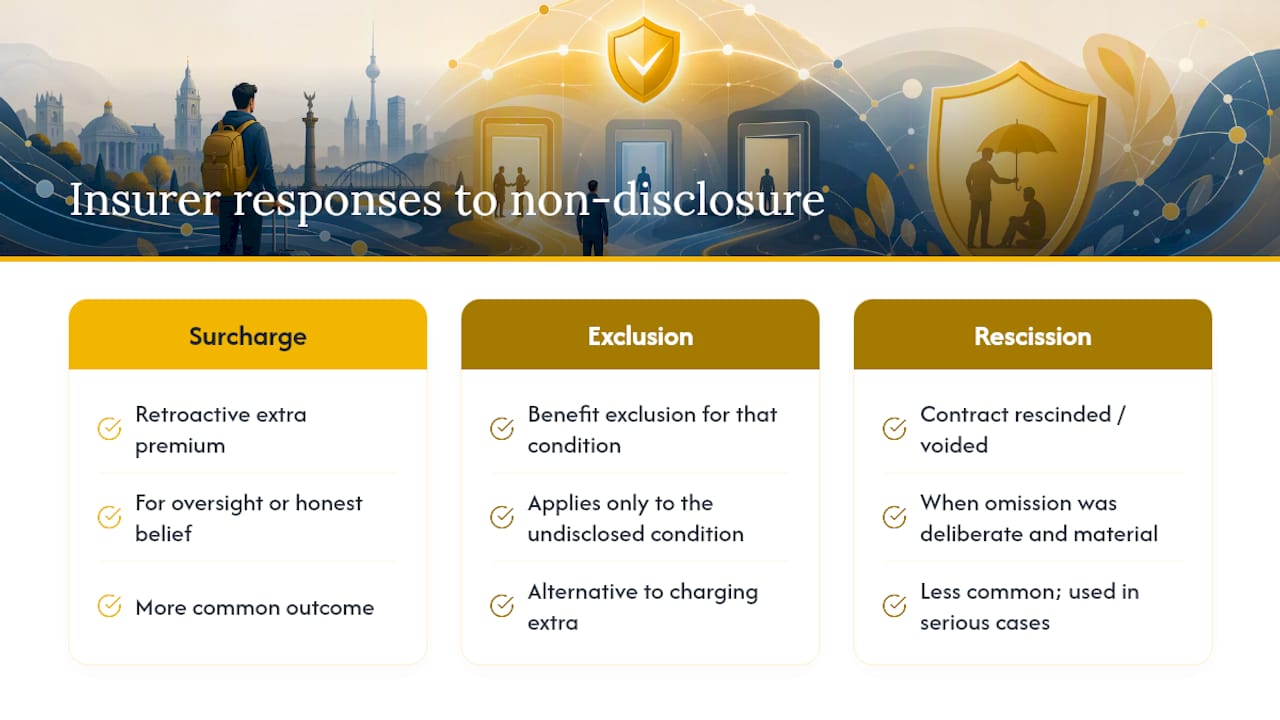
Insurers have several tools available if they discover an undisclosed condition after your policy starts: a Risikozuschlag applied retroactively, a Leistungsausschluss (benefit exclusion) for that specific condition, or, in serious cases, rescission of the entire contract. Rescission tends to happen when the insurer can show the omission was deliberate and would have changed their original decision to insure you at all. A surcharge is the more common outcome for a genuine oversight or an honest belief that a minor issue did not need mentioning.
The safer path is full disclosure paired with an anonymized pre-check or broker consultation, which flags likely surcharges before you commit to anything in writing.
What Should You Check Before Applying for PKV With a Pre-Existing Condition?
An anonymous pre-check sends your health details to multiple insurers without your name attached, so you see likely surcharge ranges before any single insurer's answer becomes part of your permanent record. Anonymized comparisons routinely show wide variance across insurers for the same medical profile, meaning a high first quote is often avoidable, not final.
Before you start any application, whether direct or through a broker:
- Request copies of all relevant medical records and doctor letters going back several years.
- Note exact diagnosis dates, treatment dates, and any periods without symptoms or medication.
- Keep records organized by condition so a broker can run a clean anonymized comparison quickly.
Pro Tip: Ask your broker how many insurers they can query anonymously in one pass. A single anonymous check with three or four carriers usually reveals your realistic price range within a week or two.
When Should You Accept a Surcharge and When Should You Fight It?
Not every Risikozuschlag deserves a fight. A modest, well-documented surcharge for a controlled condition is often the fair price of coverage, and paying it can be cheaper over time than accepting a benefit exclusion that leaves that condition permanently uninsured. Clients who follow that order rarely overpay for long. Where the case is ambiguous, a second professional opinion is worth the short delay.
— Marco
Get Help With Your PKV Risikozuschlag From Myhealthcarebroker
Using an anonymized pre-check across multiple providers before your name is attached to a health questionnaire can help avoid guessing your way through a PKV application alone. That single step routinely uncovers a lower surcharge somewhere else in the market.
Our English-speaking consultants handle the parts that trip up most expats and high earners: running the anonymous comparison, explaining tariff differences in plain terms, preparing your application paperwork, and filing a §41 VVG reassessment request if your health has genuinely improved since your policy started. The service typically does not require upfront payment and commissions are regulated and paid by the insurer after coverage begins, helping maintain adviser independence from any single carrier. Reach out through Myhealthcarebroker's private health insurance service for a first, no-obligation conversation about your situation, or check current premium ranges yourself with the PKV calculator before you decide on a next step.
Where to Verify These Rules Yourself
- §41 VVG full text: the statutory basis for requesting a surcharge reassessment.
- Allianz's pre-existing condition guide: insurer-side explanation of surcharge practice.
- Verivox's Risikozuschlag explainer: independent consumer guidance on timing rules.
- Versicherungsmagazin's lexicon entry: industry definitions distinguishing surcharges from exclusions.
This article is general information, not a substitute for advice from a qualified financial advisor. Consult a qualified financial professional about your own circumstances before acting on anything here.