
In Germany, private health insurance almost always applies a three-month general waiting period and an eight-month special waiting period for childbirth, psychotherapy, dental treatment, dental prostheses, and orthodontics. A handful of exceptions can shorten or skip these entirely, including accident-related treatment, newborn coverage, and credit for prior insurance. The exact terms still come down to your tariff and § 197 VVG, so read your policy conditions before assuming anything applies.
TL;DR:
- Waiting periods in German private health insurance are legally capped at three months for general treatment and eight months for specific benefits like childbirth and dental work.
- Exemptions from waiting periods include treatment for accidents, coverage for newborns if notified timely, and transfers from existing continuous insurance coverage.
- Applying within two months of previous coverage allows prior insurance time to count toward waiting periods; missing this window resets delays.
- Waiting periods can sometimes be shortened or waived through documentation of good health or continuous coverage, but insurers require written proof before canceling old policies.
- Failing to plan early for paperwork or misinterpreting tariff upgrades can lead to serving full waiting periods unexpectedly.
Table of Contents
- Wartezeiten PKV: The Key Facts at a Glance
- What Legal Basis Sets These Waiting Periods?
- When Do Waiting Periods Not Apply?
- How Prior Insurance Gets Credited Toward Waiting Periods
- Can You Shorten or Skip a Waiting Period?
- Your PKV Waiting Period Checklist
- What I See Go Wrong With Waiting Periods, Again and Again
- How Myhealthcarebroker Helps You Navigate PKV Waiting Periods
- Sources
Wartezeiten PKV: The Key Facts at a Glance
Before you dig into the legal detail, here's the shape of the rule.
- General waiting period: a legal maximum duration covering most medical treatment.
- Special waiting period: a legal maximum duration covering childbirth, psychotherapy, dental treatment, dental prostheses, and orthodontics.
- Immediate exceptions: accident injuries, newborns registered on time, and prior insurance credited within the application window.
- Where to check: your tariff conditions and § 197 VVG, which sets the statutory ceiling insurers cannot exceed.
Pro Tip: Three and eight months are legal maximums, not fixed rules. Some insurers offer shorter waiting periods or waive them for healthy applicants, so ask before you sign.
What Legal Basis Sets These Waiting Periods?
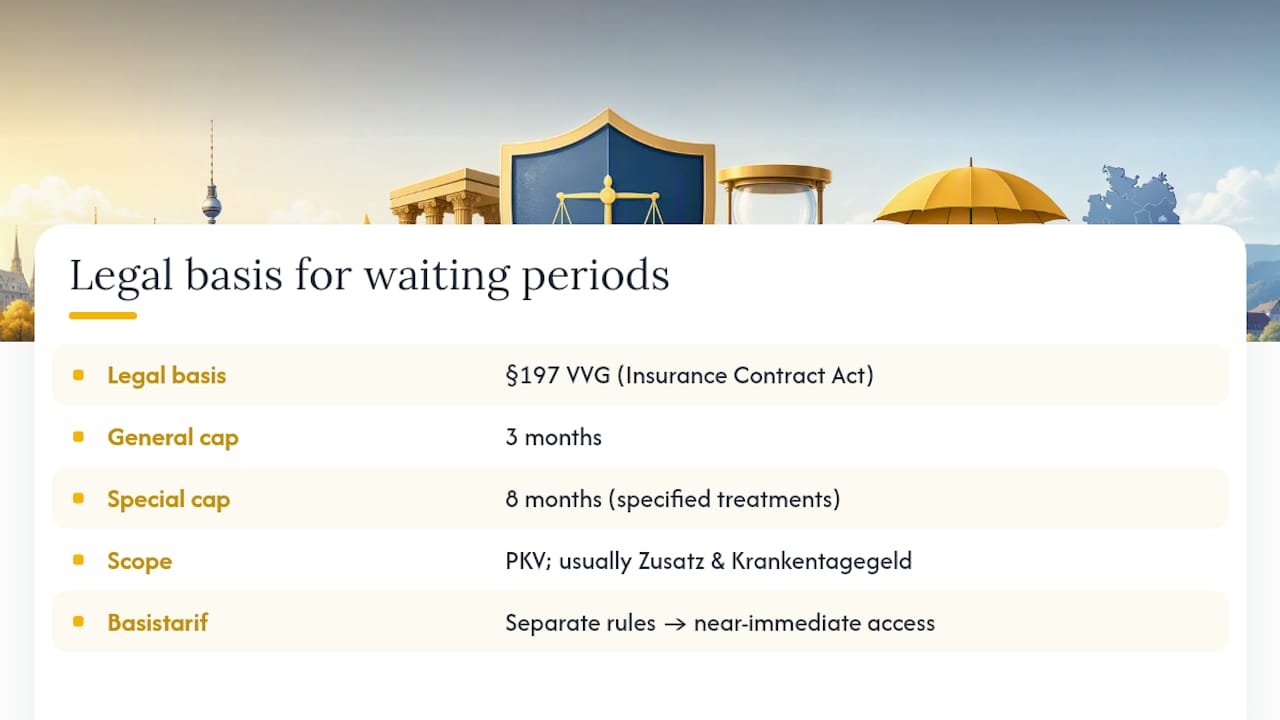
The three and eight-month figures aren't arbitrary. They come directly from § 197 Versicherungsvertragsgesetz (VVG), the Insurance Contract Act provision that caps how long a private insurer can make you wait before covering treatment. Insurers translate that statutory ceiling into their own contract language through the Musterbedingungen für die Krankheitskosten und Krankenhaustagegeldversicherung, known as MB/KK 2009. This is the template most PKV providers still build their tariff conditions on.
§ 197 VVG caps the general waiting period at three months and the special waiting period, for the treatments it names, at eight months. Insurers can offer shorter periods or waive them, but they cannot legally impose longer ones.
These limits apply to full private health insurance (Krankenvollversicherung) and, per industry sources, typically extend to supplemental plans (Zusatzversicherung) and daily sickness benefit insurance (Krankentagegeld) unless the contract states otherwise. The Basistarif and Notlagentarif, Germany's basic and emergency tariffs, follow separate rules designed to guarantee near-immediate access to care for people who need coverage urgently.
The rationale behind all this, according to the Gabler Versicherungslexikon, is straightforward risk management: waiting periods stop people from signing up the week before a scheduled surgery or a due date, which would leave everyone else in the risk pool footing the bill. Once you see it that way, the rules feel less like an obstacle and more like the price of a fair system.
When Do Waiting Periods Not Apply?
Several situations remove or shorten the standard PKV wartezeiten, and knowing them can save you months of out-of-pocket costs.
- Accidents. Treatment following an accident is generally exempt from the general waiting period, since insurers recognize you couldn't have planned for it.
- Newborns and adopted children. If you notify the insurer within the required window (usually two months of birth or adoption) and a parent already held qualifying coverage, the child typically gets immediate coverage with no waiting period.
- Marriage and spousal transfer. A spouse joining an existing policy, or transferring coverage after marriage, can often avoid re-serving waiting periods if the application happens promptly and continuous prior coverage is documented.
- Tariff upgrades. Switching to a richer tariff with your existing insurer usually keeps your original waiting periods for benefits you already had, but new or expanded benefits added by the upgrade can trigger fresh waiting periods.
The CHECK24 consumer guide confirms these exceptions are standard practice across the market, though insurers apply the fine print differently.
How Prior Insurance Gets Credited Toward Waiting Periods
If you already had health coverage before applying for PKV, that time usually counts toward your waiting periods instead of resetting the clock. The mechanics matter more than most applicants expect.
- The two-month rule. You generally need to apply for the new policy within two months of your previous coverage ending for that time to be credited automatically.
- GKV to PKV switches. Moving from statutory insurance (GKV) to private cover is the most common scenario, and continuous membership in the public system is usually straightforward to prove.
- PKV to PKV switches. Moving between private insurers works similarly, but some added benefits in the new tariff may still carry their own waiting period, even with full credit for the base coverage.
- Documentation insurers expect. A cancellation confirmation from your old insurer, a membership history letter, or an official confirmation of coverage dates are the standard proof points.
Miss the two-month window, and you may have to serve the full waiting periods again, regardless of how long you were previously insured.
Can You Shorten or Skip a Waiting Period?
Yes, in specific circumstances, though it usually takes some paperwork. Insurers can waive waiting periods at their own discretion, and a medical certificate from your doctor confirming good health can sometimes tip that decision in your favor, particularly for the general waiting period rather than the special one.
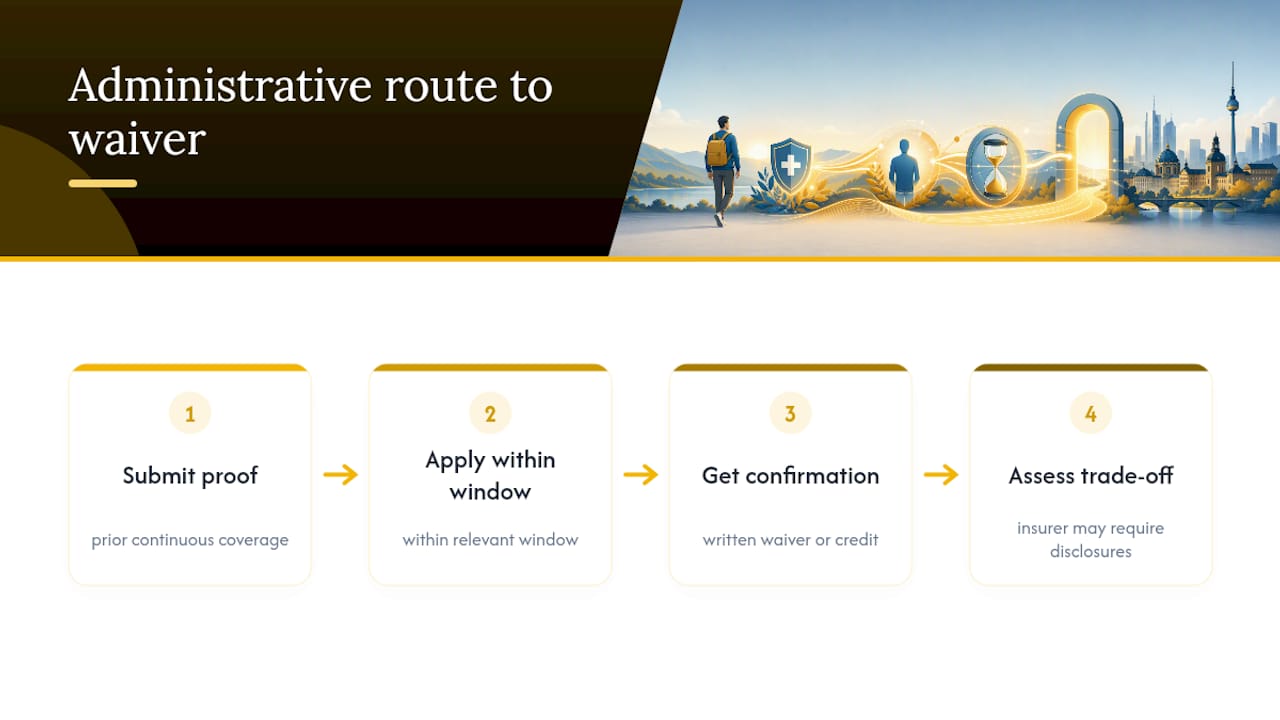
The more reliable path is administrative: submit proof of prior continuous coverage as early as possible, apply within the relevant window, and follow up with the insurer for written confirmation of what's been waived or credited. Insurers may ask for additional health disclosures in exchange for a waiver, so weigh whether that trade-off suits your situation before pushing for a faster start date.
Pro Tip: Never rely on a verbal assurance from an insurer's call center. Get any waived waiting period or credited coverage date confirmed in writing before you cancel your old policy.
Your PKV Waiting Period Checklist
Run through these steps whenever you sign a new policy, switch insurers, or plan a claim that might fall inside a waiting period.
- Confirm your policy start date in writing, then calculate exactly when your 3-month and 8-month windows expire.
- Check your tariff conditions for any carve-outs on psychotherapy, dental prostheses, orthodontics, or childbirth.
- Gather prior-coverage documents immediately, and request a written waiver or credit confirmation rather than accepting a verbal answer.
- If a claim is urgent and falls within a waiting period, ask about a medical statement or contact a broker to review your options before you pay out of pocket.
| Situation | Typical waiting period | Action to take |
|---|---|---|
| New PKV policy, no prior coverage | 3 months general, 8 months special | Confirm start date, plan non-urgent treatment after windows close |
| Switching from GKV within 2 months | Often credited, reduced or waived | Submit proof of continuous coverage promptly |
| Newborn registered on time | Usually none | Notify insurer within required window |
| Tariff upgrade adding new benefits | May apply to new benefits only | Check tariff conditions for the specific addition |
What I See Go Wrong With Waiting Periods, Again and Again
The mistake I see most often isn't ignorance of the rules. It's timing. Expats switching from GKV, employees who just crossed the income threshold into PKV eligibility, and new parents insuring a baby all tend to assume they have plenty of time to sort out paperwork. Then the two-month window for crediting prior coverage quietly closes, and they're back to serving a full eight-month wait for orthodontics or psychotherapy they didn't expect to need so soon.
The second mistake is assuming a tariff upgrade is a clean slate. It usually isn't. Whatever's genuinely new in that upgrade can trigger its own waiting period, even though your base coverage carries over. Reading the actual tariff conditions before you sign, not after, is the only real defense against this.
— Marco
How Myhealthcarebroker Helps You Navigate PKV Waiting Periods
There are services available that compare providers, check eligibility, and review prior-coverage documents before you apply, helping to avoid losing the two-month crediting window by accident. For expats especially, foreign insurance certificates aren't always accepted at face value in Germany, and knowing which documents an insurer will recognize can be important for coverage timing.
Advisors can walk through specific timelines, flag which waiting periods apply to your tariff, and help obtain insurer confirmations in writing rather than relying on a phone call. If you're weighing a switch from GKV or starting PKV for the first time, check your eligibility with us before you apply, and we'll map out exactly what to expect.
This article is general information, not a substitute for advice from a qualified financial advisor. Consult a qualified financial professional about your own circumstances before acting on anything here.
Sources
- Wartezeiten | Gabler Versicherungslexikon (Versicherungsmagazin)
- Wartezeiten in der privaten Krankenversicherung — CHECK24