
"Beherrschender Gesellschafter" is a legal status under German social-security law, not an insurance product. It determines whether you are treated as self-employed for social-insurance purposes and, crucially, whether you can choose private health insurance (PKV) instead of staying in the statutory system (GKV). If you hold or might hold controlling-shareholder status in a German GmbH, here is what to check right now:
- Verify your voting rights. Count actual votes under the articles of association, not just your share percentage.
- Review your management contract. Does it reflect your independence, or does it read like an employment agreement?
- Start a status assessment. A proactive Statusfeststellungsverfahren with the Deutsche Rentenversicherung protects you from a costly retrospective audit.
- Get an English eligibility check. Myhealthcarebroker offers a free eligibility review and documentation check so you know exactly where you stand before approaching any insurer.
Table of Contents
- What does "beherrschender Gesellschafter" legally mean?
- How does controlling-shareholder status affect your health insurance options?
- What are the biggest risks of getting this wrong?
- What documents do you need to prove controlling-shareholder status?
- What are the practical next steps and timeline?
- Key Takeaways
- Why the "head-and-soul" shortcut no longer works
- How Myhealthcarebroker helps controlling shareholders get covered
- Useful sources to read next
What does "beherrschender Gesellschafter" legally mean?
The term translates roughly as "controlling shareholder-director" and describes a managing director of a GmbH who can prevent unwanted instructions from the shareholders' meeting. The Deutsche Rentenversicherung's guidance focuses on effective influence over company decisions, not just what a share certificate says.
Common indicators authorities examine:
- Share percentage above 50%. A simple majority of voting rights is the most common route to controlling status.
- Sperrminorität (blocking minority). Even a minority shareholder can qualify if the articles give them the power to block resolutions across the full range of company activities.
- Voting agreements or pooled interests. If multiple shareholders with aligned interests act together, they can collectively be treated as controlling, even when each holds less than 50%.
- Contractual special rights. Veto clauses, consent requirements, or reserved management powers in the articles can confer control independently of share count.
- Trust or nominee arrangements. Managing shares on behalf of another owner without genuine decision-making freedom typically removes controlling status.
A 51% stake is a strong presumption of control, but it is not automatic. Conversely, a minority shareholder can still be classified as controlling if a genuine Sperrminorität is embedded in the articles. Three shareholders each holding one-third, for example, may all be treated as controlling if they consistently act with aligned interests.
Pro Tip: Share percentage alone is not decisive. Pull the articles of association and any shareholder agreements before drawing conclusions. Small wording changes in those documents can shift your classification entirely, as the Deutsche Rentenversicherung looks at governance structure and actual practice, not just the cap table.
Recent court rulings have also narrowed the older "Kopf und Seele" (head-and-soul) doctrine, which once allowed some minority directors to claim self-employed status based on their practical importance to the business. Today, clearer statutory or contractual powers are required to avoid automatic social-security coverage.
How does controlling-shareholder status affect your health insurance options?
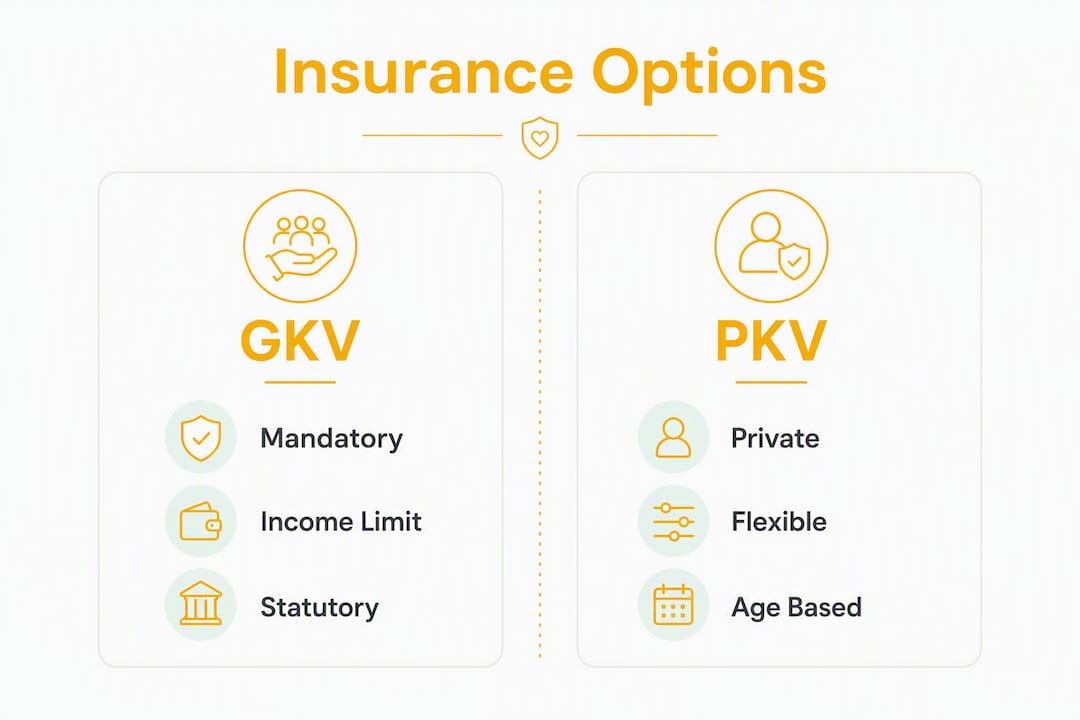
This is where the classification has direct, practical consequences. A controlling-shareholder classification typically removes mandatory GKV membership and opens the door to PKV. A director without controlling status is treated as an employee and remains subject to standard social-security contributions unless they separately meet the income-based exemption threshold.

| Feature | GKV (Statutory) | PKV (Private) |
|---|---|---|
| Eligibility | Mandatory for employees below income threshold | Open to controlling shareholders and qualifying high earners |
| Contributions | Income-based percentage | Risk-based premium (age, health, tariff) |
| Family coverage | Free for non-earning dependents | Separate premium per family member |
| Benefit level | Standardized statutory benefits | Tariff-dependent, often broader coverage |
| Returning to GKV | Possible under limited conditions (Bestandsschutz) | Switching back is restricted and often irreversible |
The timing of your switch matters enormously. Once you are in PKV, returning to GKV is difficult, and in many cases effectively impossible once you pass age 55. PKV premiums are driven by your age at entry, your health status at application, and the tariff you select. Entering younger and healthier keeps long-term costs lower. You can explore how insurance affects your net salary to model the real cost difference before committing.
Controlling-shareholder status also removes your obligation to pay into the statutory pension, unemployment, and long-term care insurance systems, which affects your future benefit entitlements. That trade-off deserves careful thought alongside the health insurance decision.
What are the biggest risks of getting this wrong?
Misclassification is more common than most expats expect, and the financial exposure is real. Companies and directors can face backdated social-security assessments covering up to four years, plus late-payment penalties and personal liability for managers who should have known better.
Common misunderstandings that lead to trouble:
- Assuming majority share ownership automatically confirms self-employed status without checking the articles.
- Believing a minority stake always means employee status.
- Relying on informal arrangements or verbal agreements instead of documented contracts.
- Thinking the classification set at company formation is permanent and never reviewed.
Red flags that trigger a Deutsche Rentenversicherung Betriebsprüfung (company audit):
- No written management contract, or a contract that mirrors a standard employment agreement.
- Salary and bonus arrangements that were not agreed in advance and in writing.
- Payments between you and the GmbH that lack prior documentation, which can be reclassified as hidden profit distributions (verdeckte Gewinnausschüttung) with heavy tax consequences.
- A sole customer relationship with no other clients.
| Risk | Potential consequence |
|---|---|
| Misclassification as employee | Up to four years of backdated social-security contributions |
| Undocumented shareholder transactions | Reclassification as hidden profit distribution, double taxation |
| No proactive status assessment | Audit-triggered reclassification with penalties |
| Informal voting arrangements | Loss of controlling status, mandatory GKV enrollment |
Pro Tip: Keep every shareholder resolution, voting record, and management contract in a single, organized file. Audits frequently happen years after the fact, and the burden of proof rests with you.
What documents do you need to prove controlling-shareholder status?
Gathering the right paperwork before approaching an insurer or the Deutsche Rentenversicherung saves weeks of back-and-forth. Here is what you need:
- Articles of association (Gesellschaftsvertrag). The current, notarized version showing voting rights, quorum rules, and any special veto or blocking provisions.
- Share register (Gesellschafterliste). Filed with the commercial register, showing your current ownership percentage.
- Shareholder resolutions (Gesellschafterbeschlüsse). Minutes from recent meetings that demonstrate your actual voting power in practice.
- Management contract (Geschäftsführervertrag). Must be in writing, pre-dated, and reflect genuine independence rather than subordination.
- Voting agreements (Stimmbindungsverträge). Any side agreements that pool or restrict voting rights.
- Commercial register extract (Handelsregisterauszug). Confirms your registered role and the company's current structure.
For expats, having a broker or lawyer certify translations of these documents before submitting them to an insurer speeds up underwriting considerably. Myhealthcarebroker's English-language advisory process includes a documentation review as part of the eligibility check, so you are not navigating German-language forms alone.
Pro Tip: Do not rely on a document set that has not been reviewed by a qualified advisor. An articles clause that looks like a Sperrminorität may not meet the Deutsche Rentenversicherung's current standard. Confirm before you apply.
What are the practical next steps and timeline?
Here is a realistic plan for the next 30–90 days:
- Self-check (immediate). Review your articles of association and voting rights. Confirm whether you hold more than 50% of votes or a documented blocking minority.
- Broker eligibility check (1–2 weeks). Submit your documents to Myhealthcarebroker for a free review. The service is paid by commission from the insurer; there is no cost to you.
- Optional Statusfeststellungsverfahren or lawyer review (4–8 weeks). In borderline cases, proactive status assessment with the Deutsche Rentenversicherung is strongly recommended. It creates a binding determination and protects against future audit claims.
- Insurer quotes and application (2–6 weeks). Once eligibility is confirmed, your broker requests PKV quotes across multiple insurers. Underwriting typically takes 2–6 weeks depending on health history.
- PKV onboarding and follow-up (ongoing). After acceptance, your broker handles enrollment and remains available for plan reviews and questions.
On cost: PKV premiums vary by age, health status, and tariff. Entering at a younger age locks in a lower base premium. The private health insurance calculator at Myhealthcarebroker gives you an immediate estimate. If a status reclassification reverses your PKV eligibility, back-payment exposure for social-security contributions can reach up to four years, which is why the proactive assessment in step 3 is worth the effort.
Key Takeaways
Controlling-shareholder status under German social-security law is a legal classification that determines your insurance obligations and your right to choose private health insurance, not a product you buy.
| Point | Details |
|---|---|
| Legal status, not a product | "Beherrschender Gesellschafter" describes a classification that affects social-security obligations, not an insurance policy. |
| Control is about voting power | Authorities assess actual influence via articles, voting agreements, and blocking rights, not share percentage alone. |
| PKV eligibility follows status | Controlling shareholders are typically treated as self-employed and may choose private health insurance instead of GKV. |
| Misclassification is costly | Backdated social-security contributions can cover up to four years, plus penalties and personal liability. |
| Myhealthcarebroker | Offers a free English eligibility check, documentation review, and independent PKV comparison across major German insurers. |
Why the "head-and-soul" shortcut no longer works
The old assumption that a key person running a GmbH could claim self-employed status through sheer practical importance has been steadily dismantled by German courts. What I see most often with expat clients is a gap between what they believe their governance documents say and what those documents actually deliver under current Deutsche Rentenversicherung standards. A shareholder agreement drafted five years ago, or one translated loosely from an English-law template, frequently fails the blocking-minority test as it is applied today.
The practical implication is straightforward: do not wait for an audit to find out where you stand. A proactive status assessment, combined with an independent broker review of your PKV options, costs far less in time and money than a four-year backdated contribution claim. The documentation work also tends to surface other governance gaps, such as undocumented salary arrangements, that carry their own tax risks. Getting the paperwork right once protects you on multiple fronts.
How Myhealthcarebroker helps controlling shareholders get covered
Sorting out your insurance as a controlling shareholder in Germany means navigating German-language documents, social-security law, and insurer underwriting simultaneously. Myhealthcarebroker cuts through that complexity with a free, English-language eligibility check and a full documentation review tailored to your governance structure.
The service covers everything from confirming your PKV eligibility and reviewing your articles of association to requesting quotes across all major private health insurance companies in Germany and guiding you through digital onboarding. Myhealthcarebroker is independent, not tied to any single insurer, and the service is free to you because the broker receives a regulated commission from the insurer when you sign up. The 2026 insurer lists are current, and the team works in English throughout.
Use the PKV premium calculator to get an immediate cost estimate, or book a free eligibility check to start your documentation review today.
Useful sources to read next
These primary and authoritative sources are worth consulting directly, especially if you are preparing for a formal status assessment or advising legal counsel:
- Deutsche Rentenversicherung — GmbH guidance. The primary administrative source on how controlling status is assessed for social-security purposes. Start here for the official test.
- GÖRG — Sozialversicherungspflicht von Gesellschafter-Geschäftsführern. Detailed legal commentary on classification criteria, audit risks, and the consequences of misclassification.
- Smartsteuer — Beherrschender Gesellschafter definition. Accessible German-language overview of the majority and minority control tests, useful for cross-checking your own situation.
- Lexware — Wann gilt ein GmbH-Gesellschafter als beherrschend?. Explains the tax-law requirements for documented agreements and the hidden-profit-distribution risk.
- Schwerd — Sozialversicherungspflicht der Gesellschafter-Geschäftsführer. Practitioner-level analysis of audit triggers and the case for proactive Statusfeststellungsverfahren.
For borderline cases, consult a German employment or corporate lawyer before relying on any self-assessment. A formal Statusfeststellungsverfahren with the Deutsche Rentenversicherung is the only way to obtain a binding determination.
This article is general information, not legal, tax, or financial advice. Confirm your specific situation with a qualified German lawyer or the Deutsche Rentenversicherung before making insurance or governance decisions.