
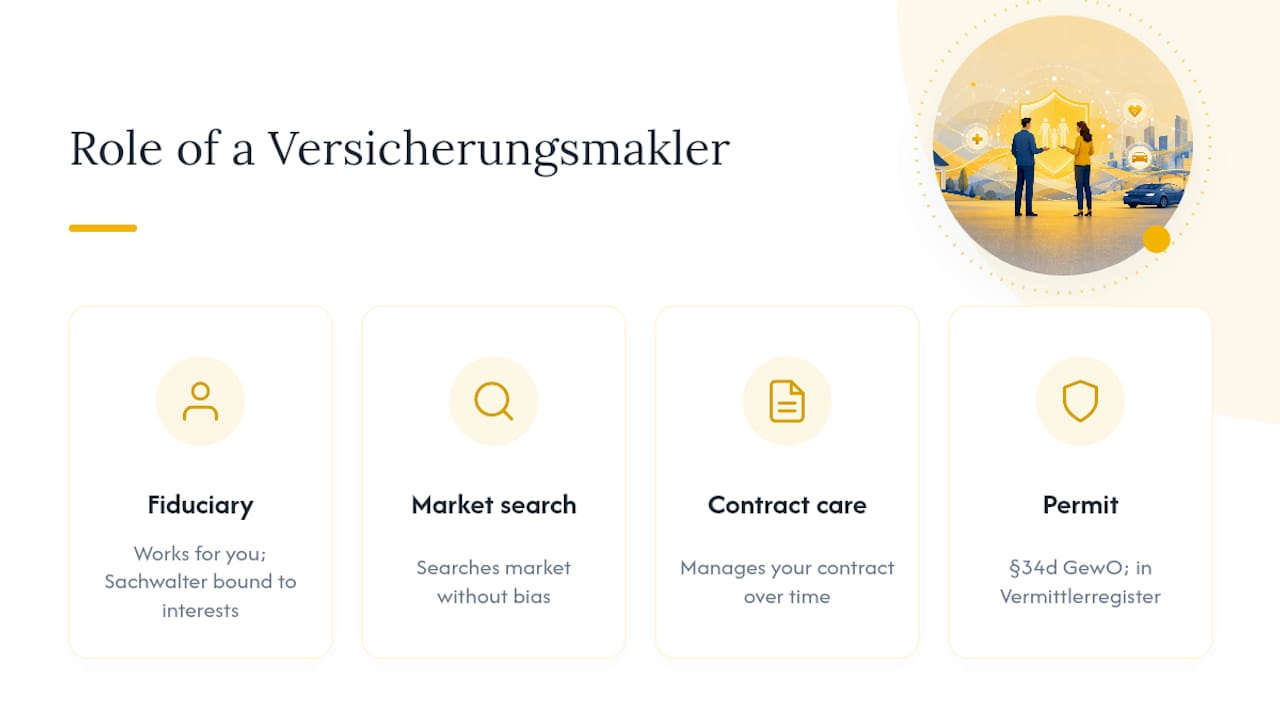
A Versicherungsmakler is an independent insurance broker who works for you, not for an insurance company. Under German law, this broker acts as a Sachwalter, a fiduciary bound to your interests, and must hold a permit under §34d GewO) while appearing in the public Vermittlerregister. Classified under §59 VVG, the broker's real job is simple: search the market without bias, then manage your contract for as long as you need it.
Key Takeaways
A Versicherungsmakler is a registered, independent broker legally bound to act in the client's interest, not the insurer's.
| Point | Details |
|---|---|
| Definition | An independent broker acting as Sachwalter, regulated under §34d GewO and §59 VVG. |
| Verify before signing | Check the Vermittlerregister, ask for IHK proof, and confirm liability insurance. |
| Payment model | Most brokers earn commission from insurers; this must be disclosed in writing. |
| Broker vs. agent | Agents represent one insurer; brokers represent you across the whole market. |
| Get matched with a broker | Myhealthcarebroker offers free eligibility checks and English-language plan comparisons. |
Table of Contents
- What is a Versicherungsmakler and what does the role actually cover?
- Broker vs. agent vs. adviser: who actually works for you?
- What legal and regulatory requirements apply to insurance brokers?
- How do brokers get paid, and what should you expect on fees?
- When does hiring a broker actually make sense?
- How do you verify a broker's credentials before signing anything?
- A short example: how a broker helps an expat find coverage
- Why the register check matters more than most people assume
- Get a broker who actually works for your situation
- Where to verify the facts yourself
- Sources
What is a Versicherungsmakler and what does the role actually cover?
A Versicherungsmakler compares offers across insurers rather than pushing a single company's products, and that market view is the entire point of hiring one. The daily work splits into two phases: finding the right policy, then keeping it right over time.
- Compare coverage and pricing across multiple insurers before recommending anything
- Handle the application paperwork and communicate with the insurer on your behalf
- Update your policy when your circumstances change (new job, new dependents, a move abroad)
- Step in during claims, translating insurer language and pushing back on denials when warranted
Because the broker's legal duty runs to you, the client, every recommendation should come with a reason attached. IHK guidance on broker contracts describes this ongoing management, ranging from a single placement to years of contract upkeep, as standard practice, not an add-on service.
Pro Tip: Ask your broker to put their recommendation in writing, including which alternatives they considered and why they ruled them out. If they can't produce that, they may not be doing the comparison work at all.
Broker vs. agent vs. adviser: who actually works for you?
The German market has three distinct roles, and mixing them up is the single most common mistake expats make when choosing help.
- Versicherungsmakler (broker): Independent of any insurer, legally a Sachwalter for the client, and free to recommend across the whole market.
- Versicherungsvertreter (agent): Usually tied to one insurer (or a small handful) and legally representing that insurer's interests, not yours.
- Versicherungsberater (insurance adviser): Works on a fee-only basis, gives advice but does not place or manage policies the way a broker does.
Watch for the "pseudomakler" problem: an agent who presents themselves as independent when they're actually tied to one insurer. German courts can hold that person to broker-level liability standards, but you're still the one who has to catch the misrepresentation first.
- Red flag: vague or evasive answers about which insurers they represent
- Red flag: no listing in the Vermittlerregister
- Red flag: no written broker mandate (Maklervertrag) offered upfront
What legal and regulatory requirements apply to insurance brokers?
Anyone operating as a Versicherungsmakler in Germany needs a trade permit under §34d GewO, which requires proof of competence (Sachkunde) and a valid Berufshaftpflichtversicherung, professional liability insurance that protects you if the broker gives bad advice. That registration then gets recorded in the Vermittlerregister, the public database maintained under DIHK oversight, and the broker is classified under §59 VVG as an intermediary who serves the client rather than an insurer.
Because a broker's actions and knowledge are legally attributed to the client (Wissenszurechnung), what your broker records and discloses on your behalf becomes part of your own legal position. That's exactly why the paperwork matters more than it might seem at first glance.
A quick checklist to verify compliance before signing anything:
- Search the broker's name or firm in the Vermittlerregister
- Ask for their IHK registration number and confirm it matches
- Request proof of current Berufshaftpflichtversicherung coverage
- Get a written Maklervertrag before sharing sensitive financial or health information
How do brokers get paid, and what should you expect on fees?
Most brokers in Germany earn commission from the insurer once a policy is placed, and that's standard practice across the industry, not a hidden cost baked into your premium. The Gabler Wirtschaftslexikon confirms commission as the typical remuneration model, with fee-based advice, known as Honorarberatung, as the exception rather than the rule.
Good disclosure looks like a written statement naming who pays the broker and how much, along with any conflicts of interest tied to specific insurers. Because commission-based pay creates a perceived incentive to steer toward higher-paying products, transparent disclosure and documented reasoning for each recommendation should be the baseline, not a bonus.
- Ask whether the broker works on commission, fee, or a mix of both
- Request a total cost example comparing at least two policy options
- Confirm in writing why a specific insurer was recommended over others
Pro Tip: If a broker can't explain, in plain language, why they picked one insurer over another, ask again before you sign. A documented rationale protects you if the policy turns out to be a poor fit later.
When does hiring a broker actually make sense?
A broker earns their keep when your situation has more moving parts than a comparison website can handle: multiple job offers with different insurance implications, a mix of employment history, or a language barrier that makes German-only insurer paperwork a real obstacle.
- Hire a broker when: you need multiple market quotes, expect to file a claim eventually, or want ongoing contract management in English
- Skip the broker when: you need simple, standard coverage with transparent online pricing and no real decision complexity
Quick five-minute test: if you can explain your coverage need in one sentence and compare three online quotes without confusion, you probably don't need a broker. If you can't, that's your answer.
Pro Tip: Complexity, not price, is the real signal. A broker's value shows up most clearly during claims and contract changes, not at the moment of the initial quote.
How do you verify a broker's credentials before signing anything?
Confirming a broker is legitimate takes five minutes and protects you for years.
- Search the broker's name in the Vermittlerregister and confirm an active entry
- Ask for their IHK certification number and cross-check it directly
- Request current proof of Berufshaftpflichtversicherung
- Get a written broker mandate before sharing any personal or financial data
- Check for membership in the Bundesverband Deutscher Versicherungsmakler (BDVM) as an added trust signal
- Red flag: no register entry or an entry that doesn't match the firm name
- Red flag: refusal to provide written disclosure about fees or conflicts
- Save it: screenshot the Vermittlerregister entry and the written mandate in case a dispute arises later
A short example: how a broker helps an expat find coverage
Consider an expat with a mixed employment history, part freelance, part salaried, who isn't sure whether they even qualify for private health insurance. A broker's first move is an eligibility check against the actual German rules, not a guess.
The value wasn't just finding a cheaper plan. It was having someone explain, in plain English, why one insurer's terms fit a freelance income pattern better than another's.
From there, the process typically runs:
- Eligibility assessment based on employment status and income history
- Comparison across private insurers with different terms for mixed-income applicants
- Application support to avoid the paperwork mistakes that cause delays
- Ongoing claims assistance once the policy is active
The real payoff shows up later: fewer surprises in the contract's fine print and faster claims resolution when something actually goes wrong.
Why the register check matters more than most people assume
Helping expats and high-earning professionals sort through Germany's insurance system for years teaches you one thing fast: the people who get burned aren't the ones who chose the "wrong" insurer. They're the ones who never confirmed who they were actually talking to.

A polished website and a confident sales pitch tell you nothing about whether someone is registered, insured, or legally obligated to act in your interest. The Vermittlerregister does. So does a written mandate that spells out fees and conflicts before you sign anything. This isn't paranoia. It's the same five-minute check that separates a broker who owes you loyalty from an agent who owes it to someone else.
Ask for the paperwork. If a broker hesitates, that hesitation is the answer.
Get a broker who actually works for your situation
Myhealthcarebroker is the independent alternative for expats and high earners who need someone comparing the full private and public market instead of pushing one insurer's products. We run eligibility checks, compare plans across major German insurers in plain English, and handle the application and onboarding so you're not translating bureaucratic German at 11 PM.
The service costs you nothing directly. Myhealthcarebroker is paid a fixed, regulated commission by the insurer once you sign up, the same standard model covered above, and that fee is fully disclosed before you commit to anything. If you're not sure where you stand, start with a free eligibility check to see which private plans you actually qualify for.
Where to verify the facts yourself
- Vermittlerregister and IHK guidance explains broker duties and registration steps
- BDVM is the industry association for checking additional broker credentials
- §34d GewO and §59 VVG background covers the legal definitions behind the broker role
This article is general information, not a substitute for advice from a qualified financial advisor. Consult a qualified financial professional about your own circumstances before acting on anything here.
Sources
- Versicherungsmakler • Definition | Gabler Wirtschaftslexikon
- Makler, Vertreter und Mehrfachagent - IHK Region Stuttgart