If you move to Germany, you must carry health insurance, no exceptions. As an EU citizen, private health insurance (PKV) becomes an option only if your gross salary exceeds the Jahresarbeitsentgeltgrenze (JAEG), which is €77,400 in 2026, or if you work as a freelancer or are self-employed. Otherwise, statutory insurance (GKV) usually applies, and your EHIC only covers short visits, not a move.
TL;DR:
- The 2026 JAEG threshold for private insurance eligibility is €77,400 gross annually; exceeding it allows a choice between GKV and PKV, while earning below it typically mandates GKV.
- Long-term residents must switch from EHIC or PEB coverage to domestic health insurance once they register their address and establish habitual residence in Germany.
- Employers automatically enroll most employees earning below the JAEG in GKV, whereas self-employed and high-earning workers above the threshold can opt for PKV or voluntary GKV.
- PKV premiums depend on age, health, and benefits at entry, with individual underwriting potentially leading to higher costs or exclusions, unlike income-scaled GKV contributions.
- An independent eligibility check helps determine whether PKV or GKV suits your income and family situation before applying, avoiding costly mistakes based on initial assumptions.
Table of Contents
- Germany's Insurance Mandate: Who Must Be Covered
- EHIC and Temporary Coverage: What It Covers and When It Isn't Enough
- Eligibility for PKV: The 2026 JAEG, Self-Employment, and Special Cases
- PKV vs GKV: Costs, Family Coverage, and Underwriting
- How to Apply: A Practical Checklist for PKV or GKV
- How Myhealthcarebroker Supports EU Citizens Through This Process
- Why the "Just Pick the Cheapest Plan" Advice Falls Short
- Get Your Free PKV Eligibility Check
- Sources
- FAQ
Germany's Insurance Mandate: Who Must Be Covered
Registering a German address, known as Anmeldung, effectively starts your insurance clock. Once you're a resident, whether working, studying, or simply living here, you're legally required to hold a policy that meets German standards. This isn't a formality you can push off until later; landlords, employers, and the Burger itself increasingly ask for proof of coverage during registration.
Most employees earning below the 2026 JAEG of €77,400 are automatically enrolled in GKV through their employer, with contributions split between both parties. Above that threshold, or outside traditional employment, your options widen.
A few groups need to pay closer attention to timing:
- Non-working residents (partners, retirees, people between jobs) don't get automatic GKV enrollment and need to arrange coverage themselves.
- Visa applicants for Germany often must show valid insurance before their appointment, not after.
- New arrivals typically have a short window after registering an address to finalize a policy, so waiting weeks to "figure it out" tends to backfire.
EHIC and Temporary Coverage: What It Covers and When It Isn't Enough
The European Health Insurance Card, or its temporary equivalent the Provisional Replacement Certificate (PEB), covers medically necessary care during a temporary stay in another EU country. Think a twisted ankle on a weekend trip or an unexpected flu, not ongoing residency.
Once you establish habitual residence in Germany, the EHIC stops being a substitute for a domestic policy. Officials rely on the EESSI system to exchange coverage evidence between countries, but that system assumes you're visiting, not living here long term.
- EHIC/PEB: acute and medically necessary treatment only, for temporary stays.
- Domestic PKV or GKV: required once you register residence, work, or study here.
- Gap coverage: short-term or temporary health insurance in Germany can bridge the days between arrival and a finalized policy.
Pro Tip: Don't assume your EHIC "still works" after your third month in Germany. Officials have flagged long-term EHIC reliance as a common source of administrative headaches, and unwinding it later costs far more time than sorting coverage up front.
Eligibility for PKV: The 2026 JAEG, Self-Employment, and Special Cases
The 2026 JAEG sits at €77,400 gross per year. Cross it as a salaried employee, and you gain a real choice between staying in GKV voluntarily or switching to PKV. Below it, GKV membership remains the default path for most workers.
Here's how the main categories break down in practice:
- Employees above the JAEG: Free to choose voluntary GKV or PKV; the decision hinges on income stability, family plans, and how long you expect to stay in Germany.
- Self-employed and freelancers: Can generally access PKV regardless of income, since the income-based GKV mandate is built around traditional employment.
- Students: Usually fall under student GKV rates, though certain private student plans exist for specific situations, worth checking on our student health insurance page.
- Civil servants (Beamte): Typically use a hybrid system involving Beihilfe plus a private supplementary policy, a structure distinct from standard employee PKV.
- Retirees and pensioners: Face their own rules depending on prior insurance history and residence status, and often need individual review.
If your situation doesn't cleanly fit one category, that's normal. A private health insurance eligibility check sorts out which system actually applies before you commit to anything.
PKV vs GKV: Costs, Family Coverage, and Underwriting
The two systems price risk in fundamentally different ways. GKV contributions scale with income, roughly 14.6% plus a Zusatzbeitrag that varies by Krankenkasse, regardless of your age or health history. PKV premiums work the opposite way: they're based on your age, health status, and chosen benefits at the time you join, not your current salary.
That difference cascades into family coverage. GKV includes spouses and children for free under Familienversicherung, provided they meet income limits. PKV insures each family member on a separate contract, meaning a partner and two kids each add their own premium line.
PKV also underwrites individually. Insurers review your medical history before acceptance, and pre-existing conditions can trigger higher premiums, coverage exclusions, or in rarer cases a declined application. This is where anonymous pre-checks with providers pay off, since you learn likely outcomes before your health data reaches an insurer's file permanently.
Benefit differences matter day to day, too:
- PKV often includes single or double rooms in hospitals and treatment from the head physician (Chefarztbehandlung).
- GKV generally covers standard care well but leaves gaps in areas like individual health services (IGeL), which patients pay out of pocket in either system for elective add-ons.
- Dental reimbursement tends to run higher in PKV, though specifics vary widely by tariff.
A quick gut check: someone single, healthy, and self-employed often finds PKV genuinely competitive on price. A family of four with young kids frequently does better financially under GKV, purely because of free dependent coverage.
How to Apply: A Practical Checklist for PKV or GKV
Getting the paperwork right the first time saves weeks. Here's the sequence that actually works.
For PKV:
- Complete a health questionnaire covering your medical history, since this shapes both acceptance and pricing.
- Request quotes from multiple insurers rather than accepting the first offer.
- Read the written policy terms carefully, especially waiting periods for specific treatments like dental or maternity care.
- Align your start date with your employment contract or visa deadline so there's no coverage gap.
For GKV:
- Choose a Krankenkasse (there are dozens, and benefits vary slightly between them).
- Provide your employment contract, residence registration, and ID.
- Complete registration, usually processed within days once your employer submits payroll details.
Watch for red flags in PKV contracts: vague wording around pre-existing condition exclusions, unusually long waiting periods, or premium structures that look cheap now but escalate steeply with age.
Pro Tip: If your visa or job offer has a hard start date, apply for PKV at least three to four weeks ahead. Underwriting reviews take time, and a late approval can delay your ability to legally start work or finalize residence registration.
How Myhealthcarebroker Supports EU Citizens Through This Process
Sorting eligibility alone, in a second language, with unfamiliar terminology, is where most people lose momentum. A service exists specifically to remove that friction for EU citizens navigating PKV and GKV in Germany.
Core support can include:
- Independent comparisons across major German insurers.
- Eligibility checks that help clarify which system, PKV or GKV, might apply.
- Guidance through applications in English.
- Pre-checks for pre-existing conditions that help estimate acceptance odds.
- Support for international moves and coverage adjustments.
Why the "Just Pick the Cheapest Plan" Advice Falls Short
Most guidance aimed at EU citizens treats this as a pricing exercise: find the lowest premium, sign, move on. That approach ignores the part that actually matters, which is fit over time. PKV premiums are locked in based on your health and age at entry. A cheap plan at 28 can look very different at 45, once age-related premium increases and locked-in exclusions from your original underwriting start showing their weight.
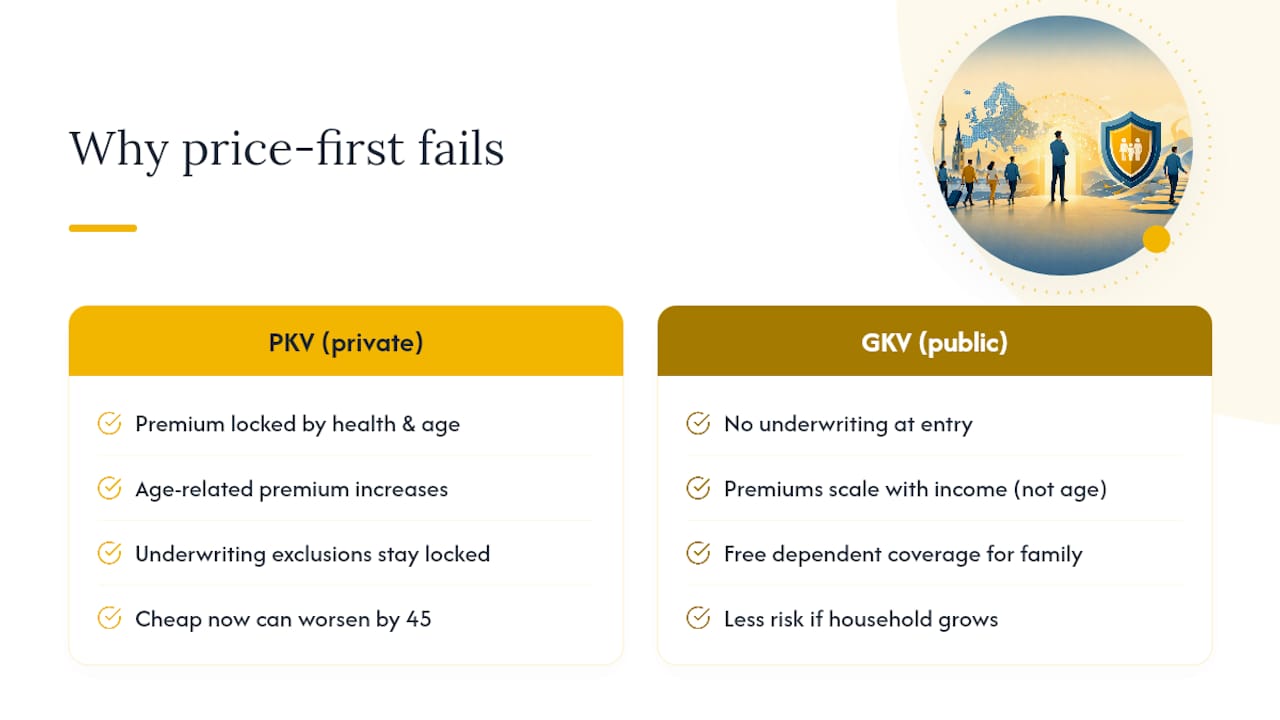
The bigger blind spot is family planning. Plenty of EU citizens qualify for PKV as individuals and jump in without modeling what happens if they have kids or a partner joins them in Germany. GKV's free dependent coverage can outweigh PKV's individual perks the moment a household grows, and that math rarely gets explained upfront by anyone selling a policy.
My honest read: eligibility should never be the finish line, it's the starting point for a longer conversation about your five year plan, not just this year's premium. Readers who treat the JAEG threshold as a green light to buy immediately, rather than a trigger to compare options properly, tend to be the ones who regret their choice later.
— Marco
Get Your Free PKV Eligibility Check
This service works differently from figuring this out solo or relying on a single insurer's sales pitch: offering independent comparison across Germany's major providers, explained in plain English, with costs typically covered by commissions from insurers after signup.
The first step is a free eligibility check that confirms whether PKV applies to your income and employment situation, or whether GKV is the better route. From there, you get a side-by-side comparison of relevant providers and hands-on help through the application itself, including document prep and start-date alignment with your job or visa. If you'd rather have ongoing support managing renewals, claims, or life changes down the line, the concierge service covers that too.
Start with a free eligibility check to see exactly where you stand before your registration deadline arrives.
Sources
- Zugang zum Gesundheitssystem für Unionsbürgerinnen und Unionsbürger, Angehörige des EWR und der Schweiz — Bundesregierung (PDF)
- European Health Insurance Card — European Commission
- Gesund
This article is general information, not a substitute for advice from a qualified doctor. Consult a qualified healthcare professional about your own circumstances before acting on anything here.
FAQ
What health insurance options do EU citizens have in Germany?
EU citizens generally choose between statutory insurance (GKV) and private insurance (PKV), depending on income and employment type. Employees below the 2026 JAEG of €77,400 typically default to GKV, while self-employed people and higher earners can access PKV.
Which private health insurance suits foreigners in Germany?
The right PKV plan depends on your income, family situation, and how long you plan to stay in Germany rather than a single universal answer. A private health insurance eligibility check compares your options across major insurers based on your specific circumstances.
What insurance do foreign visitors need in Germany?
Short-term visitors from EU countries can rely on their EHIC or PEB for medically necessary care during the visit. Anyone planning to stay longer, work, or study needs a full domestic policy, since EHIC coverage doesn't extend to habitual residents.
How much does health insurance cost for foreigners in Germany?
Costs vary significantly based on age, health status, income, and whether you choose GKV or PKV, so there's no single flat rate. Current pricing details and personalized estimates are available through Myhealthcarebroker's eligibility check, which factors in your actual situation rather than a generic average.