
You can switch from statutory to private health insurance as an employee once your regular income clears the Jahresarbeitsentgeltgrenze, set at €77,400 a year or €6,450 a month for 2026. Clearing that line gets you a shot at PKV, not a guarantee. Insurers still run a health check, your employer subsidy has a cap, and once you pass age 55, coming back to GKV becomes generally very difficult.
TL;DR:
- Employees with a gross annual income above €77,400 in 2026 can potentially switch to private health insurance, but approval depends on passing a medical check.
- Income components that count toward eligibility include fixed salary, regular allowances, guaranteed bonuses, commissions, and recurring overtime pay, while one-time payments do not.
- A salary increase must be permanent and structured as ongoing pay exceeding €6,450 per month to trigger PKV eligibility; mid-year raises may require prompt notification.
- Private insurer approval depends on a health assessment, with options for acceptance, surcharges, exclusions, or rejection, and medical history significantly influences underwriting.
- Having dependents affects costs, as PKV charges are per individual, making GKV more cost-effective for families, especially for spouses and children covered at no extra charge in statutory insurance.
Table of Contents
- PKV Voraussetzungen for Angestellte: The Income Threshold Explained
- Which Salary Components Actually Count Toward the JAEG
- When a Raise or New Contract Actually Triggers Eligibility
- What Happens During Insurer Health Underwriting
- Why PKV Is a Long-Term Bet, Not a Quick Switch
- The Step-By-Step Path From Eligible to Insured
- Does Part-Time Work Change Your PKV Eligibility?
- PKV Eligibility When You Have Multiple Jobs
- PKV vs. GKV: What Actually Changes for Employees
- What Happens If Your Income Drops Below the Threshold
- How to Choose the Right PKV Tariff
- How Having a Family Changes the PKV Calculation
- What Employees Near the Threshold Get Wrong
- Get an English-Language Eligibility Check Before You Switch
- Sources
PKV Voraussetzungen for Angestellte: The Income Threshold Explained
The Versicherungspflichtgrenze, also called the Jahresarbeitsentgeltgrenze (JAEG), is the legal line that decides whether an employee stays locked into statutory health insurance or gains the option to leave it. Below this threshold, GKV membership is compulsory. Above it, you become "versicherungsfrei," meaning you're free to choose private cover instead.
For 2026, that threshold sits at 77,400 € annually, or 6,450 € monthly. The figure isn't fixed. It moves most years according to the Sozialversicherungsrechengrößenverordnung, an annual regulation that adjusts social insurance figures in line with wage growth across Germany. That's worth remembering if you're budgeting a few years out. A salary that clears the threshold today might sit just under it after next year's adjustment if your pay doesn't rise at the same pace.
Who actually falls under this rule? A few groups deserve a closer look:
- Full-time employees are the clearest case: consistent salary above the monthly threshold qualifies you.
- Part-time employees rarely reach the JAEG unless their hourly rate is unusually high, since the threshold is based on absolute income, not hours worked.
- Employees with a second job may need to combine earnings, depending on how each position is classified for social insurance purposes.
- Marginal employment (mini-jobs) on its own never counts, since mini-job income falls under a separate, much lower earnings category.
The Versicherungspflichtgrenze guide breaks down how payroll departments actually calculate and report this figure, which matters more than most employees realize when a raise lands mid-year.
Which Salary Components Actually Count Toward the JAEG
Payroll isn't just your base salary, and the JAEG calculation isn't either. Getting this wrong is one of the most common reasons employees think they qualify for PKV when they don't, or miss out when they actually do.
Here's what typically counts toward your JAEG-relevant income:
- Fixed monthly salary — the baseline figure on your contract.
- Regular allowances paid consistently, such as a monthly transport or housing allowance.
- Fixed annual bonuses that are contractually guaranteed, like a 13th-month payment.
- Regular commissions, when they form a predictable part of your pay rather than a one-off.
- Overtime pay, if it recurs regularly rather than showing up occasionally.
- Company pension contributions, in specific cases where pensionable earnings are factored into gross income calculations.
What usually doesn't count: expense reimbursements, one-time relocation payments, and employer allowances tied to specific costs rather than general compensation. A one-off signing bonus won't push you over the line on its own, even if it temporarily inflates your annual pay.
Multiple jobs complicate things further. If you hold two positions that are both subject to social insurance, their combined income can be added together for JAEG purposes. Mini-jobs are the exception, since they sit outside the standard social insurance framework and generally don't add to the calculation.
Pro Tip: Ask your payroll department for a written breakdown of which components they classify as JAEG relevant before you assume you've crossed the threshold. A verbal estimate from HR is not the same as documented proof an insurer will accept.
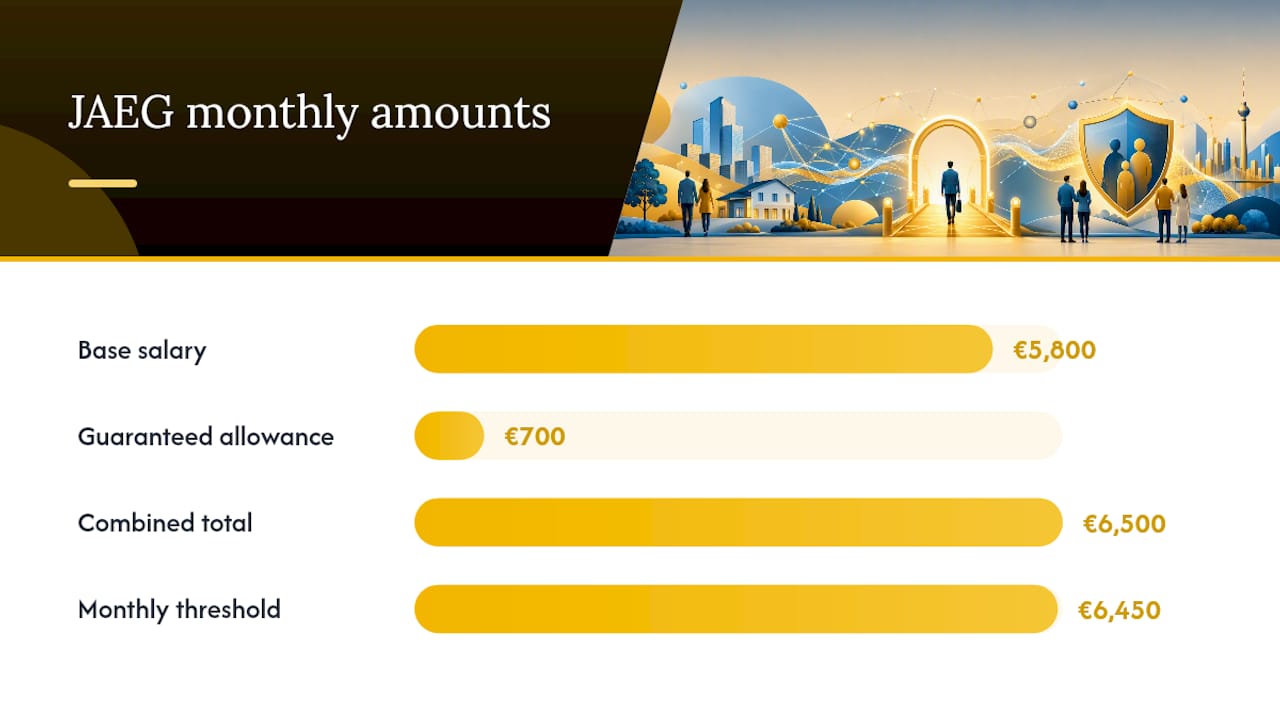
Say your base salary is €5,800 a month and you receive a guaranteed €700 monthly allowance. That's €6,500, already above the 2026 monthly threshold of €6,450. Add an irregular quarterly bonus on top, and it likely won't move the needle either way, because irregular pay typically doesn't count.
When a Raise or New Contract Actually Triggers Eligibility
Timing catches a lot of employees off guard. A salary increase only matters once it's structured as regular, ongoing pay that clears the monthly threshold, not as a one-time adjustment.
- If your monthly base rises above €6,450 as a permanent change, that's typically the trigger point.
- Your Krankenkasse will usually notify you when it identifies that your income has crossed the line, and you generally get a two-week window to declare your exit and pursue PKV instead.
- Missing that window doesn't close the door completely, but it can delay the switch and cost you the immediate transition option.
A mid-year raise that pushes your salary past the threshold in June behaves differently from a new job offer that starts you above it from day one. In the first case, your employer needs to document the change and timing correctly. In the second, you may already meet the criteria the moment you sign, according to the BMG's guidance on switching between GKV and PKV.
What Happens During Insurer Health Underwriting
Clearing the JAEG opens the door. It doesn't guarantee an insurer walks through it with you. Every private insurer runs a mandatory health assessment before approving a policy, and insurers can refuse coverage, apply risk surcharges, or exclude specific pre-existing conditions based on what that questionnaire reveals.
Expect to provide:
- A detailed health questionnaire covering chronic conditions, past treatments, and current medications.
- Supporting medical records if the insurer requests clarification on a specific condition.
Outcomes vary. Standard acceptance is common for healthy applicants. A risk surcharge adds a percentage to your premium. Exclusions remove coverage for a specific condition while approving everything else. Outright refusal is possible for serious pre-existing conditions, though roughly 10% of the German population is already privately insured, showing approval is far from rare for otherwise healthy applicants.
If you're refused elsewhere, the Basistarif offers guaranteed acceptance with no risk surcharges, functioning as a statutory safety net rather than a first-choice plan. Gather your medical history early. It's the single biggest factor in how smoothly underwriting goes.

Why PKV Is a Long-Term Bet, Not a Quick Switch
PKV premiums are risk-based, not income-based. That's the fundamental difference from GKV, and it's why entry age matters more than most employees expect. Premiums depend on your age and health at entry, with Altersrückstellungen (age-related reserves) built in to stabilize costs later in life. Switch at 30 and those reserves have decades to build. Switch at 50 and you're paying into a much shorter runway.
- The 55-year rule generally blocks a return to GKV once you pass that age, with narrow statutory exceptions.
- GKV contributions scale with income; PKV premiums scale with the risk you represent at signup, and your employer typically covers half up to a statutory cap rather than a percentage that grows with your salary.
Switching tends to make sense for younger employees in stable health with income well clear of the threshold. It's a harder case for anyone already near 50 or carrying a health condition likely to trigger a surcharge.
Pro Tip: Model your projected PKV premium at age 60 and 70, not just today's quote. A private health insurance calculator can show how those numbers shift with age before you sign anything.
The Step-By-Step Path From Eligible to Insured
- Confirm your regular earnings exceed the JAEG. Pull recent pay slips and get written confirmation from payroll on which components count.
- Notify your Krankenkasse. Once they confirm your exemption from compulsory insurance, you'll typically have a two-week window to declare your exit.
- Complete the insurer's application and health questionnaire. Submit any medical documentation requested promptly to avoid delays.
- Accept the offer and confirm your employer subsidy. Finalize the switch once your employer has processed the updated contribution split.
Each step depends on the one before it, so gathering documentation early tends to save the most time.
Does Part-Time Work Change Your PKV Eligibility?
Part-time status doesn't disqualify you outright, but it makes clearing the JAEG considerably harder. The threshold is based on absolute income, not hours worked, so a part-time employee needs a high hourly rate or a senior role to reach €6,450 a month on reduced hours.
This shows up most often with specialized consultants, senior part-time professionals, or executives who negotiate reduced hours without a proportional pay cut. A physician working three days a week at a strong daily rate might still clear the threshold. A part-time administrative role almost never will, since the pay scale simply doesn't support it.
Full-time employees have an easier path by default, but full-time status alone doesn't guarantee eligibility if the salary itself sits below the line. What matters is the number on your pay slip each month, not your contracted hours.
One nuance often missed: if you reduce your hours mid-career after already switching to PKV, dropping below the JAEG doesn't automatically force you back to GKV. Once you're privately insured as an employee, a temporary dip below the threshold is treated differently than never having qualified in the first place, though the exact handling depends on your specific circumstances and is worth confirming with your Krankenkasse directly.
PKV Eligibility When You Have Multiple Jobs
Holding more than one job adds a layer of complexity to how your JAEG-relevant income gets calculated. The general rule: if all your positions are subject to standard social insurance contributions, their combined income can be added together when determining whether you clear the threshold.
This matters for professionals who combine a primary employment contract with freelance consulting hours structured as employed work, or for anyone splitting time between two part-time roles that together add up to a substantial income. Neither job alone might clear €6,450 a month, but combined they could.
Mini-jobs behave differently. Because marginal employment sits outside the standard social insurance system, income from a mini-job typically doesn't count toward your JAEG total, regardless of how much it adds to your take-home pay. A full-time role paying €6,000 a month plus a mini-job paying €500 generally won't combine to reach the threshold, since the mini-job income sits in a separate category entirely.
If your combination of jobs is unusual, the safest move is asking your primary employer's payroll department, or your Krankenkasse directly, to confirm how your specific combination is classified before assuming you qualify. Misjudging this is one of the more common reasons employees apply for PKV and find themselves rejected on eligibility grounds rather than health grounds.
PKV vs. GKV: What Actually Changes for Employees
The coverage difference between the two systems is where most of the real decision-making happens, once eligibility is settled. GKV offers a standardized benefits package regardless of provider, funded by income-based contributions shared between you and your employer. PKV lets you select coverage tailored to your needs, from private hospital rooms to shorter specialist wait times, but the price you pay reflects your personal risk rather than your salary.
| Feature | GKV | PKV |
|---|---|---|
| Contribution basis | Percentage of income | Age and health at entry |
| Coverage scope | Standardized across providers | Customizable by tariff |
| Specialist access | Often longer wait times | Frequently faster access |
| Family coverage | Free for non-earning dependents | Separate premium per person |
| Employer subsidy | Percentage-based, scales with pay | Fixed amount up to a statutory cap |
The trade-off is straightforward once you see it laid out: GKV shares risk across the entire insured population, while PKV prices your individual risk directly. That works in your favor while you're young and healthy, and against you if your health changes or you're comparing costs decades down the line. Employees earning well above the JAEG with no dependents often see the clearest financial upside; those with a family to insure need to run the numbers more carefully, since GKV's free family coverage doesn't carry over to PKV.
What Happens If Your Income Drops Below the Threshold
Losing eligibility isn't the same as losing your policy overnight, but it does trigger a process worth understanding before it happens to you. If your regular income falls below the JAEG, whether from a job change, reduced hours, or a pay cut, you generally become subject to compulsory insurance again.
For employees who never switched to PKV, this rarely matters, since they'd simply continue under GKV as before. The real complication arises for employees who already made the switch. In many cases, if you're already privately insured and your income temporarily dips below the threshold, you're not automatically forced back into GKV, particularly if the dip appears likely to be temporary. Permanent drops are treated more strictly and may require a return to statutory coverage, depending on your specific circumstances and current Krankenkasse rules.
This is precisely where the 55-year rule becomes relevant. If you're past that age and your income drops below the JAEG, returning to GKV is typically not possible under standard rules, leaving you needing to sustain a PKV policy despite the reduced income that originally created the problem. This is one of the strongest arguments for building financial headroom before switching rather than right at the threshold's edge, since a career setback later on carries much higher stakes once you're locked into private coverage.
How to Choose the Right PKV Tariff
Eligibility gets you in the door. Picking the right tariff is what actually determines whether you're happy with the decision five years later. The mistake most new PKV policyholders make is choosing based on the cheapest monthly premium without examining what that premium excludes.
Start with coverage levels: does the tariff include private hospital rooms, chief physician treatment, and higher reimbursement rates for dental work? Cheaper tariffs often trim these first, and reinstating them later usually means a fresh health assessment. Check the deductible structure next. A higher deductible lowers your monthly premium but shifts more routine cost onto you directly, which suits a healthy employee who rarely visits a doctor better than someone managing an ongoing condition.
Pay close attention to how the tariff builds Altersrückstellungen, since a policy with weak reserve accumulation may look affordable now and become a financial strain in your 60s. The comparison guide to private health plans walks through how these premium drivers interact across different providers, which is worth reviewing before signing anything. Because premiums vary meaningfully by age and coverage choice, with your employer covering half up to the statutory subsidy cap, the tariff you pick now sets the trajectory for decades of payments, not just this year's budget.
How Having a Family Changes the PKV Calculation
This is the single biggest financial variable that gets overlooked in eligibility discussions. GKV covers a non-earning spouse and children at no additional cost, folded into the household's existing contribution. PKV charges a separate premium for every family member, with no equivalent free-rider benefit.
A single employee clearing the JAEG with no dependents often finds PKV financially attractive. The same employee with a spouse and two children needs to add up three additional premiums, each priced on that individual's age and health, before the comparison to GKV still favors switching. In many family situations, the math shifts enough that staying in GKV, or insuring the employee privately while keeping family members on GKV through a different arrangement, becomes the more sensible path.
Children born after you've already switched to PKV need their own policy from birth, and unlike GKV, there's no waiting period grace that folds them into an existing family plan for free. Pregnancy and childbirth coverage also varies by tariff, so if you're planning a family, checking what a specific policy covers for maternity care before switching matters as much as checking the premium itself.
What Employees Near the Threshold Get Wrong
The biggest mistake we see isn't misunderstanding the JAEG. It's underestimating what a premium looks like at 65, not 35, and skipping underwriting prep because the income test felt like the only hurdle. The 55-year rule turns a rushed decision into a permanent one.
Run a long-term projection before you apply, and confirm your employer's subsidy cap in writing. Eligibility checks and underwriting guidance are offered in plain English, built for exactly this kind of decision.
— Marco
Get an English-Language Eligibility Check Before You Switch
Working through JAEG calculations, underwriting questionnaires, and tariff comparisons in German paperwork is where most employees lose confidence in the process, not because the decision is unclear, but because the language and forms are. This service exists specifically for that gap: independent advice, in English, comparing every major private and public insurer rather than pushing one provider's product.
A consultation covers your specific eligibility position, including edge cases like multiple jobs or part-time pay, a realistic look at how underwriting might treat your health history, and a comparison of tariffs suited to your income and family situation. The service costs you nothing directly, since the broker is paid a fixed, regulated commission by the insurer once you sign, under a commission structure that applies whichever insurer you choose.
If you're within reach of the 2026 threshold and want a clear answer instead of a guess, start with a personalized eligibility check or explore private health insurance options for employees before your next payroll cycle locks in a decision you'd rather have made with full information.
This article is general information, not a substitute for advice from a qualified financial advisor. Consult a qualified financial professional about your own circumstances before acting on anything here.