Yes, both partners can be privately insured in Germany, but not as a package deal. PKV für Paare means two separate contracts, priced and underwritten individually, with no free spousal coverage like public insurance (GKV) offers. A simplified entry route called Ehegattennachversicherung can help, but only inside a two-month window after marriage. Your first move: check each partner's employment status against the 2026 income threshold, then gather health declarations and employer subsidy forms before you apply.
TL;DR:
- Both partners require separate private health insurance contracts without free spousal coverage, and eligibility depends on their employment category and income thresholds.
- Civil servants and self-employed individuals can qualify for PKV immediately, while employees must exceed the 2026 JAEG threshold of €77,400 annually to switch from GKV.
- The two-month application window for Ehegattennachversicherung is critical, with proper timing and documentation being essential to avoid full underwriting delays.
- Employer subsidies up to 50% apply only to the insured employee's premium and should be factored into household cost comparisons against GKV family plans.
- Long-term considerations, including potential premium increases with age and the difficulty of switching back to GKV, influence whether PKV is a wise choice for couples.
Table of Contents
- How PKV Differs From GKV When You're a Couple
- Can My Spouse or Partner Be Privately Insured? Eligibility By Status
- Ehegattennachversicherung: Timing, Conditions, and a Practical Checklist
- Costs and Who Pays: Premiums, Employer Subsidies, and Household Budgeting
- When Does PKV Make Sense for Couples? Decision Criteria
- Special Cases: Civil Servants, Self-Employed, Minijobs, and Children
- How to Switch or Apply: Steps, Documents, and Timing
- What Brokers See: Practical Guidance From My Healthcare Broker
- A Broker's Take on PKV for Couples
- Get a Free PKV Eligibility Check for Both Partners
- Sources
- FAQ
How PKV Differs From GKV When You're a Couple
Public health insurance is built around the household. One earner can cover a non-working spouse for free, and that single fact shapes how most German couples think insurance works. Private health insurance breaks that model entirely: each spouse needs their own contract, priced on their own age, health, and chosen benefits.
That difference turns a simple decision into two decisions that have to be weighed together. Plenty of couples end up in a mixed setup, one partner in GKV and one in PKV, and the cost consequences of that split are different from having both on the same system. Before you go further, run through the basics that actually determine what's available to you:
- Each partner's current employment status (employee, self-employed, civil servant, unemployed)
- Combined household income and how it compares to the 2026 insurance obligation threshold
- Whether either partner qualifies for Beihilfe as a civil servant
- Age and health history for both partners, since PKV prices are individual
- Whether children are involved, which adds a third insurance decision to the mix
None of these factors work in isolation. A partner's Beihilfe status, for instance, can make private coverage dramatically cheaper than it would look on paper for someone without it.
Can My Spouse or Partner Be Privately Insured? Eligibility By Status
Eligibility comes down to what each partner does for a living, not whether you're married. Germany sorts PKV access by employment category, and the rules differ sharply between them.
Employees need to clear the Versicherungspflichtgrenze, known as the JAEG. For 2026, that threshold sits at €77,400 a year. Cross it, and an employee can leave GKV for private cover. Stay under it, and PKV generally isn't an option as a regular employee, regardless of what your spouse earns.
Self-employed people and civil servants (Beamte) play by different rules entirely:
- Self-employed spouses can typically apply for PKV immediately, with no income threshold to clear, though full medical underwriting applies.
- Civil servants are eligible for PKV from day one of their appointment, usually paired with Beihilfe, which covers a large share of costs.
- Minijob or unemployed partners face the strictest limits. The 2026 minijob income cap is €603 a month, and below that level, family coverage through the working spouse's GKV plan is usually the cheaper, simpler route.
If your spouse earns under the minijob limit or isn't working, run the GKV family-insurance math first. It's often the better deal, even if PKV feels like the "upgrade" option.
Ehegattennachversicherung: Timing, Conditions, and a Practical Checklist
Ehegattennachversicherung is the shortcut that lets a spouse join PKV without going through full underwriting from scratch, but it only works under specific conditions. Three rules define it: you must apply within two months of the wedding, the already-insured spouse needs at least three months of prior PKV membership, and the new spouse's chosen tariff can't exceed what the insured spouse already has.
Miss the window and you're back to standard underwriting, health questions included. Here's the sequence to follow:
- Confirm the insured spouse has held their PKV contract for at least three months.
- Mark the wedding date and count forward exactly two months. Set a reminder well before the deadline.
- Choose a tariff for the new spouse that matches or sits below the existing spouse's coverage level.
- Submit a health declaration for the new spouse (simplified, but still required).
- Provide the marriage certificate and both partners' insurance details to the insurer.
The most common mistake isn't missing the deadline outright. It's underestimating how long document gathering takes and submitting on day 58 instead of day 30.
Pro Tip: File the application the week after the wedding, not the week before the deadline. Insurers sometimes request follow-up documents, and a tight timeline leaves no room to fix a missing signature or an incomplete health form.
Costs and Who Pays: Premiums, Employer Subsidies, and Household Budgeting
PKV premiums are personal, not household, prices. Age at entry is the biggest single driver, since younger applicants build lower base rates and more years of aging reserves before costs climb. Health status at underwriting comes next, followed by the tariff itself, dental coverage, hospital class, and deductible levels all move the number up or down.
Employers help absorb part of the bill. German employers contribute up to 50% of an employee's PKV premium, capped at a maximum tied to the statutory contribution ceiling. That subsidy applies to the employee's own contract. It does not automatically extend to a spouse's separate policy, which is where couples often get surprised.
The real number to compare isn't per-person premiums, it's the household total. Consumer guidance consistently points out that couples who compare their two PKV quotes side by side, without weighing them against a single GKV family plan, tend to make the wrong call. A household earning well above the JAEG might pay less combined through two well-chosen PKV tariffs than through one high-earner's GKV contribution rate. A household with one low earner often finds the opposite.
Run the comparison with these steps:
- Get individual PKV quotes for both partners at their real age and health profile.
- Add the employer subsidy each employed partner would actually receive.
- Compare that combined net cost against the GKV contribution rate on the higher earner's full household income.
- Factor in extras GKV doesn't cover well, like private hospital rooms or advanced dental work, if those matter to you.
Surprises usually show up in two places: the employer subsidy not covering the spouse's contract, and aging reserves quietly pushing a "cheap" young-entry tariff toward a much higher number two decades later.
When Does PKV Make Sense for Couples? Decision Criteria
Whether PKV fits your household depends less on preference and more on math. Combined income, ages, whether you're planning children, and civil-servant status all point toward different answers.
Three scenarios come up constantly:
- Both high earners, both employees above the JAEG. Two individual PKV contracts often work well here, especially if both are young and healthy at entry. Compare combined premiums against the higher earner's GKV rate before committing.
- One Beamter, one non-working spouse. Beihilfe usually makes this combination the strongest case for PKV, since the civil servant's coverage plus a Restkostentarif for the spouse can undercut GKV family insurance significantly.
- One high earner, one low earner or minijob worker. Family coverage through GKV is frequently cheaper here. PKV for the lower earner rarely pencils out unless they have a specific reason, like access to certain specialists or shorter wait times.
Long-term risk matters as much as the entry price. Once you're in PKV, returning to GKV later is difficult and, for most employees over 55, close to impossible under normal rules. Premiums also rise with age and health changes, and pre-existing conditions discovered after enrollment can trigger premium surcharges on renewal, not just at signup.
Pro Tip: Don't just model your premium at age 35. Ask an insurer or broker for an illustrative premium at 55 and 65 too. The entry price tells you almost nothing about what you'll actually pay two decades in.
Special Cases: Civil Servants, Self-Employed, Minijobs, and Children
A few situations change the household math enough to deserve their own rules.
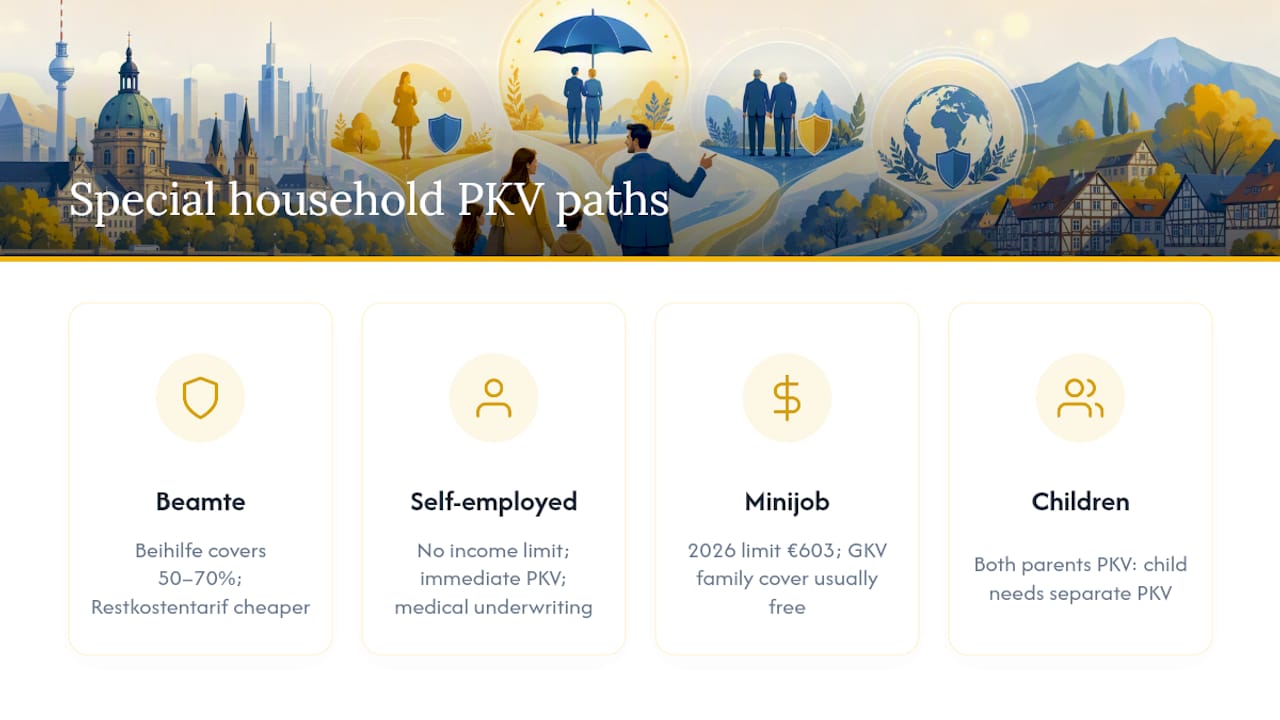
Beamte and Beihilfe. Civil servants typically receive Beihilfe covering a large portion, commonly in the 50 to 70% range, of eligible medical costs. A spouse who qualifies for Beihilfeberechtigung (subject to state-specific income limits) can then buy a Restkostentarif, a private policy that only covers the remaining share Beihilfe doesn't pick up. That combination is usually far cheaper than a standalone full PKV contract for the spouse.
Self-employed spouses. No income threshold applies. A self-employed partner can apply for PKV immediately, subject to individual medical underwriting, which means health history matters more here than in almost any other category.
Minijobs and unemployment. The 2026 minijob limit stays at €603 a month. Below that, GKV family insurance almost always wins on cost, since it's free for the non-earning spouse. PKV only makes sense here in unusual cases, like wanting to match a spouse's existing private coverage for continuity of care.
Children. If both parents are in PKV, children generally need their own individual PKV policy, underwritten separately (though usually at low, healthy-child rates). If one parent stays in GKV and earns below a certain income level, the child can often be family-insured there for free instead, which is frequently the cheaper path for a young family.
How to Switch or Apply: Steps, Documents, and Timing
Applying for PKV as a couple follows a predictable sequence, but the pace depends on how clean each partner's health history is.
- Run an eligibility check for each partner separately, confirming employment status against the JAEG or civil-servant/self-employed rules. An eligibility check at this stage saves wasted quote requests.
- Request quotes from multiple insurers for each partner's tariff needs.
- Complete health questionnaires. This is where delays usually happen, especially with follow-up requests for medical records.
- Submit employer subsidy paperwork for any employed partner.
- Finalize enrollment and confirm start dates, especially if you're coordinating a switch away from GKV.
Watch the age-55 line closely. Insurers apply stricter return-to-GKV rules past that point, and some PKV entry terms tighten too. If one partner is approaching 55, that's a reason to move faster, not later.
What Brokers See: Practical Guidance From My Healthcare Broker
Couples routinely compare PKV quotes person by person and miss the bigger picture. A tariff that looks like the "cheaper" option for one partner can make the household total worse once you factor in the other partner's subsidy, age, or Beihilfe status. Assessing the pair together, not each contract in isolation, is where most of the real savings show up.
One tool brokers use more than most people expect: Anwartschaftsversicherung, which preserves a partner's existing PKV tariff and entry age during a temporary break, like a career pause or a stint working abroad. Without it, returning to PKV later can mean re-underwriting at a much higher age, with a health check that might not go your way.
Pro Tip: If either partner expects a job gap, a move abroad, or a career break in the next year, ask about Anwartschaftsversicherung before that gap starts, not after. Once coverage lapses, the option to preserve the old tariff is usually gone.
Independent insurance brokers run eligibility checks, English-language comparisons across major insurers, and application support for couples working through exactly these tradeoffs.
A Broker's Take on PKV for Couples
Most couples treat PKV as two separate shopping decisions when it's really one household budgeting decision. The math almost never favors optimizing each partner's premium in isolation. It favors looking at combined cost, subsidy eligibility, and long-term aging reserves together, then acting fast if Ehegattennachversicherung applies to your situation.
Where things get complicated, Beihilfe calculations, self-employment underwriting, or a partner with a pre-existing condition, a DIY comparison starts to show its limits. That's exactly when a second set of eyes from a professional broker check tends to catch what a spreadsheet won't.
— Marco
Get a Free PKV Eligibility Check for Both Partners
A specialized insurance brokerage service provides couples a faster, clearer alternative to comparing PKV tariffs alone. Instead of requesting quotes from multiple insurers and trying to translate the fine print yourself, an independent comparison across all major German providers can happen in one conversation, in plain English, with no bias toward any single insurer.
A free consultation covers both partners at once: eligibility against the JAEG or civil-servant rules, Beihilfe and Restkostentarif options where relevant, and whether the Ehegattennachversicherung window applies to your timeline. For couples with a Beamter, a self-employed partner, or a more complex health history, the concierge service walks through the paperwork step by step instead of leaving you to chase forms alone.
Start with a free eligibility check to see where each partner stands, or head to the main comparison page to book a consultation and get both contracts moving before any deadline closes in.
Sources
Figures on JAEG, minijob limits, and Ehegattennachversicherung timing come from Verivox, VersicherungsRiese, and Transparent-Beraten. Beihilfe rates vary by federal state, so confirm the exact percentage and spouse income limit with your local Beihilfe office, ideally the same week you start comparing PKV tariffs.
- Private Krankenversicherung für Ehepartner | Verivox
- PKV für Ehepartner 2026: eigener Vertrag & Beihilfe | VersicherungsRiese
- Private Krankenversicherung für Ehepartner: Kosten & Wechsel | Transparent-Beraten
FAQ
Can a Wife or Husband Get Private Health Insurance in Germany?
Yes, but only with a separate contract. There's no free spousal coverage in PKV the way GKV offers it, though Ehegattennachversicherung can simplify entry if you apply within two months of marriage.
What Does It Cost to Add a Partner to PKV Coverage?
There's no fixed add-on cost, since PKV doesn't work like a family plan. Each partner gets their own premium based on age, health, and tariff choice, and employer subsidies of up to 50% only apply to that partner's own employment status, not automatically to a spouse's contract.
Can a Married Couple Share One Health Insurance Policy?
Not in PKV. Public insurance allows one household policy with free family coverage, but private insurance requires two individual contracts, one for each spouse, priced separately.
Is It Cheaper to Be on the Same Insurer as Your Spouse?
Not necessarily. PKV pricing is individual, so being with the same insurer doesn't lower either premium on its own. What actually saves money is comparing the household total, both partners' premiums plus any employer subsidy, against a single GKV family plan before choosing either route.
What Is the Minijob Income Limit for a Non-Working Spouse in 2026?
The 2026 minijob limit is €603 a month. Below that threshold, free family insurance through the working spouse's GKV plan is usually cheaper than starting a private contract.