
Private health insurance in retirement usually stays manageable, not because premiums freeze, but because the system is built to soften the increase. Most retirees see costs held in check by three levers working together: the Rentenzuschuss from Deutsche Rentenversicherung, an internal tariff change under § 204 VVG, and, for some, a Beitragsentlastungstarif purchased years earlier. The action item now is simple: pull your latest insurer statement, confirm your Rentenzuschuss eligibility, and see where you actually stand before assuming the worst.
TL;DR:
- Retirees paying for private health insurance typically see only small premium increases due to reserve systems and subsidies, with most paying under €700 monthly at age 60.
- The Rentenzuschuss from Deutsche Rentenversicherung covers about 8.75% of PKV premiums in 2026, but only if the retiree qualifies and applies, as it is not automatic.
- Applying for a tariff change within your insurer or upgrading to a Beitragsentlastungstarif early in your working life can significantly reduce retirement costs, especially if planned three years in advance.
- Switching insurers late in life often results in higher premiums or risk surcharges due to health underwriting, and returning to statutory insurance is rarely feasible for retirees.
- Civil servants benefit from Beihilfe, which can lower private insurance costs by covering a larger share of treatment expenses once their coverage percentage increases.
Table of Contents
- How Much Does PKV Cost in Old Age?
- How Are PKV Contributions in Retirement Calculated?
- What Subsidies and Reliefs Actually Lower the Bill?
- Practical Ways to Reduce Your PKV Contribution
- Can You Switch Insurers or Go Back to GKV Later?
- How Does Retirement Change Beihilfe for Beamte?
- Your PKV Retirement Timeline: What to Do and When
- How Myhealthcarebroker Helps You Navigate PKV in Retirement
- What Retirees Consistently Get Wrong About PKV
- Get a Personalized PKV Check Before Retirement Locks In
- Sources
How Much Does PKV Cost in Old Age?
Contributions do rise with age, but the jump is often smaller than retirees expect. The average PKV contribution across all age groups was about €559 per month in 2024, and more recent association figures for 2026 put some cohorts closer to €617. Those are averages across a wide population, not a prediction for any one policy, since your own number depends heavily on the tariff you bought decades ago and how much coverage it includes.
A few reference points make this concrete:
- Around age 60: many long-term policyholders pay in the €500 to €700 range, depending on deductible and benefit level.
- Around age 70: premiums commonly sit between €600 and €850, partly offset for pensioners by the Rentenzuschuss.
- Around age 80: costs can climb further, but Altersrückstellungen (the age-related reserves insurers build up over decades) are specifically deployed at this stage to blunt the increase.
Civil servants with Beihilfe pay noticeably less for their private supplement, since the state covers a large share of medical costs directly and the PKV portion only fills the remaining gap.
The reassuring number: only about 2.3% of PKV policyholders paid more than the statutory health insurance ceiling in 2024, and just 0.17% paid over €1,000 a month. Extreme premiums are the exception, not the norm, even in retirement.
How Are PKV Contributions in Retirement Calculated?
Your premium is not a single number that insurers pull from thin air. It is built from several layers, and understanding them helps you read your annual statement instead of just dreading it.
Altersrückstellungen sit at the center of the model. Every PKV policyholder pays extra during their working years specifically so the insurer can invest that money and use it later to keep old-age premiums lower than they would otherwise be. Insurers begin drawing more heavily on these reserves around age 65, with additional relief built in for policyholders past 80. That is the whole point of the reserve system: to shift some of the cost burden from your 70s and 80s back onto your 30s and 40s, when you could better afford it.
This money also feeds the reserve pool, and once you turn 60 the surcharge stops, which is itself a small, automatic reduction in your bill.
Beyond those two structural pieces, four other factors shape what you actually pay:
- The benefit level you chose (single room, alternative medicine, low deductible, and so on).
- Your age when you first signed the policy.
- Your health status at entry, which set your original risk loading.
- The insurer's investment returns and interest assumptions, which can trigger premium adjustments independent of your age.
Pro Tip: Request a tariff-comparison statement from your insurer. It is not required reading, but it is the single clearest way to see what other tariffs at the same company would cost you right now, and it often reveals savings you didn't know existed.
What Subsidies and Reliefs Actually Lower the Bill?
Three mechanisms do most of the heavy lifting once you retire, and each has its own eligibility rules worth understanding before you assume you either qualify or don't.
-
The Rentenzuschuss. Deutsche Rentenversicherung pays a subsidy equal to 7.3% of your pension plus half the average additional contribution rate, which works out to roughly 8.75% combined in 2026 figures. The subsidy is capped at half of your actual PKV premium, so it will never cover more than that share regardless of how the percentages land. You must receive a German statutory pension to qualify, and if you're self-employed, you generally need at least five years of voluntary contributions to the DRV before you're eligible. Nobody applies this automatically. You have to file for it yourself alongside your pension application.
-
Basistarif and Standardtarif. These are capped, regulated tariffs designed as a safety net. The Basistarif is open to any PKV policyholder and its premium cannot exceed the maximum contribution set for statutory health insurance, while the Standardtarif is reserved for people who took out their policy before 2009 and comes with its own income-based cap. Both trade lower cost for a leaner benefit package closer to GKV levels, so they suit people prioritizing affordability over comprehensive coverage.
-
Costs that simply disappear at retirement. Krankentagegeld, the daily sickness allowance tied to lost income, becomes irrelevant once you stop working and typically drops off your policy on its own, trimming your premium without any application. Combined with the end of the 10% surcharge at 60, retirees often see two automatic reductions land before they've done anything at all.
Practical Ways to Reduce Your PKV Contribution
Once you know the subsidies you qualify for, the next question is what you can actively change. Three tactics cover most of what a retiree can realistically do.
Switch tariffs inside your own insurer. Under § 204 VVG, you have a legal right to move to a cheaper tariff with the same company without a new health check, and your accrued Altersrückstellungen carry over intact. Insurers are also obligated to advise you on cheaper options within their own product range, though they rarely volunteer this information unprompted. You need to ask.
Consider a Beitragsentlastungstarif. These are supplementary tariffs you pay into during your working years so that a fixed sum reduces your bill automatically once you reach retirement age. They only pay off if purchased early enough, since the whole mechanism depends on years of contributions building up a discount pool before you need it.
Raise your Selbstbehalt (deductible). Accepting a higher annual deductible in exchange for a lower monthly premium can make sense if you have savings set aside for routine costs and mainly want protection against larger expenses. It is a trade worth running the numbers on rather than assuming.
Two practical steps to actually put these into motion:
- Ask your insurer in writing for a full tariff-comparison statement covering your current plan and any cheaper alternatives they offer.
- Request a cost projection out to age 70 and 80, so you're planning against a real trajectory instead of a guess.
Pro Tip: Do this exercise before you retire, not after. Advisors consistently find that early planning, including running these projections years in advance, opens up more options than waiting until the premium increase already hurts.
Can You Switch Insurers or Go Back to GKV Later?
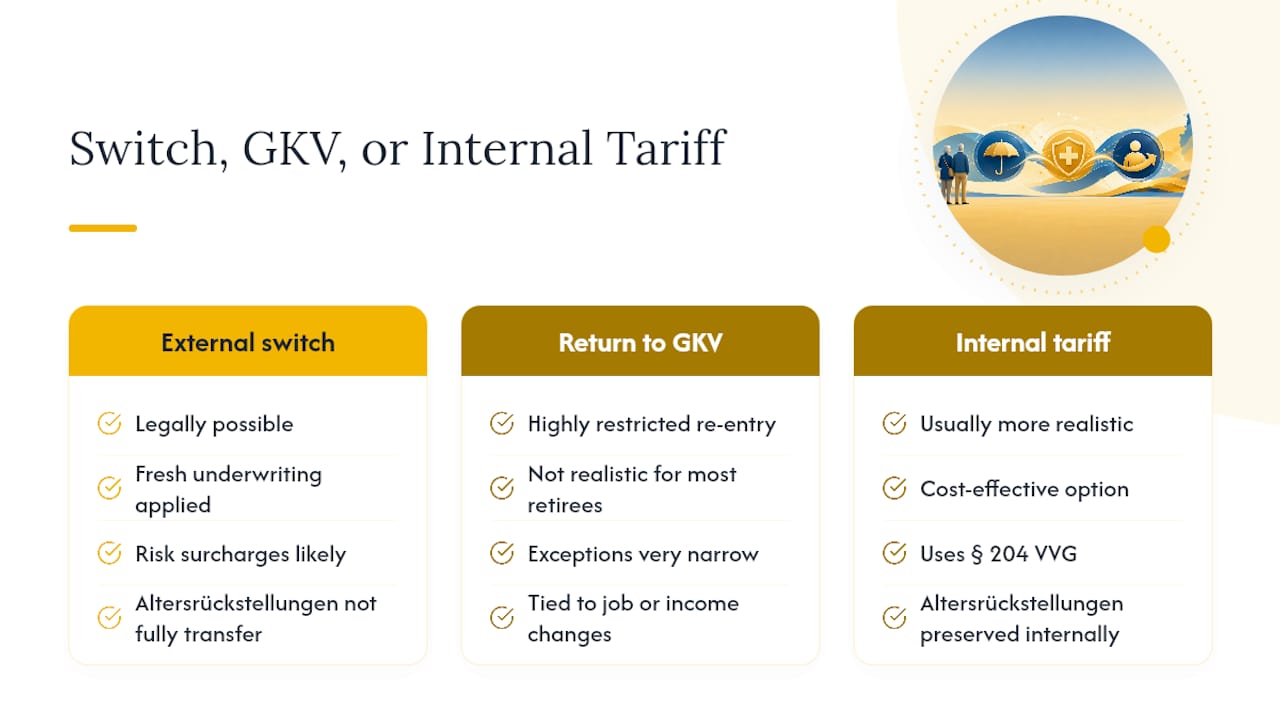
Switching providers late in life is legally possible but rarely advisable. A new insurer will run fresh underwriting on your health, and any conditions that developed since your original policy started can trigger risk surcharges that erase whatever savings you were chasing. Your existing Altersrückstellungen also don't fully transfer to a new company the way they do with an internal tariff change.
Returning to statutory health insurance (GKV) is even more restricted. For most retirees, re-entry into GKV is not a realistic path once you've spent your working life in the private system, because age and insurance-history rules effectively lock the door. A narrow set of exceptions exists, tied mostly to specific employment or income changes, but you should never build a retirement budget on the assumption that GKV is a fallback.
Given these limits, an internal tariff change under § 204 VVG is almost always the more realistic and cost-effective move compared to shopping around externally.
How Does Retirement Change Beihilfe for Beamte?
If you're a retired civil servant, the mechanics shift in your favor.
A few things matter here:
- Notify your insurer as soon as your Beihilfe rate changes, since your PKV tariff needs adjusting to match the new split.
- An Anwartschaftsversicherung, arranged earlier in your career, protects your right to affordable coverage later and is worth checking if you set one up.
- Example: a retiree moving from 50% to 70% Beihilfe coverage can see their private insurer's share of a given treatment cost drop by roughly two thirds, which typically shows up as a lower premium at the next tariff review.
Your PKV Retirement Timeline: What to Do and When
Spreading these actions across a timeline keeps the process from feeling like one overwhelming decision.
- Now, regardless of your age: request a full contribution breakdown from your insurer, confirm whether you already qualify for Rentenzuschuss, and gather your pension documents.
- One to three years before retirement: evaluate a tariff change and, if you haven't already, ask whether a Beitragsentlastungstarif still makes sense given your timeline. Run a cost projection to age 80.
- At retirement: submit your Rentenzuschuss application (it is not automatic), finalize any tariff decisions, and confirm that Krankentagegeld has been removed from your policy.
- If costs still feel unaffordable: ask about Basistarif eligibility or contact social services, since income-tested support exists for genuinely difficult cases.
Pro Tip: Set a calendar reminder for the Rentenzuschuss application the same week you file for your pension. Missing the window means missing months of subsidy you can't easily reclaim.
How Myhealthcarebroker Helps You Navigate PKV in Retirement
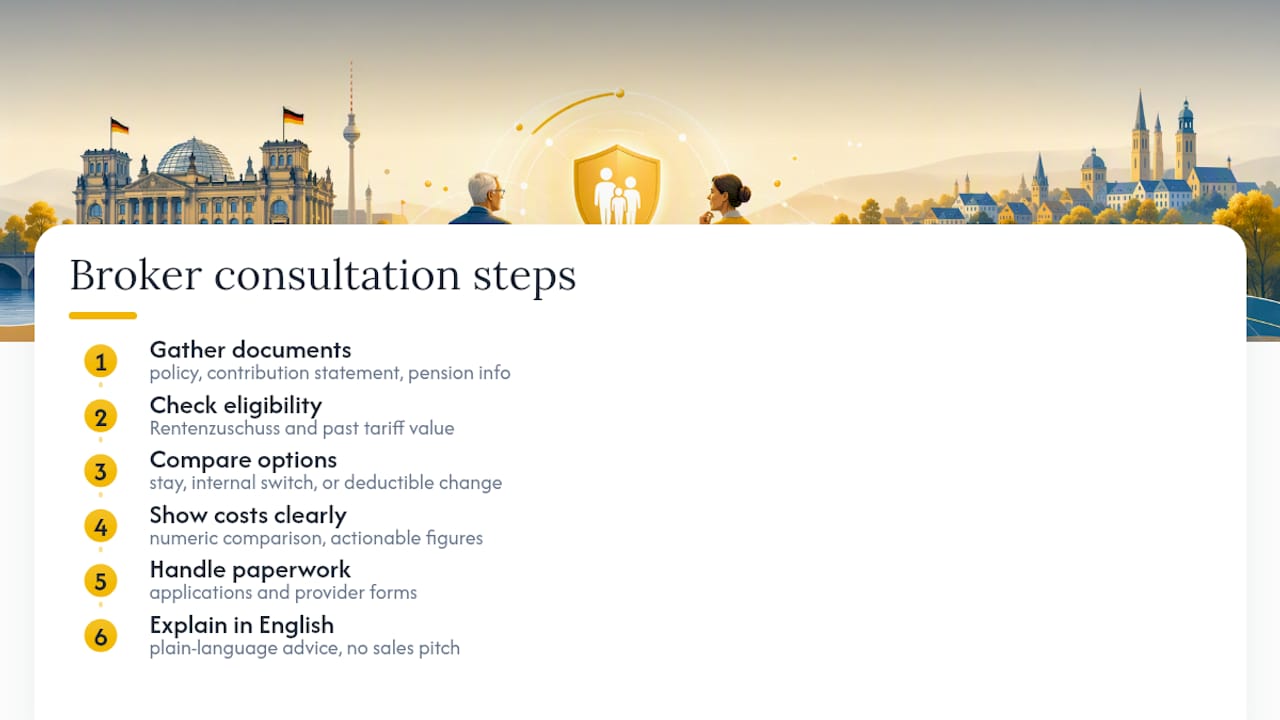
Reading your own insurer's tariff paperwork in German, while trying to work out whether a Beitragsentlastungstarif from a decade ago is still worth keeping, is genuinely hard even for native speakers. Insurance brokers can help clients by checking Rentenzuschuss eligibility, comparing tariffs across providers, handling the application paperwork, and explaining every step in plain English.
A typical consultation starts with your current policy documents, your most recent contribution statement, and basic pension information. From there, expect a clear comparison of what staying, switching internally, or adjusting your deductible would actually cost, laid out in numbers you can act on rather than a set of vague suggestions. If you're a retiree evaluating whether your current provider is still right for you, the goal of any consult is clarity, not a sales pitch.
What Retirees Consistently Get Wrong About PKV
Most people treat their PKV contract like a subscription that will inevitably get more expensive until it becomes unaffordable. That's the wrong mental model. The insurer can raise your premium for reasons tied to medical inflation and interest rate assumptions, but the contract itself guarantees your benefits for life, and the entire Altersrückstellungen system exists to redistribute cost away from old age, not toward it.
The bigger mistake is passivity. Retirees who request a tariff-comparison statement and apply for the Rentenzuschuss the moment they're eligible consistently do better than those who wait for a premium increase letter to force the issue. Planning three years out beats reacting after the fact, every time.
— Marco
Get a Personalized PKV Check Before Retirement Locks In
Working through Altersrückstellungen, Rentenzuschuss eligibility, and tariff comparisons on your own is doable, but it eats hours you probably don't want to spend deciphering German insurance letters. Some services provide a faster route to the same answer: a free eligibility check and tariff comparison across major providers, explained in English, with no obligation attached.
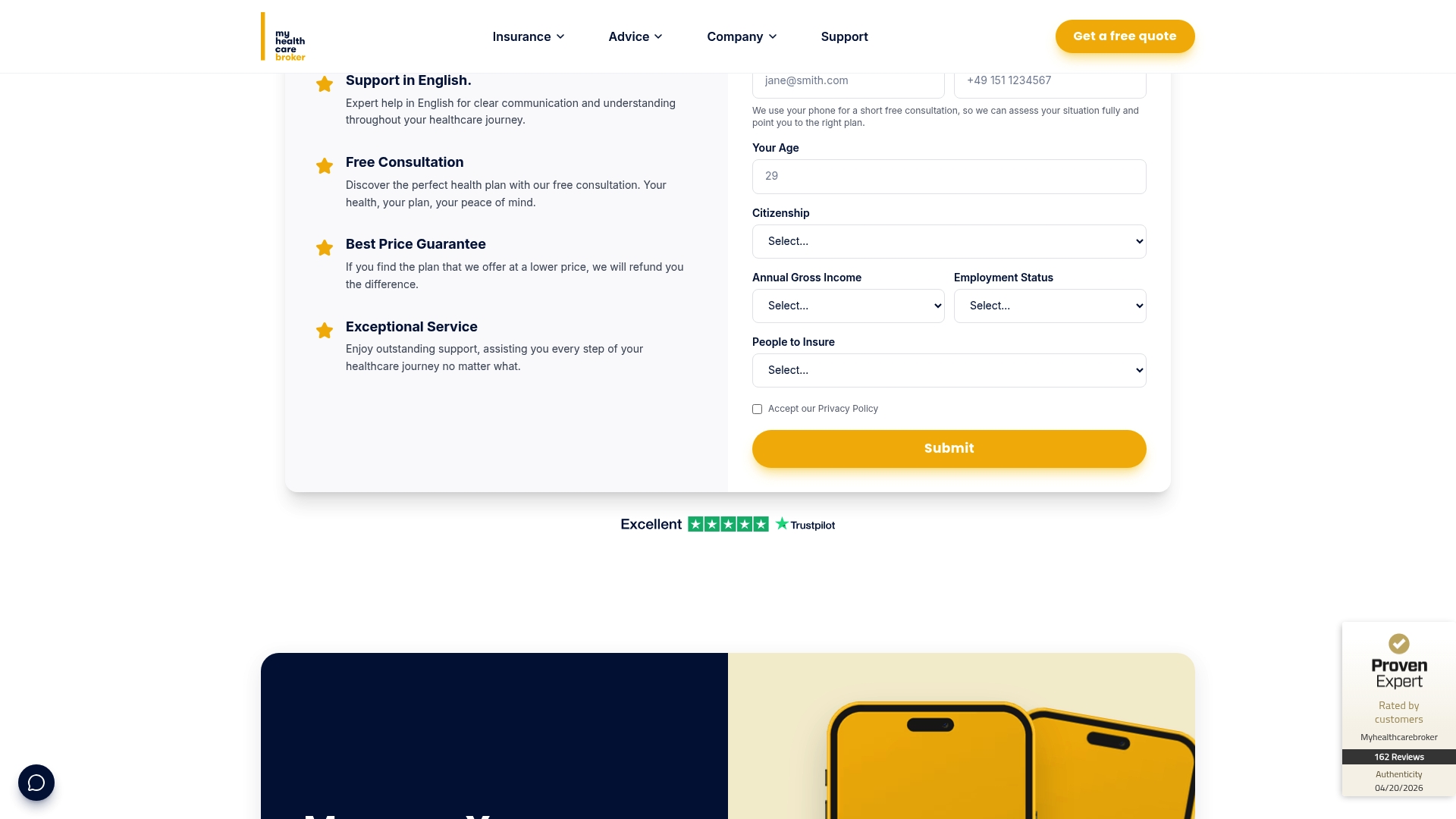
The process starts with the private health insurance calculator, which gives you a quick first read on where your premium could land under different scenarios. From there, if you want a full comparison and application support, the English-language advisory service walks you through eligibility, paperwork, and provider options at no cost to you, since the service is paid through a regulated commission from the insurer, not by you. Book a consultation and get a clear answer on your options before your next premium notice arrives.
Sources
- So hoch sind die PKV-Beiträge im Alter
- PKV im Alter - Wie Du als Rentner Deine Beiträge senkst
- PKV im Ruhestand 2026: Beiträge & Tipps – Ratgeber, Rechner
This article is general information, not a substitute for advice from a qualified financial advisor. Consult a qualified financial professional about your own circumstances before acting on anything here.