
Whether your German private health insurance survives a move abroad depends on one thing above all: your destination. Stay inside the EU, EWR, or Switzerland and your PKV contract typically continues without a break, provided you keep paying. Move outside that zone permanently, and coverage usually lapses within a short window unless you arrange Anwartschaft, prove an Entsendung (posting) status with A1/S1 documents, or line up international private medical insurance (IPMI) before you go.
TL;DR:
- Moving within the EU, EWR, or Switzerland allows your private health insurance to continue seamlessly as long as premiums are paid, with claims processed for reimbursement rather than direct billing.
- Outside the EU, EWR, or Switzerland, insurers typically limit coverage to one to six months unless you arrange Anwartschaft, prove an Entsendung status with A1/S1 documents, or acquire international private medical insurance beforehand.
- For short-term postings under 24 months, maintaining German coverage with A1 documentation and an employer-confirmed Entsendung generally suffices, supported by a temporary evacuation top-up if needed.
- Choosing between small and large Anwartschaft hinges on age and reserves: small preserves health status at low cost, while large preserves reserves and avoids premium jumps upon re-entry.
- For permanent moves outside the EU, options include local mandatory schemes, international private insurance, or large Anwartschaft, depending on the likelihood of returning to Germany.
Table of Contents
- PKV und Umzug ins Ausland: EU/EWR/Switzerland vs Non‑EU Rules
- How Does Entsendung Affect Your PKV and Social Security?
- Small vs Large Anwartschaft: Which One Fits Your Move?
- What Are Your Options Besides Keeping Full PKV?
- Your Pre‑Departure Timeline: 3 Months to Deregistration
- Which Documents Prove You Have Coverage Abroad?
- Client Scenarios: A Broker's Decision Framework
- What Happens to PKV Taxes When You Live Abroad?
- How to Choose Supplemental Coverage as an Expat
- Why Planning Early Changes the Financial Outcome
- Get Help Preserving Your PKV Before You Relocate
- Where to Verify the Rules Yourself
- Sources
- FAQ
PKV und Umzug ins Ausland: EU/EWR/Switzerland vs Non‑EU Rules
The line that matters most isn't "abroad" versus "home." It's whether you're moving within the EU, EWR, or Switzerland, or leaving that zone entirely. Inside those borders, PKV coverage generally continues indefinitely as long as you keep paying premiums. Your insurer treats you the same as if you'd stayed in Germany, though claims may need to be filed and reimbursed rather than settled directly with the foreign provider.
Move outside the EEA, and the picture changes fast. Most tariffs cap automatic coverage at a short period, commonly around one month, with some insurers extending that to two or six months if you ask in advance. Beyond that window, many contracts allow the insurer to end coverage on a permanent, non-EU relocation.
A few things shift once you cross that boundary:
- Reimbursement, not direct billing, becomes the norm for most claims filed abroad.
- Host-country mandatory insurance schemes may require you to enroll locally regardless of your German PKV status.
- Insurers may ask for proof that your move is genuinely permanent before deciding whether to terminate or pause your contract.
Notifying your insurer the moment you know your departure date, rather than after you've landed, gives you time to negotiate terms instead of discovering them after a claim gets rejected.
How Does Entsendung Affect Your PKV and Social Security?
Posted employees, or those on Entsendung, occupy a different category entirely. If your German employer sends you abroad temporarily while keeping you on German payroll, you can typically remain under German social insurance law for up to 24 months under EU coordination rules. That status hinges on documentation, not assumption.
- Get the A1 certificate first. Your employer applies for this before you leave, and it confirms which country's social security law covers you during the posting.
- Understand what S1 does for GKV holders. The S1 form lets statutory insurance members register for care in the host state. PKV holders don't use S1 the same way; instead, you need a Certificate of entitlement or a formal insurer letter confirming your coverage.
- Loop in the DVKA when needed. The Deutsche Verbindungsstelle Krankenversicherung Ausland handles cross-border coordination questions and exception requests when standard rules don't fit your situation.
HR departments often assume A1 approval happens automatically. It doesn't. Missing that step can leave you exposed to local social security liability the moment you land.
Small vs Large Anwartschaft: Which One Fits Your Move?
Anwartschaft, a "waiting" or "standby" contract, is the tool most PKV holders reach for when they're leaving Germany but might come back. It comes in two forms, and picking the wrong one gets expensive later.
Small Anwartschaft freezes your health status. If you develop a condition abroad, you won't be penalized for it when you return and reactivate full coverage. It's the cheaper option, often running in the low tens of euros per month. What it doesn't do is preserve your Altersrückstellungen, the age-based reserves PKV builds up over time to keep future premiums manageable.
Large Anwartschaft preserves both your health status and those reserves. It costs considerably more, frequently a sizable share of your original full premium, but it protects you from what brokers call premium shock on return: the jump in monthly cost you'd otherwise face rejoining PKV at an older age with reserves reset to zero.
Pro Tip: If you're over 55 or have built substantial reserves, run the numbers before defaulting to the cheaper option. The Anwartschaft fee often costs far less than the lifetime premium increase from losing those reserves.
- Younger movers with uncertain return plans: small Anwartschaft usually suffices.
- Older policyholders or those with significant reserves: large Anwartschaft protects more value long term.
- Anyone unsure which applies: a broker-run break-even comparison settles it quickly.
What Are Your Options Besides Keeping Full PKV?
Not everyone wants, or can afford, to keep German PKV running in parallel while living abroad. Three realistic paths cover most situations.
International private medical insurance, or IPMI, offers worldwide coverage including medical evacuation, and suits long-term non-EU expats or self-employed professionals who need continuous protection without ties to the German system. Costs vary widely by age and destination, often running from roughly €150 to €800 a month.
Long-term travel or Auslandskrankenversicherung policies cost less but come with a ceiling, usually somewhere between six months and five years of coverage. These work well as a bridge during a defined assignment rather than a permanent solution.
Then there's simply joining the host country's mandatory scheme, which many non-EU destinations require regardless of what you carry from Germany. When that happens, sort out early which system pays first and how reimbursement claims move between the two.
- IPMI: broadest protection, highest cost, best for genuine long-term relocation.
- Travel insurance: cheapest, time-limited, best for defined-term stays.
- Local mandatory enrollment: often required by law, not optional once triggered.
Your Pre‑Departure Timeline: 3 Months to Deregistration
Losing track of dates is the single most common way people lose PKV rights they didn't need to lose. Work backward from your departure date.
- Three or more months out: Notify your insurer in writing, request formal confirmation of your options, and if Anwartschaft makes sense, get the paperwork signed before you leave, not after.
- If you're posted abroad: Your employer requests the A1 certificate, and you gather the posting letter, contract addendum, and any host-country registration forms you'll need on arrival.
- One month out: Confirm whether Anwartschaft is active and correctly dated to start the moment full coverage would otherwise lapse, with no gap in between.
- At Abmeldung (deregistration): Confirm your new arrangement, whether Anwartschaft, IPMI, or local enrollment, is actually in force, and keep every piece of insurer correspondence. Deregistering fully in Germany typically ends your insurance obligation here, and that's the exact moment gaps appear if nothing else is lined up.
Which Documents Prove You Have Coverage Abroad?
Host-country authorities frequently expect paperwork shaped for the statutory system, not private insurance. That mismatch causes more registration headaches than any actual coverage gap.
The Certificate of entitlement exists specifically to close that gap. PKV insurers issue it (or a formal letter with equivalent content) to confirm you carry adequate coverage, since foreign officials often ask for something resembling an S1 or EHIC form that PKV simply doesn't produce.
A few practical notes save real time:
- Request the certificate weeks before your move, not the week of.
- Ask whether the host country requires a translated or notarized copy; some registration offices reject English or German originals outright.
- Check your policy for Rücktransport (repatriation) coverage. Many standard PKV tariffs exclude it, which is why a short-term travel top-up covering medical evacuation is worth buying even when your main coverage is solid.
Client Scenarios: A Broker's Decision Framework
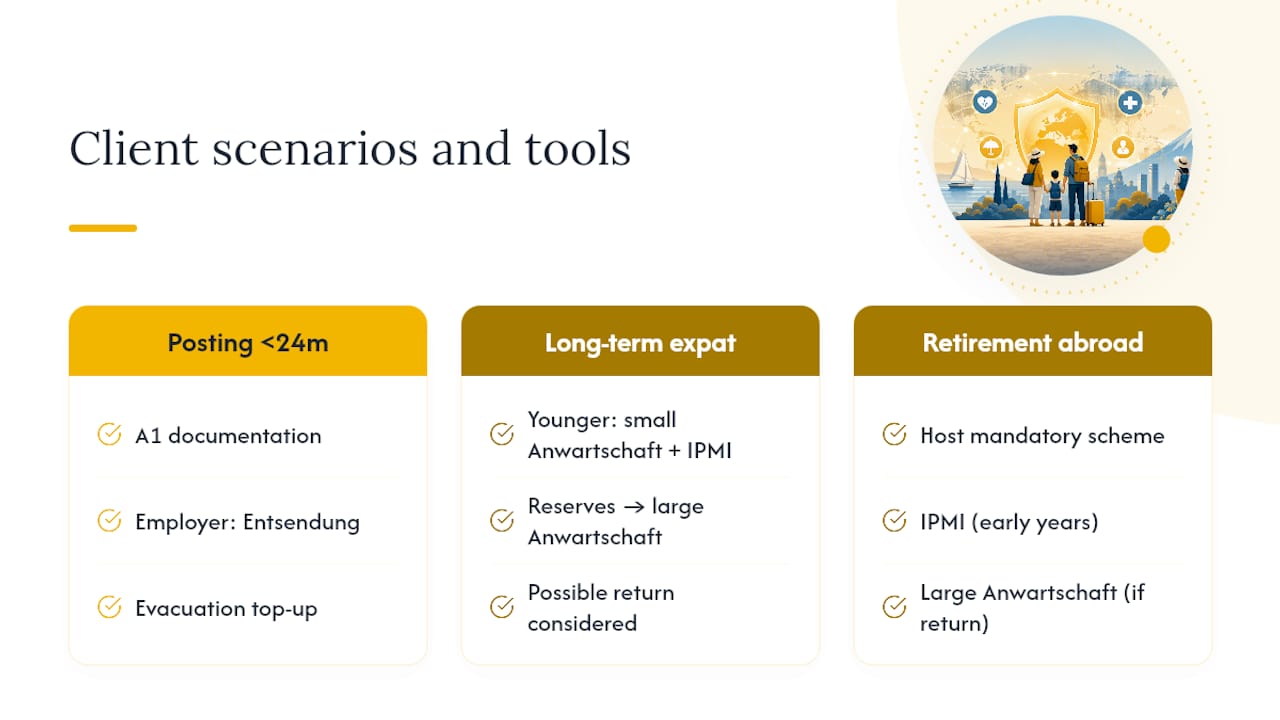
Three patterns come up again and again with clients planning a move abroad, and each calls for a different combination of tools.
Scenario A covers postings under 24 months. Here, maintaining German coverage through A1 documentation, with the employer confirming Entsendung status, usually works cleanly. A short-term top-up for evacuation coverage fills the remaining gap.
Scenario B involves long-term expats who might return one day. The right mix depends heavily on age and built reserves: younger movers often pair a small Anwartschaft with IPMI, while those with substantial reserves lean toward large Anwartschaft alone.
Scenario C is permanent retirement abroad. This calls for weighing the host country's mandatory scheme against IPMI for the early years, with large Anwartschaft only if a return to Germany stays genuinely plausible.
What Happens to PKV Taxes When You Live Abroad?
Keeping a PKV contract active while living outside Germany raises a separate question most people overlook until tax season: what happens to the premiums you're still paying?
If you've fully deregistered in Germany and have no German-taxable income, you generally lose the ability to deduct PKV premiums on a German tax return, since that deduction applies to residents filing German income tax. Retaining Anwartschaft or full PKV while abroad doesn't create German tax liability on its own. The premiums simply become a personal expense you're paying from wherever your income is now taxed.
Where things get more complicated is for posted employees under Entsendung. If you remain tax-resident in Germany during a posting, your PKV premiums may still qualify for the usual deductions on your German return, subject to the same contribution limits that applied before you left. This is exactly the kind of detail where posting duration, tax residency, and social security status all interact, and getting one piece wrong can mean either missing a legitimate deduction or claiming one you're no longer entitled to.
Double taxation agreements between Germany and your destination country can also affect how health insurance premiums are treated for residents who split income across both systems. None of this is something to guess your way through. A tax advisor familiar with cross-border cases, ideally one who has handled PKV specifically, should review your situation before you file, especially in the first year after a move when residency status itself may be ambiguous.
How to Choose Supplemental Coverage as an Expat
Anwartschaft and A1 documentation solve the German side of the equation. They don't necessarily give you comprehensive care in your new country, which is where supplemental international coverage earns its cost.
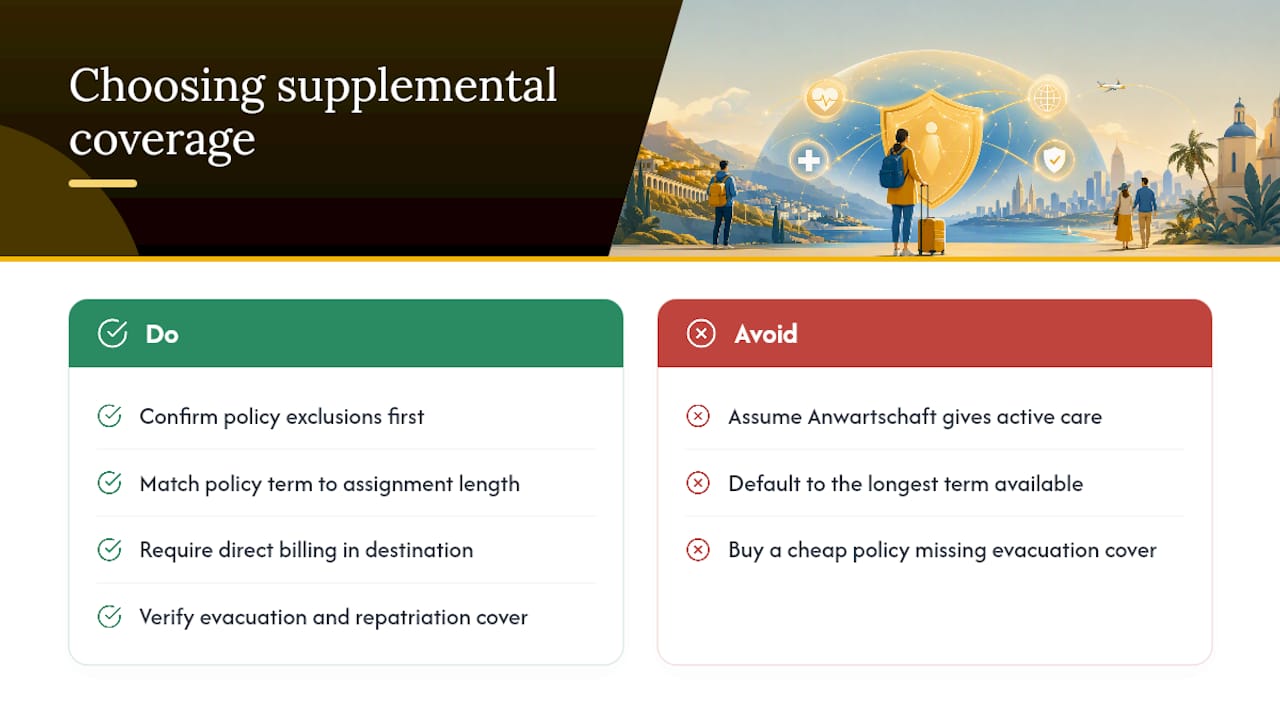
Start with what your primary arrangement actually excludes. A small Anwartschaft provides no active coverage at all, so anything short-term needs to come from elsewhere. A large Anwartschaft has the same gap. Even full IPMI plans sometimes cap evacuation benefits or exclude specific regions, so read exclusions before assuming worldwide means everywhere.
Match the policy term to your actual plans rather than defaulting to the longest option available. Someone on a two-year assignment doesn't need a five-year IPMI contract; someone retiring permanently outside the EU probably does need something built for indefinite use, not a travel policy meant for a sabbatical.
Check how claims get settled. Direct billing with hospitals in your destination country saves enormous hassle compared to paying upfront and waiting for reimbursement, particularly for anything involving surgery or extended treatment. Ask specifically about this before signing, since marketing materials rarely spell it out clearly.
Finally, weigh evacuation and repatriation coverage on its own, separate from general medical benefits. This is the piece standard PKV tariffs tend to skip entirely, and it's also the piece that matters most if something goes seriously wrong far from adequate care. A policy that's cheap on paper but silent on evacuation can cost you far more than the premium difference if you ever need it.
Why Planning Early Changes the Financial Outcome
The clients who come out ahead aren't the ones with the most complicated insurance history. They're the ones who called before booking a flight, not after. Delaying that conversation is what turns a manageable Anwartschaft decision into a lost set of Altersrückstellungen and a costly scramble to re-enter PKV years later at a worse rate.
None of this requires guessing. It requires a documented plan, made while you still have every option on the table.
— Marco
Get Help Preserving Your PKV Before You Relocate
Working through Anwartschaft paperwork, A1 requests, and IPMI comparisons on your own, in German, while also planning an international move, is a lot to carry at once. There are services offering independent advice in English, comparison across providers rather than a pitch for one insurer, and assistance with confirmation letters and certificates your host country will demand.
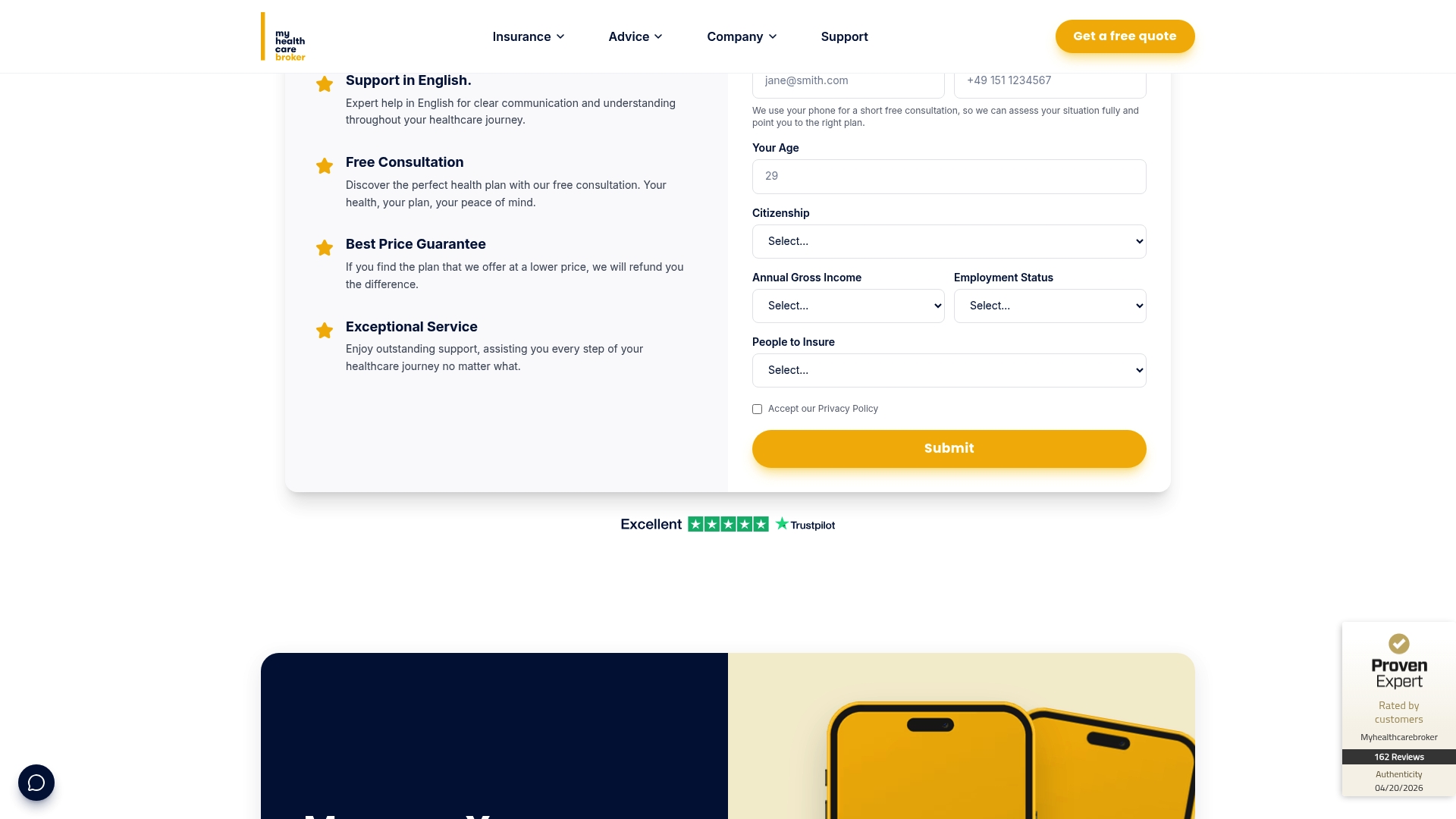
Some insurance brokerage services cost clients nothing because insurers pay a fixed, regulated commission when a policy goes through. Navigating Anwartschaft cost comparisons or IPMI options alone can be challenging. If you're not sure whether small or large Anwartschaft fits your timeline, our health insurance calculator Germany gives you a starting estimate, and our eligibility check is the fastest way to get a documented plan before your departure date locks in.
Where to Verify the Rules Yourself
- The PKV Verband's guidance on coverage abroad covers EU/EWR/Switzerland continuation rules directly from the industry association.
- krankenkassen.de's Certificate of entitlement page explains how to request proof of PKV coverage for host-country authorities.
- The European Commission's social security coordination pages detail A1 and posting rules across EU member states.
- If your move involves a defined work assignment, Flexible Nursing Careers' guide to short-term healthcare assignments offers useful context on how posting length shapes insurance needs.
This article is general information, not a substitute for advice from a qualified financial advisor. Consult a qualified financial professional about your own circumstances before acting on anything here.
Sources
- Privatversichert im Ausland — PKV Verband
- EU social security coordination / A1 guidance — European Commission
- PKV, GKV or international insurance — Insurancy
FAQ
What happens to my private health insurance if I move abroad?
Inside the EU, EWR, or Switzerland, your PKV typically continues without interruption as long as you keep paying premiums. Outside that zone, most insurers limit automatic coverage to a short period, commonly around one month, unless you arrange Anwartschaft or another solution beforehand.
What happens to health insurance when you move abroad permanently?
A permanent move outside the EU/EWR usually triggers the insurer's right to end your contract after the initial coverage window closes, unless you've set up large or small Anwartschaft to preserve your standing. Fully deregistering in Germany also generally ends your German insurance obligation entirely.
Can I cancel my private health insurance when moving abroad?
Yes, you can cancel PKV when moving abroad, but canceling outright means losing your accumulated Altersrückstellungen and starting over if you ever want German private coverage again. Choosing Anwartschaft instead of full cancellation preserves that value at a much lower monthly cost.
Can I keep my health insurance if I move abroad?
You can generally keep it if you're moving within the EU, EWR, or Switzerland, or if you're posted abroad by a German employer with proper A1 documentation. For permanent non-EU moves, Anwartschaft is usually the tool that keeps your PKV relationship intact without paying for active coverage you're not using.