PKV can cover prevention services in Germany, but only to the extent your specific tariff says so. The legal floor comes from § 192 VVG, which obliges every private insurer to reimburse statutory ambulatory preventive examinations. Beyond that floor, coverage for a check-up, vaccinations, or dental prophylaxis depends entirely on what you signed. The next sections break down the legal basis, the services people actually claim, and how to read your own contract correctly.
TL;DR:
- Private insurers are legally required to reimburse statutory preventive examinations, but any additional coverage depends entirely on your specific tariff.
- Most tariffs cover well-known services like general health check-ups and organized cancer screenings, but coverage for wellness services or lifestyle programs is less certain and often requires explicit clauses.
- Carefully review your policy’s benefit descriptions, exclusions, and frequency limits in writing to avoid misunderstandings and denied claims.
- Obtaining pre-authorization for expensive diagnostics or interventions and documenting medical recommendations significantly improves the chances of claim approval.
- Using an independent broker can help clarify your individual coverage, assist with pre-authorization, and prevent costly claim errors before services are booked.
Table of Contents
- Präventionsleistungen PKV: The Legal Baseline Under § 192 VVG
- Common Prevention Services You'll Find in PKV Tariffs
- How to Read Your Tariff for Prevention Coverage
- A Step-by-Step Checklist for Claiming Prevention Benefits
- Expert Corner: Common Errors and How a Broker Helps
- Tax Treatment of Prevention Expenses Under PKV
- Why Prevention Support Extends Beyond Your Contract
- How an independent broker can help you verify prevention coverage
- Sources
- FAQ
Präventionsleistungen PKV: The Legal Baseline Under § 192 VVG
The starting point for every Präventionsleistungen PKV question is the same paragraph of German insurance law. § 192 VVG requires private insurers to reimburse agreed ambulatory preventive examinations aimed at the early detection of disease. That is the guaranteed minimum. Everything above it runs through your tariff, not the law.
This is where PKV diverges sharply from statutory health insurance (GKV). GKV entitlements are standardized: every member of every statutory fund gets the same catalog of preventive services, defined centrally rather than negotiated. PKV works the opposite way. Your insurer builds preventive benefits into a specific tariff, and two people at the same company can have wildly different coverage depending on which plan they bought.
Two institutions shape what "statutory" prevention even means:
- The Bundesministerium für Gesundheit (BMG) defines the content and rhythm of the general health check-up, covered once between ages 18 and 34, then every three years from 35 onward.
- The Gemeinsamer Bundesausschuss (G-BA) sets the guidelines for organized cancer screening, deciding which tests count as standard early detection and at what intervals.
Both bodies matter for PKV holders because insurers often mirror these organized programs when defining their own preventive benefits, even though they are not legally bound to match them exactly.
Common Prevention Services You'll Find in PKV Tariffs
Most PKV tariffs cluster around a familiar set of prevention services, though the fine print on frequency and limits varies from contract to contract.
- General health check-up. The BMG-defined Check-up 35 is the baseline nearly every tariff reimburses, and some PKV plans offer shorter intervals than the statutory three years.
- Cancer screening. Organized program tests, mammography, cervical screening, colorectal checks, generally get covered when they follow G-BA guidelines. Extra checks outside those programs, like earlier colonoscopies for people without documented family risk, depend on an explicit tariff clause. The G-BA itself has said evidence still falls short for organized colorectal screening under age 50 based on family risk alone, which is exactly the kind of expanded test insurers can legitimately decline.
- Vaccinations. Routine immunizations on the standard schedule are typically reimbursed. Travel vaccines and occupational shots vary by tariff and sometimes need separate justification.
- Dental prophylaxis. Professional tooth cleaning, or Zahnprophylaxe, often gets partial coverage with an annual cap rather than full reimbursement. This is one of the most common places where PKV holders overestimate what their plan actually pays.
- Behavioral prevention courses. Movement, nutrition, and stress-reduction programs almost never get automatic coverage; these types of services include online courses and classes that focus on lifestyle and stress reduction. They typically require an explicit clause and, in many cases, prior written approval before you enroll.
The takeaway across all five categories: the closer a service sits to an organized, government-defined screening program, the more likely a standard tariff pays for it automatically. The further it drifts into wellness or lifestyle territory, the more it depends on what you specifically negotiated.
How to Read Your Tariff for Prevention Coverage
Advertising brochures describe prevention benefits in glowing generalities. Your actual entitlement lives in three sections of your policy document, none of which are optional reading if you want a straight answer.
- Leistungsbeschreibung (benefit description): this is where the insurer lists exactly which preventive services it pays for and under what conditions.
- Leistungsausschlüsse (exclusions): check this before assuming a service is covered just because it's mentioned elsewhere in the contract.
- Frequenzangaben (frequency limits): many tariffs cap check-ups, screenings, or dental cleanings to once per year or once every two years, regardless of medical recommendation.
- Ambulante Vorsorgeuntersuchungen clause: this is the specific line that ties your plan back to the § 192 VVG minimum.
Watch for phrasing that sounds generous but carries hidden conditions. "Bis zu" (up to) signals a cap, not a guarantee. "Auf Nachweis" means reimbursement only against a submitted receipt or documentation. "Nach ärztlicher Indikation" means a doctor has to justify medical necessity before the insurer pays, which rules out screenings done purely on request.
Pro Tip: Never trust a phone call alone. If a customer service representative tells you something is covered, ask for that confirmation in writing, referencing the specific tariff clause. Verbal assurances rarely survive a claims dispute.

A Step-by-Step Checklist for Claiming Prevention Benefits
Following a consistent process before and after preventive care cuts your denial risk dramatically.
- Check the wording first. Before booking anything beyond a routine check-up, locate the relevant clause in your Leistungsbeschreibung and request written confirmation from your insurer for anything non-routine.
- Get a prevention recommendation. A check-up under the BMG framework can generate a formal recommendation for further prevention measures; keep that document attached to your invoice, since a recommendation strengthens your claim but is not itself a coverage guarantee.
- Request pre-authorization for costly extras. MRIs, extended lab panels, or multi-session courses often need a pre-authorization reference. Insurers frequently deny non-indicated diagnostics submitted without one.
- Submit invoices cleanly. Use correct procedure codes and keep screening invoices separate from any follow-up diagnostic or treatment bills; mixing them can complicate both this claim and future underwriting.
- If denied, escalate properly. Start with your insurer's internal complaint process, then contact the Ombudsmann Versicherungen if unresolved, or ask a broker for an anonymous pre-check before you commit to further spending.
Pro Tip: If a screening turns up something abnormal, document the follow-up diagnostics as a separate event from the original prevention exam. This keeps your paper trail clean if you ever apply for a new tariff later.
Expert Corner: Common Errors and How a Broker Helps
A common costly mistake among PKV holders is booking the service first and asking the insurer questions afterward. By the time you're holding an invoice for an MRI without medical indication, the tariff's exclusion clause has already decided the outcome, and no amount of arguing changes that.
A broker who works across the market, rather than for one insurer, adds value in a few concrete ways:
- Reading your Leistungsbeschreibung against your actual health goals, not the marketing summary.
- Running an anonymous pre-check on pre-existing conditions before you disclose anything to an insurer directly.
- Helping structure the paperwork for pre-authorization requests so they don't get bounced on a technicality.
That last point matters more than it sounds. Insurers reject a surprising share of claims purely on documentation format, not medical merit.
Tax Treatment of Prevention Expenses Under PKV
Prevention costs that your PKV tariff doesn't reimburse aren't automatically lost money at tax time, but the rules are narrower than many policyholders assume. Germany's tax code treats health expenses under the umbrella of "außergewöhnliche Belastungen" (extraordinary burdens), and preventive care sits in a gray zone compared to treatment for a diagnosed illness.
Purely elective wellness services, gym-adjacent movement courses, general nutrition coaching, rarely qualify as deductible medical expenses because tax authorities view them as lifestyle choices rather than medical necessity. A prevention course tied to a documented medical indication, prescribed in writing by a physician, stands a much better chance of being treated as a deductible health cost, provided you also cleared the § 192 VVG reimbursement question with your insurer first.
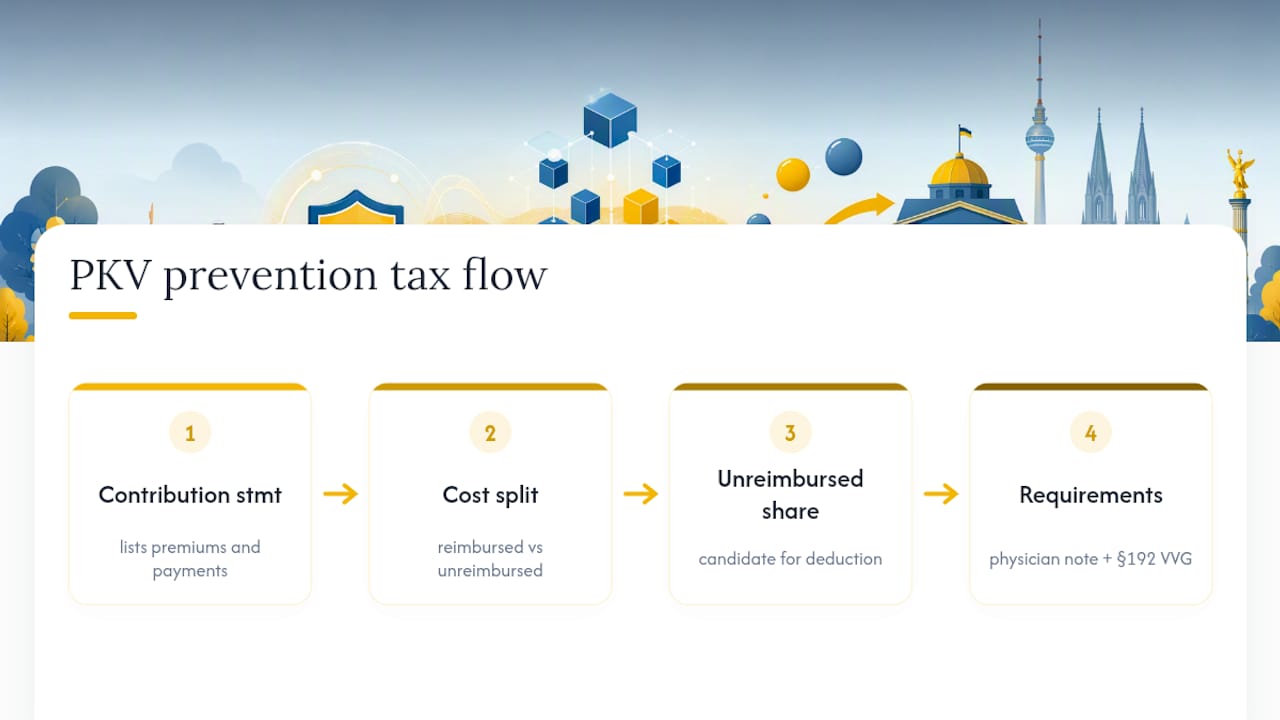
Where PKV does interact cleanly with tax filing is through your annual contribution statement (Beitragsrechnung), which your insurer issues each year and which itemizes what you paid in premiums, distinct from what you spent out of pocket on uncovered preventive extras. Keep those two figures separate in your own records. If your insurer reimbursed part of a prevention service and you paid the remainder yourself, only the unreimbursed portion is even a candidate for tax deduction, and only with proper physician documentation behind it.
This is genuinely one area where a tax advisor familiar with PKV specifics earns their fee, since the interaction between insurance reimbursement and deductible medical expense rules shifts depending on your income bracket and filing situation.
Why Prevention Support Extends Beyond Your Contract
PKV insurers fund public prevention campaigns and pilot programs alongside groups like the BZgA, and that industry-level engagement is real. It does not, however, rewrite your individual contract. A company-wide wellness pilot or a public awareness campaign can expand what's available in the market generally, but your reimbursement still runs strictly through your own tariff's clauses. Data-privacy and regulatory limits also constrain how far insurers can push personalized prevention offers. The practical lesson: broader industry initiatives are worth watching, but they change your options at renewal time, not your coverage today.
— Marco
How an independent broker can help you verify prevention coverage
Reading tariff clauses against your own medical situation is exactly the kind of task that eats an evening and still leaves you unsure. Independent brokers exist as alternatives to guessing your way through a German-language policy document: they compare tariffs across private and public insurers and explain, in plain English, what your specific plan actually reimburses before you book a preventive service.

If you're not yet sure whether private coverage even makes sense for your situation, start with a free eligibility check to see where you stand. Already insured and want a tariff review before your next check-up or dental cleaning? Our concierge service handles document review and pre-authorization requests directly, so you're not the one decoding "auf Nachweis" clauses alone. Either way, the next step is simple: reach out through Myhealthcarebroker and get a straight answer about what your plan covers before, not after, you pay for anything.
Sources
If you're contesting a denial or just want to double-check a tariff clause yourself, these are the primary sources to go back to rather than relying on insurer marketing copy.
Keep these bookmarked. When an insurer's phone rep gives you a vague answer, these pages give you the actual standard to point back to.
This article is general information, not a substitute for advice from a qualified financial advisor. Consult a qualified financial professional about your own circumstances before acting on anything here.
FAQ
What are the three types of prevention?
Public health frameworks generally distinguish primary prevention (avoiding disease before it starts, like vaccinations), secondary prevention (early detection through screening, like G-BA-defined cancer checks), and tertiary prevention (limiting complications in an existing condition). PKV tariffs mostly engage with primary and secondary prevention; tertiary prevention overlaps more with standard treatment coverage.
Which prevention measures does health insurance pay for?
Statutory ambulatory preventive exams are reimbursable under § 192 VVG, which covers things like the general health check-up and organized cancer screenings. Beyond that legal floor, coverage for vaccinations, dental prophylaxis, and prevention courses depends entirely on your specific PKV tariff's Leistungsbeschreibung.
What does "Präventionsleistung" actually mean?
A Präventionsleistung is a preventive health service aimed at detecting disease early or avoiding it altogether, rather than treating an existing condition. In the PKV context, it specifically refers to the services named in your tariff's benefit description, anchored by the statutory minimum set out in § 192 VVG.
What counts as a pre-existing condition (Vorerkrankung) in PKV?
A routine preventive check-up itself is not treated as a pre-existing condition for underwriting purposes. However, if that screening leads to a diagnosis, the diagnosis and any resulting treatment can become relevant for future tariff applications, which is why keeping screening and follow-up documentation separate matters. If you're unsure how a past finding might affect a new application, an anonymous pre-check is worth doing before you disclose anything formally.
Does My Healthcare Broker charge for reviewing my PKV tariff?
Myhealthcarebroker's comparison and eligibility check services carry no published fee for the client, since the brokerage is paid a regulated commission by the insurer when a policy is arranged. Current details on the concierge service are available directly on Myhealthcarebroker.