
An Optionstarif lets you lock in your current health status now, so that later you can switch into a full private health insurance tariff without a new health exam. It works alongside Germany's statutory Basistarif safety net, but it goes further: it protects your right to genuine private coverage, not just an emergency fallback.
TL;DR:
- Buying an Optionstarif is most beneficial when you expect to become eligible for full private insurance within a few years, such as through civil service or self-employment.
- The option locks in your current health status without a new health exam, but offers little coverage during the option phase itself, making it a risk hedge rather than actual insurance.
- Premiums are usually low, starting around €4 to €6 per month for young applicants, with the right to switch typically ending around age 49 or 50.
- The value depends heavily on which full tariffs the option permits; some contracts restrict you to mediocre plans, so reading the fine print is essential.
- Missed deadlines or aging out of the window invalidate the right, so setting reminders for trigger events is crucial to exercise the option successfully.
Table of Contents
- PKV Optionstarif Explained: The Basics
- Benefits and Limits You Need to Weigh
- Who Actually Benefits From an Optionstarif?
- Optionstarif vs. Anwartschaft vs. Basistarif: Don't Confuse Them
- How to Buy and Exercise an Optionstarif, Step by Step
- Costs, Duration, and the Clauses That Actually Matter
- Where German Law Fits Into the Picture
- An Independent Broker's Honest Read on Optionstarife
- How Myhealthcarebroker Helps You Compare Optionstarif Terms
- Sources
- FAQ
PKV Optionstarif Explained: The Basics
An Optionstarif is a contractual right, not a policy that pays claims. You answer health questions once, at signup, and the insurer freezes that health snapshot for the life of the contract. There is usually little to no actual coverage during the option phase itself, which is the trade you're making: you give up meaningful benefits now in exchange for guaranteed, unconditional access to a full PKV tariff later.
The contract spells out three things that matter enormously: how long the option runs, how old you can be when you use it, and which specific full tariffs you're allowed to switch into. Some insurers restrict you to a narrow set of target tariffs; others give broader choice. According to Studysmarter's guide to the Optionstarif, the insurer cannot apply a new health check or exclusions based on anything that changed since you signed up. That single feature is the entire point of buying one.
In practice, you're paying a small monthly fee today to buy insurance against your own future health.
Benefits and Limits You Need to Weigh
The upside is straightforward: you preserve today's acceptance terms, permanently, for a fraction of what full PKV coverage costs. If you develop a chronic condition, an autoimmune disorder, or anything else that would trigger a rejection or a hefty risk surcharge later, none of that matters once the option is locked in.
The limits are just as real:
- Minimal or no cover during the option phase itself, so it isn't a substitute for actual health insurance.
- Insurers vary widely on which full tariffs you're permitted to switch into, so cheap options aren't automatically good ones.
- Option windows and age caps are finite. Miss the deadline or age out, and the right disappears.
The core trade-off comes down to timing. Buying while you're young and healthy is close to free insurance against your own uncertain medical future. Buying later, closer to any age cap, gets less valuable fast, since you're paying for a shrinking window.
Who Actually Benefits From an Optionstarif?
This product isn't for everyone, and honest advice starts there. It makes sense for people whose future is likely to include private insurance eligibility, but who don't have it yet.
- Students, especially in medicine, law, or teaching tracks that lead toward civil service.
- Prospective Beamt:innen (civil servants), since beamtification is one of the clearest triggers for exercising the option.
- People planning to become self-employed, since freelance status opens the door to PKV.
- Employees who expect to cross the Versicherungspflichtgrenze (the compulsory insurance threshold) within a reasonable time frame, referenced by industry sources for 2026 eligibility thresholds.
If you're certain you'll stay in the GKV for the foreseeable future, and none of those triggers apply to you, an option probably isn't worth the premium. It is a bet on a future you actually expect to happen, not a general-purpose safety net.
Optionstarif vs. Anwartschaft vs. Basistarif: Don't Confuse Them
These three terms get mixed up constantly, and the confusion costs people money. An Anwartschaft (small or large) is a waiting-period product: it either preserves your age-related reserves (small) or keeps you at your current contribution level (large) while you're temporarily outside PKV. It doesn't secure switch rights into a new tariff. It maintains what you already have.
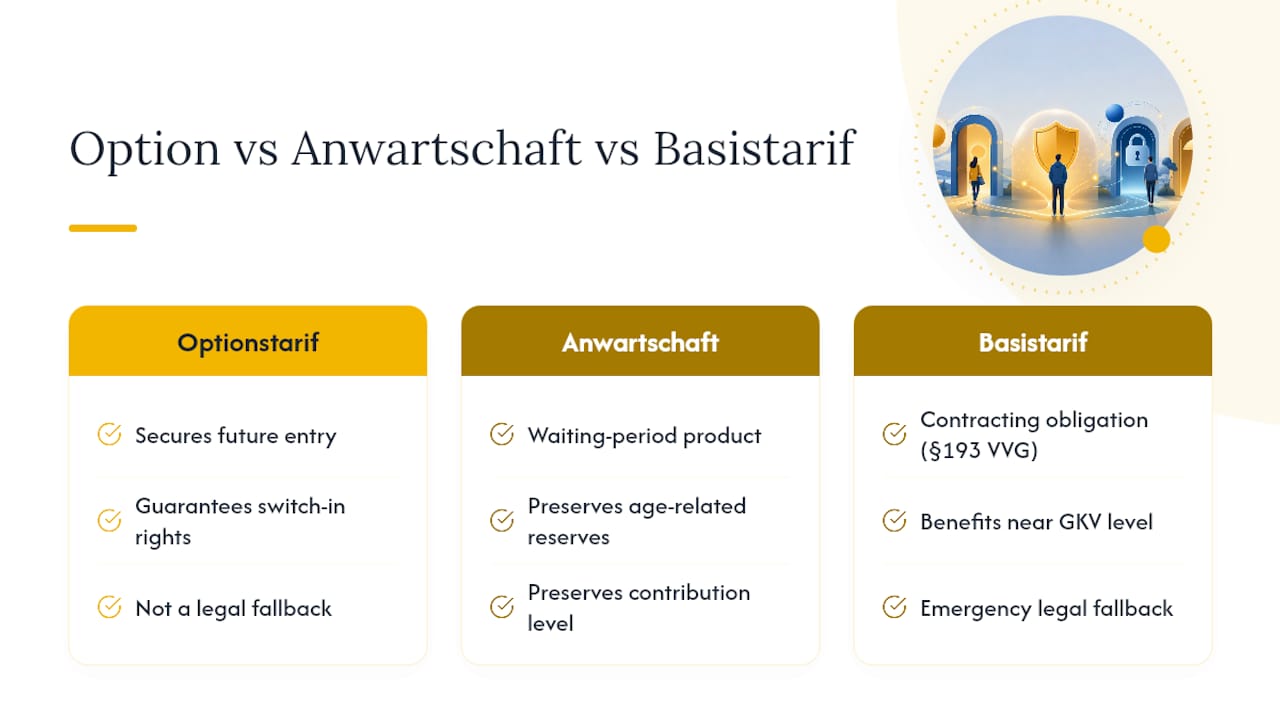
An Optionstarif does something different: it secures your future entry into a tariff you don't yet hold.
The Basistarif sits in a separate category entirely. Under §193 Abs. 5 VVG, German law imposes a Kontrahierungszwang, a contracting obligation, forcing PKV insurers to accept eligible applicants into the Basistarif regardless of health status. But Basistarif benefits sit near GKV levels, with GKV-comparable contribution rules. It serves as an emergency fallback, not equivalent to full private coverage. The simplest way to remember it: option secures full PKV access, Anwartschaft preserves existing terms, Basistarif is the legal floor beneath everyone.
How to Buy and Exercise an Optionstarif, Step by Step
Getting from "I bought an option" to "I'm now in full PKV" follows a fairly consistent sequence across insurers.
- Complete the one-time health declaration. Answer every question accurately. This declaration is what gets frozen, and any dishonesty here can void the entire option later.
- Pay the option premium and keep your paperwork. Save the original contract, the declaration, and any renewal correspondence somewhere you can find it years later.
- Watch for your trigger event. Common triggers include losing GKV eligibility, being appointed as a civil servant, or starting self-employment.
- Notify the insurer within the deadline. Exercise windows commonly run 2 to 6 months after the qualifying event, per guidance from Wissen-PKV. Miss it, and the option usually lapses.
- Complete the switch. The insurer checks that you're within the contract's age and term limits, but it typically does not reopen your health history from signup onward.
Pro Tip: Set a calendar reminder for every deadline the moment your life circumstance changes, before you even contact the insurer. Option lapses almost always come down to missed paperwork windows, not rejected applications.
For the administrative side of an actual GKV-to-PKV move, our guide on switching from public to private insurance walks through the timing requirements in more depth.
Costs, Duration, and the Clauses That Actually Matter
Option premiums run cheap by design. Insurer explainers like Allianz's OptionFlexiMed show entry premiums starting around €4 to €6 monthly for young applicants, though your actual quote depends on age and insurer, so treat these as illustrative rather than a promise.
Contracts commonly run for multiple years, sometimes in decade-long blocks that can be extended, with usage typically capped near middle age. After that, the right to exercise simply ends.
The clause worth scrutinizing hardest is which target tariffs the option actually permits. Two options priced identically can lead to very different futures: one might open the door to a strong full tariff, another to something mediocre. Wissen-PKV's comparison of optionstarife makes clear that contract terms vary enough between providers that reading the fine print before signing matters more than the sticker price.
Where German Law Fits Into the Picture
The Kontrahierungszwang under §193 Abs. 5 VVG exists to guarantee that nobody in Germany is left completely uninsurable. It requires PKV insurers to accept qualifying applicants into the Basistarif no matter their health history, and that's a genuinely important legal backstop.
But it isn't a substitute for what an Optionstarif does. The Basistarif caps benefits near GKV levels and ties contributions to income in a way full PKV tariffs don't. If your goal is real private coverage, comprehensive dental, private rooms, shorter waits, faster specialist access, the statutory safety net won't get you there. An option is what preserves your ability to reach that level of coverage later, on today's terms, regardless of what happens to your health between now and then.
An Independent Broker's Honest Read on Optionstarife
Most explainers treat the Optionstarif as a binary: buy one, or don't. That framing misses the real question, which is whether your specific timeline justifies the premium you'd pay to hold it open.
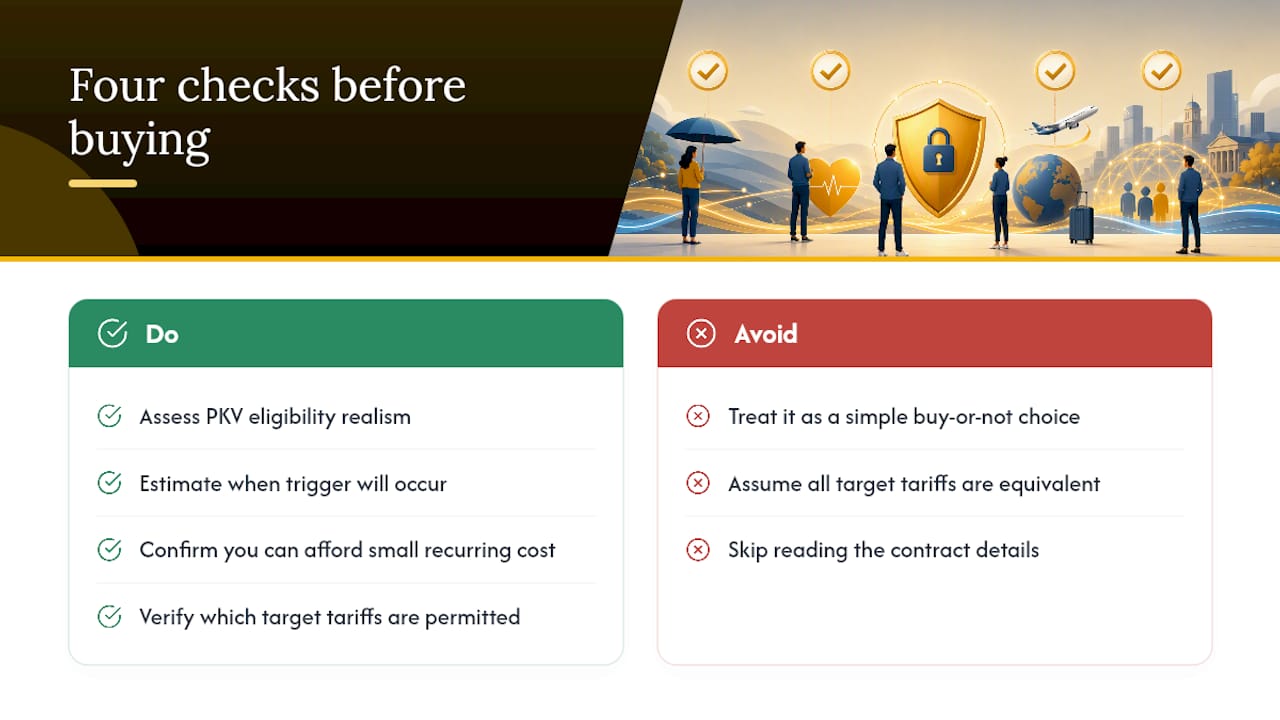
Run through four checks before deciding. First, is your path toward PKV eligibility realistic, or aspirational? Second, roughly when do you expect that trigger event, next year or in five? Third, can you comfortably absorb a small recurring cost for a benefit you might not use for a decade? Fourth, have you actually read which target tariffs the contract permits, or are you assuming they're all equivalent?
That last point trips up more people than health status ever does. An option that only unlocks a mediocre tariff isn't worth much regardless of how cheap it was. If you want a second opinion on your specific numbers, running an eligibility check through our calculator takes a few minutes and gives you something concrete to work from instead of a guess.
— Marco
How Myhealthcarebroker Helps You Compare Optionstarif Terms
Reading ten insurers' option clauses side by side, in German legal language, is exactly the kind of task that eats an evening and still leaves you unsure which tariff you actually locked in. There are services that offer independent comparison across major private insurers, explained in plain English, with no commission bias toward any single company.
We check your actual eligibility timeline, walk through which target tariffs each insurer's option permits, and flag the contract clauses that matter before you sign anything. Some brokerage services are free to clients, as they are paid a fixed, regulated commission by the insurer only if clients go ahead with a policy. If you're an internationally employed professional in Germany weighing an option now against full PKV later, start with our private health insurance advisory page and book a conversation, or run your numbers first through the insurance calculator to see where you stand.
This article is general information, not a substitute for advice from a qualified financial advisor. Consult a qualified financial professional about your own circumstances before acting on anything here.
Sources
FAQ
What Is an Optionstarif in Private Health Insurance?
It's a contractual right that freezes your current health status so you can switch into a full PKV tariff later without a new health check, as explained by Studysmarter.
Is an Optionstarif Worth Buying?
It's usually worth it if you realistically expect to become PKV-eligible later, such as through civil service, self-employment, or crossing the income threshold; it's less useful if you're certain to stay in the GKV long term.
Standardtarif or Basistarif, Which Is Better in PKV?
The Basistarif is the current legal standard and is generally preferable to the older Standardtarif, since it's backed by the Kontrahierungszwang under §193 Abs. 5 VVG, though both offer coverage closer to GKV levels than a full PKV tariff.
What's the Difference Between an Anwartschaft and an Optionstarif?
An Anwartschaft preserves the terms or age reserves of insurance you already hold during a temporary gap, while an Optionstarif secures your right to enter a full tariff you don't yet have, without a future health check.
How Long Does an Optionstarif Usually Last?
Contracts commonly run in 10-year blocks, sometimes extendable once, with exercise typically capped around age 49 or 50, though exact terms vary by insurer.