Yes, an Anwartschaftsversicherung lets you pause your private health insurance and return to your original tariff later without a new health check. It does not provide active medical coverage while it runs, so you need insurance elsewhere during that time. You choose between two variants, small or large, and you typically have about two months to reactivate once your reason for pausing ends.
TL;DR:
- Small Anwartschafts costs 3% to 10% of your regular premium and only preserves your health status, suitable for short, predictable pauses.
- Large Anwartschaft costs 20% to 46% and also preserves your entry age and accumulated reserves, ideal for longer or indefinite breaks.
- Reactivation deadlines are typically about two months after your pause ends, requiring prompt documentation like proof of GKV membership or employer confirmation.
- An Anwartschaft is generally worthwhile only if your return to PKV is certain and the projected savings outweigh its premiums, especially for long or uncertain breaks.
- Reading insurer-specific clauses on reactivation and timing is crucial, as wording differences can significantly impact your reactivation rights.
Table of Contents
- What Is an Anwartschaftsversicherung PKV and How Does It Work?
- Who Actually Needs an Anwartschaft?
- Small vs Large Anwartschaft: Which One Fits Your Situation?
- How Do You Calculate Whether an Anwartschaft Pays Off?
- Reactivating Your PKV: Deadlines and Required Documents
- When an Anwartschaft Isn't Worth Buying
- How Myhealthcarebroker Advises Clients on This Decision
- Why the Standard Advice on Anwartschaft Misses the Point
- Get Your Anwartschaft Decision Reviewed Before You Commit
- Sources
- FAQ
What Is an Anwartschaftsversicherung PKV and How Does It Work?
An Anwartschaftsversicherung is not a form of health coverage. It is a contractual placeholder that keeps your seat reserved at your original insurer while you are covered somewhere else, whether by statutory health insurance (GKV), foreign coverage, or free Heilfürsorge. Your PKV contract switches into a "ruhend," or dormant, state. Benefits stop, premiums drop sharply, and your right to return without underwriting stays intact, according to consumer guidance from Finanztip.
What gets preserved depends entirely on which variant you buy:
- Small (kleine) Anwartschaft: locks in your current health status only, so no new health questions apply on return, but your entry age resets and your accumulated Altersrückstellungen are not preserved.
- Large (große) Anwartschaft: locks in health status, original entry age, and your existing Altersrückstellungen, according to Signal Iduna.
Contract wording differs by insurer. Some define the dormancy period, reactivation process, and documentation requirements quite differently, so read your policy's specific clauses rather than relying on general descriptions.
Who Actually Needs an Anwartschaft?
Four situations come up again and again in practice:
- Students graduating into GKV. You expect your income to rise past the threshold for private eligibility later, and you want your original PKV tariff waiting when it does.
- Temporary relocation abroad. You plan to return to Germany and want to avoid re-underwriting after a stint working in another country.
- Short-term unemployment or contract gaps. A gap between jobs can legally push you into GKV under SGB V §5, even if you intend to return to private cover quickly.
- Beamte, police, and soldiers on free Heilfürsorge. You currently pay nothing for care but expect to need PKV later, whether after leaving service or during a career change.
Each scenario shares one trait: a temporary interruption with a clear, expected return to private coverage.
Small vs Large Anwartschaft: Which One Fits Your Situation?
The two variants solve different problems, and the cost gap between them is notable enough that picking the wrong one wastes money over time.
- Small Anwartschaft protects your health status only. It typically costs 3% to 10% of your regular PKV premium, according to Allianz. It fits short, predictable pauses where you're not worried about losing years of accumulated reserves.
- Large Anwartschaft protects health status, entry age, and Altersrückstellungen together. It commonly runs 20% to 46% of the regular premium, per Signal Iduna. It suits long or open-ended pauses, and it is often the right call for Heilfürsorge beneficiaries who won't touch PKV again for years.
Illustrative example: on a €450 monthly base premium, a small Anwartschaft might cost roughly a few tens of euros per month, while a large Anwartschaft could be significantly more expensive. These are illustrative ranges built from the published percentage bands, not quotes from any specific insurer, so treat them as a starting point for your own comparison rather than a guaranteed price.
Independent advisers note that duration is usually the deciding factor: short, predictable gaps favor small, while long or indefinite gaps favor large, particularly when Altersrückstellungen have already built up over several years.
How Do You Calculate Whether an Anwartschaft Pays Off?
Several variables move the math in different directions:
- Your current tariff level and how rich the benefits are.
- Your age at the point of conversion (younger buyers lose less by resetting entry age under a small Anwartschaft).
- Insurer-specific rules on how Altersrückstellungen carry over.
- Whether you keep or forfeit those reserves under the variant you choose.
A practical way to run the numbers: estimate your current premium, then estimate what you'd likely pay if you re-entered PKV fresh at a later age with no reserves. Multiply that gap by your expected pause length in years, and compare the total against what you'd spend on Anwartschaft premiums over the same period. If the projected premium gap over time exceeds your total Anwartschaft outlay, the policy is probably worth it.
Tools like the private health insurance calculator can help you model this with your actual tariff numbers. For background on how Altersrückstellungen compound, see how aging provisions affect PKV premiums over a longer horizon.
Reactivating Your PKV: Deadlines and Required Documents
Missing your reactivation window is the single most common way people lose the benefit of an Anwartschaft entirely.
- Confirm the deadline. Most insurers require you to apply for reactivation within about two months of the pause ending, according to Allianz. Miss it, and you may face a fresh health check.
- Gather your documents. Insurers typically want proof of your GKV membership dates, foreign insurance certificates if you were abroad, or an employer letter confirming your return to eligible employment.
- Submit and confirm in writing. Ask your insurer to confirm receipt and the exact date your PKV coverage resumes.
Pro Tip: Request written confirmation of your exact reactivation deadline the day you buy the Anwartschaft. Insurer wording on "when the pause ends" varies more than you'd expect, and a written date avoids disputes later.
Mark the deadline in your calendar the moment your pause begins, not when it's about to end.
When an Anwartschaft Isn't Worth Buying
An Anwartschaft is not automatically the right move just because you're leaving PKV temporarily. It falls short in a few common situations:
- You're not sure you'll return to PKV at all, or you might want to switch insurers anyway.
- Your pause is so short that the premium you'd pay exceeds any realistic savings from avoiding a health check.
- You'd rather negotiate different terms with a new insurer later, accepting some health risk in exchange for flexibility.
If any of those apply, staying in GKV without an Anwartschaft, or negotiating a limited private continuation directly with your insurer, can be the more sensible route. Before signing anything, watch for contract red flags: policies with no retroactive recognition of your pause, unusually long notice periods to cancel the Anwartschaft, or minimum-term clauses that lock you in longer than you expected. Consumer pages from HUK consistently flag the lack of active coverage as the detail people overlook until they actually need care.
How Myhealthcarebroker Advises Clients on This Decision
Advisers typically weigh four factors: how long the pause will realistically last, your career trajectory and expected earnings, the quality of your current tariff, and whether you're happy staying with the same insurer. The three questions worth asking before committing: How long am I actually pausing? What happens to my Altersrückstellungen if I don't preserve them? And am I certain I want this insurer again? A contract review can answer all three before you sign anything.
Why the Standard Advice on Anwartschaft Misses the Point
Most guides treat this as a binary: small or large, done. That framing skips the variable that actually decides the outcome, which is how confident you are about your return date. An Anwartschaft is a bet on your own future certainty, not just a product feature comparison.
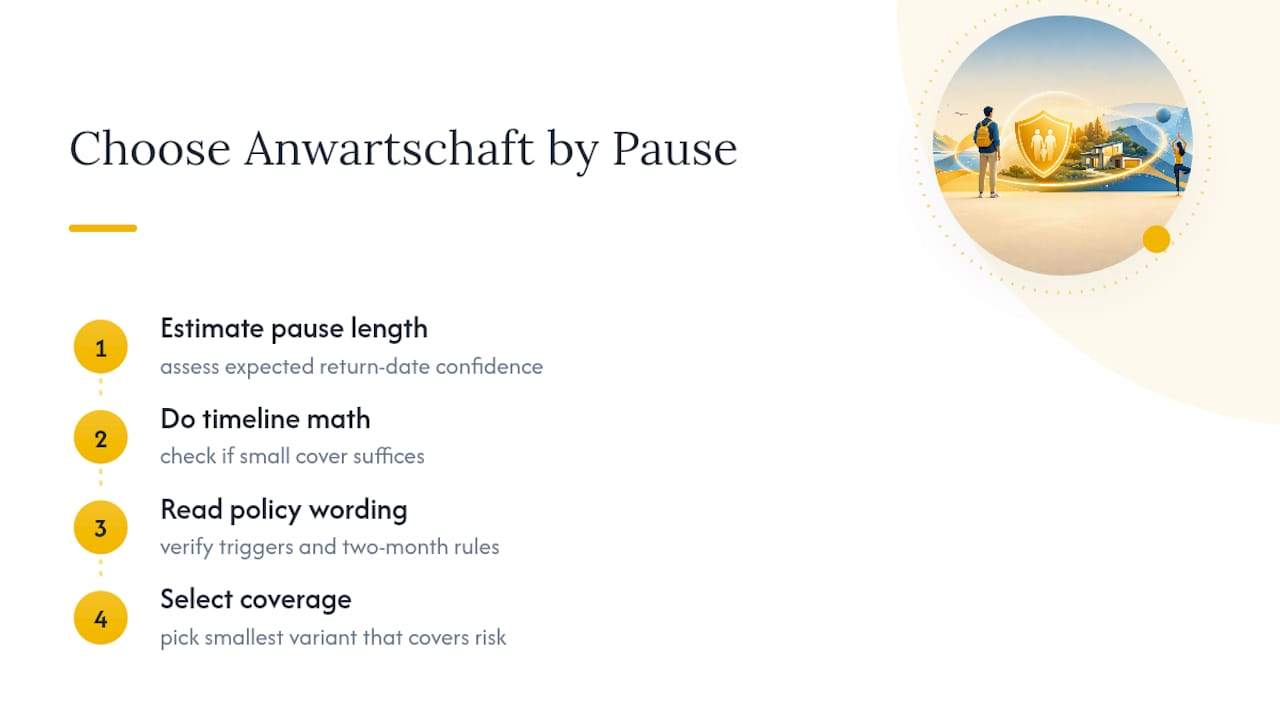
The conventional advice also underplays how much insurer-specific wording matters. Two policies both labeled "große Anwartschaft" can differ in what counts as a valid reactivation trigger or how strictly the two-month window gets enforced. Reading the actual clause matters more than reading a summary table.
If there's one priority for readers, it's this: get your expected pause length honest before you compare percentages. A rough guess dressed up as certainty leads people into the large variant when a small one would have covered the same risk for a third of the cost. Do the timeline math first. Everything else, small versus large, cost bands, deadlines, follows from that one estimate.
— Marco
Get Your Anwartschaft Decision Reviewed Before You Commit
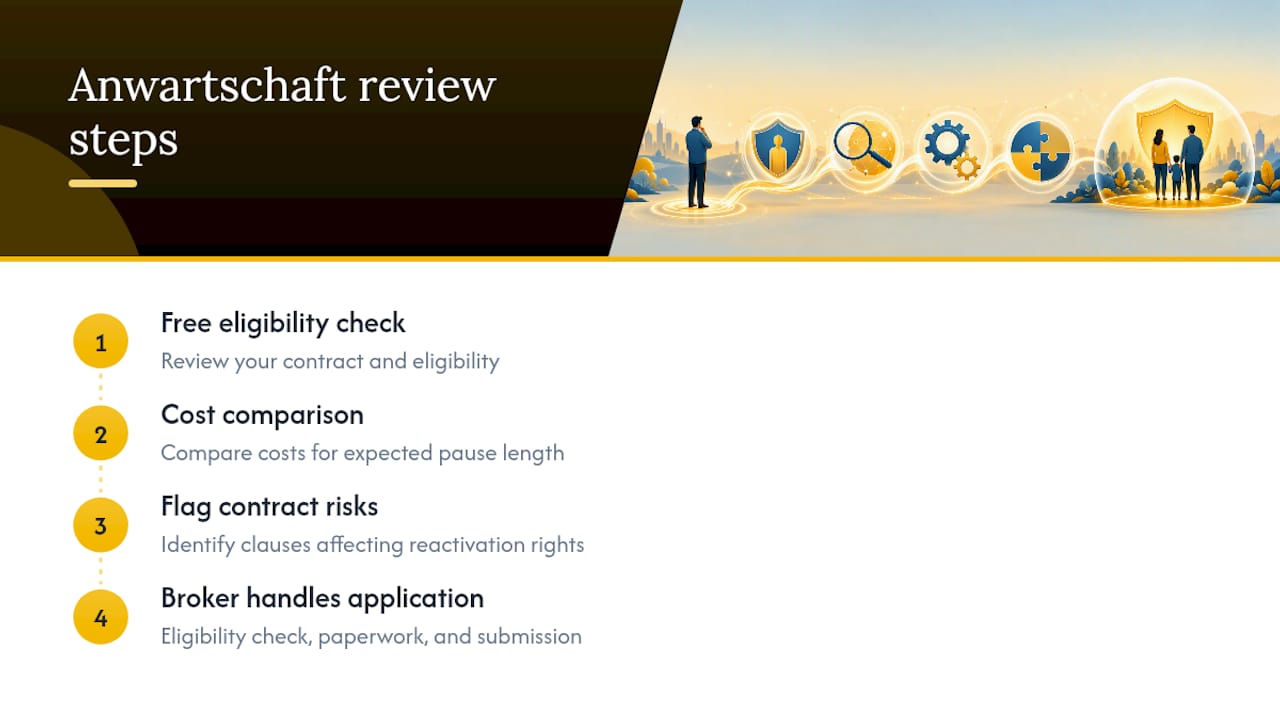
Choosing between a small and large Anwartschaft, or deciding whether you need one at all, comes down to numbers specific to your tariff and timeline, not generic percentage ranges. Myhealthcarebroker reviews your existing PKV contract, runs the cost comparison against your expected pause length, and flags any contract clauses that could cost you your reactivation rights.

Because recommendations from independent brokers work across major German insurers, advice you receive isn't tied to steering you toward one company's product. That matters here specifically, since insurer wording on reactivation deadlines and Altersrückstellungen varies enough to change the right answer for your situation. An independent broker can handle the eligibility check, the paperwork, and the application itself, so you are not translating contract clauses under time pressure while a deadline runs out.
If you're weighing an Anwartschaft against staying in your current setup, start with a free eligibility check and tariff review and get a straight answer based on your actual contract.
This article is general information, not a substitute for advice from a qualified financial advisor. Consult a qualified financial professional about your own circumstances before acting on anything here.
Sources
- Anwartschaftsversicherung PKV: Kleine und große Anwartschaft
- Anwartschaftsversicherung: Alles zur Anwartschaft | Allianz
- Anwartschaftsversicherung: Frühzeitig planen – später profitieren
FAQ
What Is an Anwartschaftsversicherung in Private Health Insurance?
It's a contract that suspends your active PKV coverage while preserving your right to return to the same tariff later without a new health check.
How Long Does an Anwartschaftsversicherung Last in Germany?
There's no fixed maximum duration; it runs as long as you keep paying and typically requires reactivation within about two months after your reason for pausing ends, per Allianz.
Is an Anwartschaftsversicherung Worth Buying?
It's worth it when you're confident you'll return to PKV and the projected savings from avoiding a future health check or reset entry age outweigh the premiums you'll pay during the pause; if your return is uncertain, it often isn't.
Does an Anwartschaft Provide Any Health Coverage?
No. It only reserves your right to return to your original tariff; you must arrange separate coverage, such as GKV or foreign insurance, while it's active.