"PKV option bei Firmenbenefits" usually points to one of two things: an employer subsidy toward a full private health insurance policy, capped under §257 SGB V, or a separate employer-funded bKV supplemental plan. Civil servants need to add a third variable, Beihilfe, into the timing. Your first move is simple: ask HR which model they actually offer, then check whether your salary clears the 2026 eligibility threshold before you sign anything.
TL;DR:
- The statutory employer subsidy for PKV is capped at half of the hypothetical public insurance contribution based on the BBG, not on actual salary, restricting subsidy growth beyond that limit.
- The 2026 thresholds are €77,400 for JAEG, which determines PKV eligibility, and €69,750 for BBG, controlling the maximum employer subsidy calculation.
- A bKV offers supplemental coverage such as dental or hospital upgrades, but it never replaces full PKV or GKV, nor does it affect insurance eligibility.
- Employers typically fund PKV subsidies via a fixed line labeled "AG-Zuschuss PKV," and proper documentation of PKV premiums and Pflegepflichtversicherung is essential for correct subsidy calculation.
- High earners exceeding the BBG may see their subsidy plateau, making private coverage more costly over time, and civil servants can benefit from Beihilfe, reducing private insurance costs.
Table of Contents
- What "PKV option bei Firmenbenefits" actually covers
- Who qualifies: JAEG and the contribution ceiling for 2026
- How the §257 SGB V employer subsidy is calculated and capped
- bKV as a Firmenbenefit: what it offers and what it doesn't
- Your step-by-step checklist for evaluating the offer
- Three scenarios: how the subsidy plays out in real numbers
- Documents and payroll setup: what HR needs to get right
- What Marco sees go wrong most often
- Why the standard advice on this topic misses the point
- Get a Clear Answer From an Independent Broker, Not Your HR Department
- Where to verify these figures yourself
- Sources
- FAQ
What "PKV option bei Firmenbenefits" actually covers
The phrase gets used loosely, and that looseness costs employees money. When a company lists a "PKV option" as a Firmenbenefit, it almost always means one of two distinct legal arrangements, and confusing them leads to bad decisions.
The first is a statutory employer subsidy toward a full private health insurance contract. This isn't a perk your employer invented. It's a legal obligation under § 257 SGB V, which requires employers to contribute toward an employee's private premium once that employee is eligible for and enrolled in PKV. The subsidy replaces what the employer would otherwise pay into public health insurance.
The second is a betriebliche Krankenversicherung, or bKV. This is a voluntary supplemental group policy the employer buys on top of your existing insurance, public or private. A bKV does not replace full PKV, and it doesn't touch your GKV or PKV eligibility status at all. It typically covers extras like dental treatment, a single hospital room, or specialist access that your base plan skips.
Reading your employer's own materials usually settles the confusion fast:
- Payroll language mentioning "AG-Zuschuss" or "Arbeitgeberzuschuss PKV" signals the statutory subsidy model.
- References to a "Gruppenvertrag," "Bausteinmodell," or a flat monthly benefit amount point to a bKV.
- If HR asks for proof of your existing PKV insurer and premium, that's the subsidy model in motion.
- If HR hands you a benefits catalog with modules to pick from (dental, vision, alternative medicine), that's a bKV.
The distinction matters because a bKV and a full PKV subsidy solve completely different problems — one supplements coverage you already have, the other helps fund a switch away from public insurance entirely. Mixing them up in a benefits conversation with HR wastes everyone's time.
Who qualifies: JAEG and the contribution ceiling for 2026
Two separate thresholds govern this decision, and mixing them up is the single most common mistake expats and even long-term residents make.
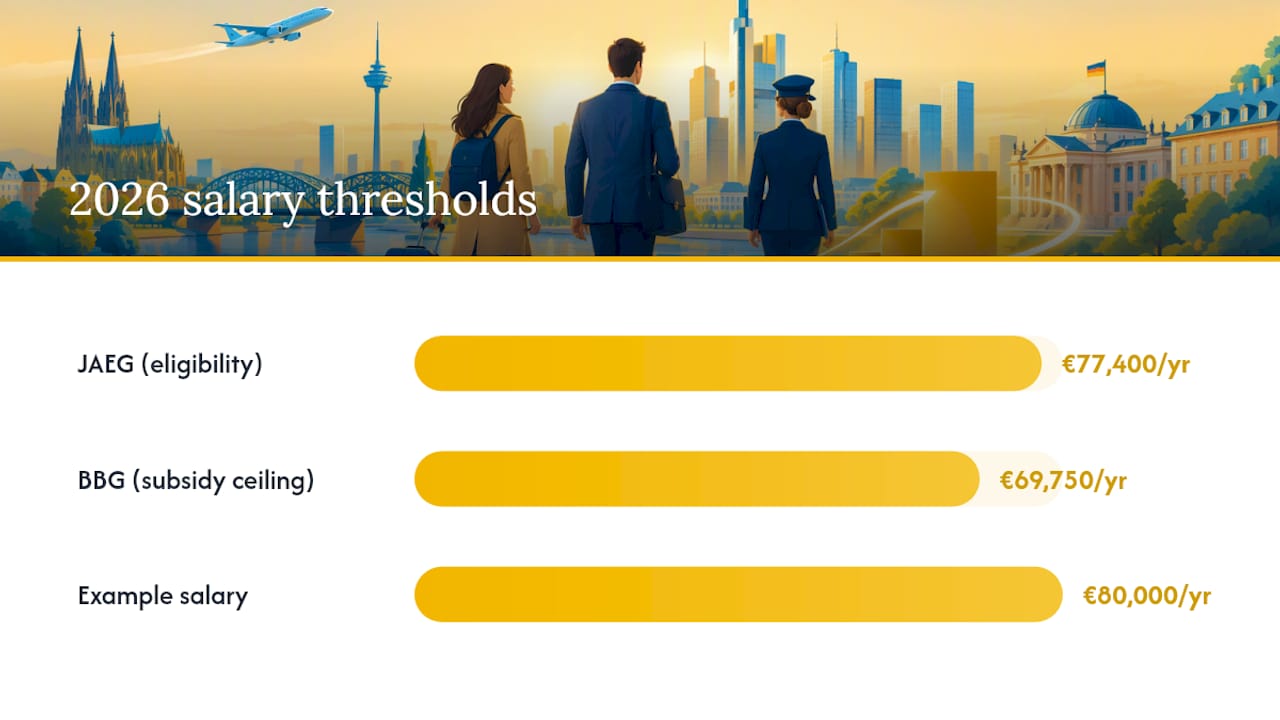
The Jahresarbeitsentgeltgrenze (JAEG) determines whether you're even allowed to leave public insurance voluntarily. For 2026, that figure sits at €77,400 per year. Cross it, and you gain the right to opt for private health insurance instead of GKV.
The Beitragsbemessungsgrenze (BBG) is a completely different number with a completely different job. It caps the salary base used to calculate the employer's subsidy contribution. For 2026, the BBG for health insurance is €69,750 per year, or €5,812.50 per month.
2026 thresholds at a glance: JAEG (eligibility to enter PKV) = €77,400/year. BBG (subsidy calculation ceiling) = €69,750/year (€5,812.50/month). These are two different numbers doing two different jobs.
Here's why that gap matters in practice. Say you earn €80,000 a year. You clear the JAEG easily, so you're free to sign a PKV contract. But your employer's subsidy calculation still uses the BBG figure as its ceiling, not your actual €80,000 salary. Earning more than the BBG doesn't shrink your subsidy below what someone at exactly the BBG would get. It just means your subsidy stops growing once your reference salary hits that ceiling, while your actual PKV premium keeps climbing with age, coverage level, and health factors.
- JAEG answers: "Am I allowed to choose PKV at all?"
- BBG answers: "How much can my employer's subsidy be worth, at most?"
Confusing the two leads people to assume a high salary automatically means a high subsidy. It doesn't. For a closer look at how these figures interact with your own paycheck, our guide on private health insurance salary thresholds breaks down the math in more detail.
How the §257 SGB V employer subsidy is calculated and capped
The subsidy formula sounds bureaucratic until you see it applied to real numbers, at which point it becomes fairly mechanical.
Your employer calculates what they would have paid if you were still in public insurance: half the general contribution rate plus half the average Zusatzbeitrag, applied against your salary up to the BBG. That hypothetical GKV employer share becomes the basis for your PKV subsidy, subject to one more limit: the subsidy can never exceed half of your actual PKV premium, whichever number is smaller wins.
- Employer calculates the hypothetical GKV contribution using your salary capped at the 2026 BBG of €69,750/year.
- Employer takes half of that hypothetical contribution as the maximum possible subsidy.
- Employer compares that figure against half of your real PKV premium.
- Whichever number is lower becomes your actual monthly subsidy.
- You pay the remainder of your PKV premium out of pocket.
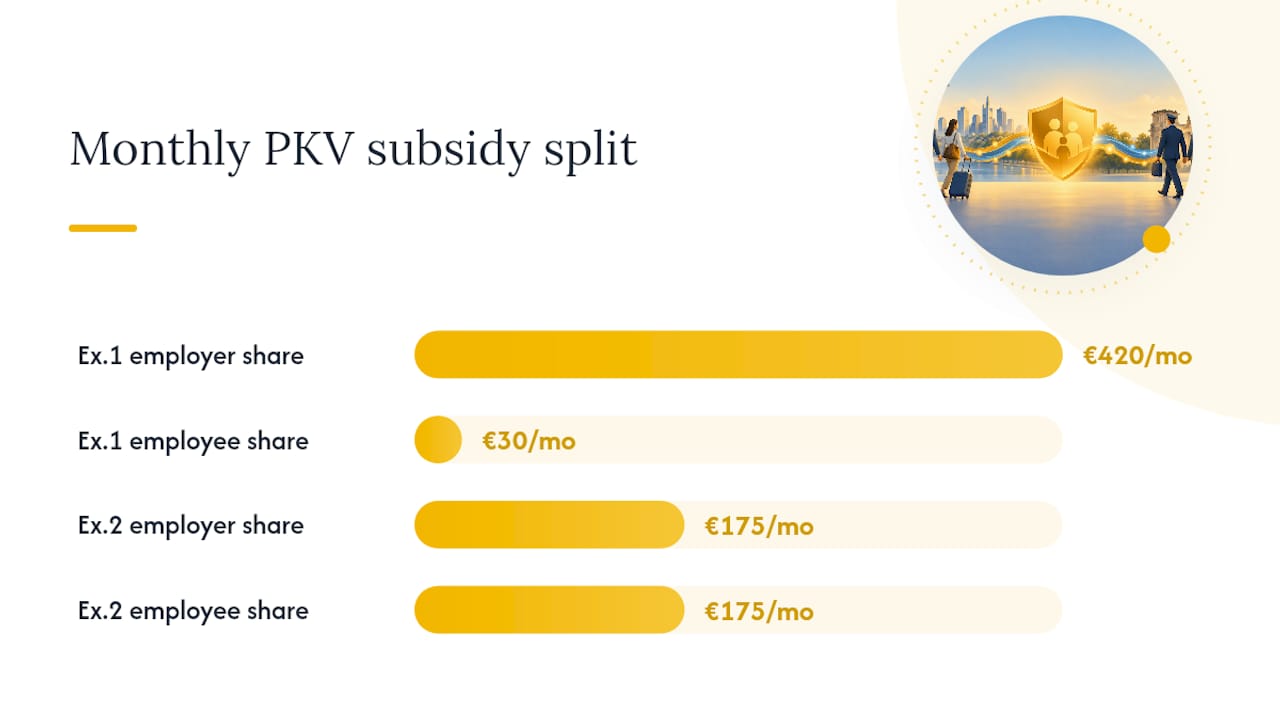
If your PKV premium is €450/month and the calculated GKV-based cap comes out to €420/month, your employer pays €420. If your premium is €350/month and the cap is €420, your employer pays only €175, because the rule caps the subsidy at half your real premium, not half the theoretical ceiling.
There's a second, separate subsidy that people frequently forget: private Pflegepflichtversicherung, the mandatory long-term care component of your PKV contract. Employers must subsidize that too, calculated on similar logic but tracked as its own line. You'll need to submit proof of your PV contribution separately from your health premium proof.
On the payroll side, this typically shows up as a distinct entry labeled something like "AG-Zuschuss PKV" rather than the percentage-based GKV deduction lines a publicly insured colleague would see. If your payslip shows no health insurance deduction at all after switching to PKV, that's not an error. It just means the accounting logic has moved from a percentage deduction to a fixed subsidy credit.
bKV as a Firmenbenefit: what it offers and what it doesn't
A bKV works on entirely different tax logic than the statutory subsidy, and that difference is exactly what makes it attractive to employers.
Companies typically structure bKV contributions using one of three models. A group contract enrolls all employees (or a defined group) under one negotiated policy, usually without individual health questionnaires. A budget model gives each employee a fixed euro amount to spend across a menu of optional coverage modules. A Baustein model lets employees pick specific building blocks, dental, vision, alternative therapies, hospital upgrades, and combine them into a personal package.
- Group underwriting means employees with pre-existing conditions often get coverage they couldn't get individually.
- Contributions structured as a Sachbezug (benefit in kind) stay tax and social-security free up to €50 per month, provided the employer applies the rule correctly.
- Employer contributions are generally deductible as a business expense.
- Entry-level module costs in many employer programs run well under €50 a month, based on typical industry group pricing.
Pro Tip: Don't assume a bKV benefit means your employer is subsidizing your full health insurance. Ask directly: "Is this a supplement to my existing insurance, or does it help fund switching to PKV?" The answer changes your entire financial calculation.
The limits matter as much as the advantages. A bKV never substitutes for full PKV or GKV, and it does nothing to change your insurance eligibility status under the JAEG. If you're hoping a generous bKV benefit will somehow let you skip a proper PKV decision, it won't. It's a supplement, not a substitute, and coverage under most bKV modules is narrower than what a comprehensive individual PKV policy provides.
Your step-by-step checklist for evaluating the offer
Before you commit to anything, work through these steps in order. Skipping ahead is where expats and civil servants alike run into avoidable trouble.
- Ask HR in writing which model they're offering: statutory PKV subsidy or bKV. Get the terms in an email or benefits document, not a verbal summary.
- Verify your JAEG eligibility. Confirm your annual salary clears the 2026 threshold of €77,400 before assuming you can enter PKV voluntarily.
- Time your PKV start date around Beihilfe, if you're a civil servant. Your Beihilfestelle needs your private policy start date to align with your Beihilfe entitlement; a mismatch can leave you paying full costs out of pocket for weeks.
- Collect your documents: insurer acceptance letter, premium breakdown, and separate proof of your private Pflegepflichtversicherung contribution.
- Submit everything to payroll promptly so the subsidy calculation and the "AG-Zuschuss PKV" line appear correctly on your next payslip.
- Calculate your net impact, including family coverage costs, since PKV premiums for dependents aren't subsidized the same way individual employee premiums are.
- Think about re-entry risk. Once you leave GKV for PKV, returning to public insurance later gets considerably harder, particularly once you're past 55 or your income drops. Model that risk before you sign.
Our practical walkthrough on switching from public to private health insurance in Germany covers the paperwork sequence in more depth if you want the full mechanics.
Three scenarios: how the subsidy plays out in real numbers
Numbers make this concrete faster than any formula. Here are three situations that cover most of the readers evaluating a PKV Firmenbenefit.
Scenario A: Salary just above the JAEG. Someone earning €80,000 clears the eligibility line comfortably but sits well within the BBG cap for subsidy purposes. Their subsidy calculation uses the full salary-based reference, so the subsidy tends to land close to the maximum, roughly half of a moderate PKV premium.
Scenario B: High earner well above the BBG. Someone earning €150,000 a year is still capped at the same BBG reference of €69,750 as the person in Scenario A. Their subsidy doesn't grow with their salary past that point, so as their PKV premium rises with age or added coverage, a larger share of the difference comes out of their own pocket.
- Scenario A subsidy: calculated near the maximum allowed under the BBG reference.
- Scenario B subsidy: capped at the same BBG reference regardless of the higher salary.
- Scenario C subsidy: statutory subsidy plus Beihilfe reimbursement, often the most favorable combination.
Scenario C: Civil servant with Beihilfe. A Beamter typically has Beihilfe cover a portion of medical costs directly, often 50 to 70 percent depending on family status, with a private supplementary policy covering the remainder. Combined with any applicable subsidy, this arrangement frequently makes private coverage more affordable for civil servants than for private-sector employees at similar income levels.
Documents and payroll setup: what HR needs to get right
Getting the paperwork right the first time avoids weeks of back-and-forth later. HR and payroll teams should request and store three specific documents.
- The employee's PKV insurance certificate showing the exact monthly premium.
- Separate proof of the private Pflegepflichtversicherung contribution.
- Employer confirmations when the employee holds multiple jobs, since subsidy calculations change when income is split across employers.
On the payroll side, the subsidy should appear as its own distinct line, commonly labeled "AG-Zuschuss PKV," separate from any bKV contribution and separate from base salary. Labeling everything generically as "health benefit" is exactly where reporting errors and tax complications tend to start.
Common pitfalls worth flagging early: late submission of Pflegepflichtversicherung proof delays the full subsidy from applying; misapplying the €50 Sachbezug rule to a bKV contribution that exceeds it triggers unexpected tax liability; and using gross salary instead of the BBG-capped reference inflates the subsidy calculation incorrectly, which creates a correction headache down the line.
What Marco sees go wrong most often
After years of walking clients through this exact decision, a few patterns repeat constantly. The most expensive mistake is treating a bKV benefit as if it were a full PKV subsidy, then being surprised months later that switching out of GKV was never actually part of the deal.
Missing Pflegepflichtversicherung proof is the second most common snag, and it delays subsidy processing more often than any other document issue. High earners frequently assume their subsidy scales with their salary past the BBG. It doesn't, and that misunderstanding shapes bad budgeting decisions before a contract is even signed.
One underused strategy: request an anonymous pre-check with a broker before disclosing health details to any single insurer. It protects your negotiating position and avoids a formal rejection on your record. For readers weighing options as a newcomer to the system, our health insurance guidance for newcomers in Germany walks through eligibility nuances specific to international employees.
Why the standard advice on this topic misses the point
Most guides treat PKV Firmenbenefits as a single, simple perk: your employer helps pay for private insurance, end of story. That framing is where the trouble starts. The real decision splits into at least two separate legal products with different tax treatment, different eligibility rules, and completely different long-term consequences.
The conventional advice also underweights timing. For civil servants, aligning your PKV contract start with your Beihilfe entitlement isn't a minor administrative detail, it's the difference between smooth reimbursement and weeks of paying full costs yourself. For high earners, the BBG cap deserves far more attention than it gets, because assuming your subsidy scales with your salary leads directly to underbudgeting.
What should you prioritize first? Confirm which of the two models your employer is actually offering, in writing, before comparing tariffs or calculating anything. Every other step depends on getting that one distinction right.
— Marco
Get a Clear Answer From an Independent Broker, Not Your HR Department
Working out whether your employer's PKV option actually saves you money means running your specific numbers against your specific situation, not a generic formula. Independent brokers compare tariffs across major German private insurers, so clients are not limited to the provider featured on their employer's benefits platform.
A typical engagement starts with a free eligibility check confirming you clear the JAEG, followed by a side-by-side comparison of PKV tariffs against your employer's subsidy structure, and English-language support through every document your insurer or payroll department requests. For civil servants, that includes coordinating your contract start date with your Beihilfe entitlement so nothing falls through the timing gap. If the paperwork itself feels like the bigger obstacle, the healthcare concierge service handles the coordination between insurer, employer, and payroll on your behalf.
Start with a free eligibility check to see where you stand under the 2026 thresholds before you commit to anything with HR.
Where to verify these figures yourself
For readers who want to check the legal and statistical basis behind everything above, these are the primary sources worth bookmarking.
- § 257 SGB V sets out the employer subsidy rules and calculation caps in full legal text.
- The Bundesregierung's 2026 Beitragsbemessungsgrenzen announcement confirms the current JAEG and BBG values.
- Gesetze im Internet hosts the full text of German federal law for anyone verifying bKV or PKV-related statutes directly.
Sources
FAQ
What Is PKV?
PKV stands for private Krankenversicherung, Germany's private health insurance system, available to employees earning above the annual JAEG threshold, the self-employed, and civil servants. Unlike GKV's income-based percentage contributions, PKV premiums depend on age, health status, and chosen coverage level at the time you sign up.
What Are Typical Employee Benefits in Germany?
Standard employee benefits in Germany include statutory health insurance contributions, pension contributions, paid vacation, and increasingly, supplemental perks like a bKV for extra medical coverage or meal vouchers. A PKV subsidy under §257 SGB V is a legal entitlement rather than a discretionary perk once an employee is privately insured.
What Is the Minimum Salary for Private Health Insurance in Germany in 2026?
Employees need to earn above the Jahresarbeitsentgeltgrenze, set at €77,400 per year for 2026, to voluntarily switch from public to private health insurance as an employee. Self-employed people and civil servants generally aren't bound by this threshold at all.
Which Is Better, TK or AOK?
TK and AOK are both public health insurers (Krankenkassen), and both operate under the same statutory benefit rules, so differences come down to service quality, digital tools, and optional extras rather than core coverage. If you're eligible for PKV and comparing it against staying with a public insurer like either of these, an independent comparison at Myhealthcarebroker can show you the actual cost and coverage trade-offs for your situation.
Does a bKV Replace the Need for Full Private Health Insurance?
No, a bKV is a supplemental benefit that adds coverage like dental or hospital upgrades on top of your existing GKV or PKV policy. It doesn't change your insurance eligibility status and can't substitute for a full private health insurance contract.